Peter HK
-
Posts
619 -
Joined
-
Last visited
-
Days Won
29
Content Type
Profiles
Forums
Events
Everything posted by Peter HK
-
I've had a 90 and a 50 ETEC and both performed well. They are lighter than an eqiuvalent 4 stroke and pick up really quickly. Fuel economy is nearly as good as a 4 stroke. The only thing that I didn't like about them compared to 4 strokes is that they are definitely noisier and not quite as smooth. They use very little oil so I'm not sure if that cost would sway me. If performance is the issue then ETECs are great. 4 strokes are quieter, smoother and some say may have greater longevity. I'd choose the yamaha 4 stroke if it were my boat as the slight gain in performance wouldn't be my priority on a Marissa. HTH Cheers Peter HK
-
Interestingly, I have used the other option...sailing as a Cat yawl (ie a reef in the mizzen only) rather than a Cat ketch (or a schooner as noted above)... and even planned for it when I built my CS17. I had always intended to have reefable sails on tracks and had considered the possibilities. As Wes has said he always reefs both sails at the same time but I had wondered if there might be conditions where only a smaller sail reduction was needed ie reefing one sail only. My thinking was that if sailing in stronger conditions, particularly single handed, then having the larger area of sail under the control of the sheet in my hand would be preferable. That would be the main, not the mizzen, as easing the main and rounding up to windward is the safer option to easing the mizzen and falling off. With this in mind I made sure that I could lower the centreboard to the maximum possible degree by setting the centreboard downhaul as high as possible on the centreboard arm and cutting the slot in the centreboard case cap as long as possible. This means that when I am sailing with the full rig, to optimise balance, I have the centreboard not as far down as possible. When I sail the boat as a Cat yawl, with the board down all the way, I have the slightest weather helm. I find it sails very well this way in the right conditions...about 15-20 knots single handed...as I have the most efficient sail (the main) driving the boat and the reefed mizzen just doing the balancing and if a gust comes then easing the larger main is the ideal option. Ps With respect to the original posting...these boats have a large rudder area and with a centreboard are remarkably controllable with almost any combination of main and mizzen. I usually sail into the ramp with mizzen only and it will even go to windward quite well, so any amount of main and mizzen will be quite good. The important thing when confronted by a squall is to get some/any sail off. My 2c worth Cheers Peter HK
-
I have some experience on a larger scale- a 10 metre tri. The average sailing induced twists along the long axis are reasonably controlled with lines from a point higher on the mast to each arm of the wishbone which at least prevented the arms from dropping and so limited the movement. They didn't work so well in stronger breezes when there is a lot of torque and when the torque changes suddenly in manoeuvres like a gybe. We bent the aluminium wishbone in a corkscrew fashion twice...each time gybing in strong conditions (40 knots plus). Here's a photo. Cheers Peter HK

-
Hi Edward The tack of the staysail attaches to the windward fitting on the gunwale. You have it attached to the leeward one. The main should be to leeward of the staysail ie the staysail is between the main and mizzen. Cheers Peter HK
-

Any B&B Designs Currently building in Australia?
Peter HK replied to WhidbeyOne's topic in B & B Yachts Forum
If you're coming up this way in December I have a CS17 in Brisbane. A CS 17 would be luxurious on Lake Burley Griffen...a Spindrift is probably all you need Cheers Peter HK -
Under mizzen is fine if you can luff it at the dock. If directly downwind I drop the main, use the mizzen to get close then release the mizzen halyard which is within easy reach and do the last boat length or 2 under bare poles. If it is really blowing I've used variations of Gordy's bucket theory with good effect in the past. Cheers Peter HK
-
I've found my CS17 remarkably controllable with just the mizzen up which is how I usually come into the dock/ramp. Cheers Peter HK
-
floor stringers just aft of the forward bulkhead - CS 17
Peter HK replied to Chris Stone's topic in B & B Yachts Forum
I actually find the stringers a bit helpful. I keep the anchor/'chain/rode in a plastic box in that area. With a couple of stringers screwed under the box it keeps it aligned and easy to pull in and out whereas when I didn't have the stringers under the box it would fall to the lowest point i.e. in front of the the centerboard case and then be hard to pull out. I suppose there is always a plus and minus. Cheers Peter HK -
floor stringers just aft of the forward bulkhead - CS 17
Peter HK replied to Chris Stone's topic in B & B Yachts Forum
From memory the floor stringers aft of the bulkhead did not lie completely flat and had to be screwed in a few spots to hold them in place... also the aft ends extended past the scarf where the 6mm and 9mm ply was joined (and thus forming a small step) so I trimmed 3mm off the end of the stringer to accommodate the change to the 9mm. Cheers Peter HK -
Hi Wes I can't reply with exact figures as I am not near the boat and my copy of the plans is still in a box after moving house. I made my masts about a foot longer than the plans to allow for halyard turning blocks, room under the sails etc. They are a little too long and I don't hoist the sails all the way...perhaps 6 inches from the top. You can get some idea of the clearance under the sails from the accompanying photos. The foot of the mizzen is about at eye height so it is easy to see under it. The main has about 15 inches clearance from the foredeck and my crew has never complained of difficulty getting under it while tacking. PS Forgot to mention this is a CS17 not a 20.


-
It looks fabulous. Try meditation while sanding. No...it doesn't help Just keep sanding. Cheers Peter HK
-
I've certainly had mine self steer to windward for 30 mins at a time. Generally the main needs to set fairly tight and the mizzen eased a little so if she falls off a bit the mizzen fills and drives her back up. This is with a tiller control line that holds it in a certain position....getting the right position takes a minute or two. Also everyone needs to stay fairly still so trim doesn't change- the only time I have to adjust anything is when someone grabs another beer. Cheers Peter HK
-
CS 17 284 Where the heck does this stuff go?
Peter HK replied to Jim Stumpf's topic in B & B Yachts Forum
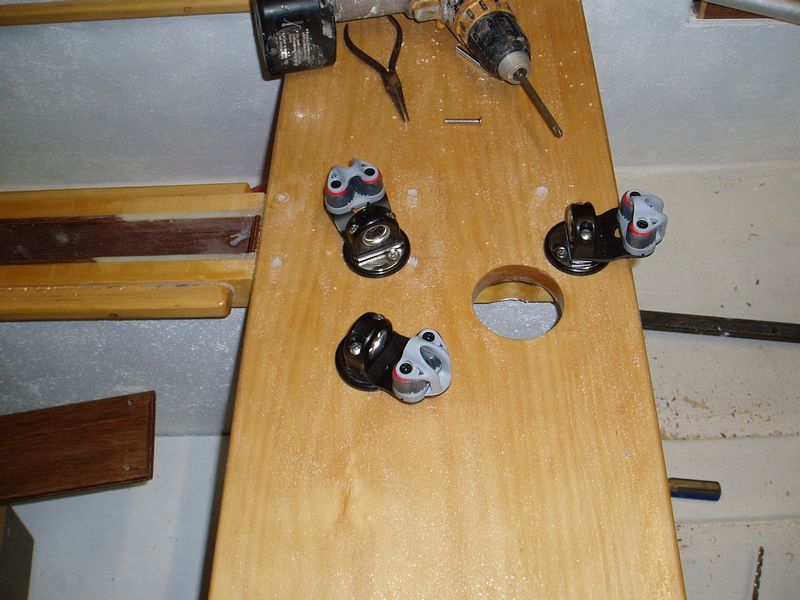
Actually it's not a block, but one of these that I bent to fit on my tubular aluminium boom. I tried one without the eye at first but the sheet caught in the corner. The one with the eye works well. Cheers Peter HK
-
CS 17 284 Where the heck does this stuff go?
Peter HK replied to Jim Stumpf's topic in B & B Yachts Forum
Here's a photo of how mine is rigged. The red line on the transom acts as a traveller...the block is attached with a quick release clip as the sheet stays with the boom for trailering. You can't see in the photo, because of the sail, that the sheet runs through a fairlead under the boom and then to the block on the mast and down to the thwart. Cheers Peter HK
-
CS 17 284 Where the heck does this stuff go?
Peter HK replied to Jim Stumpf's topic in B & B Yachts Forum
I have mine rigged the same way. I never have problems with the main and mizzen sheets getting tangled as the mainsheet sits either side of the centrecase forward of the thwart and the mizzen is aft of the thwart. Cheers Peter HK
-
This brings back memories. I remember going to a Tasar masterclass with Frank Bethwaite in the 1980's... this was at the Gold Coast just south of Brisbane. There was a group of dinghies on the beach to which people were assigned. A short race then followed. Frank was with us on the first one advising how to tune the boat...we were well ahead. When he moved onto the next boat in the next race we didn't do so well I always remember the Tasar as awfully efficient. As you say the rotating mast was relatively small. Cheers Peter HK
-
I once spent some time with a GPS and compass on my CS 17 getting some measurements for a polar diagram. This was on a lake with a steady light breeze. The disclaimer is that I only did one set of readings so accuracy is not guaranteed. My best VMG to windward was at 50 degrees ie 100 degrees between tacks. I could sail closer but it was slower. Cheers Peter HK
-
CS17 #284 Coaming... FL 120 T minus 58 days
Peter HK replied to Jim Stumpf's topic in B & B Yachts Forum
I think people have mixed/ ambivalent views on the coaming....and that is entirely appropriate. The coaming is there for 2 reasons. One is that it looks good aesthetically. The other is that it keeps drips out if you have well fitted boom tent ( and it makes a good spot to fit the tent too). The one thing that it does not do is stop spray/waves/water from entering the cockpit when sailing (except to a trivial extent). If you only want to sail/race the boat then no coaming is best (no racing dinghy has them). If you want to cruise /sleep on the boat with a tent then you have to put up with the coaming and maybe fit a seat outboard. With respect to aesthetics....that's up to you. Cheers Peter HK -
Hi everyone- Quick question on self tacking jib
Peter HK replied to sitearch's topic in B & B Yachts Forum
Just a couple of points. I'd have a few attachment points under the club foot so you can find the best position with respect to twist. Also If you have a roller furler then, when you ease the sheet and furl, the club foot will only have tension at the tack point and will tend to lift while the clew end will press down onto the deck. It might be good to prepare a small cradle to hold it. As I said earlier when you release the sheet the club foot jib will weather cock so you may not need that roller furler. Cheers Peter HK -
I made longer mini epoxy fillets to hold it together when the wires were removed. I remember thinking how firmly they held when the wires were out. I filled a zip lock plastic bag with thickened epoxy and cut a small hole in the corner to extrude epoxy into the join. I then made a mini fillet with a cut down tongue depressor with a small radius. To avoid any problems with sanding /secondary bonds I did this one night and the next morning removed the wires and filleted/taped over everything while the mini fillets and epoxied ply were still a little green. With respect to taping over fillets I prefer to pre wet the tapes on a bench...it seems easier that wetting out the tape on the epoxy fillet. Cheers Peter HK

-
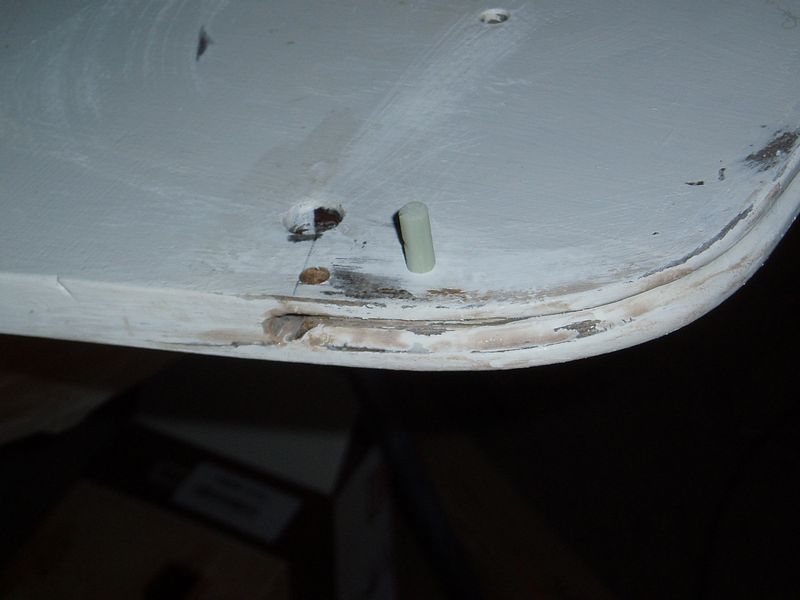
I've had this happen also. The low stretch 4mm downhaul line cut straight though a centre veneer of the rudder blade when the adjustable auto release cleat didn't fire (and I was only going slowly with a 2 hp outboard on idle in a dead calm). I rinsed and let the blade dry, then wedged the crack apart and squeezed epoxy into it and clamped it. Since the problem was the line cutting into the ply veneers at the bottom of the groove that had been cut into the rudder to accommodate the down haul line, I decided to reinforce this point. I drilled a hole through the rudder blade where the downhaul exits and turns to lie in the groove and glued a piece of pultruded fibreglass rod in. The downhaul now bears on this and won't be able to wedge the veneers apart. You can see the rod here and the hole into which it was glued. I don't think that point will fail again. Cheers Peter HK


-
Wrong hull shape for a multihull... needs to be long and thin. Cheers Peter HK
-
Hi everyone- Quick question on self tacking jib
Peter HK replied to sitearch's topic in B & B Yachts Forum
Bob The reason for the boomed jib (or in the case of your photo a club foot jib) is that they can be self tending. A standard self tacking jib needs a track across the boat which is, ideally, curved up at the ends so that it sits in a stable fashion until tacking. When easing the sheet the same problems with awful sail shape occurs as with any other jib. A club foot jib like the photo is attached to the bow of the boat at a point back from the tack position of the jib. This makes the jib self vanging and keeps sail shape when eased and means sheet tension is low. A simple centre sheet will work. When sailing alone a club footed jib doesn't need to be touched when tacking and only needs a simple centre sheet rather than a track with sheets led either side. When easing to a reach or run the club foot jib has a better shape. The club foot is a nice arrangement when you don't want to fuss around with jib sheet. Another nice feature is when the sheet is fired it just weathercocks and doesn't flog. Cheers Peter HK -
If done correctly a secondary bond is still stronger than the ply, so there really is no issue. I've tested plenty of them and the wood fails first. Cheers Peter HK
-
CS 17 #284 Update FL 120 71 days and counting
Peter HK replied to Jim Stumpf's topic in B & B Yachts Forum
FWIW I vote for the simpler, cleaner lines Cheers Peter HK