Peter HK
-
Posts
619 -
Joined
-
Last visited
-
Days Won
29
Content Type
Profiles
Forums
Events
Everything posted by Peter HK
-

CS 17 #284 Update FL 120 71 days and counting
Peter HK replied to Jim Stumpf's topic in B & B Yachts Forum
Literally " in taste there is no dispute" though a more accurate paraphrasing might be ...."on matters of taste an argument is not appropriate" Perhaps the French might say it even better..."chacun a son gout". You are close to the mark with schools. I did play against St Laurences in cricket and rugby Cheers Peter HK -
CS 17 #284 Update FL 120 71 days and counting
Peter HK replied to Jim Stumpf's topic in B & B Yachts Forum
Well you asked for an opinion so I'll give one...a bit too feminine for me But remember...de gustibus non est disputandem. Cheers Peter HK -
That mount is certainly overkill. I bought a smaller one (some Italian brand but similar) and it's very functional but none of these are pretty. I suppose it's like the Peanuts cartoon when Lucy walks past Snoopy and says "who would wear a fur coat in summer". The thought bubble over Snoopy read- "some of us prefer to sacrifice comfort for style" I'll attach some photos of my bracket so you can judge if the smallest lifting aluminium bracket will suit you. As I said they work really well, so I chose comfort over style. Cheers Peter HK


-
Get it right next time You have more keel protection than I and I'm sure it's more than enough. Cheers Peter HK
-
All deck up and no place to go CS 17 #284
Peter HK replied to Jim Stumpf's topic in B & B Yachts Forum
Just a word of warning re the stainless piano hinge. I used them on my CS 17 and they rusted out in less than 12 months. It looked like the central metal spine may not have been stainless or perhaps a poor grade of stainless and it rusted very quickly. The initial reaction was that it was probably chinese rubbish (though I suspect that china isn't alone in poor quality items at times). Ask about the grade of stainless before you buy it as the piano hinge holds water a bit longer than smaller hinges and thus is prone to corrosion. Cheers Peter HK -
Questions About Core Sound Sail/Rigging Configurations
Peter HK replied to Lorne's topic in B & B Yachts Forum
That was Rob Blackburn. I'm not sure what he ended up doing, but he came to see me here in Brisbane about a year ago. He was wondering about roller furling on a carbon main mast or changing to a sloop rig. He wanted to see how I had arranged reefing with tracks and reefing lines. Maybe he'll reply and let us know. Cheers Peter HK -
I used a piece of aluminium about 5mm by 15mm by 6 metres, driled a few holes and screwed and sikaflexed it on. Price of aluminium was about $5. Not as pretty as nice rounded stainless/brass strips from the chandlery but as it's out of sight it doesn't worry me. Cheers Peter HK
-
We really need to challenge and change cultural norms.
Peter HK replied to Ray Frechette Jr's topic in B & B Yachts Forum
Forget about the engagement ring....peanuts compared to the wedding. I offered my daughter money to elope but she wouldn't An engagement boat would also give them somewhere to live- a win/win situation Cheers Peter HK -
I have a somewhat more sophisticated reefing system on my CS17 with reefing lines always attached. I made a short video (on a calm day) to show how you can reef by just pulling on a few lines. Cheers Peter HK

-
I've used the navionics app for iPhone and it's quite effective. You can download charts for the area of interest. It works offshore and in one article I read recently it was the only GPS on a trailer sailer crossing Bass strait. Personally I wouldn't rely on a phone in a marine environment and would use a waterproof GPS. Cheers Peter HK
-
I'm not sure with kevlar but with fibreglass an estimation of weight is easy. With a hand layup it is usually not possible to get a resin to cloth ratio better than 50/50 ie the same weight of cloth and resin (vacuum bagging/resin infusion can achieve better ratios with much less resin which is why racing boats are built that way). This means you only have to estimate the area you are glassing, multiply by the weight of the cloth and double it to get a reasonably accurate figure. I imagine kevlar is about the same as glass. Some other cloths like dynel and Xynole apparently use a lot more resin. A quick estimate of your proposal (in metric as I'm used to that) is: Area maybe 3 sq metres Cloth weight 130 gsm Therefore total cloth weight is 396 gms- say 400gms With resin - 2 by 400 equals 800gms i.e. about 1.75 lbs Not a lot of extra weight. Cheers Peter HK
-
There are many options. On a Welsford design I built some years ago, the design showed a rudder box with a slot in the head into which the tiller slid and was held by a pin. On my 2 paw I plan to do the rudder like Storer does for the Goat island skiff- this leaves tiller and rudder box together but allows very easy separation of rudder and tiller/rudder box whille allowing a kickup and depth adjustable rudder. HTH Peter HK


-
There's only one question that remains- how much did it weigh and how many beers did it take? We could then work out the beers/kg coefficient which would help boatbuilders all over the world :-) Cheers Peter HK
-
I'd certainly bevel it as it's very easy to do and saves a lot of epoxy/filler and potential mess. You'd have to mix up a lot of thickened epoxy to bed in a non beveled keel batten and would likely have a lot of squeeze out and a lot of cleaning up. Also the beveling tends to keep it in the fitted position. I seem to remember using a small piece of unbeveled timber the same width as the batten and roughly measuring the depth in the middle at various points along the bottom, say every foot. I then marked these points on the outside edges of the keel batten and used the powerplane to bevel between the centre line of the batten and the line joining the marks on the edge . This way it was fitted to the boat and I didn't care what the angles were. It doesn't have to be perfect. And yes, the batten does bevel down to 1/4 inch edges at the forward end. Cheers Peter HK
-
I've just worked it out that a 3 piece aluminium/wood topmast mast blank with solid hoop pine (equivalent to doug fir)would be 12 lbs - probably just under 11 with spruce as the top mast. Birdsmouth would bring it to about 10 lbs. It's still a nice light option. Cheers Peter HK
-
I presume you are talking about a mast blank rather than a mast with all fittings/halyards/tracks etc ready to put in the mast tube and go sailing. If so what was the weight of the finished mast with all fittings/halyards etc done with spruce (which I can't get without a lot of expense ). It would be nice to know with respect to the weight of the 3 part aluminium/wood mast (with all fittings) as I have posted. Hope you can help Cheers Peter HK
-
My 3 part mast for a CS17 has a slightly thicker-walled section than specified for the bottom 8 ft, then the standard midsection and then a solid wood (hoop pine) topmast. I worked out I would only save about 100gms (3 oz) by doing birdsmouth for the top section as it's only 6 ft long and either end needs solid wood plugs, so I didn't bother. It's also a foot longer than design specs ie just under 21 ft. Total weight with blocks/halyards/track etc was 9.5 kg (21 pounds) Cheers Peter HK
-
Maybe prices are different in the US but the materials for a birdsmouth mast here in Australia (local hoop pine - about equivalent to Douglas fir, same density and a little stronger) would have cost about 25 % more than 2 sizes of aluminium tube with a wooden top mast which is what I used. The other factor that I think is important is the weight of the finished spar with respect to lifting and fitting into the mast tube- my CS 17 mast is quite OK but approaching the upper limit of comfort. It might be worthwhile to spend a bit more time/money to get a lighter mast for a CS20, not from the performance point of view but for ease of rigging. If I did it again I would use aluminium for the lower half (10 ft for a CS17) and birdsmouth for the topmast in a 2 section mast. Birdsmouth isn't hard at all but just a bit fiddly. Cheers Peter HK
-
I don't know- I've always wanted to try a land yacht and they say ice yachts are even faster. Fit a couple of sleds and go for a sail Cheers Peter HK
-
Double braid polyester is typically used for hand held sheet lines... twists / hockles are often the result of how the rope was rolled up or taken off a roll. The time honoured way to remove the twists is towing it behind the boat for a while. There is a technique for coiling lines which doesn't reintroduce such twists...it ends up looking like a figure of 8. If it looks really neat and circular you probably have introduced twists. For sheets it's often better to go up a size to make hand holding comfortable, but on a sprit boomed CS the sheet tensions are very low so it's probably not necessary. Halyards are better with low stretch hi tech line- spectra/ dyneema/etc- as they are long and even a little stretch affects luff tension. Vang- shouldn't have one on a CS15, but on racing boats with a standard boom this would also be a low stretch line. Most other lines on a CS would only need to be double braid polyester as the tensions are so low. Cheers Peter HK
-
Some years ago , before I built the Core sound, I built a Welsford Golden Bay dinghy. In the plans the space under the foredeck wasn't sealed and water could drain back into the cockpit bilge. I wanted to seal this area for buoyancy so after a bit of thought I built in a PVC tube around the mast and drained it out the bottom. It has worked OK so far (about 10 years). I didn't use the the PVC in any structural way however and the mast fits into a wooden mast step and bears only on the wooden king plank at deck level where I drilled a hole 2mm larger than the mast. The PVC tube was glued and glassed onto the mast step and under the king plank and the mast never touches it. The Gougeon brothers recommend flaming (not burning) the PVC for better epoxy adhesion as this can be a problem. Having said that I would never do it that way again- the fitted fibreglass tube is easy, elegant, stronger and more durable. I'd be prepared to hit the fibreglass tube in my CS17 with a hammer, certain in the knowledge it wouldn't break. I'm always careful as I'm inserting the mast in the Welsford dinghy not to bump the PVC as I have no such confidence in it. Cheers Peter HK


-
I can't remember exactly but I did make them each about a foot longer than the plans as some on the forum had mentioned they wished they had made them a bit longer. It certainly means you can raise the main high enough to get good vision under it on a light day. I never actually hoist them right to the top though and every so often think I should trim about 6 inches off the end but as it's doing no real harm this hasn't been a priority. Remember the snotter position would need to be higher if you raise the sails much higher (or have a couple of snotter attachment points) Cheers Peter HK
-
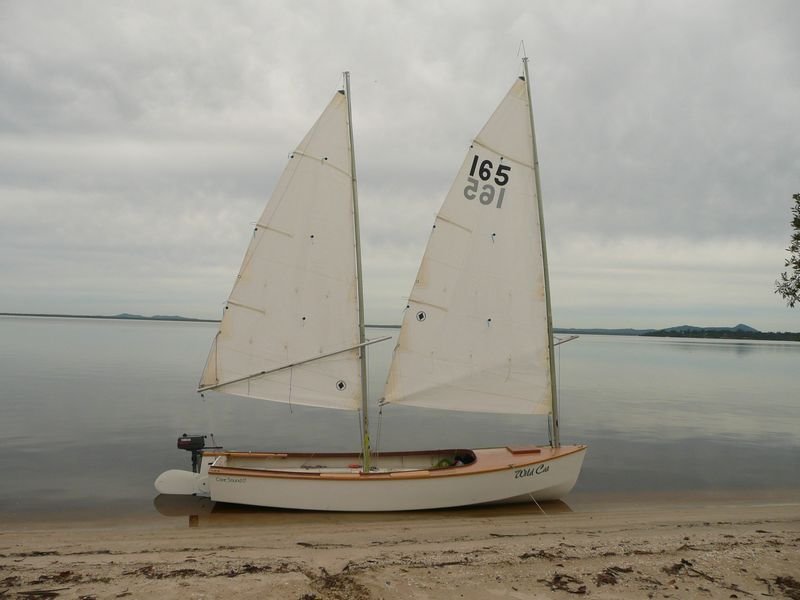
Hi Jim I'll attach a couple of photos. One shows the seat blocks shaped, routed, planed down and epoxied much as Ray described. The others show the position of the seats from side on and also how the control lines run inside the forward seat. Cheers Peter HK


-
My brother used a trangia alcohol stove for a couple of years on a 22ft trailer sailer...at times cruising for a fortnight. He said it worked fine but his view of cuisine is pretty basic. Cheers Peter HK
-
Hi I set my aft set of hiking seats so the front edge of the seats is about level with the mizzen mast. The aim is to be as far forward as possible to keep crew weight central. That is about as far forward as the hiking stick reaches (I finally bought an expensive extendable one as the fixed one was a bit of a stretch). If I did it again I would raise the height of the seat to be just higher than the coaming....mine is level at 3/4 inch....as you tend to sit on the inner part with your legs angled down into the cockpit so you still feel the coaming a bit. Cheers Peter HK