Peter HK
-
Posts
619 -
Joined
-
Last visited
-
Days Won
29
Content Type
Profiles
Forums
Events
Everything posted by Peter HK
-
Hi Dig I'm in Brisbane with a CS17 if you come up this way. This group is starting to sell kits for the CS17 here in Brisbane which might be of interest (doesn't appear to have made it to the website yet) http://www.trailawayboatkits.com.au/epages/trtr3084.sf/en_AU/?ObjectPath=/Shops/trtr3084 Cheers Peter HK
-
Looks really good. Did you lower the cabin height or is that merely an illusion? Cheers Peter HK
-

The Definative Princess Picture Thread
Peter HK replied to Joe Nelson CS#35's topic in B & B Yachts Forum
Courtesy of Dictionary.com via Google Cheers Peter HK -
Hi I'll answer though without any real idea if Hoop pine is available in the USA- I doubt it. On the basis of this 2006 post I sought out a Hoop pine supplier here in Oz for my CS17, having used Oregon/Douglas fir on the previous build. It's a nicer timber to use with fine grain and easy working characteristics. As light as Doug. fir. There is now available Hoop pine ply- heavier than meranti/pacific maple but better strength profile and renewable from the greenie point of view. From the aesthetic angle it's a bit of a bland white timber. Cheers Peter HK
-
I even forked out the money for the telescopic tiller extension (see below) as it increases the range in the boat a lot, yet still clips down to the tiller and doesn't cause a problem with the mizzen sheet. It's very nice but was a bit expensive https://www.whitworths.com.au/main_itemdetail.asp?cat=200&item=87957&intAbsolutePage=&LinkedItem=87965&search123= Cheers Peter HK
-
Hi Phil In answer to your questions I'll offer my opinion ...I don't think this would be any stronger than a standard fibreglassed butt joint (I presume you intend to glass either side). All it does is shift the joint into two halves- each veneer is still not connected except at 90 degrees. My 2 cents worth is to spend a few hours with some scrap ply and learn to scarph it - not hard to do, elegant and strong. As always you can test the theory by doing a standard fibreglassed butt, your joint, a scarphed joint and let them set and then apply "destructive testing" as my brother the engineer describes it and see which one fails first. Easy Thumbnails is a simple free program to reduce photos to a suitable size Cheers Peter HK (in Brisbane)
-
I received my Two Paw plans recently and wonder if anyone has a comment on the rig options. I've sailed most rigs and currently have a gaff rigged schooner, a standing lug catboat and a CS17. I am favouring the boomless sprit option for a couple of reasons- one is I've never sailed one, another is that it should pack away nicely with a short mast (likely 2 piece) and no battens. The intended use (all going well) will be as a small tender for a 30 ft power cat when I semi retire in a few years. Sailing the Two Paw will just be a fun option at a nice anchorage somewhere, maybe with the grandson, so performance isn't a great issue and ease of use and easy storage would be more important. The few boomless sprit rigs I've seen haven't set very well downwind (at least viewed from a distance). Anyone have a comment? Peter HK
-
Looking at the design I see the hull weight of the Argie is expected to be 60 kg compared to 137-160 kg for the CS15. This tells me that for the same length the CS is much more boat- more solidly built and robust and likely feel more secure underfoot. If intending sailing in rougher waters I'd favour the stronger option. I note that side tanks are optional and "will limit the sleeping width a bit". I don't think the safety aspects of side tanks/ capsize recovery are optional, see my capsize test here


-
Hello from here in Australia, though I was born in South Africa and my cousin still lives in Somerset West (per your website). Last visited in 2006. I'll try to answer your questions Here is what it needs to be able to have/do: 1. Sailing day trips in False Bay (semi protected bay) Either will be fine 2. Have enough spave for a porta pottie (for wifey) CS 17 a little better 3. Easy and fast to rig Not much difference 4. Being build on a tight budget Not much difference 5. Should be able to store in a garage 18' in length (including trailer) Hard for a CS17- I built mine in a 19 ft garage on a mobile cradle but cannot store it there. If you search the forum you will find that Wes Kisting has a trailer coupling that folds to shorten the tongue...not sure how available that is in SA as I've never seen it in Oz. 6. Occasional (once a year) sleep aboard in tent Better on a CS17 7. Tons of fun Both are fine 8. take 4 people on a day trip CS17 much better for 4 Will the 15' be able to adhere to these requirements, or should I go for the bigger 17? Will the CS15 be just as stable and sea worthy as the CS17? Bigger boats are always better on the water...just not as easy to trail/ build/ store Cheers Peter HK
-
Certainly it has been my experience that, with a good sailing breeze, waterline length is hard to beat. Light airs add all sorts of variables but when it picks up I'll put money on the longer boat. Sailing in a gale adds another dimension again Cheers Peter HK
-
Hi Ken If you come to Brisbane, I'm sure I could arrange it but towing the boat to Sydney or Perth (!) would be a bit much. Cheers Peter HK (currently in Boston for a conference- quite a few boats sailing the harbour today when I went on the harbour cruise)
-
I agree. A simple tiller control line with friction adjustment so you can set the tiller in a certain position is very helpful.

-
Wes said Ray said Here in my part of Australia you don't have to register a boat unless any motor is greater than 4 hp. You could have an engineless 70 ft sailing vessel with no need to register it. In the wooden boat association I know of one boat being built- a narrow motor cruiser about 30+ft long- with 3 four horse 4 stroke outboards partly to avoid the need for registration. You guys are over-regulated :sad: Cheers Peter HK
-
Bob said At one stage I decided to try a powersailer and ended up with a Mach28 (an Australian designed and built powersailer loosely based on the Mac 26 but built to a much higher standard). This was water ballasted with about 1.2 tonnes in the tank under the floor and powered with a 90 hp ETEC.


-
I couldn't resist (Wes has set a precedent) and so here is a photo of my first grandchild and newest crew member, delivered about 5 hours ago. Oliver Matthew, 4240 gm (9lb 5.5oz!)- all well. At this rate he'll be a lot of movable ballast in times to come!

-
My brother occasionally used to take out our 30 ft Bolger Folding schooner by himself. This is a boat that likes 4-5 crew for stability in a decent breeze. He used 20 litre plastic jerry cans for water ballast- 6 or 8 from memory- so about 300lbs. It certainly gave him enough stability to go sailing but was not nearly as fast as movable live ballast from a crew.
-
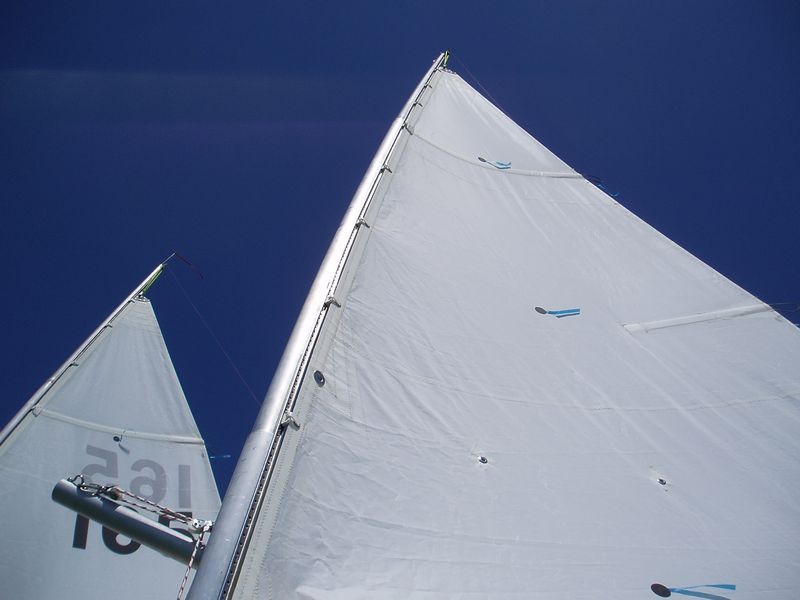
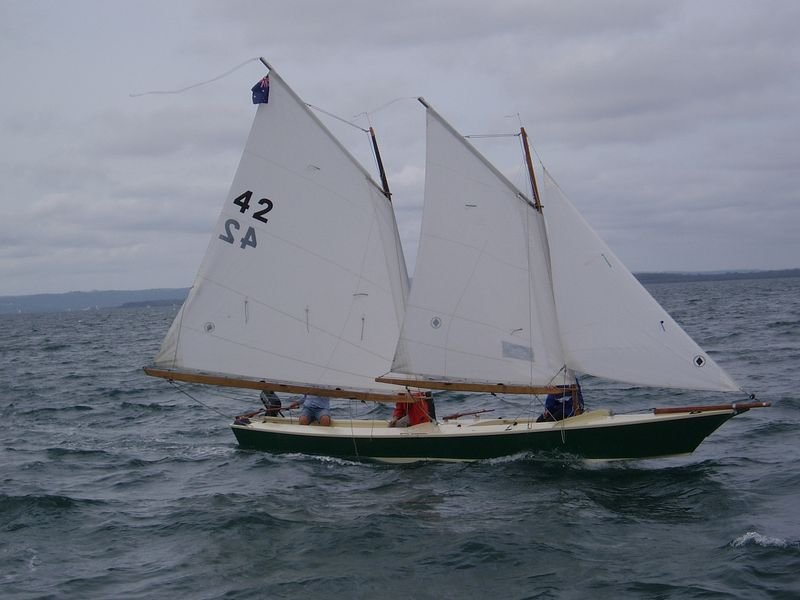
Here's where the sailmaker put telltales on my sails...I think it best not to have them too close to the luff because of the disturbed airflow near the mast (with a jib closer to the luff is fine). Each is matched with a leech telltale.


-
I have to say I can't think of any reason to row downwind in a sailing boat with a good breeze. If wind chill was a factor then going with the breeze as fast as possible minimises the effect Cheers Peter HK
-
Ray, Graham Thanks for the tips...I'll see what I can fit in. Cheers Peter HK
-
I've heard about bears and that they can quite nasty but hibernate during the winter...this must be a new tourism initiative (putting the bears into cold rooms) Seriously though Ray, I'm going to be in Bar Harbor for a day (September 17) on a pre-conference cruise ending in Boston. Any suggestions for best one day outing (perhaps with a little value for money given your earlier statements)? BTW just to keep it on topic- I'm with the engine group. Don't use it much but it's nice occasionally. Cheers Peter HK
-
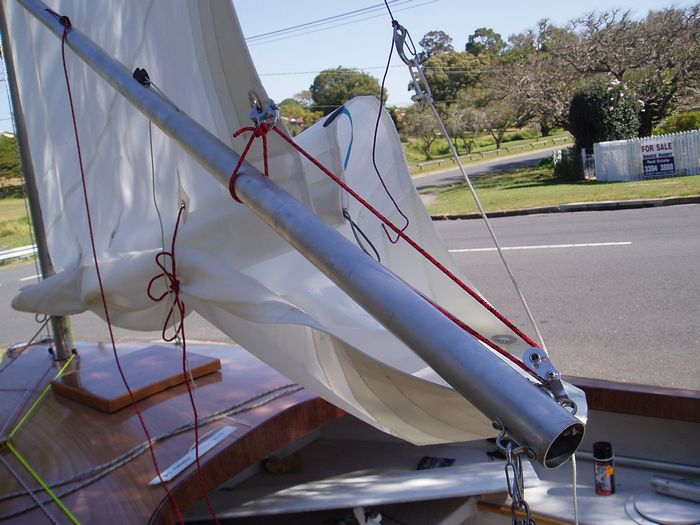
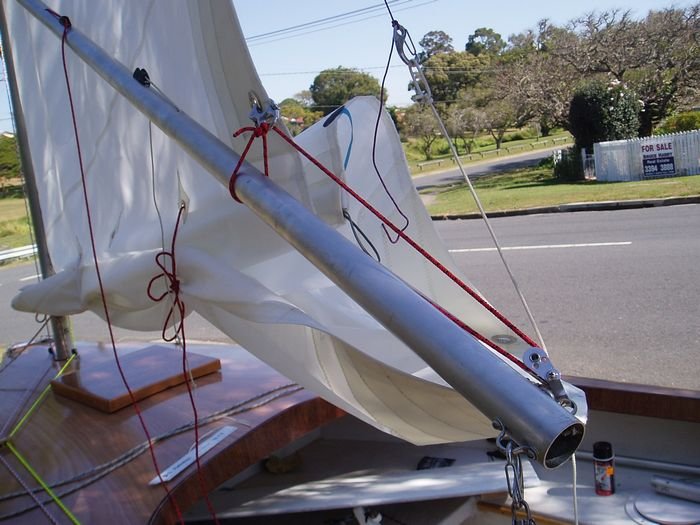
I decided to go with the more complex setup for reefing from the beginning, so I have clew reefing lines permanently set, with topping lifts and a permanently run tack reefing line to the first reef led aft to the cockpit so that I don't have to get onto the foredeck (except to shift it to the second reef when I would drop the main). The clew reefing line can be seen here when I was fitting everything- you can see the loop around the boom which makes it self adjusting so the snotter doesn't need to be eased. The attachment to the reef clew point is with a snap shackle so it can be shifted up to the next reef point. The line is led internally in the aluminium spritboom to an internal turning block and then back led out to a cleat on the boom positioned in easy reach.

-
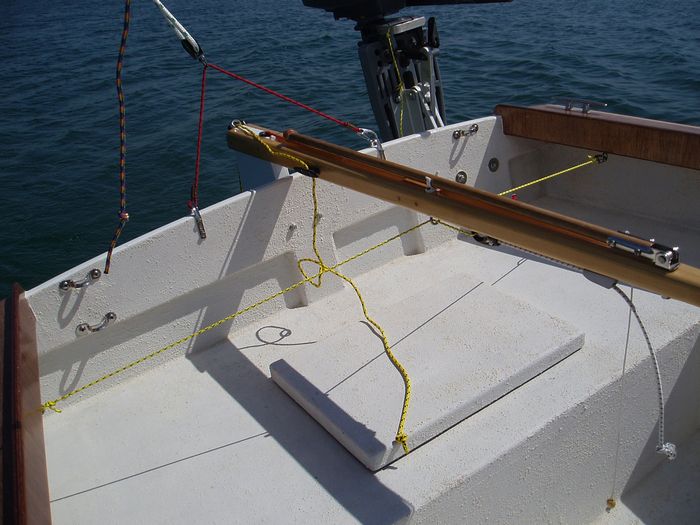
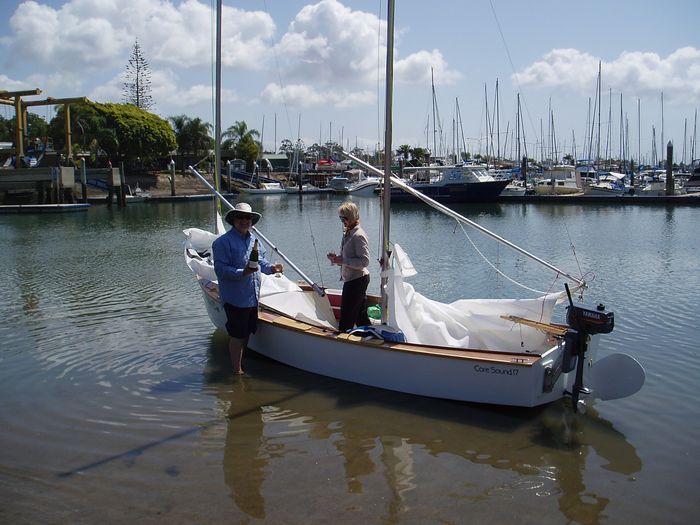
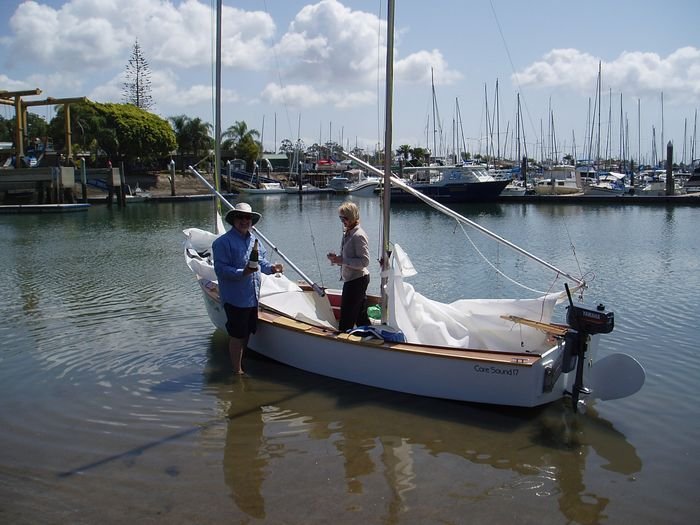
I'd second the call for the smallest, lightest outboard you can get. The motors you quote are about 25 kg (55lb). That's a lot of weight to lift and leave hanging out the back ruining sailing performance. You don't need much power- my 2 hp Yamaha 2 stroke weighs 9.8kg (21lb) and gets my CS17 to hull speed (about 5 knots) at 1/2 throttle. I have a short shaft motor as the adjustable bracket puts it as deep as you want. In the photo from launch day you can see the up position; when fully down the lower edge of the motor board is just above water level. The in-between positions are good in shallow water
-
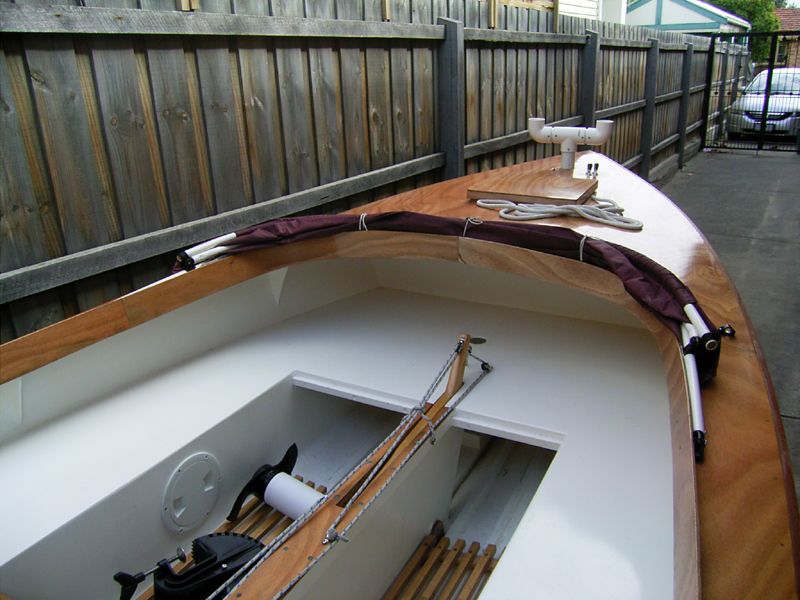
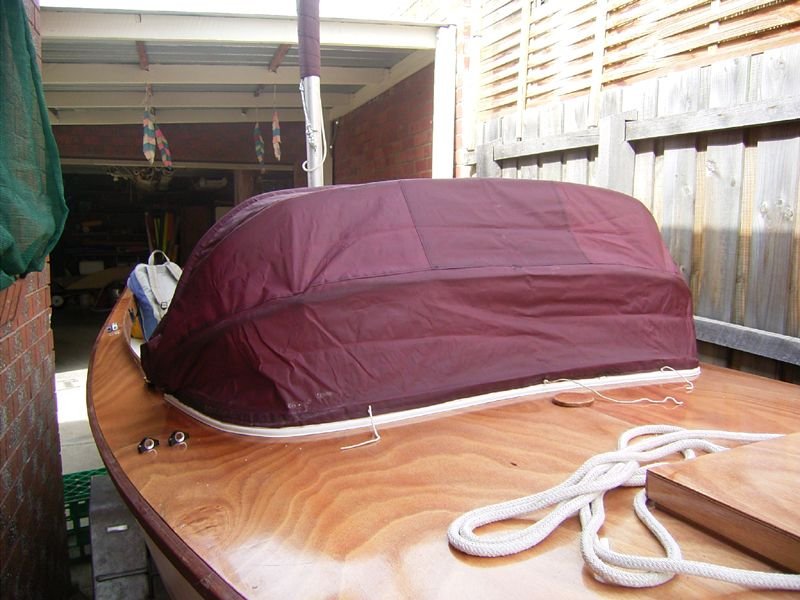
I've always liked Peter Batchelor's dodger as it's unobtrusive and folds away nicely. http://www.batchelors.net/personal/boat/cs17/index.html

-
The white paint on the floorboard (and the whole cockpit) is a nonskid paint. I don't like "slippery when wet" Cheers Peter HK
-
Trying again