Designer
-
Posts
1,758 -
Joined
-
Last visited
-
Days Won
182
Content Type
Profiles
Forums
Events
Everything posted by Designer
-
Don, I did use my smartphone GPS and I liked it. I planned it as a backup but I used it when the Garmin had too much glare to read from my helm position, I had it in my pocket and could hold it away from the glare. I used it at night for trip planning because it had better scrolling and measuring than the Garmin. I thought that I would have needed it for real one day when the Garmin gave me the dreaded crash and then the black screen. I shut it down or a while and it rebooted as though nothing had happened. One of the many jobs that was not completed before I left was mounting the compass and elected to mount it along the way. I never felt the need for it while underway as the GPS with its projected course line is way superior to the compass as it is calculated from your projected course over the ground with set and drift and recomputing continuously. I did use the compass while not under way checking on wind direction as fronts came over. Alex, I had to hold my nose to put on a 2 1/2 hp motor let alone 6. My problem was running late and facing winter fronts coming continuously. There was one day when I would not have said no to another hp but I just do not want the extra size. There was one time when the motor was handy. We were ripping down the Cape Fear River with a strong fair tide and following wind. I had to do a 90 degree turn to rejoin the ICW and it became quickly apparent that if I did not use the motor I might get swept past the channel. The motor was on the lee side so there was no issue of the prop ventilating but it was interesting to hear the motor change rpm's as the puffs came, accelerated the boat and unloading the prop and reloading as the puff went away. A couple of work boats around 40 - 50 feet came up the river, entered the channel behind me and it was interesting to see how much they crabbed as they turned across current. I have put this time to good use and have made a better GPS mount which will allow me to angle the unit to any helm position as well as downward to reduce glare. I also made shelves, washboard and cup holder, pencil and binocular rack and lots of other little details.
-
Here is the link to the last boat that we did together. Rough Point FB page The crew was too bummed out to work for the rest of this week. I am sure that she will be finished okay. We will help in any way that we may be needed.
-
We are still reeling over the news. We have collaborated on boat designs for close on 30 years, the red boat above is one that we did about a decade ago. In fact we had just recently started on a new 41 footer for a customer in Maryland and he was scheduled to come over last Tuesday for another design brain storming session. He was always thinking on ways to improve on the building methods and loved to push the 3d modeling as far as we could so that we could use the technology by machining out as much as possible in advance to make the build more efficient. After the three of us spent a few hours together we could always expect at least two phone calls on his way home as his fertile mind was racing after leaving the shop. We have always expected this to happen sooner as he was not healthy and his brother died from a heart attack when he was fairly young. The finality is the hardest part for me. The realization that I will never be able have him visit or call him again is tough.
-
Dave, That is the idea, I have found that I do not even need the vane when going upwind. Last year in the EC I used a 1/2 oz. nylon vane that was too fragile. Optimistically I stowed the vane below to protect it hoping that the wind might turn fair. It never did turn and I sailed more than 100 miles with the helm lashed amidships. Down wind the rudder is pretty much on center also.
-
Tom, I want the rudder fixed to aid directional stability. Before engaging the vane, I try to find the sweet spot for the rudder and lock it. I will then observe the course after the vane is engaged for a while and may rotate the vane at the clutch or move the tiller slightly. Usually I adjust the clutch because did not have the right load on the vane when clutched. It is a powerful little vane and will tolerate a fair amount of imbalance. All self steering systems hunt so the better everything is balanced the less it will hunt. Howard, Did you see Alan's video on Carlita? He shows the auxiliary rudder. Wind vanes are not for everyone. If you do not enjoy fiddling then they are not for you. Naturally they are worthless in waterways because the wind is too shifty. It did do a great job last week running down the Cape Fear River. The GPS showed a top speed of 8.75 knots and the speed was rarely under 6, at least 3 knots of that was current.
-
Howard, Horizontal axis vanes and servo pendulum paddles are the most powerful self steering systems and are certainly required for large or heavy handed vessels. Carlita is a light well mannered boat and requires finesse rather than brute force. If you have not already seen the self steering video, check out the video and answer your own question. She is running almost straight downwind and surfing. After this video was taken she surfed to a little over 10 knots without misbehaving. The key is an ultra light vane and very low friction. The lead counter weight weighs just 6 oz. to balance the vane. This makes the vane very responsive and reduces friction and lowers the mass moment of inertia. The next important feature is differential feedback in the linkage. This means that when the vane kicks the servo tab over and the tab turns the auxiliary rudder, the angle of the tab is rapidly reduced. If you do not have this feature the boat will hunt badly down wind where there is no natural balance from the sails as you do when close hauled. The whole thing is a delicate balance between power and feedback.
-
I have done the stretch from Miami to home twice and some stretches many times. Once I sailed about 95% of the stretch but there was no time pressure and we put down the anchor when we could not make progress. The second time I was the delivery skipper and every day cost money and we motored for 95%. It would be easier to sail from south to north. I have not done the Great Loop but with the locks involved and going upstream up the Hudson River etc. it would be pretty difficult to near impossible without a motor.
-
Core Sound 20 Mk 3 -- #4 "Chessie" . .
Designer replied to Pete McCrary's topic in B & B Yachts Forum
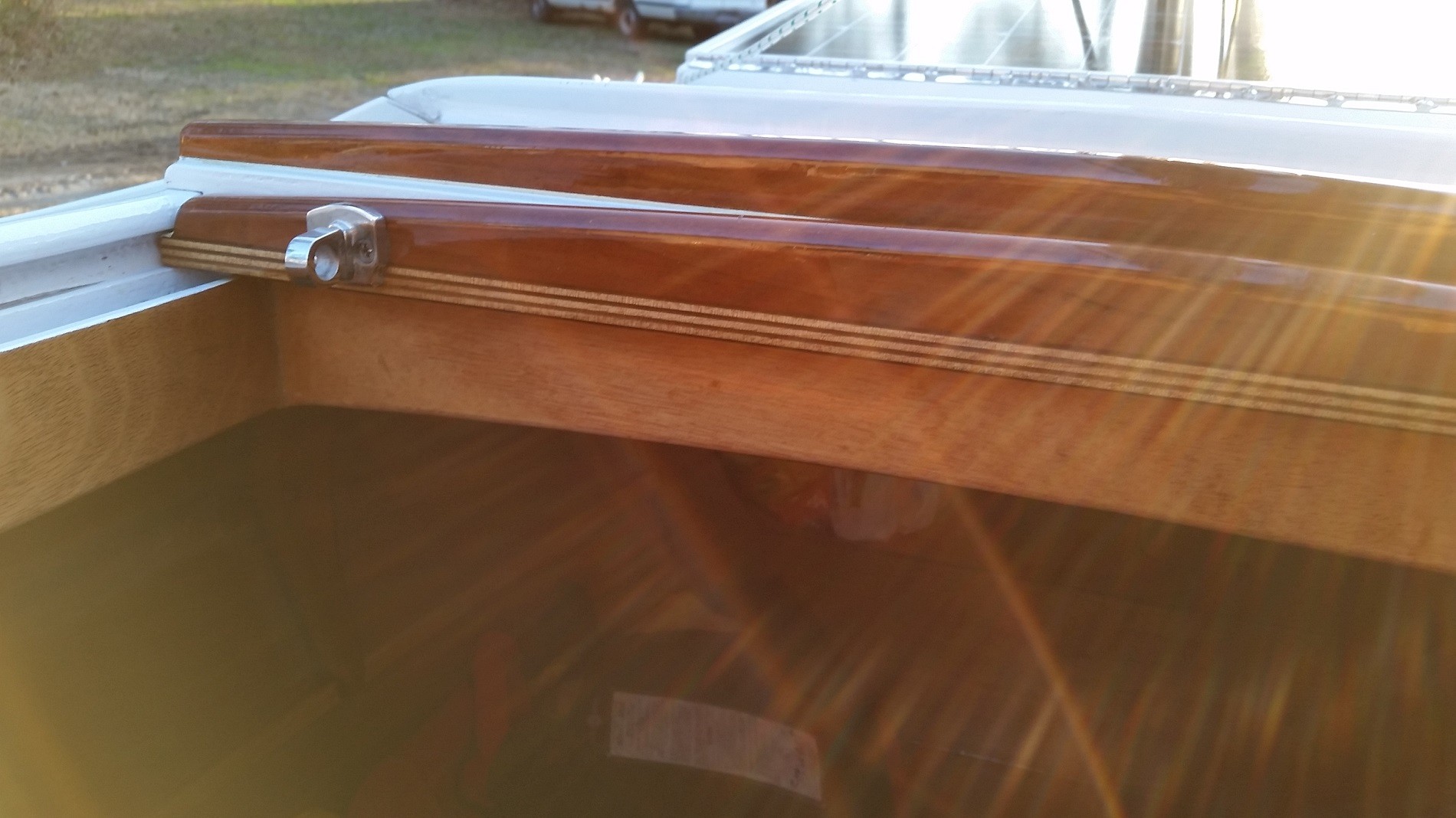
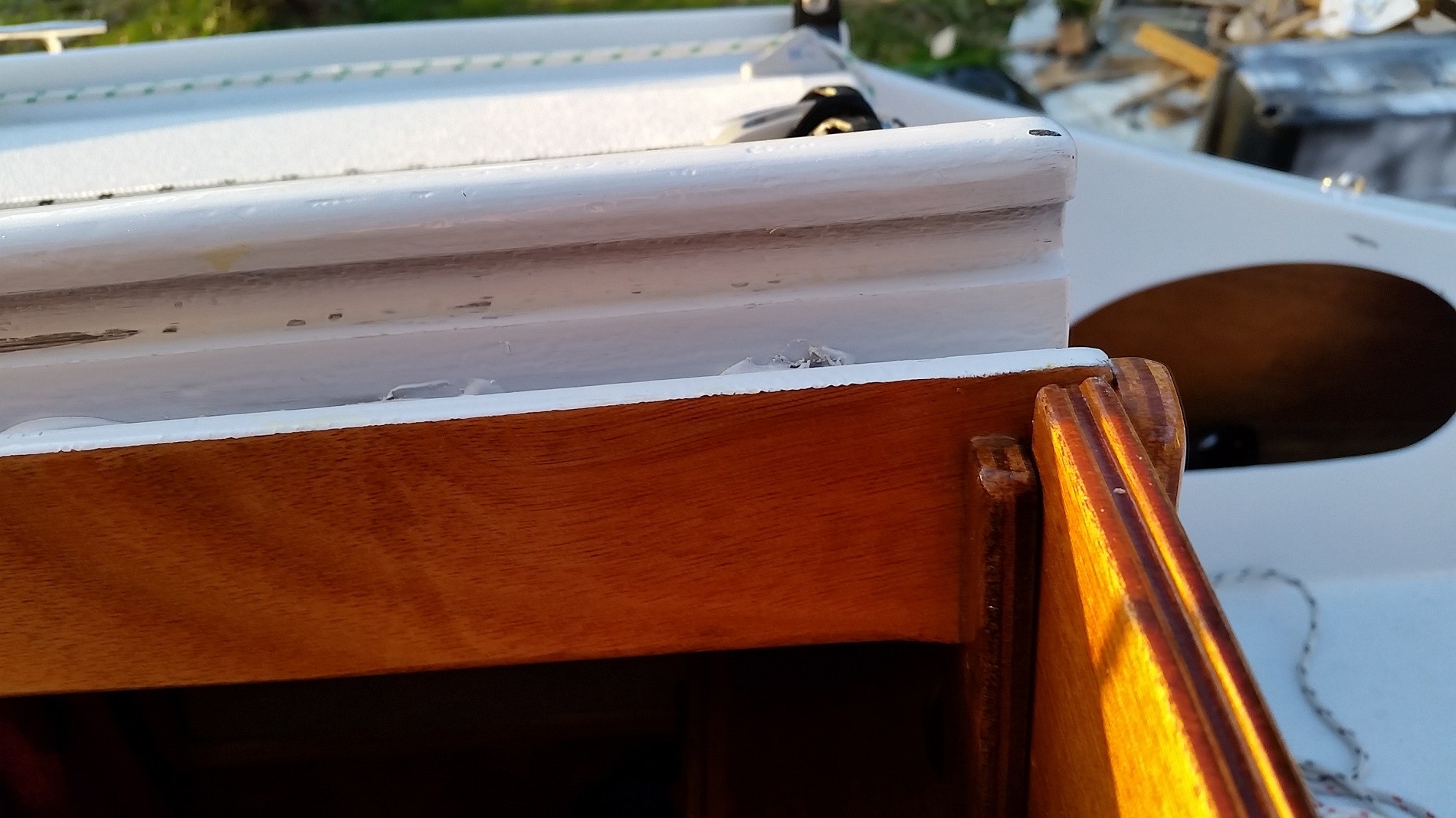
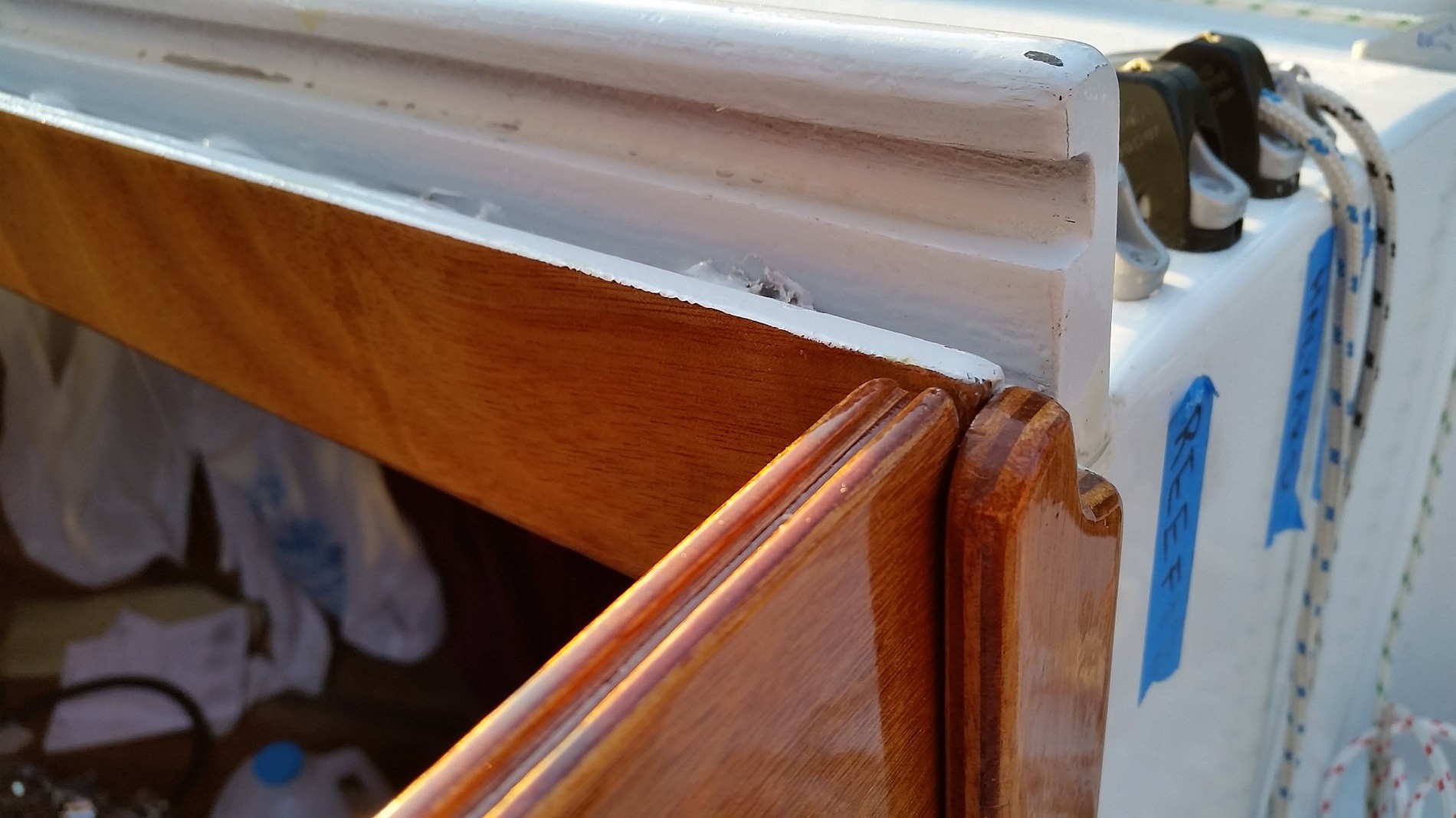
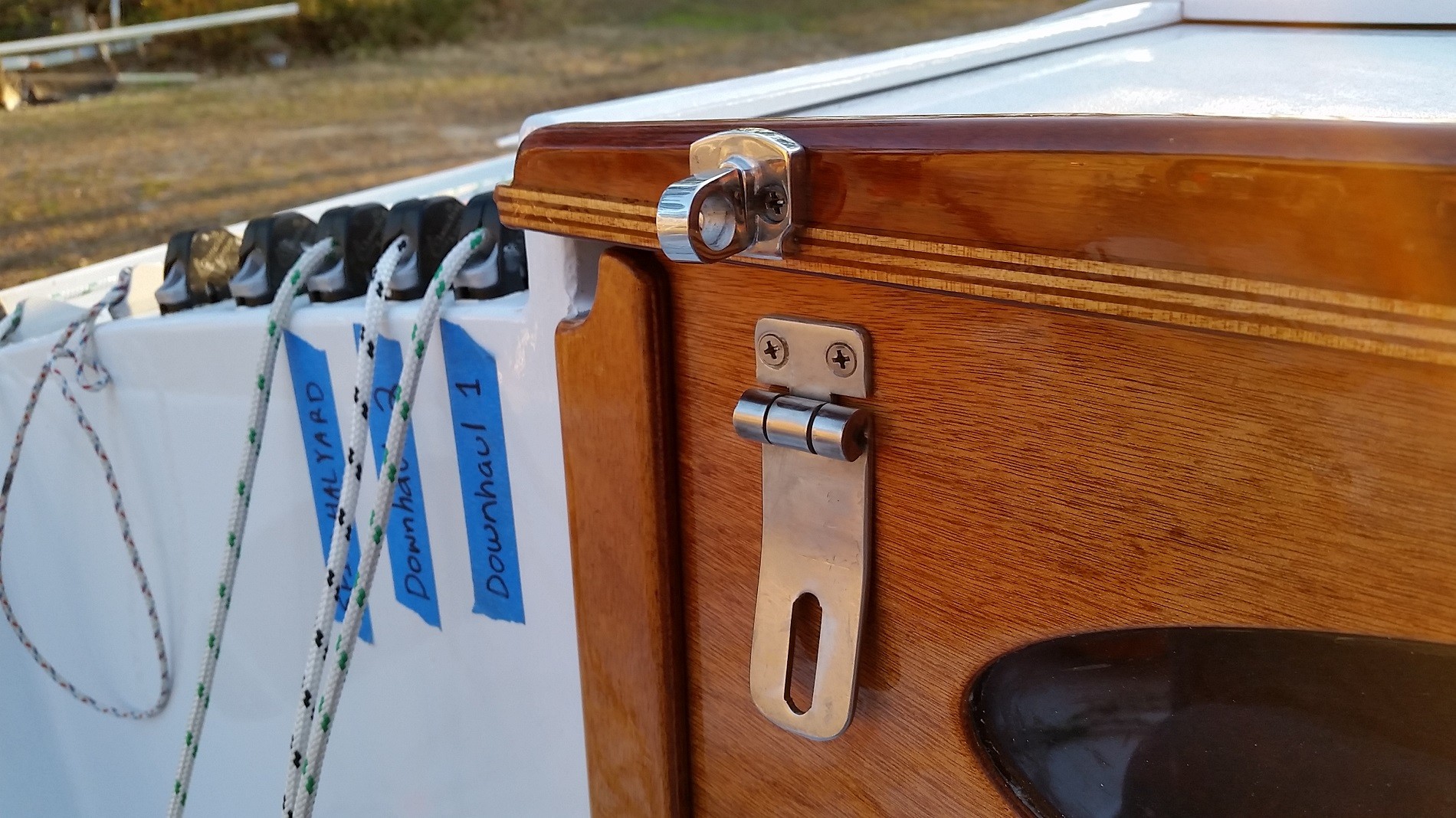
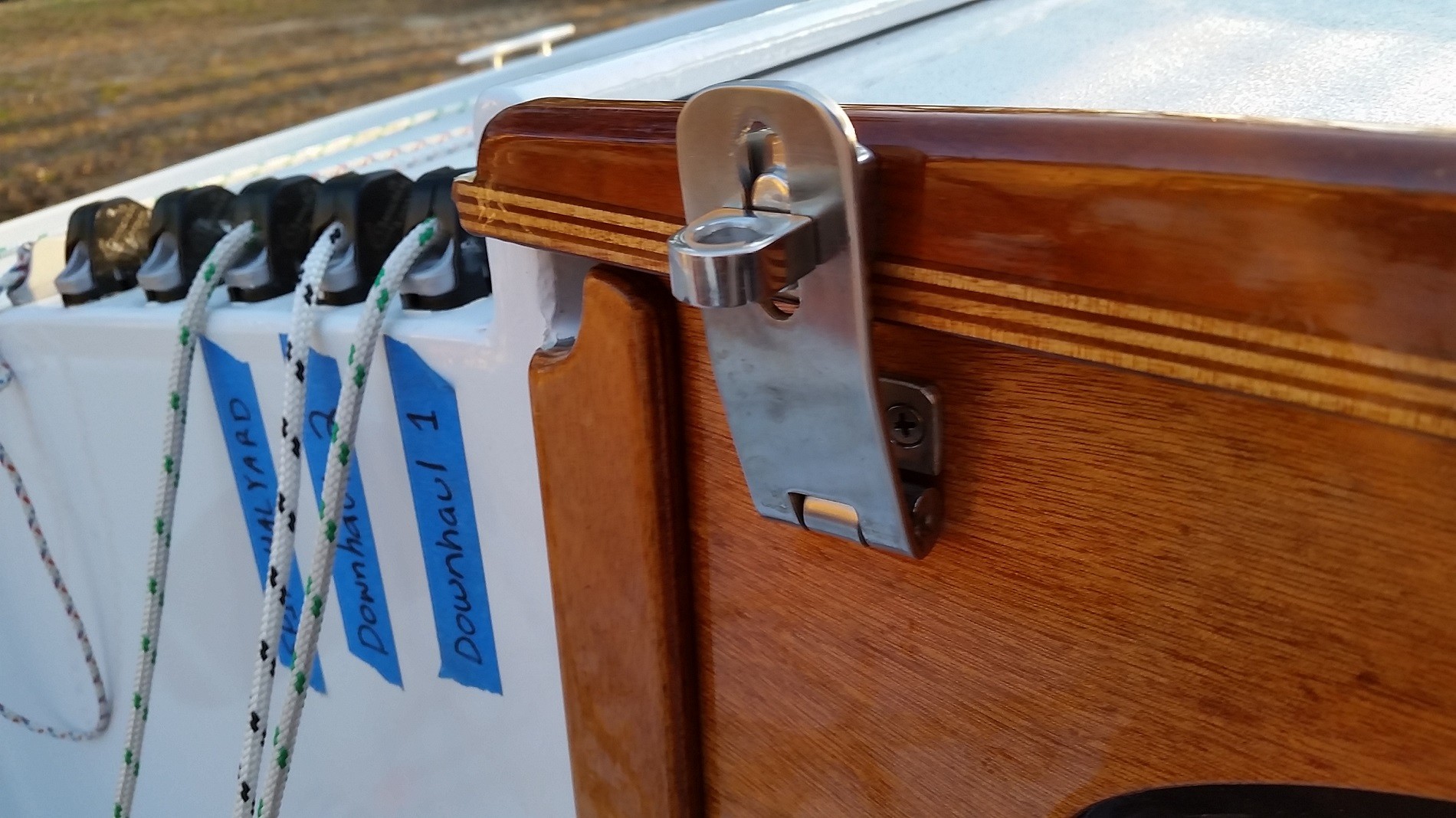
Pete, Here are shots of my hatch and locking system. The first two show the drip groove in the top wash board. Third shows the drip groove under the hatch, sorry about the poor focus. Fourth shows the hasp and staple. Fifth shows the staple turned 90 degrees. Sixth, locked. Seventh shows the hatch wide open, the staple is far enough to the side that it is not in the way.


.thumb.jpg.d9dd7858ae90afb1361bcd8306bcd5b7.jpg)

-
Par is absolutely right. I have lived in this area and have observed the weather for a long time and have a great deal of respect for it. I was not prepared to go out into the Atlantic at this time of the year without a good forecast. The systems came thick and fast, when the weather was good it was from the south west, on the nose. Back in 2000 I sailed a 32’ sloop to Cuba in February and jumped out at Cape Fear and sailed straight to Ft. Lauderdale. The second night was squally and nasty but otherwise it was a good quick passage. I made good 205 miles in 7 ½ days including the weather hold on the last day. This put me behind schedule. I was tidying up the boat while waiting for the weather and noticed the missing connecting rod and swivel. I searched the boat for a couple of hours with no luck. Talking it over with Alan and Carla it was decided that it would be far more productive to come home and make a new part and use the rest of the time before driving down the Florida to finish some of the jobs that I did not finish. I also had time to observe my stowage needs and I will work on them. I had a grand adventure and Carlita did a great job. The little Suzuki was put to the test and worked hard. The last day I sailed back 20 miles to get to the launching ramp. I had ½ gallon of fuel left and wanted to sail as much as I could to make sure that I would have enough in case the conditions turned worse. A light wind came from the south east as I was rigging the boat, a quick check on Windy tv showed that the forecast had now changed. I had a fair current for a couple of miles, the wind died as I turned the corner and into a foul current. I motored out of the channel and put the anchor down to wait for the tide change. The wind slowly built to a nice sailing breeze and I set off into the last of the foul tide. The rest of the day turned into a perfect sail and I made my destination well before dark. Tony Day came and brought me home and we had very pleasant time telling stories. I spent a lot of time today going through every locker on the boat just in case I had a mental lapse and stowed the missing part and forgot about it. No such luck so I get the have the pleasure of making it again.
-
Alex, I have just finished packing and am off to bed as it is a very early start in the morning. I can post some more picks when I get back. This will be my last post for a while. I am bringing the link forward for the spot tracking. http://share.findmespot.com/shared/faces/viewspots.jsp?glId=0eHa05kYuBYnYvSIGGCbp4PpdXZchEvKn It will be active when I start it tomorrow afternoon. Just click the link and you will see the position updated every 10 minutes. The position can be shown on a map.
-
Drew, I can't wait to try it out either. I am hoping that it will lift my daily average in light air. If you follow the line that passes by #7 on the registration numbers down, you should be able to see part of the bow board poking out that I am experimenting with. I am hoping that it will reduce the lee helm when I am sailing close hauled. I have carried a spinnaker on Southern Skimmer with the wind forward of the beam which can induce a fair amount of lee helm if the wind is fresh. Once the wind goes further aft it is not problem. The board is not real big as I wanted to keep it within the forward locker. It is all experimental. I had an old Harken furling drum and Bainbridge once sold me some blue sail cloth cheap that the die had run and they could not sell it as premium quality.
-
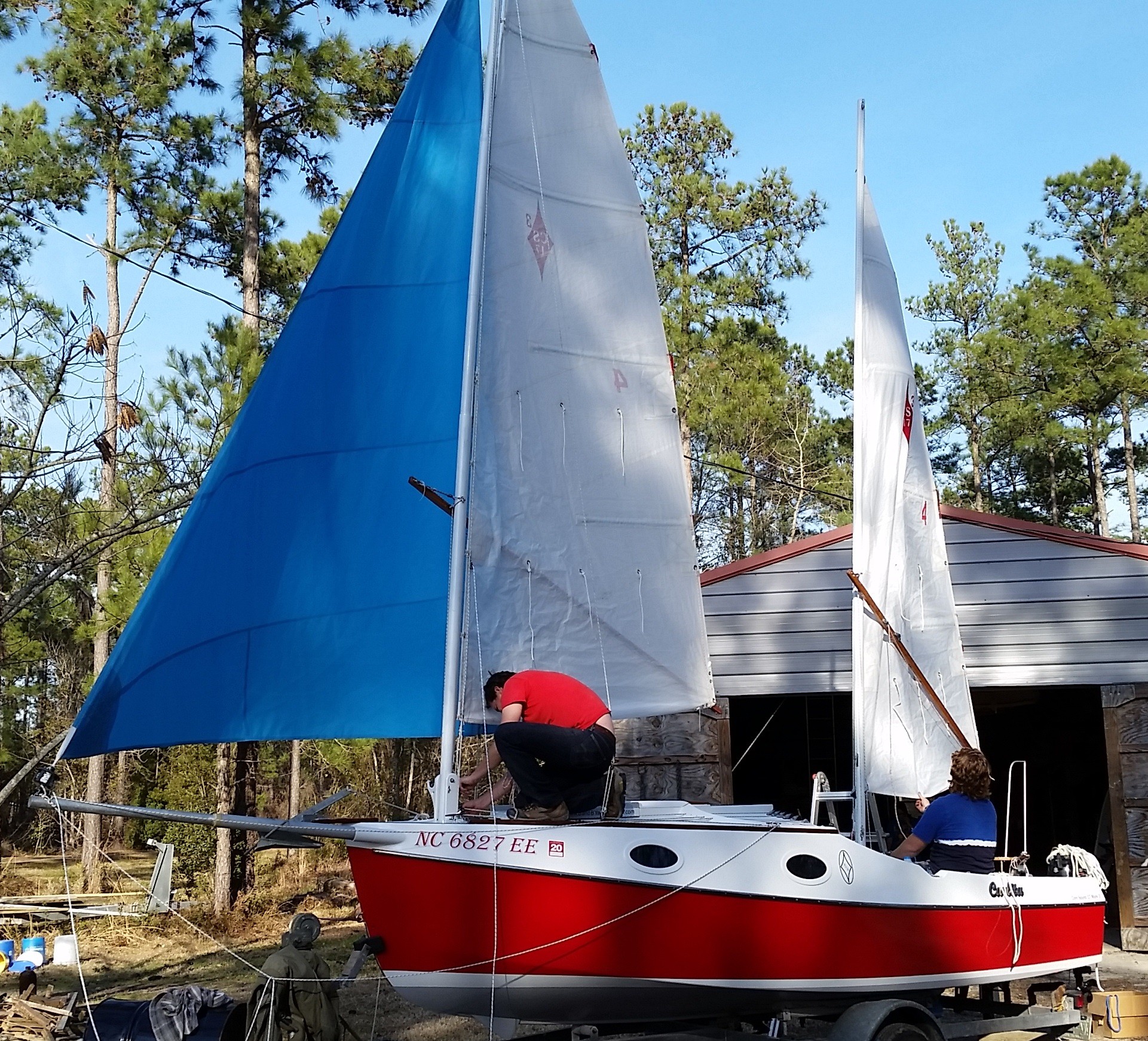
A lot of work has been done since I last posted but Carlita is about ready for the big trip. I am about 4 days behind my target departure date which is starting to run my daily average higher than I am comfortable with. Beth has volunteered to drive me down to Wrightsville beach NC Friday morning to help me catch up my lost time. The centerboard and trunk modification is finished, the keel re-faired and SS hollow back installed, bottom anti-fouled, cockpit painted and the varnish inside and out coated. One modifications I did was to build a roller furling jib which will be a lot easier to use than hoisting and dousing a spinnaker single handed. I also made a pair of 9' 9" take apart oars so that they can be stowed inside the cockpit coamings without hanging out of the back of the boat.


-
Don, Yes there is a magnetic compass aboard. I would not like to be without a compass and it almost never breaks down. As far as I know, there are no other fees. There is a annual subscription fee if you want to keep the charts updated. Polaris is another nav app and it is free. The charts can be copied for free but they were fairly large files and I needed a lot of charts. If you were sailing a local area and only need a few charts at a time it would be a cheap way to go.
-
Thanks tjsmith. I see that the lake level is almost 14' so there should not be any restrictions on the other locks. Rick, thanks for the offer, I will take your number with me. Thanks to everyone who has given me encouragement. The boat is now upright on the trailer and I think that I will be able to leave on schedule.
-
Carlita’s navigation system consisted of a Garmin 640 chart plotter that runs off of the house battery, charged by a solar panel and a Samsung Galaxy 5 cell phone for communicating, weather maps and finding the nearest supermarket within bicycle distance etc.. I was concerned that if either failed I would be screwed and my trip might be compromised. Alan and I have been following the Android development and felt that the newer models were more of a sideways step rather than real advancement and have stuck with the Galaxy 5. It can be opened up and the battery can be changed and the SD card be replaced or increased in size for more memory. The good news is that now that they are a couple of generations old they can be had cheap. I just got a refurbished unit which looks and feels brand new for $162 delivered. I went to Walmart and got a big SD card and a waterproof case. Downloaded the Navionics app for $10 and all of the US charts for $15. The chart quality is excellent. It even has our dock charted. I walked down the center of our 5’ wide dock at 2.3 knots and the course projection was down the middle of the dock. The speed and scrolling is superior to the Garmin. I will not be using it as a phone but just as a computer and navigator. With my phone also loaded with the app it gives me three GPS units and I think that I will not bother with paper charts. I have the set for the EC which I will carry. If the phone quits I can swap the SIM card and call Verizon and I am back in business. This a far cry from my first ocean crossing. There were no electronics not even a VHF, it would have been useless as there would not have been anyone within range. just a sextant a two dollar alarm clock and a cheap short wave receiver for time signals. For weather, if you have not downloaded the https://www.windytv.com/?35.143,-77.163,5 app, you should.
-
I just set the Spot to track and you should be able to see the Lat and Long every 10 minutes. You should also be able to see the position on a map. The check mark is the OK signal and the boot is the track.
-
Roam, The link is in the first post at the beginning of this topic. I just put the Spot transmitter outside and sent an OK signal and sure enough it is at the link, so everything is up and running.
-
Jay, I am sure that everyone here wishes that they had a nickel for every one of these "if only I could hit the replay button and do it over". I am sorry that you will miss out on the sail. I saw Alan's reply, I second his recommendation. It is good for me to see that the structure behaved as it was supposed to.
-
The trunk and the centerboard have been finished. The keel was cleaned up and re-faired with the help from epoxy and the bottom was also cleaned up and re-faired and finished with two coats of Interlux 404 barrier coat and will be fine sanded ready for anti fouling. While the boat was upside down I sanded the deckhead and cleaned up some rough epoxy. It will never be easier as I was working down hand rather than up hand when the boat is right side up.

-
Even though I have had the good fortune to have built more boats than I deserve, like most builders I dream of all kinds of cruises and adventures that I would like to achieve while I am building. One of mine during the build was to sail to and from the Everglades Challenge rather than go through the mad dash down I 95. I just retired from 31 years teaching evening boat building classes at Pamlico Community College and Alan has very capably taken over the running of B&B Yacht Designs, so what is to stop me? It is a cruise of about 1000 miles to get from here to the starting line at Mullet Key in the mouth of Tampa Bay. It is not that difficult except that I have about 30 days to get there which means that I have to average 33 miles a day. That is a fairly easy task until you realize that it will be in the dead of winter. We typically get bad weather every week which will add to the challenge. The good news is that the further south I get the less severe the winter storms will be. The warmer weather is usually brought about by fresh south westerly winds and the course will be SW until I get to Georgia. I plan to cross the Okeechobee canal. The Suzuki will get a workout as the canal is 154 miles long and has five locks to raise you from sea level up to the lake level (currently at about 14 feet) and back down to sea level. Of the 25 bridges crossing the waterway only 8 of them are below my mast height. The last leg northward from Fort Myers to Mullet Key will be generally upwind. What are my chances of making it on time? I will give myself 50/50. My backup plan if I get to the Okeechobee turn off too late to make it in time is to just keep on going south to Key Largo to the EC finish for the party. You all can follow my progress, if it interests you, from my Spot track at http://share.findmespot.com/shared/faces/viewspots.jsp?glId=0eHa05kYuBYnYvSIGGCbp4PpdXZchEvKn . It shows my track and speed. When I stop for the night or to get supplies or do maintenance or am weather bound, I will send an okay message on the Spot and turn it off until I move again so that everyone can see that there are no problems. I plan to leave at about the end of this month. The actual departure time depends on how long it takes me to work through my long list and a reasonable weather window.
-
Core Sound 20 Mark 3 Build - Chesapeake, VA
Designer replied to AmosSwogger's topic in B & B Yachts Forum
Amos, I do not think that you can make a well work on the 20 if you are staying in the 2 1/2 hp range. Your freeboard is a bit taller than the 17. If my freeboard was 1/4" taller or more it would have gotten ugly. The reason is that there is no reverse and you have to turn the motor 180 degrees for reverse. The problem is that the exhaust curves back over the cavitation plate which swings under the bottom of the boat in reverse. If you cut the well deeper, the cowl under the motor will hit the transom. Mine clears the bottom by an honest 1/4" and the cowl clears the transom top by less. Before everyone says just get a long shaft, the shaft extension goes under the exhaust / cav plate and does not solve the problem. I put mine to port before I realized my error because the tiller is to port which comes very close to the cockpit coaming. with the tiller down I can turn the motor a couple of degrees to port without hitting the port cockpit coaming. It just allows me to tune the motor for straight running with the tiller down. I can only reverse the motor by turning it 180 to port but only after lifting the tiller 90 degrees. I am not finding this a big deal in real life but it would be more elegant if the motor was to starboard. With the tiller lifted I can vector the thrust each way for tight maneuvering and fortunately the motor has a clutch, so swinging it 180 degrees is not difficult. When I turn the motor to rotate the boat I am glad that it is only 2 1/2 HP because it really turns fast. -
I remember that day well. Our bucket can lift a 1000# from the middle and each of the four boxes weighed a 1000#. We had to trick it a bit to get each box into the truck and position it on the truck for weight distribution so that the driver could drive it safely. The transmission hoist allowed us to support back of the box to get a second lift to get the box into the truck. A 4 x 4 was then used to push the front boxes all of the way in. The truck had to connect with a ship in New York and timing was critical.
-
I think that you are okay.
-
This method of construction is very forgiving. If the fillets are too big you just added more weight and used more epoxy without gaining much. I like to make sure that the thickness across the filleted joint is slightly thicker than the ply thickness. The glass tape gives the tensile strength and the fillet fills any gaps and thickens the cross section of the joint gaining stiffness. I feel that if the joint is thinner than the ply you could get some flexing at the joint which could fatigue over time. The glass tape on each side adds to the joint stiffness as well. As it is not possible to make a perfect fillet you could err to slightly thicker so that your minimum cross section is slightly thicker than the ply after you radius the outside. It is desirable to radius the outside of the joint because it is impossible to glass around a sharp corner without getting air bubbles under the glass. The rounded over corner makes the chine joint less susceptible to damage and just looks better. A 1/4" outside radius is about as tight as you can glass without a fight but 3/8" is better still and is more tolerant to less than perfect workmanship. As the angle of the joint gets more obtuse like as you work forward toward the bow you can lay the filleting tool over in the direction you are working and you will increase the cross section a bit. You can change to a larger tool but you will get to where the the angle of the side bottom angle approaches 180 degrees, just blend out the fillet altogether. Here is a drawing of the joint showing that with 1/4" ply, 3/8" outside round over and a 1/2" radius filleting tool you have a cross section of .32" which is just over 5/16". Of course it will vary as the angle changes but it is a good average.

-
Roam, As you have already been told, do not worry about the raised finger joint, I anticipated this happening when laying out the panels for the kit. Instead of joining the bottom panel at the end of the sheet like the home builders do I placed the joint centered on the nesting bulkheads so that the finger joints will be cut in two and will be well glassed into the nesting bulkhead structure. You got away with this one but is should be a reminder that when building boats you have cajole ever piece into it's proper alignment. It almost never automatically falls into alignment by itself. My two cents on the jig saw. Bosch used to be the gold standard. I am on my third one at the shop and we were on the second one at the boat building class. I will not be buying any more because they are not holding up. I think that the other manufactures have caught up. Just make sure that it takes the Bosch pattern blades and and has the features that Steve mentioned. We were given a Hitachi a while ago and although it is not quite as strong as the Bosch I will pick it up and use it if it is closer at hand. I would certainly look at the Grizzly.

.jpg.6521e14d1568c82e7ebe27b11eb671bd.jpg)