Designer
-
Posts
1,758 -
Joined
-
Last visited
-
Days Won
182
Content Type
Profiles
Forums
Events
Everything posted by Designer
-
Here is some more.


-
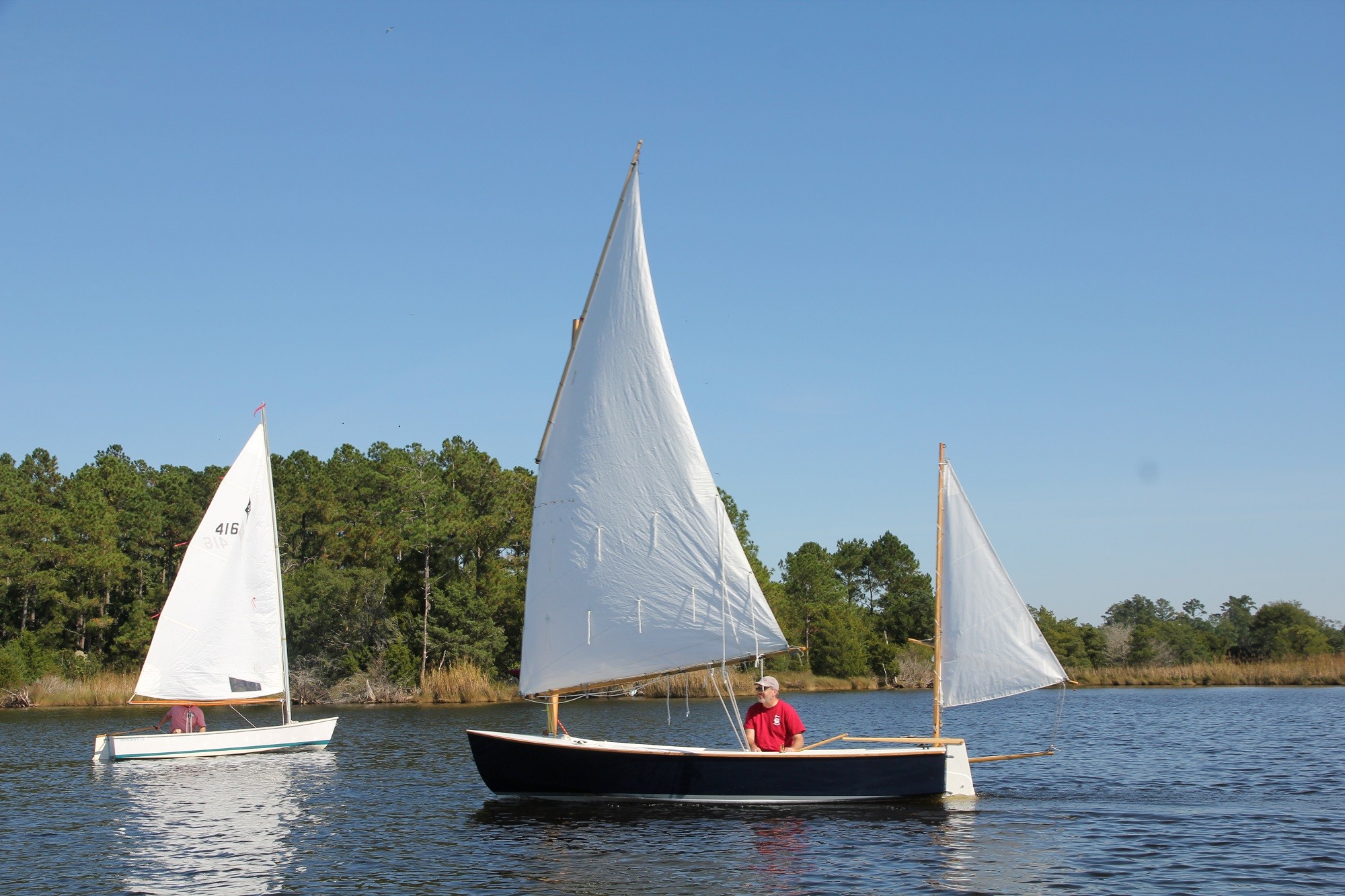
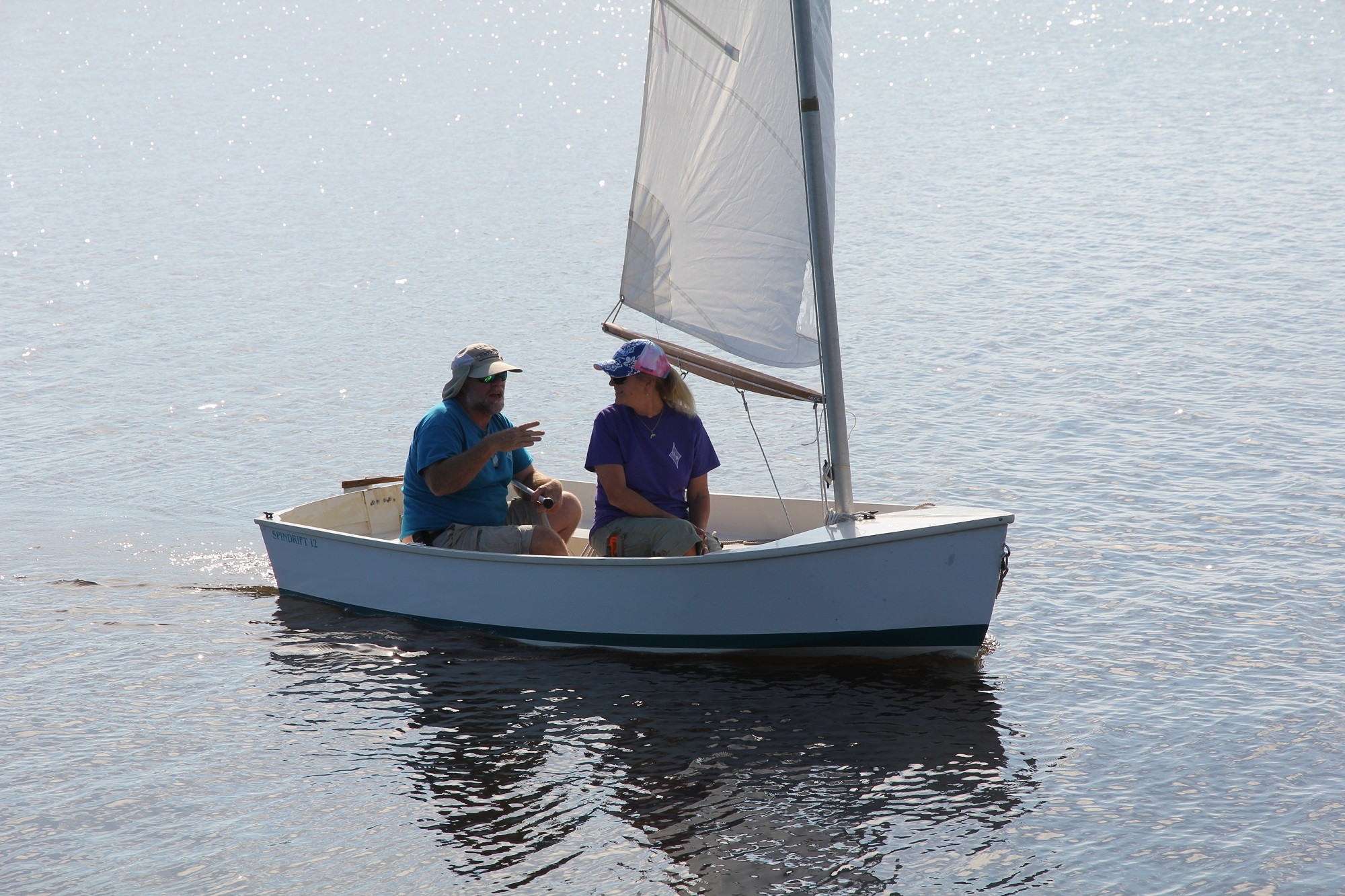
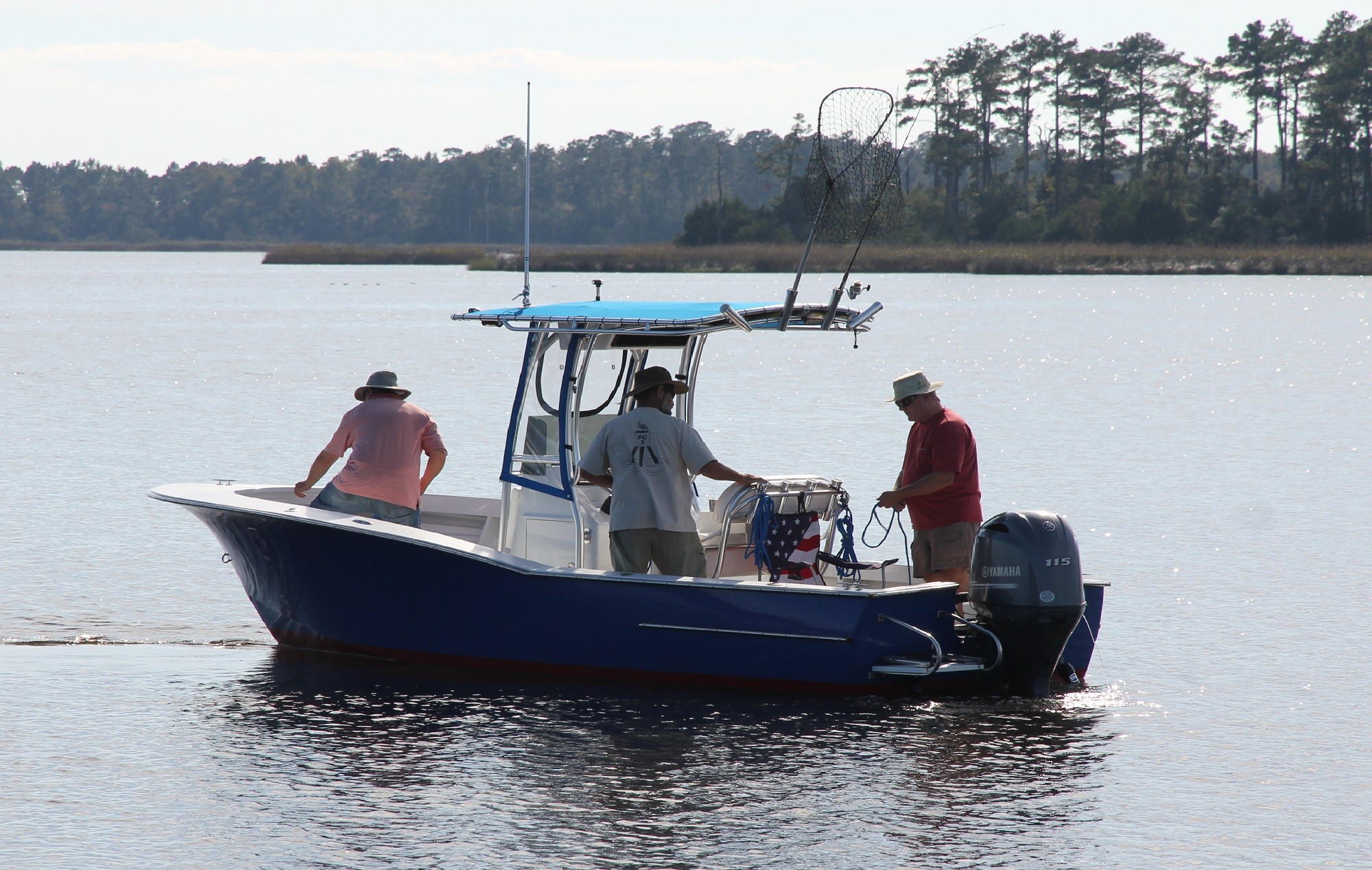
Oyster, It was a pleasure to have you both visit. Chloe sure was cute sailing that little box around. Here a couple of pictures to start with. The camp fire on Saturday night. Steve sure plays a mean guitar and harmonica and Bob can belt out a shanty. Alan sailing Carlita with family. Forrest and sue on a Spindrift 12 Bill brought his Ocracoke 20


-
The flagpoles make terrible masts. As has been pointed out, they use a softer grade of aluminum to allow them to be able to spin taper the pole. They have to use the same heavy wall thickness all the way to the top. In fact the act of spin tapering actually forces the wall thickness to increase which is why the center of gravity is so high on flag pole masts. We are able to calculate the loads on the mast at different heights and reduce the diameter and wall thickness as required.
-
We are off to the Port Townsend Wooden Boat Festival in Washington State. We are off in the morning. The First leg is to Drummond Island In Northern Michigan where I will visit Gordy who now has a summer place there. I will get to sail in the northern Great Lakes for about a week before pushing west. Maybe Gordy will catch some of those fish that he talks about I am looking forward to catching up with our west coast group. It is a long haul of about 7,000 miles round trip the way I am going. We will see if the little Golf is up to the task. Beth has been hard at work dressing her up with revarnishing and finishing some top coat and I have completed the dodger and the Micro nesting dinghy. Alan should have uploaded the video of assembling the Micro in the water by now. It is easier to assemble than we had hoped and rows pretty well too. It took Alan just under 30 seconds to put it together and no water in the boat. With 1/2" hollow back down the keel and fendering all around, the front half came out right at 25# and the aft half weighs 20#. Carlita must be about the smallest boat to carry a hard dinghy on deck. It actually fits pretty well and I can go forward easier with it on board than without. I have been too busy to get some pictures of the dodger but I will get some along the way.
-
About the only improvement that I can see would be a Marissa under construction in that shop. Because the Marissa backbone slots together there is no conventional building jig. She is built on a pair of saw horses. They are about 43" wide with the aft one 36 5/8" high and the forward one 35" high and are setup 100" apart. All of this is not critical. I built hull #1 on a pair of 55 gallon drums with a pair 2 by's across the drums and a pair fore and aft to rest the cockpit sole on. The main deal is to pack the cockpit sole so that it is flat and pitches up 1 degree aft for drainage. Remember we are talking about the boat upside down which means that the cockpit will pitch down aft for drainage when turned upright. The stem is extended down to the floor and fixed as well frame extensions. On a concrete floor like you have, I usually epoxy down some short lengths of 2 x 4 to screw the stem and frame extensions. It is not hard to grind off the epoxy and repaint the floor after the build.
-
Chick, I can't let you have all of the fun. By the way, I have not seen anything about your new motor canoe. Don that round disc was to reinforce the nesting bulkhead hardware. We are now thinking of eliminating it.
-
Fred, I took the roller furling jib with me to Texas but left the bowsprit tip behind. As I was doing it the hard way, most of the time I was reefed going to windward so it was no loss and there was mostly excess wind. Except for the time that Alan and I tested the spinnaker I have not flown it as I have been single handed most of the time and taking it down alone in freshening conditions can be difficult. I have flown the jib a lot because it is fitted to a furling gear and it is easy to furl up and it can be dropped easily furled or left up for later use. It does not have the area of the spinnaker but it still increases the sail area off the wind a lot. It can be carried a lot closer to the wind than the spinnaker can but like the spinnaker it is in the wind shadow of the mizzen when running deep. I have not fooled around with a pole for running deep down wind. I have not used a mizzen staysail as the jib is bigger and easier to tack and I think that there would be too much back winding of some of the sails if carrying it as well as the jib at the same time. I cannot be sure if the forward board is of much help as it is small and I cannot tell much difference on the helm. I do not think that I would fit one again unless I had the room to make it bigger. Overall I think that the jib is worth the effort as it does rev up the performance off the wind for casual racer, it does come at the cost of more stuff to have on board. I use the aft end of the bowsprit as my mast crutch when the masts are down. Unless you are a serious racer I think that I would leave the spinnaker off. I did rig a staysail halyard on the mizzen mast and I have been using it as a topping lift to support the mizzen sprit when I stow the sails.
-
Pete, The hull is made from 4mm ply and I could not go any thinner. I hate to say this early but I hope that each half of the boat will not exceed 25#. The assembled ply only hull weighed just 20#. Instead of zip ties for most of the chines, keel and aft transom except for the high load areas I was able to hot glue it together, it saved a lot of time. As soon as I can find someone to help, I will weigh her again now that the transom stiffeners and laminated gunwales are on. In case you are wondering why I laminate the gunwales, I always laminate them on nested boats so that they do not spring straight when the boat is cut.
-
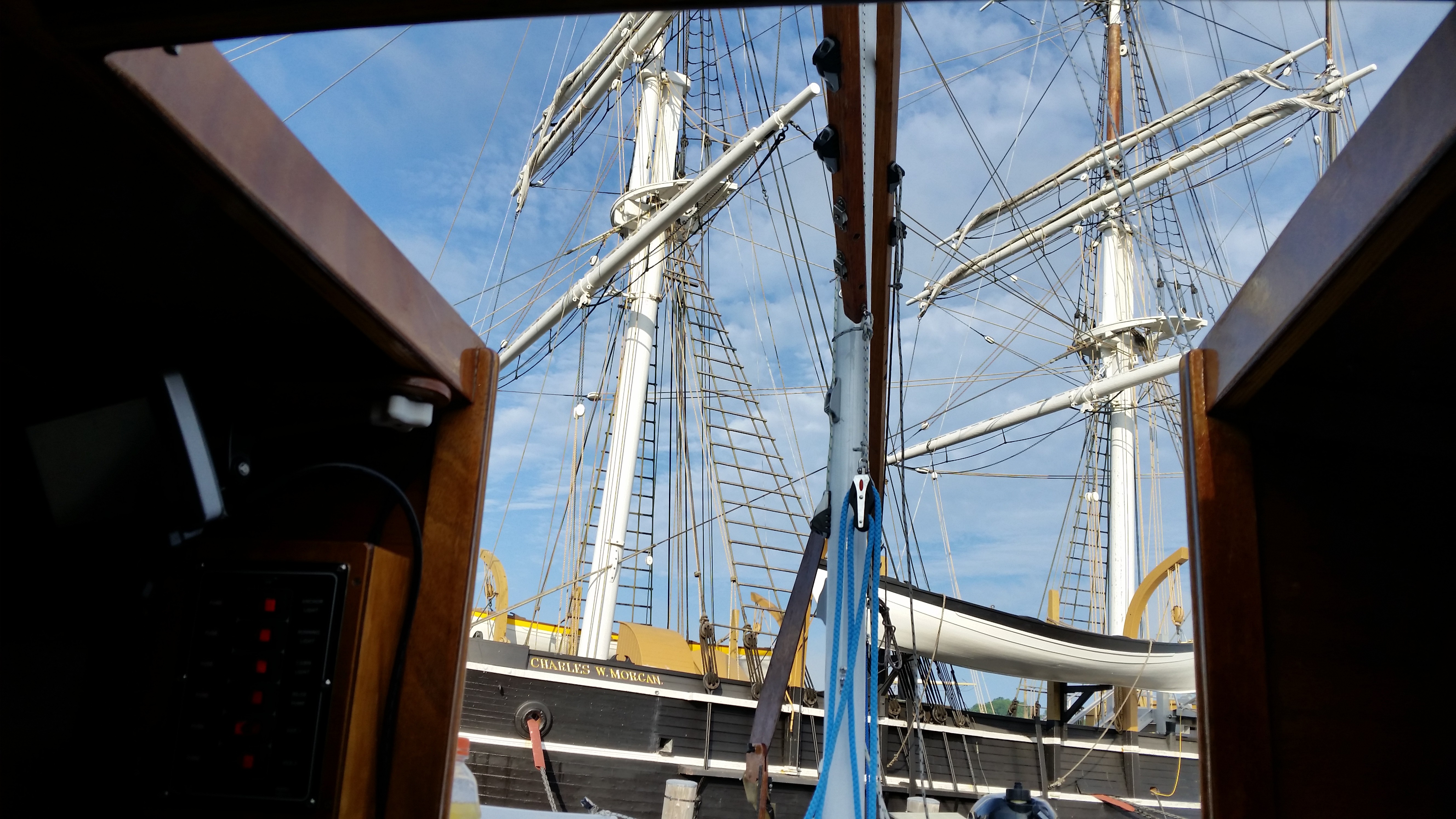
I meant to share these pictures. Beth and I lived on Carlita at the show and the first picture is what I saw as I opened my eyes each morning and looked out the companionway hatch from my pillow. The second picture was taken through the aft starboard port. The Charles W Morgan was built in 1851 and is still fully functional. While on my trip down the Intra Coastal Waterway last January I was invited to a yacht club party at my hosts house. During the night he showed me some memorabilia of the Morgan as his family owned the shipping company that had her built.


-
I usually tack weld between the ties so that I can remove the ties without messing with hardened epoxy on either Ip ties or tie wire. One advantage with zip ties where they are strong enough to do the job is that sometimes you need to epoxy them in such as a corner that has a lot of tension and there is not enough space to avoid getting epoxy on them, just cut them smooth and leave them in.
-
Alex, The tender does not interfere with the dodger. Now that it is summer I moved the dodger to the back burner. It is all done except for the sewing.
-
Spindrift 10N help needed - outboard pad and fwd bulkhead question
Designer replied to Rdubs's topic in B & B Yachts Forum
Don, I thought that you came on a bit aggressive for a polite conversation between friends. I accept and appreciate your apology. -
If you slack off of the snotter and tighten up the reefing line all the way then retighten the snotter until you get the draft that you want you will remove all of that bagginess. The sail still has to bend over the sprit when it is on the lee side of the sail but the big crease will be gone and the draft of the sail will be more uniform.
-
sail question: grommets on either side of clew
Designer replied to tfrei's topic in B & B Yachts Forum
It is hard to tell from the picture if the forward cheek block is on backwards. The sheave should be forward to allow room for the reefing line to pass down the aft side before it turns forward. -
sail question: grommets on either side of clew
Designer replied to tfrei's topic in B & B Yachts Forum
Those grommets are just backup for the leech and foot line cleats. -
Thanks Oyster for posting that picture. That is CS20 hull #1. She was built by Peter P for a customer who is now in his 80's. He donated her to the NC Maritime Museum in May. He told me that she was his hardest possession to give up. She looks to be well sailed in those conditions.
-
Spindrift 10N help needed - outboard pad and fwd bulkhead question
Designer replied to Rdubs's topic in B & B Yachts Forum
My transition to the current painter/ bow connection design came about because I wanted to avoid a metal eye on the bow of the tender that could attack my boat. I also wanted to avoid a potential leak into the forward flotation compartment. Imagine how it would tow with the bow full of water. I Know that the pundits call for the tow point to be as low as possible. I always use a painter that floats so that it is always lighter than polyester or nylon, especially when wet. This creates a very small catenary when it is towing so that when the tender is eased back to the optimum towing length for the conditions, there is very little change of angle between the low towing eye and where I put it and the conventional position. You need a floating painter so that it cannot get wrapped around the prop. I have experimented with different towing eye heights and I cannot tell the difference. Remember that with the shorter waterline length of the tender she will squat, giving a bow up attitude when the towing vessel is reaching hull speed. Living aboard and using the tender every day except when on a passage, I noticed that after 5 years that there was some wear on the painter where it passed through the bow. I untied the stopper knot and cut off 6" and after retying it I had another 5 years before I needed to do it again. I believe that a metal connection would need replacing by then. After 15 years of full time use I believe that this method met requirements of being functional, reliable and cheap. If you want to go with the conventional bow eye, have at it, it is a small deal. -
almost finished my marissa eco18 need answers
Designer replied to driver758's topic in B & B Yachts Forum
If you buy three 6 gallon portable fuel tanks you have paid for a 18 gallon tank. I like to have 25% reserve fuel on a trip in case the weather turns foul on me and my fuel economy goes to hell and I need the reserve to get home. The fuel down in the bilge is out of the way, cannot move and gives the boat the maximum stability. Portable tanks can be in the way and may be moved to the stern to be more out of the way and not put the boat in the ideal trim for optimum efficiency. You do not have fill the tank up if you are going on a short trip. If you are running at about 4000 rpm you will burn about 2 gallons an hour which is only 9 hours run without counting your reserve. Run faster and you will burn a lot more. -
It is that time again. The crew have been working very hard preparing for the Family Boat Building program at Mystic. We are leaving tomorrow as the show runs from Friday through Sunday. We are also taking Carlita to display.
-
Alex, I did use both vanes. With the winds mostly fresh, the small vane had plenty of power.
-
It turns out that the CS17 that Oyster saw was the only other finisher beside Southbound in this years Challenge.
-
I followed the race as best as I could and saw that the winds were 20 from the SW and gusting to 30. Alan called me after he finished and said that the current was pretty strong rowing through the Harlow canal. Strong SW winds tends to lower the water level in Pamlico sound and the water rushes up the canal to try to equalize. He was sailing the CS17 Southbound built by Ken. She has the lace on rig without reefing. Alan said that he went to the shore and rigged one of the masts in the third step and that she handled very well in that configuration. Ken, I think that she is faster in white.
-
This is a boring story. Nothing important broke or screwed up. It was a long tiring 3000 mile drive but the sailing was worth it. Jay and Carol live about 950 miles down the track and very kindly offered to host me for the night to break up the drive and go the rest of the way in convoy. It was a real treat. The skippers meeting was quite casual. After handing over our signed disclaimer we were told that this was an unassisted cruise and if we want to withdraw now or at anytime that was fine, do not bother to inform the group. If you want to rejoin later, that was okay also. “You are the skipper and all decisions are made by you.” I actually like the fact that we were responsible for our actions. In fact they were a most caring group and would go to any length to assist if it was needed. Because we had an extra day they added a new anchorage which they called Camp Zero. It was about 20 miles to windward and they were a bit vague as where we were to go as it has changed from the last hurricane. I had the disadvantage that I was the first to arrive at “I don’t know where Camp Zero is”. I decided on the prettiest beach but most everyone else’s draft was too deep and I became a group of one. The hard way did have a fair proportion of windward work but we did get in an extra day of sailing over the traditional group while they did the car/ bus shuffle. One of the most rewarding parts for me was to be able to see how our boats perform against such a disparate variety of craft in what was sometimes a long hard grind. 63 boats were registered with 108 crew. All of the boats were well reefed some of the time. This year was not as hard as some prior years, but I suspect that one reason that not as many boats withdrew was that there were no crazy boats this year. Probably the most extreme boat was a C scow that was bought on ebay for $200 with trailer. The crew flew in from Port Townsend and Vancouver and picked up the boat in Houston. They spent a few days going over the boat and setting up a reefing system. I believe that they sailed it reefed all of the time as they told me that when it got heavy, it was all that they could do to stop it from nose diving. They auctioned it off for $250 on the beach after the event. Navigation here is always interesting, the water is hard to read as it is somewhat brackish and the charts often bear no resemblance to reality. At Camp 1 we walked over Lost Mans Pass which was several feet above sea level, some of the boats went through it last year. This is where our shallow draft really paid off as we could wing it when we had no idea which way to go. I can’t tell you how many times I blessed the cat ketch rig when I was able to reach the main clew and push it to leeward to make the boat tack where I wanted it to go after I was stopped by the centerboard on the bottom. We all felt for the skipper on one of our competitor’s sloop designs. He came into Army Hole late and decided to beach his boat along side. Like the rest of us, his centerboard hit the bottom and as he lost way, the boat blew off to leeward and his billowing jib pulled him down on the nearby lee shore. He fired up his Honda to back him out of the embarrassing situation. Unfortunately the Honda was not that reliable and I think that he ended up on the lee shore 4 times before he got out of it. When I touched the bottom there, a quick backing of the main and I was around and sailing to the windward shore. The anchorages looked prettier than they were with large shell beaches and mud bottoms and mosquitoes. I was not expecting much from the Camp 3 where we met the rest of the group as it was called Mud Island. In reality it was the best of all with a nice beach and the wind was blowing straight off. I just had time to organize the boat, set a stern anchor to prevent the boat from chafing on the beach all night and have a swim when Jay and Carol fetched up along side in their CS20 mk3 "Southern Express". The three B&B boats performed very well and were always near the front of the fleet especially when we were on the wind. Carlita was usually the slowest of the three, it is understandable being the smallest. On the 40 mile run from Camp 3 to Army Hole, Jay tacked as he reached the channel, I had placed my final way-point on the channel and I was heading straight for that way-point. I was able to read that I had .8 miles to go. It is not often that you can measure exactly how far you are behind. If you look at the video that Travis took of Carlita from his Princess 22 “Pilgrim”, it was taken just a few minutes before Jay made his tack, you can get an idea of how perfect the sailing was that day. I tried to get some video of Pilgrim because she looked so good charging along but I could not read the screen in the sun and it failed. Here is a link to Travis’s video of Carlita, it is 4 short takes. https://www.dropbox.com/sh/e4cub4wvbecgkrd/AADKY0Avwb27c22xGUt8hDiIa?dl=0 It hard to say which boat was the fastest because conditions vary, boats sail different courses and leave at different times. Jay’s boat was right up there as one of the fastest. There were multi-hulls but when overloaded with stores, camp gear and sailing reefed, they were no faster over a range of conditions than a good mono-hull. We concluded over dinner at Camp 3 that we probably had the best boats for such an adventure. There were a number other boats that capsized but were recovered okay. Several boats with deeper draft required help and retired. The wind vane lived up to expectation and overall I am very happy with it, it was driving during Travis’s video. During the harder gusts the vane rudder which is on the starboard side just about came out of the water and occasionally needed help. On the way to Camp 3 I did pull the push rod out of a sleeve that I had used to lengthen it. Because I was on the wind I did not need it and just let the boat steer itself. It pulled out because I did not finish the limit stop and used a line for a stop which became untied. I re-glued it back but put some glass reinforcing across the joint. The line came untied again but the repair held. Raking the vane in fresh running conditions reduced the over steer considerably which gave me the idea that I should tilt the vane axis back a few more degrees. This will reduce some of the power of the vane of which it has plenty in return for more course stability. More testing. Pictures to come.
-
Spindrift 10N help needed - outboard pad and fwd bulkhead question
Designer replied to Rdubs's topic in B & B Yachts Forum
I have been gluing the hatch rings into the boat with thickened epoxy and no fasteners for about 30 years now and never had one come loose or leak. Like you said, it is important that you have the hatch screwed in place to prevent the ring from distorting. When I push the hatch in place, some epoxy will squeeze out the fastener holes, I just wipe off the excess from the holes and clean up the perimeter and I am done. I always paint the boat before I install the hatches and I mask for the hatch ring to save having to remove the paint for the epoxy to bond. -
Carlita and I are leaving tomorrow to participate in the Texas 200 http://www.texas200.com/Route.html For those not familiar with the event, it is basically a cruise in company from Port Mansfield near the Mexico border for 200 miles to Magnolia beach in Matagorda Bay. There are 63 boats entered so far. There is a second event called "the hard way" with 20 of the boats choosing that option. The winds are usually fresh from the south east giving a fast reach for the boats going north. The hard way goes from the finish, south against the prevailing winds until meeting up with the north bounders at Mud Island called Camp 3 and then everyone works toward the finish at Magnolia Beach. Texas has an Intracoastal Waterway with Outer Banks so that the whole event is in relatively sheltered water. I will be running my Spot for anyone interested. I did the inaugural T200 back in 08 and am looking forward to doing it again. Being hard headed I have opted to do the hard way. There are four B&B boats entered plus regular contributor here Charlie Jones.