Designer
-
Posts
1,758 -
Joined
-
Last visited
-
Days Won
182
Content Type
Profiles
Forums
Events
Everything posted by Designer
-
Core Sound 20 Mk 3 -- #4 "Chessie" . .
Designer replied to Pete McCrary's topic in B & B Yachts Forum
I am painting in the anchor locker on Carlita. I just epoxied Southern Skimmer's anchor locker for the reasons stated above. It took a good while but the UV's have started to break down the epoxy. It is not a big deal as I will re-epoxy it and then paint it. -
Beacher, The CS20 mizzen staysail is larger than the CS17. We make them if you want to buy one or you can email me for the dimensions.
-
Double diagonal planking is an excellent method. The main reason that I use the Ashcroft method is that the planking has less twist in the direction as drawn compared the the opposite diagonal and the planking goes a bit easier as well as the afore mentioned, being able to work both layers at the same time. As for strength, the strength difference is marginal, when you consider the stringers and the fact that it is covered in glass. To answer your earlier question about working both layers together. When you are working faster than the glue can dry, you just use permanent fasteners to hold the inner planking in place. They can be any non ferrous material, stainless staples, brass escutcheon pins or as we use, fiberglass nails shot from an air gun. I realize that you may not be able to go to your local hardware store in Vanuatu get them. With your big crew, the way that you are doing it is good. There are two important points to beware of when planking. DO NOT EDGE BEND the planks to close up a gap between the plank edges. I would rather leave the gap and fill it later. Ply cannot stretch or compress and you cannot get rid of the extra material that you have just induced. I like to fasten the plank in the middle and work outwards so that the plank will lie down tight to the inside layer planking. The second point is drawing the planks together between the stringers. I typically use staples. It is necessary to have someone onside with a big piece of wood to buck up behind the inner planking to draw the two layers together. This is especially important when a staple hits near the edge of one of the inner planks and pushes it away instead of drawing it together. If you do not have staples you can drywall screw through both planks into some scrap wood on the inside. You might be able to get away with one row between each permanent stringer. Good luck with it. It sounds like you guys are going like gangbusters.
-
The DMV was announcing on the news this evening that at least one lane would be open near Kinston. Don made it through this afternoon.
-
Amos, Several people have told me that they are camping. We are scratching up some fire wood. if you have some lying round you can bring it. Sally and Joe are the first arrivals.

-
We are back up. The phone line along with our internet has been fixed. The line crew have been doing an incredible job. They were working on the power line coming to the shop this afternoon. We should have electricity there in the morning. I was surprised that NOAA was as far off as they were. They kept revising the path further north continuously. I found that the best source was Sailflow which was giving wind direction and speed for the whole region and could be zoomed in to our area. As I advanced the time forward it was giving a good view of the eye and how the the expected winds would behave. They were pretty close to reality. It was still a cat 1 when it passed by with the eye passing over Cape Lookout and then out to Hatteras before moving northeast rather east and then south as predicted by NOAA right up to the last moment. The Coast Guard station at Hobucken, 6 miles recorded a top gust of 75 mph. As Alan said we got off very light. The wind direction was good for us and the water was not forced up like it was with Irene. The flooding that is currently on the news is further inland where the water is rushing down rivers from the large catchment area and cannot get through restricted areas quickly enough. They are reporting water rising as high as 27 feet above normal.
-
Tiger, I would rather deal with hurricanes than fires or shovel snow etc.. It is exhilarating to feel the power as you lean into the wind. It looks like we might dodge the worst of it. We were at the waterfront around noon and the wind had a good roar to it and I had to lean into the gusts. The wind was east south east and gusting at about the middle 30's and the waves were just breaking onto the shore in places. Of course Mandy thought it was great and had a couple of swims. At 2: 30 there was little change. Some houses have lost power in the county and we have had our lights flicker so we might be in a blackout as the storm passes.


-
Fred, The oarlocks are in the normal position, about 12" aft of the bridge deck. They do clear the mizzen mast. She is a sail boat first and a row boat second but I did row in and out of checkpoint 1 during the EC without much trouble. I cut down the coaming to help with oar length. I used Southern Skimmers oars for the race which are a little under 10', I have forgotten their exact length but the oar blades stuck out the stern. If you look at the self steering video you can see how far the blades stuck out. Now that it has cooled down here and the boat is mostly finished I can do things like refine my rowing system. One of the aggravations of living here is dealing with hurricanes. This week Mathew has consumed a huge amount of time. First it had a bulls-eye right over us, then it was going to curve east long before it reached us. Yesterday they kept moving the track further north toward us. The overnight track seems to have stabilized and it's strength has diminished some. It looks like we might dodge a bullet and just get some wind, lots of rain and some high water. We do not expect the water to reach Irene levels which put 50" of water in the lower shop and 16" in the upper shop. We have moved everything up that can be moved so we should be okay.
-
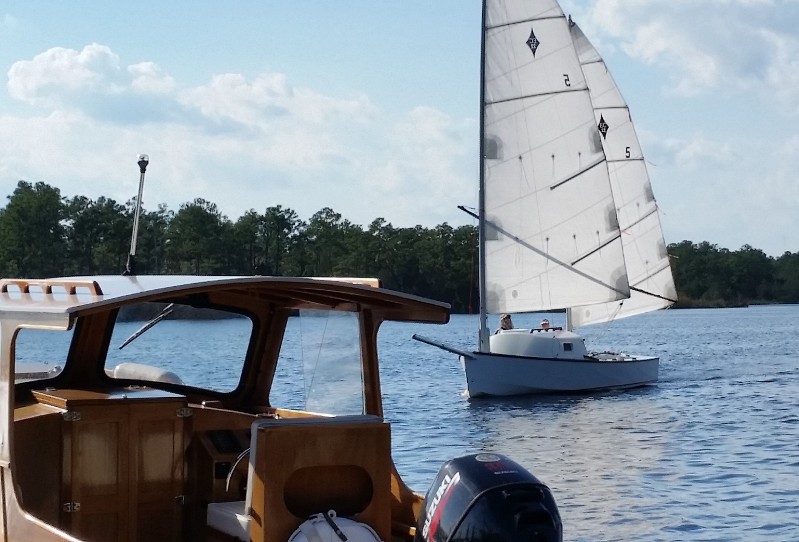
I just recently got this picture recently of a lug rigged cat ketch . Guess what boat it is?

-
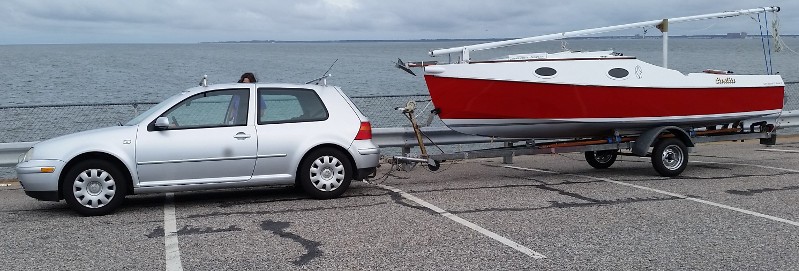
Thanks Fred, We are back home after a great weekend. It was good to meet many old friends and make some new ones. Here is a shot of the finished rig on the Chesapeake Bay Tunnel Bridge facing eastwards. The land in the background is Cape Henry, the southern cape guarding the entrance to Chesapeake Bay, to the left is nothing but ocean for a couple of thousand miles until you reach Spain. With 430 miles to refill the tank, the car averaged 31 miles to the gallon.

-
A
-
Here are a couple of shots from Alan.


-
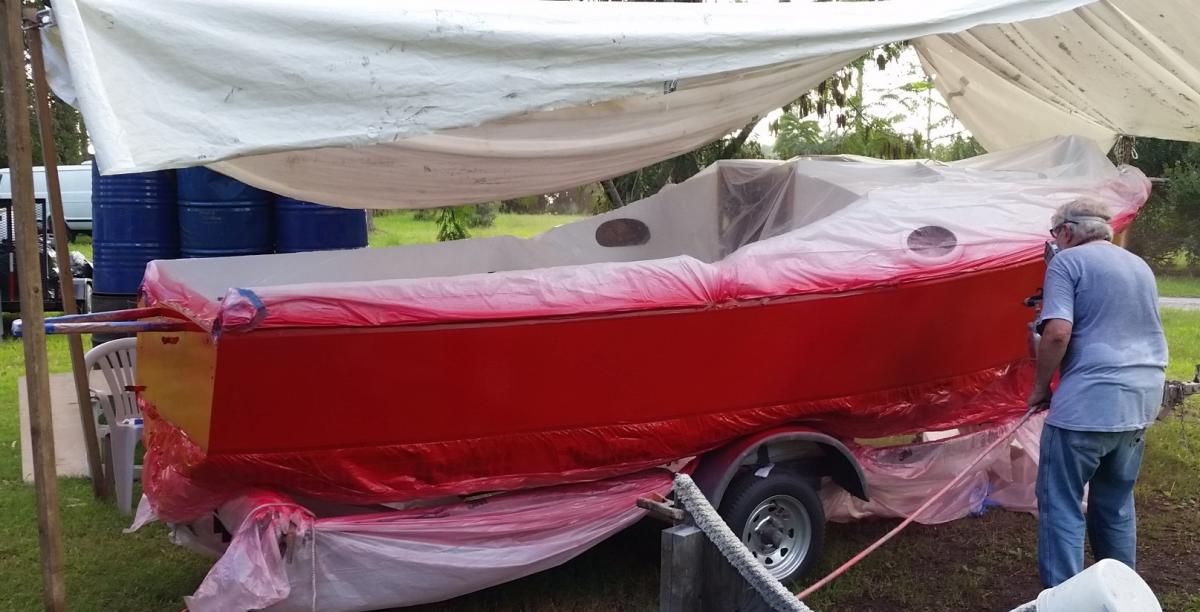
Steve, Yes we are heading for St. Michaels next weekend. Alan and Taylor are taking the expedition canoe and Beth and I are taking Carlita. Due to the total lack of interest by the Navy in our stealth Carlita we have decided to give her some party clothes. Here she is getting her red skirt in our spray booth.

-
Carlita is finally getting tarted up. Having missed my trip west this summer I want to take her to the Mid Atlantic Small Craft Festival. She has been filled and sanded to Beth's satisfaction, I have permission to paint her. The picture shows her with a light coat of white AwlGrip white 545 primer. She had gray 545 primer but about 60% was sanded through. The one advantage of being used for 6 months before final painting is that all of her coatings are as cured as they are going to be and print through should be minimal, not to mention a few fittings being re-positioned with the old holes filled and painted over. That is my story and I am sticking to it. After a light sanding she will be top coated with AwlGrip polyurethane.

-
Jetech, I agree that the cat rig is the way to go. The plans are not for both versions due to structural and interior layout. They are for one version or the other.
-
Gene, The masts on the Core Sounds have been well tried and tested. The only masts that I am aware of that have broken on a Core Sound have used the wrong metal or have hit something with their masts. Core Sound 20 Dawn Patrol was the most prominent recent dismasting. She has raced for many years in various adventure races without mishap until she got her spinnaker halyard caught on a day marker in the dark doing about 6 knots hard on the wind. The boat rotated about 90 degrees around the piling before the mast came down. They tided up and stowed the rig on board and carried on racing with just the mizzen. They went on to win the Everglades Challenge and set a course record. We have since sized the wall section on the lower masts up one size to allow for extra abuse.
-
The controlled tests are the way to go. It is a bit late to be out on your own to find that you cannot get back on board, or find some other issue. They made a movie where everyone went for a swim during a calm, only to find that the freeboard was too high and the sides were too slick to climb. They all perished except the baby who was left on board. I think that it was called "Overboard". Joe, you certainly have to be aware of the chine coning at you but it seems to be slow enough that I never found it to be a problem. I do not waste any time getting to the stern as the boat could get away from you if you tarry.
-
Alex, That is one pretty Spindrift 12. I have done it in the conditions that you describe while sailing alone in a EC22. It was pretty much as Joe showed only quicker as I was not posing for the camera, there was no one fool enough to be out there to catch it. The only difference was that I did not walk out to the end of the board. I sat right down and slid my butt out to the end of the board with my legs wrapped around and under. I have done it three times in real conditions. I have not done it on a CS in real conditions. Alan and Paul have but they have a cabin on their CS 20. What makes it so easy is that there is enough volume above the water in the cabin that prevents from the boat from inverting or water getting inside the boat. This allows the crew to climb up the windward side using the coaming, cockpit side, mast and cabin as steps. I made a rope and PVC ladder like the one on the Spindrift 12 a few posts ago which is pretty important if you want to get aboard after she is righted. Good job Joe.
-
Dnjost, There is one more critical point that you have missed. In light air there is no problem using the staysail set-up that you have BUT in a fresh breeze you run the risk of damaging the mizzen mast. To save the clutter of permanent running back stays I make the staysail halyard do double duty. You need a stopper knot that hits the halyard block when you have the right halyard tension. This takes a couple of iterations to get the knot positioned just right. The halyard then needs to be cleated in the position where it does the most good. This means that as far to windward as you can to counter the side load and far enough aft to counter the forward load. About the best position is to put a regular cleat facing down under the coaming near the aft rowing position. When the halyard is properly set, you should be able to sight up the mizzen mast and it will be fairly straight, not sagging off to leeward or pulling forward. I also use the halyard tension to adjust the luff entry angle. If the luff is too tight, the entry angle will be too full and the reverse if the halyard is too slack. This is critical if the wind is just too tight to let you hold your course without the staysail luffing. Ease the luff and you will be able to point another 10 - 15 degrees higher.
-
jetech, I have owned several S10's and I now have a S12. The S10 is an incredible boat and we have had some amazing adventures in her. It takes almost as much time to build a 10, 11,or 12 as the building steps are the same. There is an extra sheet of ply needed for each extra foot of length and the bigger boat will need a few more feet of glass and some more epoxy etc.. You will enjoy the bigger boat, especially when you have a crew or two. I launch my 12 by myself. I would never build the nesting version unless I had special space requirements as the standard interior is more seaworthy and better ergonomically.
-
attaching harken block to cs 17 aluminum mast
Designer replied to tfrei's topic in B & B Yachts Forum
There are 4 holes on the Harken halyard block flanges for fastening to the mast. I use 2 - 1/2" x 3/16" ( # 10) bolts for the lower holes. There is a plug in the top of the mast. I put in the plug with caulk after I install the lower bolts. I use 2 - 3/4" #10 ph screws into the plug. Everything is caulked to prevent leaks and isolate the stainless from the aluminum. We supply plastic caps or you can make a wood plug. -
Trying to keep this simple. The most efficient planing hull shape would be a flat rectangle. The problem is that it is not very seaworthy. V or deadrise allows the hull to carve through the chop much better and improve handling. How much deadrise? Is more better? Like everything else it is a compromise, more V requires more horsepower which means more fuel. If carried to it's logical absurdity, the boat needs to be stronger and heavier requiring more HP and more fuel to the point that the boat could end up slower. There is a lot more involved than just deadrise. Carefully blending the entry angle of the bow, the (delta conic) or convexity, the center of gravity etc.. The 13 degree transom deadrise is a good compromise between efficiency and soft riding if the bow is carefully blended. A lot of people want to go further offshore into bigger water and are prepared to pay a bit extra to be able to push the boat harder in rough conditions. 16 degrees at the transom is still a good compromise between good riding and HP especially if you add keel flats and lifting strakes.
-
I have been putting on toe rails, bow sprit, gunwales etc, I hope to paint Carlita soon.
-
I am planning to be at the WBF with the CS17 mk3. I will be available to go over the construction.
-
The beam is just under 10 feet with the guards,