Brent
-
Posts
564 -
Joined
-
Last visited
-
Days Won
3
Content Type
Profiles
Forums
Events
Everything posted by Brent
-
Great idea, and third weekend in April is great. Instead of an organized cookout, how about each boat bring something to grill or cook, and share with others. I would likely sleep on the boat, but a site that could accommodate a fire and some tents would be ideal.
-
Over the years lots of folks have expressed concerned that the CS20 is too big for them to handle solo. With a decade of solo sailing a CS20 I can say with confidence that boat is a fast fun ride for the solo sailor. Never had a problem stepping the masts, or in handling the boat when the weather gets rough. My boat has sail tracks; the masts are raised as bare poles, without the weight of the sails. The tracks also allow easy reefing when the weather builds. This is an example of many decisions we make as individual builders that give each boat its character. Boats with luff sleeve sails are no doubt more challenging both in raising the masts and in handling heavy weather. That said, I like the tabernacle idea, which I suppose will make the task of mast raising even easier. There is a small advantage to having the masts rotate when running down wind or in deep reaches. The advanced sailor, with a sharp eye to air flow over a well trimmed sail can get perhaps an additional 0.1 knot out of the boat with rotating masts on down wind points of sail when conditions are right. This advantage is not in my opinion a sufficient reason to not build tabernacles for the sailor wanting very easy mast raising.
-
An aquaintance with a beautifully done Welsford boat REFUSES to sail along with the Core Sounds because his boat has no hope of keeping up. To take four adults out in those big bays and sound you will really appreciate the Core Sound 20, especially when you are running home in deteriorating conditions.
-
Howard, I recommend grassing the hull bottom before the keel flats are put on. These keel flats will swell and move with variation in moisture. The glass will form a barrier to protect your hull ply from that. Also as Scott mentioned, grassing the ply will substantially stiffen the hull.
-
Dave, by sharing your knowledge your helping a lot of people be better more thoughtful boat builders.
-
Keep your main sheet drawing from as close to centerline as possible. Mine cleats at the edge of the seat deck, where they are easy to reach when hiking. My mizzen sheet runs from a stationary yoke at the stern through a block with a becket, then runs along the sprit to cleat at the mizzen mast. This way the mizzen sheet is in front of me, not behind. This is shown in detail somewhere in the archives.
-
For Tom and 176 The hull sides are half inch foam, and the bottom is 3/4. The 3/4 significantly exceeds minimum standards, but I wanted a stiff hull. There are two layers of 1708 on the outside and one layer on the inside. I am getting good quality laminations with about 1.0 lb of resin per lb of glass. If I am careful the net might be 20 percent lighter than a plywood hull of similar strength.
-
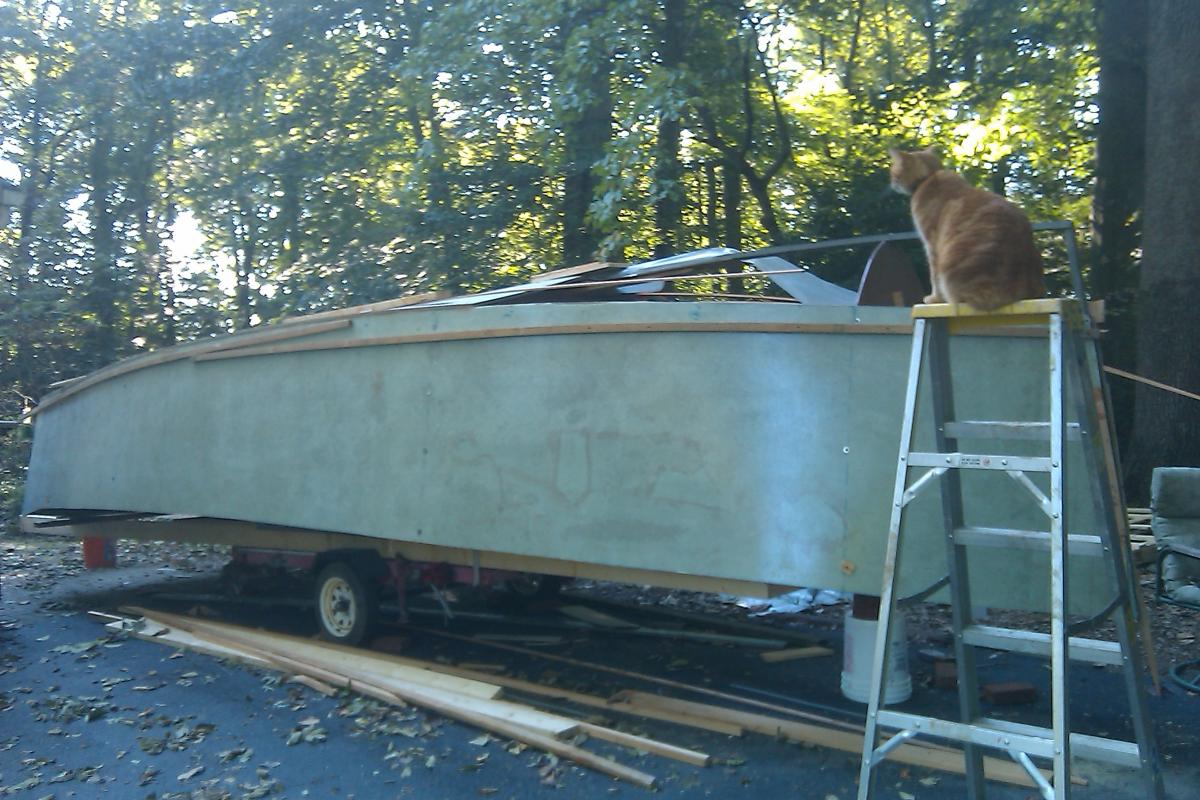
Howard, Yes there are a few differences from the plans. Some of these are due to differences in laminated foam core construction versus plywood and some are simply my choice. Oyster, Good to hear from you my old friend. I thought hard about hiring at least portions of this out, recognizing this is a huge project. In the end I am taking it on myself,but will certainly be tapping into my network for help with certain parts. That is my backyard, my garage, and a familiar cat (which I wont claim as mine). I am hoping to get the hull to a stable condition before winter sets in and weather will certainly be a factor in the schedule. Wish I had a nice place to work like yours. Also wish I had your skills, but I will just have to cope as best as I can.
-
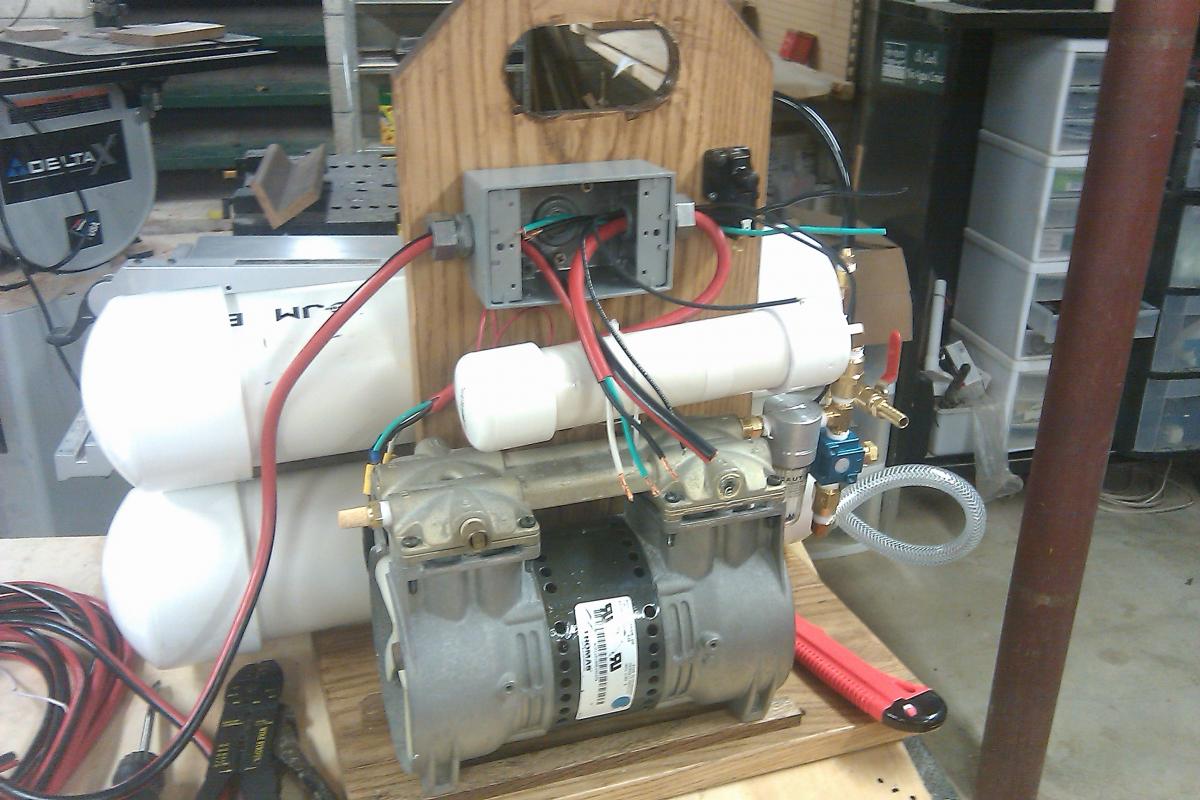
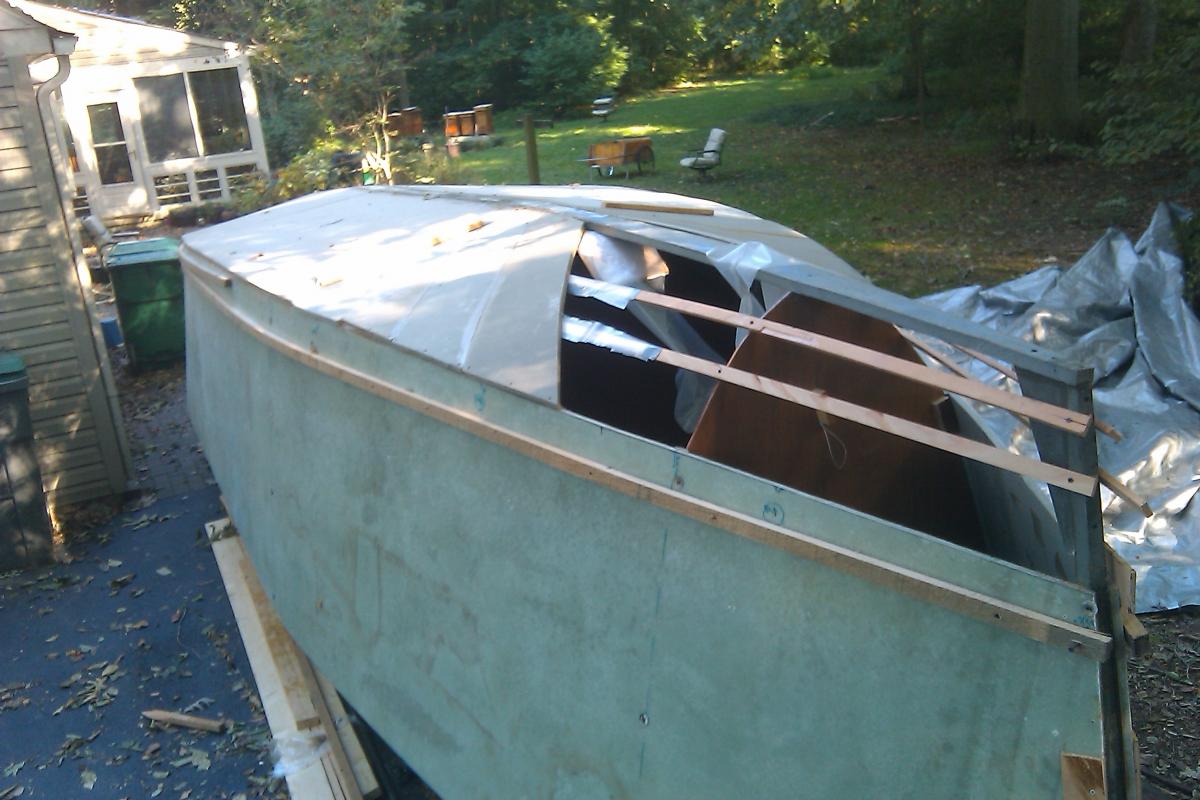
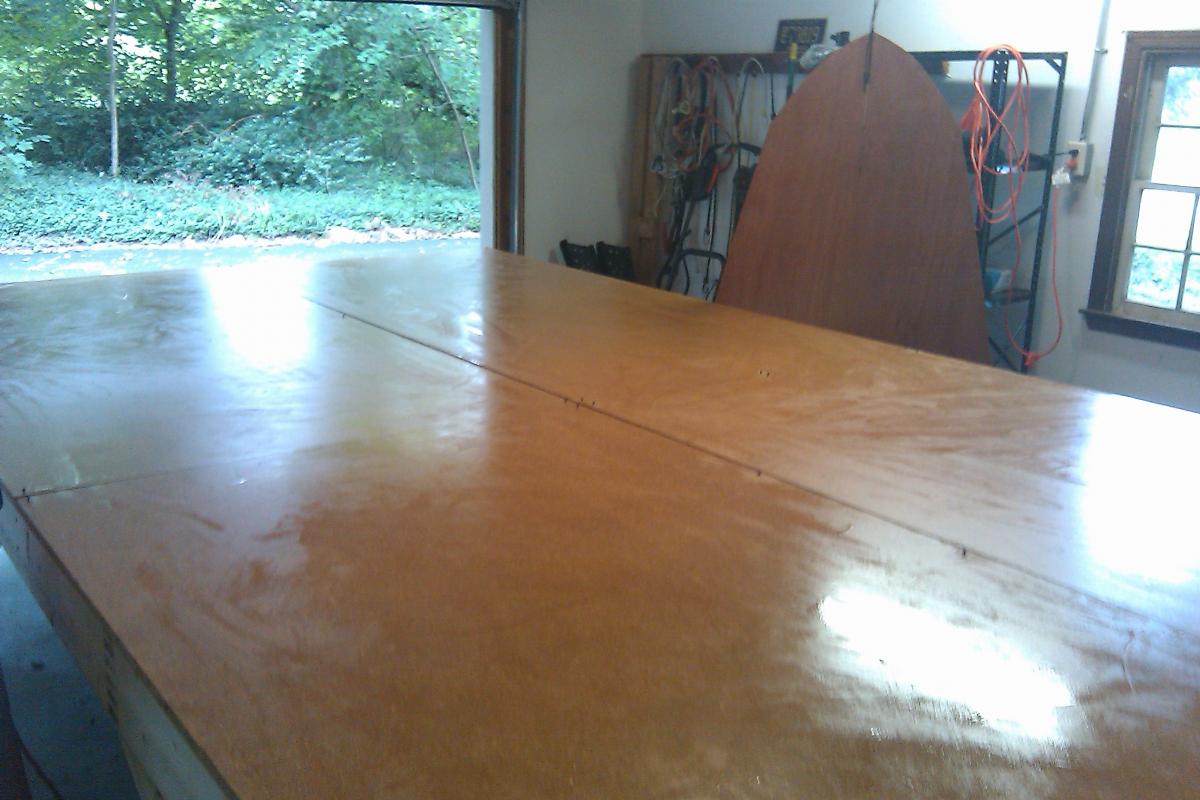
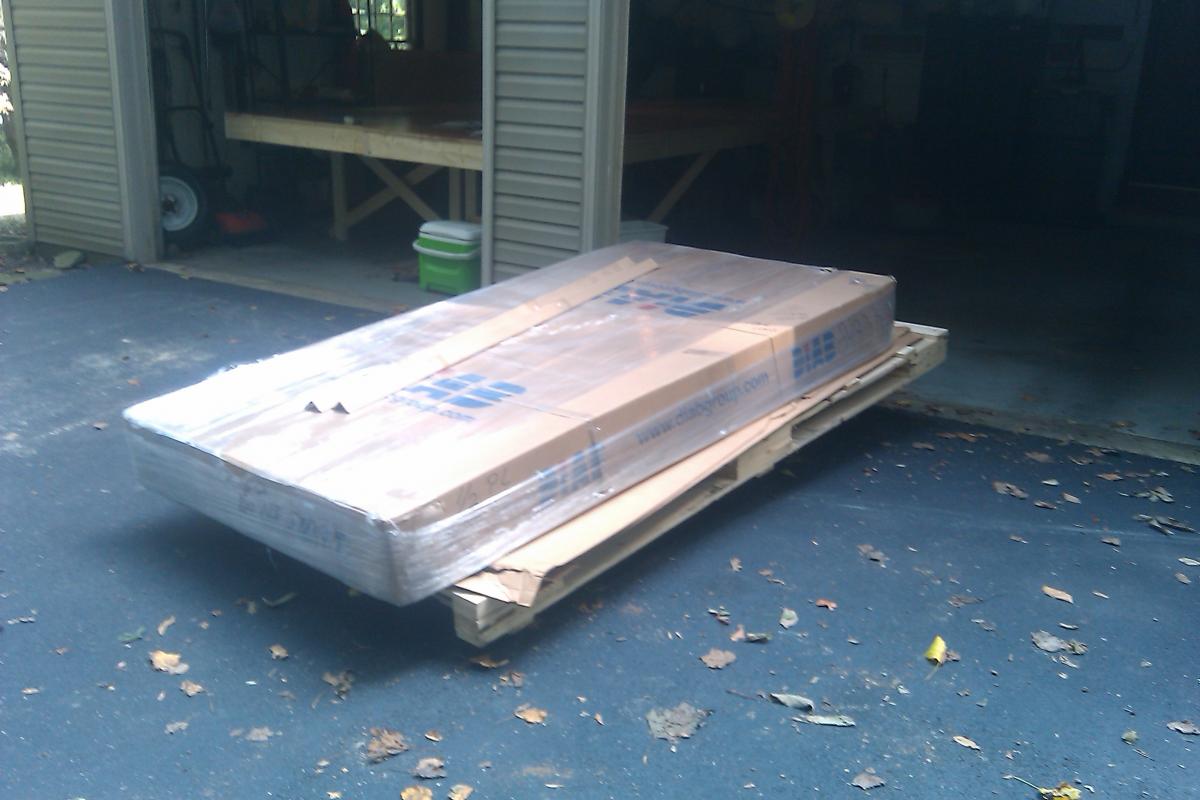
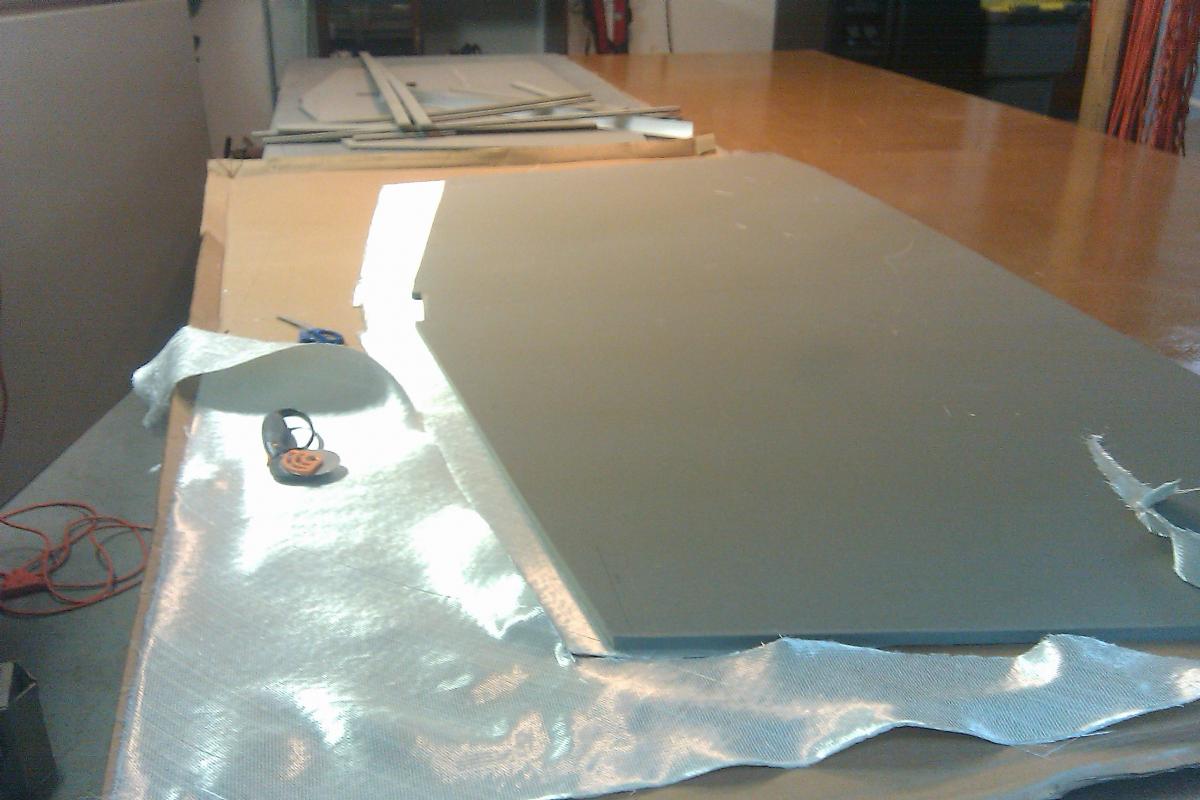
I have a Princess 26 under construction. This boat is being built using vacuum bagged laminated foam core construction. This construction is more difficult than wood, but should be very strong and light weight. First I had to build a vacuum pump rig. Then the laminating tables Then source the materials Here are some of the first laminations. Vacuum bagging has its challenges, but gives very nice results. Now the hull is assembled, trued, and the hull bottom panels are going in.


-
wwbaginski, I have done exactly the same thing! I find the boat sails very well in schooner mode. My CS20 drives powerfully in schooner mode and can be readily controlled even in high winds and rough seas. I prefer ample power in these situations to keep the boat in command of the situation. Earlier this summer I was in the same situation you describe. As the storm rolled in it was necessary to take a reef to keep the boat in control and moving steadily. Using the schooner configuration the boat was able to handle the rapidly escalating wind and large seas. The boat was moving very fast but not in full plane in the large confused sea. However the speed was ample to get off the open ocean and behind the jetties in good form. Once in the protection of the jetties the boat speed increased further as the sea state settled somewhat and I was able run out from under the storm. By the way my friend Norm was in Raid Finland again this year, and sends his regards.
-
Howard, I agree with avoiding filling spaces with heavy stuff just because they are there. I also do not like closed up spaces on these boats. So far the best thing I have come up with is access thru bulkhead 4 as you mentioned. I am thinking an open passage to starboard of the mizzen tabernacle. Peter is clever guy, thought he might have an even better idea. Come to think of it under that cockpit sole should be a fish hold filled with ice and beer.
-
Lots of good advice above. I like to come in charging, with enough power in the sails to steer the boat exactly where I want it. The snotters are the key to the power in the sails. .Even with the sheets loose the sails can still power up if the sail shape is retained. The snotters on my boat are accessible from the helm. At the last moment I let the snotters run to the stopper knots, which completely depowers the sails. The boat coasts to a halt. When it is blowing I tie a dock line around the mizzen at the thwart. This line is easy to drop over a piling or cleat and hold the boat in tight to the dock while things get settled.
-
How are you using the space under the cockpit floor? There is a great big space there on the P26 plans, that needs something other than being closed up. It is a little short and a little to far aft for battery storage. Might be good for a fuel or water tank I suppose.
-
If the companion way is shifted to starboard a bit there is room to place a slide out expansion making the pilot berth into a cozy double. This might be a preferred bunk space on a summer night. The cockpit can also be made into a very nice sleeping space for those that don't mind the dew. I am curious if the composting head works for occasional use. I am sure it will be fine in regular daily use, but I wonder if it may need to be fed if the boat sits unused for a few weeks. Any experience with this?
-
You can run the sheet from the tack of the staysail...to the lee side of the mizzen sprit...around the windward side of the mizzen...back to the staysail tack forming and endless sheet that does not have to be rerouted when gybing. The staysail still is dropped, the boat gybed, and the sail rehoisted , but at least the sheet is ready. I recommend 3/16 or 1/4 inch sheet for good sail shape in light air.
-
Wayne, Thanks for these pictures, this is exactly what I was hoping for. From the details I can see this is not your first build. Nicely done. I too am thinking about the seat saloon and extending the cabin back to the mizzen. Please keep the pictures coming when you have the opportunity.
-
Steve, thanks for posting the video. It was fun meeting everyone. I hope to do this event again next year.
-
Anyone have pictures of a Princess 26 interior? I see the layout on B&Bs website, but would like to see how that manifests in three dimension. There are surely many layout possibilities also. The effective use of head room is a key point of thought, recognizing I wont be able to stand up in a Princess, except when in the hatch. I am curious how people have utilized the interior space for best effect.
-
My current plan is to launch the CS20 about thirty miles north on Wednesday or Thursday sailing south to catch up with the Wye Island group on Thursday, then arrive in St Michaels Friday. I'll have crab traps on board and may stop several times to use them. You are welcome to join in as your plan allows
-
I am considering sailing to the small craft festival next weekend. anyone else going?
-
Congratulations Tom. Winning a race with family on board is always great, but to do so on your birthday is excellent. When you said 80 ...I would have never guessed your age correctly.
-
I sail the Northern Chesapeake on a Coresound 20. If building for the Chesapeake I would choose the Princess 22 over the Belhaven for the additional creature comforts from the larger cabin...personal preference. Both can get into the shallow water where the really spectacular Chesapeake anchorages are. The princess is a more complex build, and will take a little longer to complete. This thread if full of trailer comments that dont sway me one bit. I know how to set up a trailer that will make getting either boat on and off an easy job for a singlehandler.
-
Ray, knowing you are a thoughtful guy...what drove you to the Belhaven versus say a Princess 22? I have thought about this choice a few times, and go back and forth myself.
-
Spindrift 10 Dinghy - Sail, Motor, Row. Great yacht tender and performance dinghy. Complete sailing kit including mast sail, rudder, centerboard, sheet, vang, etc used once. Well built and lightly used. Located in Delaware. $1450

-
Being somewhat performance minded, I make snotter adjustments frequently. The snotter has a big impact on sail power on my boat. As Peter mentioned adjusting for upwind/downwind, but also setting just right for changes in wind. I like the snotter run to where I can easily reach it from the helm. A useful trick when coming into a dock is to come in charging (ala Captain Ron) and then blow the snotters loose at the last moment. This takes all the power out of the sails. Your goal here is to ease up stopping 1 inch from the dock dissapointing everyone around by snatching away that big crash they were expecting.