Brent
-
Posts
564 -
Joined
-
Last visited
-
Days Won
3
Content Type
Profiles
Forums
Events
Everything posted by Brent
-
I am considering building something similar in concept. A 17' kayak type hull form with catamaran hulls making a trimaran, and a radical amount of sail. My thoughts currently lean to a main hull of maybe 29" width with a cocoon around the cockpit to keep the spray generated by 10+ knots off the driver.
-
Looking for CS 17/20 sailing tips
Brent replied to Richard Whitney CS#70's topic in B & B Yachts Forum
She be carryin' full batten sails on sail tracks with just a bit more in the leech that thare plans suggest. The mast do rotate as they please, and the snotters are run back to the helm. -
Yep, as Jeff points out full battens, rich roach.
-
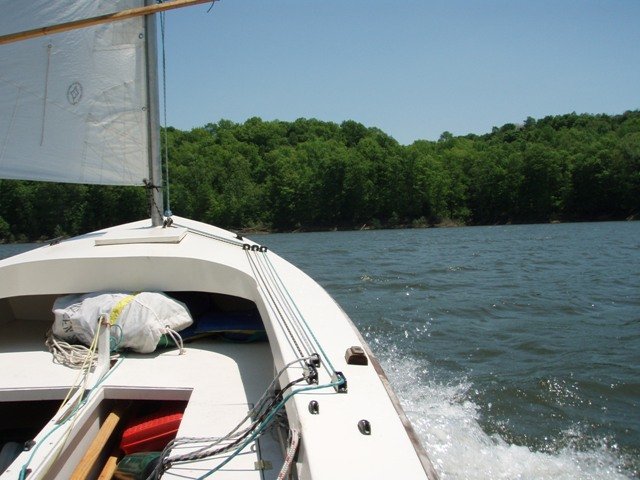
Thot maybe there might be room on the board for an occassional picture of a boat not under construction. This Core Sound is planning at double digit speeds in 15 knots of wind.
-
Tom, I am certainly looking forward to seeing more progress photos of the lap wing. Your workmanship is always inspiring. It is also great that you are able to give the next generation of sailors a boost with those opties. Best of wishes for a smooth and complete recovery. ---Brent
-
My boat routinely chases down much larger plastic boats while pointing. In the North Channel off Bayfield I found myself in the midst of a fleet of forty footers close hauled in a breeze. None passed, and many were passed. I did more tacks than most, but overall windward performance was acceptable. One of the skippers stopped by at the marina afterwards to inquire about the boat and explained the effort they went to in a failed attempt to catch me.
-
The biggest issue I have with single handling the mizzen staysail is keeping the boat pointed on a deep reach while moving around getting the sail ready to hoist. I recommend working out a tiller tamer or better yet a running a steering line forward so you can drive from a position forward of the mizzen while you sort out the staysail setup.
-
Niels, I was pondering this "cut the transom down a little" option. I think it might preserve the lines of the boat versus the bracket - but as I have the covered deck lazarette some modification would be required. I come up with 20" from top of deck to low point of the hull - so a long shaft motor hung at deck level would work. But again it might be possible to hang a short shaft motor a little lower and result in less above deck intrusion. Some modification required... So cut the transom down to about 14" to get good submersion. Cut out a section of the rear deck and install appropriate reinforcement to the transom. Then box in the motor well to provide good drainage etc. I havent run the dimension yet but the motor would end up partially below deck level in a little well - with hopefully good air flow into the air intake. Hopefully there would be room for the motor to swing as reverse in the little outboards involves spinning the motor around.
-
Lets see if I can post a picture...

-
Thanks Ken, That is what I wanted to see. As I ponder further I am leaning toward the shart shaft motor with a mount that puts the motor further aft and lower. Ideally high enough to keep the motor from dragging in the water when tilted. I have considered making my own mount, but am leaning more towards purchasing a spring mounted unit to raise the motor up when tilted.
-
Every year about this time I consider adding a motor to my CS20. Up to this point I have ended up with sails and sweeps and mostly get along fine. But there are a few time when a motor would be oh so nice. It is really a shame to put a motor on such a fine sailing boat, but... So I consider it again this year. I am thinking of a Nissan 3.5 four stroke. Seems like plently of motor. I definitely want a motor that can cruise for hours, cause if it were not for long distance situations I would just use the sweeps when the wind is down. I was pondering a short shaft motor on a spring loaded mount versus a long shaft on a more stationary mount. I dont want the motor to drag in the water when not in use. What have other tried? Post some pictures of your motor mount arrangement, and discuss fine points. Thanks.
-
Make the end of your sprit that runs through the loop on the clew about 4" long tapered from 1 x1 " down to about 1/2 x 1/2". This allows the clew loop to run well onto the tapered end of the sprit. This will require making the sprit slightly longer than the plans dictate. When reefing push the reefed clew loop over the primary clew loop. In this way the clew is never separated from the sprit. Make a mark on the snotter that indicates when the snotter is loosened enough to easily allow the reefed clew loop to be run over the tapered snotter end. This mimizes the bouncing that an overly eased snotter can cause in a blow. With this setup you wont find yourself trying to stab the sprit end into a wildly dancing clew that is flaying about in the other hand.
-
Alan, I sail in the midwest where we gets plenty of light air sailing time. Here is what I would recommend. Build the snotters by laminating as Charlie describes them and make the aft ends as tapered as possible. Follow the plan dimensions and trim as much wood off on the outboard end as possible working down to something in the 1 x 1" range. Should be plenty strong and light. Before I started messing with alternate snotter connect points play with snotter tension first. In light air a deep belly in the sail will give more power - this is accomplished by easing the snotter. Gravity tends to drop the forward end of the sprit when the snotter is eased. Watch the leach of the sail - letting off the snotter significantly changes the leach shape - and a little experimenting will locate a sweet spot. Consider the location of the sheet blocks on the deck. Position the blocks to maximize horizontal pull on the sail and minimize pull in the verticle direction. I have a yoke that puts the mizzen sheet turning point about 16 inches off the rear deck - minimizing downward pull by the sheet when close hauled. This is helpful on the mizzen which is usually sheeted in closer than the main when close hauled. For the main consider taking steps to minimize the weight of the sheets on the sail. I have a 3/8" main sheet to be easy on the hands - but 3/16" is plenty strong enough. I would not care for 3/16" sheets but have considered connecting the the main sheet block to the sprit by a long section of 3/16" line to minimize the weight of the sheets on the leach clew. This is especially useful when running where the sprits are wide and away from the centerline. Alternately when the wind is light and I am running off the wind I have been known to unreave the main sheet from a double run to the sprit to just a single run with a stopper knot - reducing the sheet weight by 50 percent.
-
There is little interaction between main and mizzen sails on the cat ketch. When pointing close to the wind there may be some acceleration of wind off of the main sail interacting with the back side of the mizzen, but the effect is small. I sometimes use the snotter to flatten the mizzen slightly versus the main to better handle this apparent wind. When properly trimmed both sails are powerful and the boat moves very nicely to windward. The stay sail is another matter - it does impact both the main and mizzen. But this sail is not for close reaching to windward - only for broad to deep reaching ( downwind sailing)
-
Thanks Dale for sharing the story of this trip. I enjoy hearing the stories of people out using their boats.
-
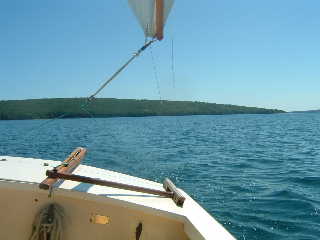
Howard, attached to the tiller...er...ah...yea that is it...it is an autopilot. Actually the tiller and extension are made of teak, and the tiller extension is laying across the rear deck sort of poking at the handrail on the rear deck. The tiller extension and handrail are so sized that the extension snugs just under the handrail holding the tiller steady. That would make it an autopilot I guess, maybe a Kaintuck Autopilot, but that suits me. The block in the picture is the turning block for my mizzen sheet, which cleats at the base of the mizzen mast. A little different from the plans, but again it suits me. Mike, you captured the essence of the moment. It was great to slip into the water, hoist sail and slip around the bend...then keep on going...just for the sake of being there. You are welcome to join in anytime.
-
all one of us.
-
Saturday brought a fair wind for a long trip on the Ohio River. Ran down wind and up river for about 15 miles then had a great beat back. The boat was on plane for a considerable portion of this trip.


-
Got a few hours to sail my CS20 yesterday. A variable wind took me up river a couple of miles. Coming around the bend I notices a number of sails on the water ahead...I had forgotten about the big regatta this weekend. This is the first year in many I have not been crewing aboard a keel boat in this annual regatta. Knowing all the boats and skippers I decided to sail up to watch the action for a bit. Running a deep reach I arrived parrallel to the windward race course mark as about half the boats had rounded and started their downwind leg. I took care to keep well clear of the race, and continued running a course parrallel to the racers. This fleet is an eclectic mix of mostly keel boats ranging from 24 footers up to 40 footers. Many of the boats carry high tech racing sails and spinakers. The competition is friendly but intense. Here is the point of this little story: Running a deep reach with two cat ketch sails flying on a CS20 we rolled over 29 boats racing on a coarse parrallel to mine, we arrived at point parrallel to the lee mark before the race leaders. I ran a little further on, then headed up to watch the last windward leg to the finish from a clear distance. Running a typical CS close hauled coarse we did no worse than keep pace with the racing fleet. Perhaps this is a reasonable place to celebrate the speed of these CS boats. I wouldn't want to say to much about rolling over the race fleet at the after race watering hole. While I never built the CS to be a race boat, it has proved to be plenty quick. Over the years I have accumulated a number of stories like this. May this provide some inspiration to those of you building. And to those of you already sailing...sail on.
-
For short distances, and tight quarters I row from a standing position facing forward steering with the tiller between my knees. For longer distances I have a rowing position forward of the mizzen. The boat balances better from this position. You will want a rowing seat here - temporary or otherwise.
-
Continued Discussion about Brent's Rig
Brent replied to Joe Nelson CS#35's topic in B & B Yachts Forum
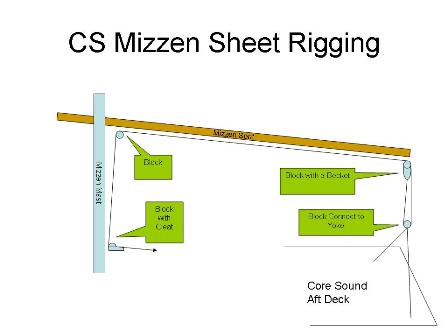
The mizzen cleat is a Ronstan RF5 - a cam cleat on a swiveling base. See West Marine number 545046. There are several devices out there that would work, but this is what I used. For the mizzen sheet I went with 5/16" line in a quality yacht braid - still easy in the hand and plenty strong. Stoppers are not really needed at the top of the mast - let the track run far enough up to the top block or sheave that when the sail is fully hoisted the sail slugs are still on the track. Note that when the breeze picks up the first "reef" is to lower the sails on the tracks to the lowest possible position - lowering the center of effort - without actually reducing sail area. An additional benefit of this move is that it increases the downward angle on the sprits making it easier to get a nice firm leach on the sail - perfect for good sail performance as the wind builds. Run the main track to within about 3" of the deck - just enough to get the sail slug on the track. Allow enough track to run the mizzen as low as you can get while still being able to duck under it for a tack. You will want some sort of stop at the bottom of the track to keep the sail from sliding off the track while lowered. I tried several things - but ended up with a simple bungie cord snug around each mast - works great. -
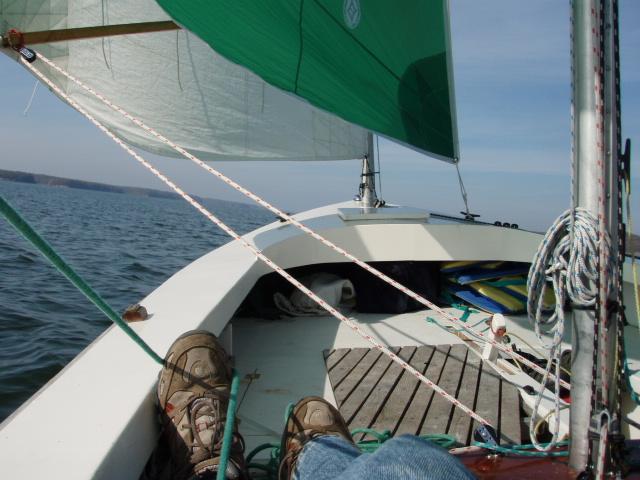
The rig is actually simple. The yoke at the stern keeps the mizzen sheet up off the deck and give better sheeting angles than running to blocks on the deck. (avoid lots of downward sheet pressure on these cat sprit rigs - destroys sail shape.) A pair of blocks are suspended from the sprit for the sheet to run forward just under the sprit. The aft block is at the aft end of the sprit, and has a becket for attaching the bitter end of the sheet. There is a two to one purchase provided here. The forward block is just aft of where the mizzen sprit crosses the mizzen mast, and turns the sheet down to a cleat. The cleat is located at the mizzen mast just above the thwart. The mizzen sheet is the white/red line running down the center of the mizzen mast in the "new years reach" picture The yoke and block can be seen in the other picture


-
My mistake, I wrote boom, should have wrote sprit. The mizzen sheet bitter end is tied at the end of the sprit, runs down through a block on the yoke and back to the block at the end of the sprit, then along the sprit to another block near the mast, turns down to a cleat on the mast near the thwart. What I like about this is the missen sheet is always right there at the thwart, I can find it without looking for it. No reaching back behind meself to find it. Oh, and with the yoke keeping the sheet off the deck there has been no trouble with hangups back there.
-
My mizzen sheet runs through a yoke to keet it off the aft deck, and then along the boom to a cleat at the mast base.

-
Where did this design end up with regard to head room and displacement? I like the Torquedo idea - I expect electric technology to advance quickly - I can easily see a solar array providing a large portion of the boats power needs.