paul_stewart
-
Posts
277 -
Joined
-
Last visited
-
Days Won
8
Content Type
Profiles
Forums
Events
Everything posted by paul_stewart
-
Jeff, Well done. Beautiful. Let us know what it weighs... ...and how it paddles.
-

CS17 centerboard removal & replacement
paul_stewart replied to Randy Jones's topic in B & B Yachts Forum
You can view my experience with that on our CS20 at CS20DawnPatro.blogspot.com/2010/09/centerboard-refinished.html http://cs20dawnpatrol.blogspot.com/2010/09/centerboard-refinished.html -
EyeInHand posted a comment on http://cs20dawnpatrol.blogspot.com/2010/09/speed-sails-oars-motor.html about the "third option" --electric motors-- based on his own first-hand (first-eye?) experiences with an 82lb system. It raises the interesting question in my mind, "How heavy a propulsion system am I willing to tolerate if the pay-off is super-quiet auxiliary propulsion?" What if it is out-of-sight so that I don't have to see it hanging on the transom? For adventure racing and day sailing we just carry the oars, but for multi-day vacation cruising how much negative impact would a heavy system have? If we capsize, which is more robust to a dunking: internal combustion system or electric system? What happens to a battery submerged in salt water for 15 minutes ? --Paul
-
To motor or to row, that is the question. I posted a trip report four our 8-day 200-mile June trip. "Speed: Sails, Oars, Motor" http://cs20dawnpatrol.blogspot.com/2010/09/speed-sails-oars-motor.html --Paul

-
Dawn and I will be there. Wouldn't miss it! --Paul
-
Diagram for sloop rigs here: http://www.gosailing.info/Heaving%20To.htm

-
For purposes of reefing the main on our CS20: Ideally we want to let the main flop about unconstrained while tying reefing knots on the main; otherwise, the effect of inadvertantly holding the main still is the same as sheeting-in the main which makes the boat want to start sailing. In higher winds I have found the boat more forgiving in this regard if the rudder is fully rotated out of the water. Leaving the rudder down and locking it in the go-straight-ahead position has seemed only second best (but fine in lighter winds). I usually raise the centerboard (CB) too in higher winds as this (seemingly logically) makes the boat more forgiving (i.e., less likely to try to start sailing.) As long as the main is completely free to flog away, a fully deployed (down into the water) CB should provide a beneficial pivot point for the mizzen's weather-vane function --the more forward the pivot, the more beneficial it is. But having the CB fully or partially deployed has not seemed necessary for the mizzen to do its thing, and if I accidently hold the main still while reefing it then the fully/partially deployed CB can act an accomplice to the main's trying to make the boat start sailing. --Paul
-
Heaving to in a cat ketch? Conventional method: Fully sheet out the main and fully sheet in the mizzen while pointing the bow directly into the wind. Optional: then raise the cb and/or raise the rudder. Drift backward at ~ 1 knot. The sheets, helm and cb can be left unattended. Useful for a variety of reasons: for reefing / unreefing, for dealing with the anchor, for manual bailing, for taking a break from the helm if single handing, etc. Be careful not to inadvertantly sheet in the mainsail while reefing/unreefing it. Alternative method: Slowly motor directly into the wind with main fully sheeted out. May or may not need to sheet in the mizzen. This method requires someone to stay at the helm motoring the bow directly into the wind. --Paul
-
I wouldn't be interested in water ballast on our CS20. However, I could mention one advantage of water as a material for ballast: it is neutrally buoyant when submerged in water --Paul
-
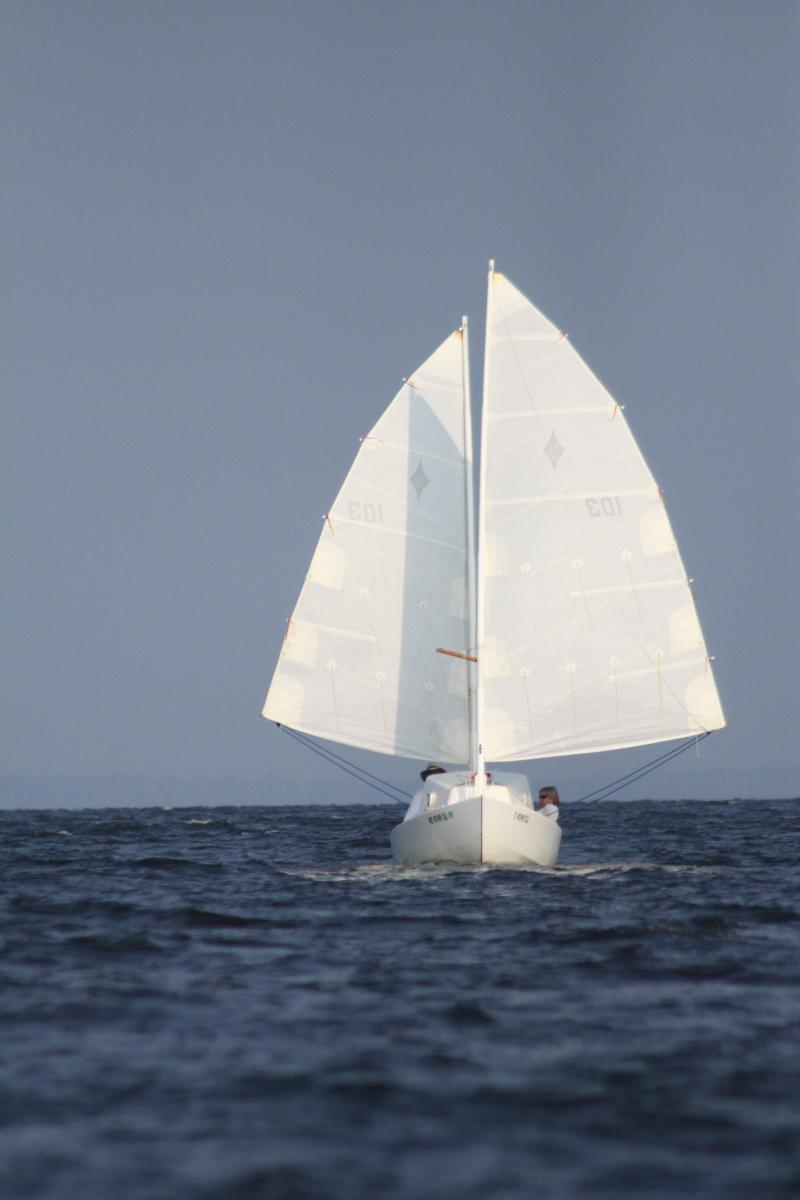
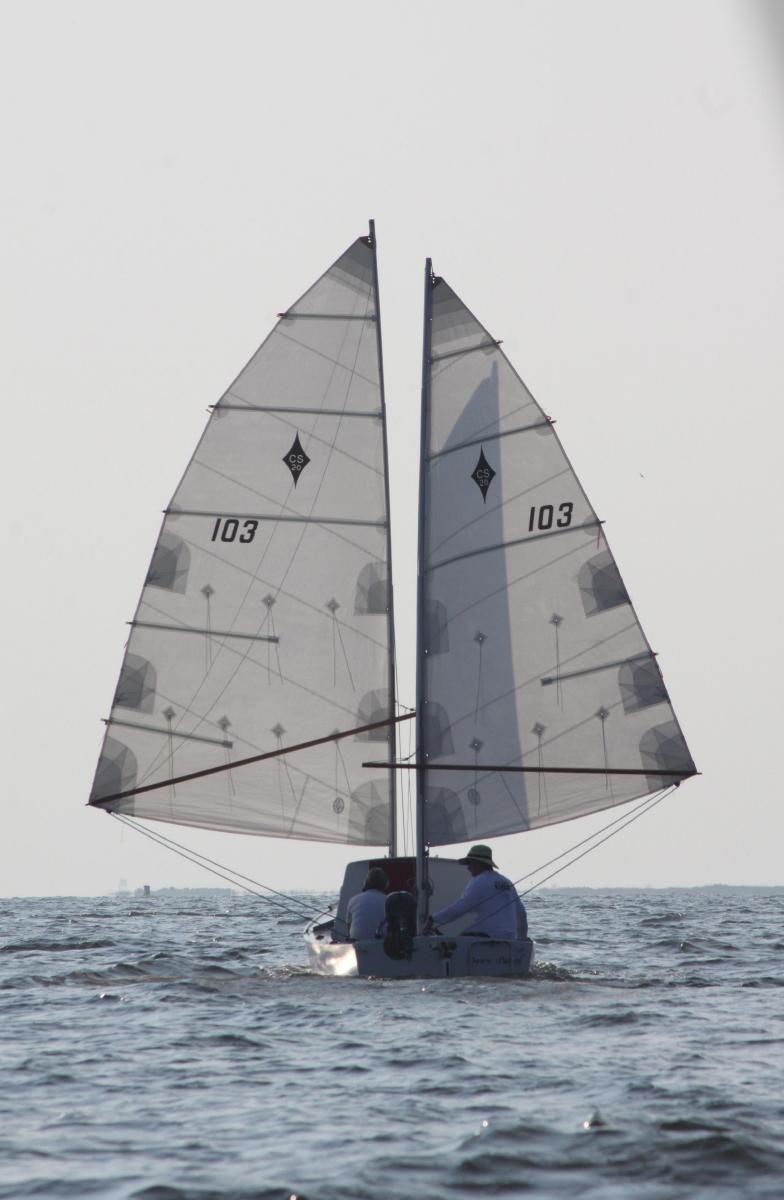
Dawn and I just started a blog for posts about our "Dawn Patrol" trip reports, related maintenance / projects, etc. http://cs20dawnpatrol.blogspot.com You are welcome to come and take a virtual ride on the "Dawn Patrol". --Paul (photos below by crew of the Welsford Pathfinder "Spartina")


-
Tom, Your experience and advice are highly valued and greatly appreciated. Thanks a million! It certainly is possible that the sides might be bent inward just a bit "toward the top". If that diagnosis is correct, then I think repair is possible. There would be nothing lost in attempting a repair if the alternative is to replace it anyway. Even though it is located under the thwart, I'm sure it has seen lots of abuse from the crew. But the bailer definitely does not leak. Dry as a bone when closed. LATER... On my lunch break I investigated your diagnosis and I believe you were exactly right. The Bailer looks fine and I was not able to see, measure, or detect that the sides of valve box had been "bent inward a bit toward the top." However, the bailer is such a simple and elegant design that the tolerances seem to be very small and any such defect hard to see. I did detect that the bail (the wire part that flips over) seemed to be ever so slightly bent in a way that might contribute to the defect you suggested. The diagnosis you suggested makes sense, so I went ahead with the appropriate repair for that problem. With the bailer in the closed position I expanded some outward pressure on the insides of the valve box as gently and carefully as possible. That appears to have solved the problem. Now with the bailer in the open position (extended down into the water) there appears to be much more friction holding it in place. I also removed the bail, corrected its shape slightly, and then reinstalled it. I will have to put it in the water and go sailing to verify that the repair is good and I haven't created some other problems or leaks. My guess is, it's good to go. Success! Thanks again for your insight, Tom. --Paul
-
Joe, do wait for the experts to speak but for what little it's worth, on the CS20 we used joinery as represented in your bottom two photos --diagonal cuts (which I believe is what Graham recommended), and occasionally the "diagonal half lap" (in the very last photo) for cometic reasons. --Paul
-
After two years of using the Andersen Bailer (model 564136 / 50026) in our CS20, the bailer does not want to stay down in the deployed position. For example, during the 100mile WaterTribe 2009 NC Challenge, we had to keep one foot on the bailer all the way up Core Sound to keep the bailer working as we pounded close-hauled through big short chop. The bailer does not leak (bedded in 4200 with no rubber gasket) and it sucks the water out just fine --as long as it is held down. As far as I know, it not bent. Best I can tell, the parts in the mechanism that provided the friction necessary to prevent it from popping up are worn out. Grit/sand has occasionally infiltrated into it and surely must have worked like sandpaper when we moved it up and down. (Will definitely try to avoid that in the future!) I certainly don't want to carry around a brick to hold it down, so the choices are to either repair or replace it. However, it is such a simple design with so few moving parts, it is not at all clear to me that it can be repaired. Any advice on the possibility of repair? --Paul
-
W, Not bad for calm air. Without additional structure, a good breeze with cause the sides of that simple shelter to oscillate: the higher the wind, the louder the flapping noise. In contrast, wind is less of a problem if the shelter has more structure; e.g., fabric stretched over curved tent poles such as in dome-shaped camping tents. --Paul p.s. This is one of those "don't ask me why I know that" situations. Been there, done that, there was a lot of flapping noise all night. But "your mileage may vary."
-
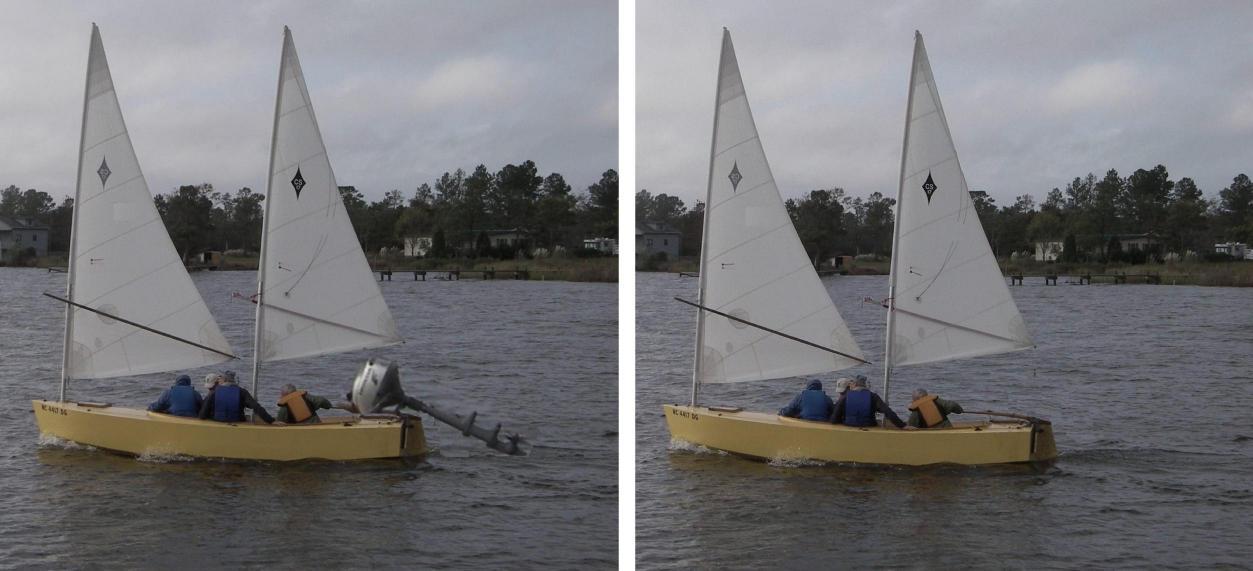
John, You're doing so well! Beautiful motor too! (My wife has been twisting my arm to get one of those.) Course, that motor's a little small compared to the one on CS17 "Southbound" --shown with and without. ; ) --Paul
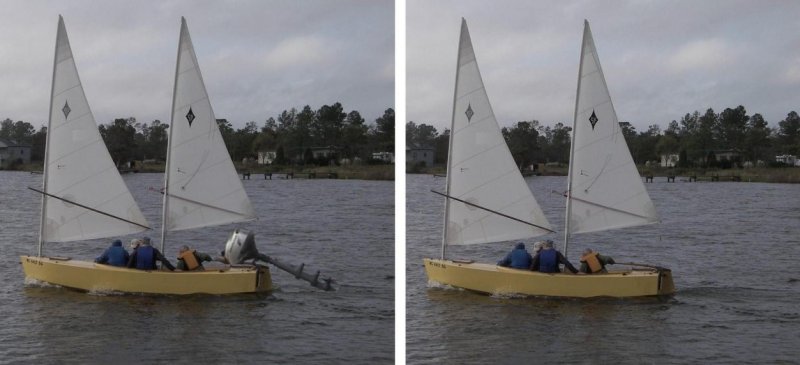
-
Frank, Amen to what Ken and Dave said. This website is a beauty. Much appreciated! It is hard to improve on perfection. Thanks for all your great efforts. "Keep up the good work," as they say. --Paul
-
As they make the channel run into Chokoloskee (check point 2), the CS20 of Doug Cameron (RidgeRunner) and Michael Collins (GreyBeard) appears to be running a few minutes behind the Sea Pearl 21 of Bill Fite (Jarhead) and Jonathan Arthur (HonestJohn). Another Sea Pearl 21, "Maggie", single handed by seasoned EC veteran Dave Combs (DaveOnCudjoe) capsized in rough Gulf conditions on the first day of the race. Dave was rescued. Last I heard "Maggie" was waiting to be recovered. Have heard it said that Sea Pearls are difficult to right after a capsize --especially if single-handed. Meanwhile the Tornado catamaran set another record time (again) for finishing the 300-mile EC: 1 day, 2 hours, a few minutes. Zooommmmmm. More details about the race at SandyBottom's blog: http://sandybottomkayaker.blogspot.com
-
I agree with the above comments. Specific to building B&B boats, the tool set I have liked ... power tools: shop vac, portable jig saw, band saw, RO sander, stationary belt sander with disk sander, cordless drill and bits, good lighting. hand tools: planes, japanese saws, sharp chisels, scrapers, hammers, screwdrivers, stapler, scissors, box cutter, etc. measurements: tape measure, calipers, compasses, level, rulers (12', 48', 60') epoxy & paint: 4' foam rollers for epoxy work and painting, chip brushes, foam brushes, bamboo skewer sticks for stirring epoxy, dust/fume mask, 22" fan + 22" furnace filter for use when stirring fillers into epoxy, disposable vinyl gloves, masking tape, roll of 6 mil clear plastic sheet, roll of paper towels clamping: Right, Ken! Can't have enough clamps. Among them, cutting up PVC pipe to make cheap C-clamps really does work well for clamping on an inwale, for example. Other (e.g., table saw, planar, drill press, router): Some means of ripping long lumber is essential. My table saw is an inexpensive Delta that is just adequately accurate if I fiddle with it enough and it spews out a tremendous amount of dust --not designed for dust collection systems. Recently I've found that the local hardware/lumber co. where I find straight doug fir has a full service woodworking shop that will accurately rip lumber for a few pennies while I wait --takes 5 minutes. They also have planars of various kinds. Same great deal. Having a planar at home would be a nice luxury, but.... So, a full-service woodworking shop such as this can sometimes be an alternative to owning a table saw, planar, etc. I have an old router that I mounted under a cheap router table. It is occasionally very helpful, but perhaps not freqently enough to be put in the category of 'essential' for B&B boat building. One Christmas my son gave me a massive 1950's standing drill press (Craig's list $150) that is loads of fun. I love it. I can't say it is essential, but it is a joy to use.
-
Jim, Looking very good indeed. Hanging youself above the boat with epoxy in hand definitely requires an assistant! (How else would we get to see a photo of you?) And it helps to be a skinny young sort of sailing/boatbuilder/engineer. Here is Alan Stewart's most recent solution for a hard-to-reach place; this time the place being the San Blas Islands off the Caribbean coast of Panama .... http://www.eyeotw.org http://ffeyeotw.blogspot.com ... and the Bahamas, Jamaica, Turks and Caicos, Cartagena, Panama Canal, ... etc. Circumnavigating classroom: just another tough job, someone has to do it. --Paul
-
Congratulations! She's a beautiful small craft. --Paul
-
This month I noticed that Fitch Lumber in Carrboro, NC, had 2x2 doug fir perfect for sprit booms. As I recall, up to 12' long. Very straight boards with clear straight grain. I don't recall that they had 2x2 previously. Too bad I don't need a sprit boom. I was buying fir for stringers for Dawn's B&B Grand Diva kayak. The full-service woodworking shop at Fitch ripped up two 2x2's on their accurate table saw for $4. Took 5 minutes. Probably saved us an hour of wrangling with our cheapo table saw. --Paul
-
Tom, Sound like your main mast will be in a tabernacle. Some previous discussions of mast length on the CS20.... http://www.messing-about.com/forums/index.php?topic=6484.0 http://www.messing-about.com/forums/index.php?topic=6878.msg60210#msg60210 --Paul
-
Well done, John ! --Paul
-
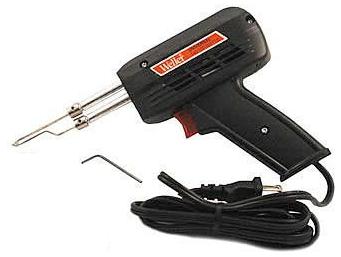
A variant on "shorting the wires with a 12v battery": If using a soldering gun, you can remove the 2-pronged heating element and insert instead the two ends of the wire so that you let the wire play the role of heating element. Squeeze the trigger to get a red-hot wire. If you don't need to "nuke it" red hot, you can just hold a hot soldering iron against one end of the wire as you and Peter mentioned. --Paul


-
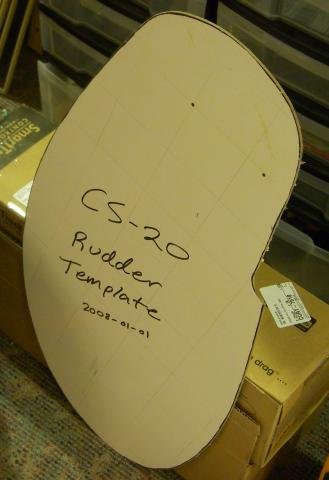
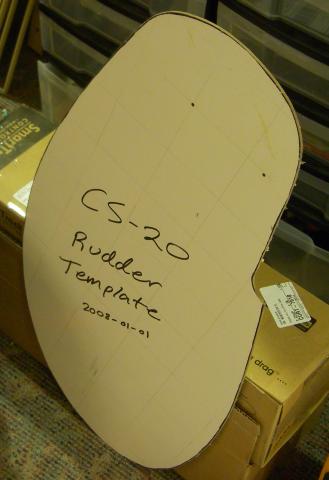
For making full-size templates I've liked using 1/8" x 4' x 8' sheets of hardboard with one side being smooth gloss white and the other side being dark hardboard ("Masonite"?). Lowe's sells it as "Thrifty White Hardboard Wall Panel". A couple of years ago at Lowe's it was about $10/sheet; now, it's almost $12/sheet. In your location it may or may not be cheaper than luan sheets. I think it may be a little more flexible/bendable and easier to cut than luan. The material is very uniform. Cut edges can be sanded or planed back to a drawn line. The smooth white side is nice for drawing and marking. If your full-size patterns need to be thicker than 1/8" then that hardboard may not work for you. Currently I have a few of those 4x8 panels covering the carpet in our basement workshop, taped together, while we are building a 17.5' B&B Grand Diva kayak (picture below.) It beats tripping over plastic sheeting or a drop cloth. Things on wheels roll smoothly on it. --Paul ( B&B Grand Diva kayak CNC-cut http://sandybottomkayaker.blogspot.com/2009/12/ready-go.html )