paul_stewart
-
Posts
277 -
Joined
-
Last visited
-
Days Won
8
Content Type
Profiles
Forums
Events
Everything posted by paul_stewart
-
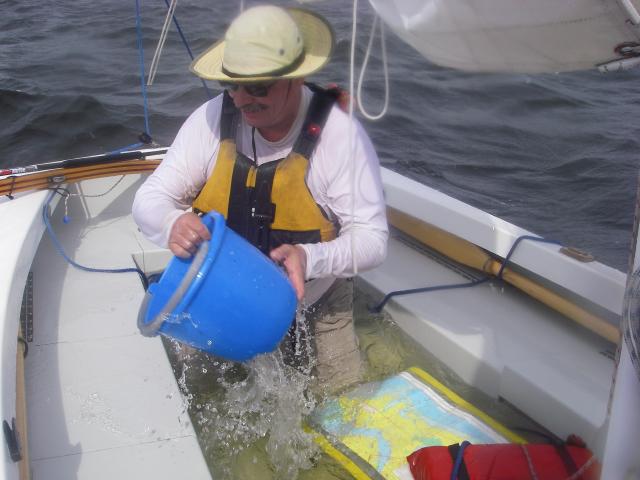
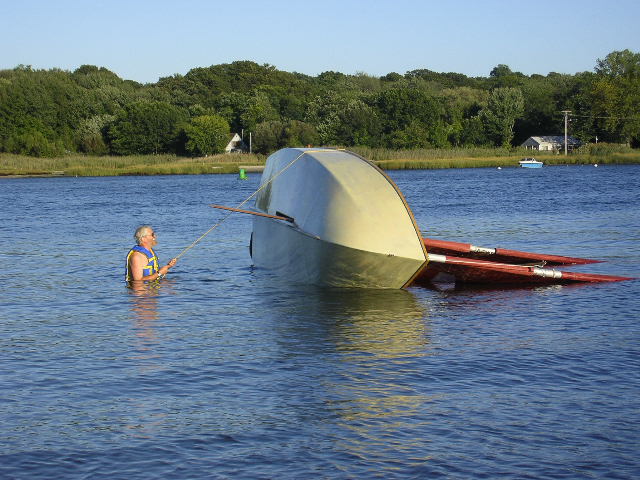
Jeff, If not the NC Challenge 2009, there's always 2010. The race pits one's own creativity, skills, and preparedness against the challenges of the course. So there are lots of winners. Secondarily it's a race among friends. That's how I see it. The capsize... Uhh... oh yes, that's right, I meant to do that! Almost. Not really. Glad we can compare notes. Next time I think I'll be better mentally prepared, having "been there" before (with the CS20), and may try to snap a photo or two of the recovery process. One thing I might do differently: the stays'l halyard was very handy right there on the mizzen waiting to be used and while I was near the thwart I could have easily tied a fender to it and could have run the fender out horizontally all the way "up" to the top of the mizzen mast. My intuition is that that would have absolutely been enough to prevent going turtle. Might be an unnecessary waste of time, but it would not take more than half a minute to do. --Paul
-
Scouting the WaterTribe
-
With the WaterTribe's 100mile NC Challenge just around the corner (Sept. 25-27, 2009) and late registration still open, I am posting a detailed report of our trip scouting the course. We scouted the first 65 miles of the 100 mile course. I realize that if Southern Skimmer wins this one it will surely be only because of this valuable info I'm posting, but here it is.... About 45 photos and 4 charts are posted at http://picasaweb.google.com/danceswithsandybottom/20090822_Scouting_the_NC_Challenge# Trip Report: Scouting the WaterTribe


-
Jeff, Glad to hear you're back on the water! --Paul
-
Bob, "Interesting boat" could be in the running for the year's greatest understatement !!! Beautiful work! It is no wonder why the crowd cheered at first launch. Please, please, please.... we cannot come to Alaska to see "First Attempt", so please give us an extensive tour of your boat in photos and narrative. We on the B&B forum would dearly love to see all the details of your numerous innovations and artfully built boat, and hear all about the performance advantages and disadvantages (if any) you realize. --Paul
-
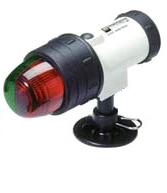
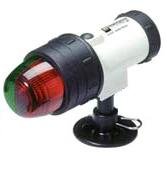
Doug, We're still using those lights from Innovative Lighting www.innovativelight.com/ Also available at Duckworks www.duckworksbbs.com/hardware/electrical/il-560-111x/index.htm White on the stern. Red/Green on the bow. They work well. Still, I'd be interested to hearing other ideas. --Paul
-
I think Tom Lathrop is right. Probably not an EC challenger: (1) No apparent rowing station/s.* (2) Weight-- If it is a CS20 (modified), it likely has weighted CB (no CB horn in the cabin), and weight also added by addition of the generous cabin and roof hatch, lifeline hardware, transom extension, and rudder system. I'm wondering if there is weight in the keel, given that lifelines were added. Take away the lifelines and I like the looks. Is there an anchor well in the bow?? Apteryx, I'm not sure about "no chine at the stem". I think there may well be a chine at the stem but for me the picture is too fuzzy to be sure. (* Unlikely but possibly in EC Class 6: electric powered propellor with battery charged by human power only (e.g., by pedaling to turn a generator.))
-
 Ken, In case you missed it.... please check your inbox for message re sailing plans. --Paul
 -
Re: "MORE Misadventures with Capt. Jeff" -- reader reaction
paul_stewart replied to paul_stewart's topic in Main Forum
Jeff, Thanks for sharing the adventure. Whew, glad to learn that Capt. Jeff and the CS20 Beatrice Ann are home again. I have a few questions: I assume the boat beached itself directly downwind of where it had been at anchor, right? Do you have any ideas about what it collided with that did the damage? (rocks? other boats?) What is your guess about what happened to the rudder? A more general question: I too have had the experience of sand in the CB trunk --when anchoring (in calm flat-water conditions) the boat on a beach with the keel sitting on the sand and the locked in the retracted position with one anchor far in on the beach and the other anchor off the stern out in deeper water. After being parked this way for several hours I found that sand and small gravel has sloshed up between the CB and the inside walls of the trunk and "locking" the CB in place. Out in deeper water a minute of jiggling the horn (handle) of the CB and pouring water in from the top solved the problem but the experience probably put some light scratches on the inside walls of the trunk. But it sure sounded awful "grinding" the CB out to an extended position. A slotted rubber gasket mounted on the outside of the CB slot would probably help, but until I do that (if I do that) I suppose I should just limit the time the boat is parked in the shallows. I'm wondering if others have any comments/suggestions about this issue. -
Re: "MORE Misadventures with Capt. Jeff" -- reader reaction
paul_stewart replied to paul_stewart's topic in Main Forum
Hole E Carp! Oooooo that really hurts. Oh man! I feel your pain. Didn't see that one coming. I must say, it is impressive how well Capt. Jeff maintained his cool and/or state of shock. So it wasn't Colonel Mustard. Hmm. Sounds more like it was a band of rudder-stealing Ferengis packing multiphasing hull disrupter weapons! Wow. I am not even going to try to guess what Capt. Jeff will do next. What will he do! What WILL he do!? -
Jeff, You posted a cliff hanger! Imagine that: good summer reading right here on the forum! Holding my breath 'til you post Part II Agatha Christy's got nothing on you. My bet is on Colonel Mustard in the Marina with the candle stick which is really a Klingon cloaking device and the boat is still there but invisible. I nailed it, didn't I.
-
Wes, How about... Wendy if she's a girl. Snotter if he's a boy. Very happy for you and Anna. You know you're going to be bombarded by a million crazy name suggestions. Enjoy. --Paul
-
Charlie, Very happy for you and Laura getting to go outside and play. Whoooo-hooooo! All the best, --Paul
-
Wes, The advice I received from the Shaw & Tenney Company: polish the entire oar and then varnish the shafts and blades but just oil the handles ("grips"). (http://www.shawandtenney.com/index.php) Actually the way they said it was something like "if you want to blister your hands be sure to varnish the grips." [While building our CS20 in time for the EC'08, my son Alan and I wanted to build our own oars but we flat ran out of time; so, we turned to Shaw & Tenney for a pair of absolutely beautiful oars. Very nice but 'ouch' --we proved once again that time is money. They are very good however. A year later they surprised me by sending me another little bottle of oil. Wow. If you can't build your own and need to buy oars, check out Shaw & Tenney..... ] So far, lots of rowing and no blisters at all. It would be interesting to hear others opinions about oar handles. For example, does the appropriate treatment depend on the kind of wood, or is oil best on all handles? --Paul Update: two choices of grips below...


-
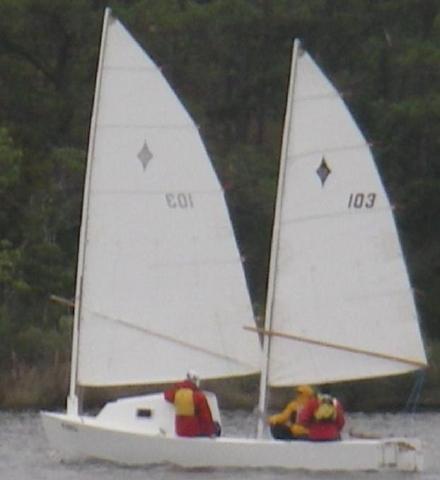
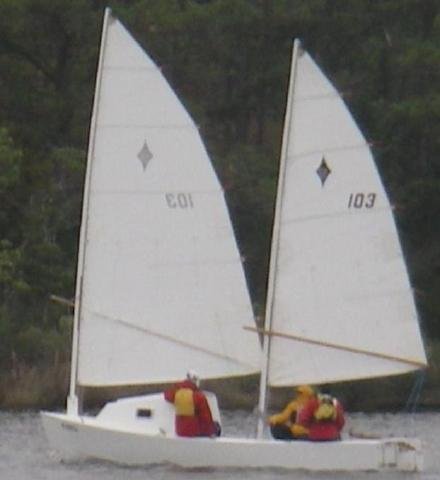
Joel, Regarding mast length: Like Ray said, Graham/Carla can give you the definitive design info. Go with that. For various reasons, mast lengths seem to have varied a little on other recently-built CS20's; here's a link to some of that info; several of us were discussing the mast-length question... http://www.messing-about.com/forums/index.php?topic=6484.0 For example, Terry Dunn's CS20 #36 has a slightly taller mizzen mast that allows clearance below the mizzen sail for a bimini top. The bottom line is you want your sails to be raised "high enough, but not too high". Another example: on our CS20 #103 which has a tabernacle for the main mast I think we came very close to the design specs on the plan sheets we had... mizzen mast: 20' 9.5" mizzen sail: 15' 10.5" luff, 7' 11.0" foot, 16' 3.0" leech. main mast: 20' 2.5" (mast pivots in tabernacle; otherwise it would have needed to be longer) main sail: 17' 6.0" luff, 9' 0.0" foot, 18' 4.0" leech. So on this boat the masts are just slightly longer than the 20' hull. I like the fact that the masts and hull are about the same length when it comes to towing, and for storage in our 20' garage... http://www.messing-about.com/forums/index.php?topic=5825.msg59915#msg59915 --Paul
-
Richard, You may be looking for this thread from January 2009.... http://www.messing-about.com/forums/index.php?topic=6560.0 That thread and some older threads are identified by the following Google search... [ Brent sheet mizzen cleat site:www.messing-about.com ]
-
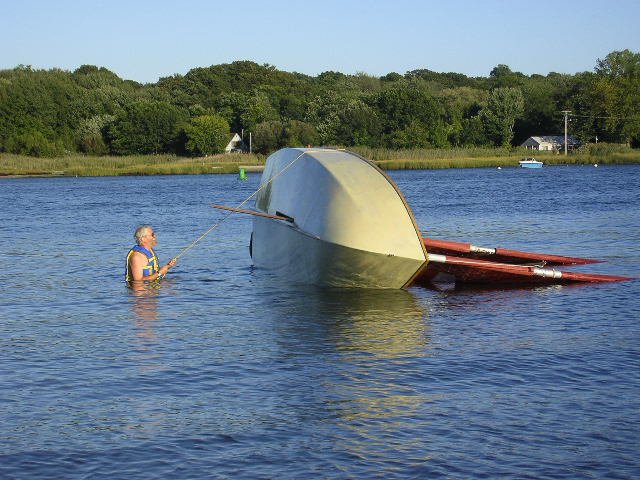
Ken, Yes thanks! We'd sure like to take you up on that chase-boat offer! Even without the KFC that would be much appreciated. This weekend is out, so I hope we can talk about next weekend. Whoo Hooo ! KFC! Jeff, You've generated valuable info and discussion here with your cabin innovations, capsize testing, photos and reporting. Really cool stuff. Your earlier (2005) capsize-test (http://www.messing-about.com/forums/index.php?topic=3896.0) and the discussion and insights it provided is also a noteworthy highlight of this forum. The photos there illustrate the knotted "righting line" that Graham had suggested in his advise ... I'll be installing knotted "righting lines" a.s.a.p. to be tucked away under the combings. (Your photo from 2005, shown below.) I had also thought about the possible usefulness of a horizonal painter line / grab line running from the starboard stern eye up to and through the bow eye and back around the other size to the port stern eye --not dragging in the water but low enough to reach when overboard. In hand, it would tend to lead a swimmer back to the transom, which is good. In a capsize it could lead a swimmer from the transom up to midship, but only if either (1) a substantial amount of slack could come into play, say, slack coming through the bow eye from the other side as well as from there being perhaps several feet of the line being bungee centered in the bow eye area, -or- (2) a personal quick-release line from the swimmer was clipped onto the painter which might be an iffy proposition. Such a line running from bow to stern would not be pretty, but I wonder if it would be desirable when in rough conditions.
-
When you look at the broken epoxy joint is the epoxy still adhering to both pieces of wood? if "yes" then the epoxy adhered to the wood but the epoxy itself fractured as if brittle. If "no" then the epoxy stayed intact but did not adhere to the wood. If "yes" and "no" then the epoxy did not adhere in some places and some parts of the epoxy was brittle and fractured. Another possibility is that the wood splintered, but it sounds like that is not the case. I'd have to guess there was a mistake mixing the epoxy which is where most problems seem to originate. (Defective resin or defective hardener is not as likely, I would have to guess.) Too much hardener yields a softer weaker epoxy. Too little hardener yields a hard brittle epoxy.
-
Jeff, Thanks a million for sharing the experience; very helpful. Update: I realized that your previous capsize test was also reported on the forum: www.messing-about.com/forums/index.php?topic=3896.0 The boat seemed harder to capsize this time --because of the additional weight of batteries and/or cabin? Yes Dawn and I definitely need to try our own capsize tests. There's no substitute for direct experience. In a 5 knot wind on flat water with the CB up and hiking out on the leeward side I'm pretty sure I could roll tack 'er right over into a capsize. ;D I'll probably not try that particular maneuver close to shore/trees/rocks. Somehow I'd like to try a capsize method that doesn't put quite that much bend in the mast(s). Your cabin looks great. I'm sure you and your crew are going to enjoy all the benefits of that nice spaceous, dry, cabin. They'll be perching on top if allowed and using it as a high dive for jumping off the boat. --Paul

-
Jeff, Wow! Well done!! Good job testing! And congrats on finishing the cabin project too. Thanks so much for sharing. We've been planning to try this soon on our CS20. This information is encouraging and will be helpful when we try it. Dawn has suggested that we capsize the boat configured with sails set and all our usual gear in place, and I'm willing to try that, but I was thinking our first capsize test should be under more controlled conditions. Your test was exactly what I had in mind. Do you think the forced capsize maneuver was in anyway a hardship on the mizzen mast? Would you recommend doing it that way? What do you think you would you have had to do to force it to turtle; or, are you concluding that it will not turtle. (Assuming typical inshore/inland conditions. Sure, big seas and storm conditions could do whatever .... ) Can't wait to see any photos you have. --Paul
-
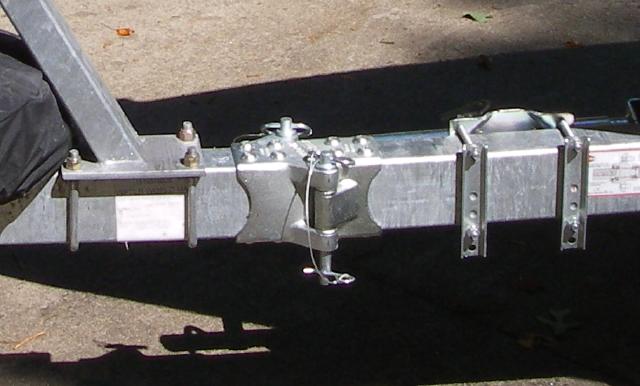
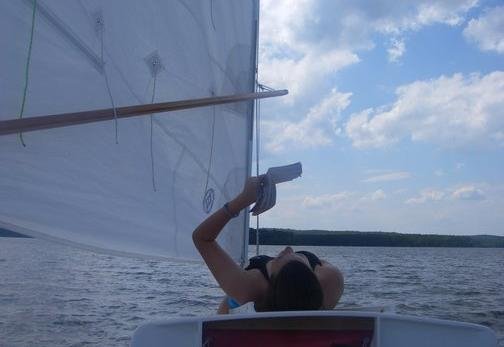
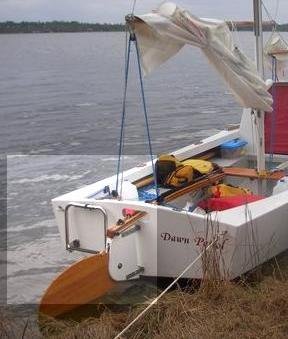
How we put a 20' sailboat in a 20' garage: For several months now our CS20 has enjoyed the luxury of a clean, dry, temperate shelter when at rest. Wow, what a wonderful change from the days of trying to make do with a tarp boat cover to fend off the weather, dampness, temperature extremes, bugs and leaves. We considered building various kinds of tents and sheds but ultimately decided to saw off the tongue of the trailer and put her in our (unheated) garage. Good choice! Having the boat in the garage greatly facilitates work on the boat. The lighting is good, the tools are handy, the temperatures are moderate. Much more convenient. It is now easy to spend a few minutes now and then working on the boat --much different than when it was outside. I love it! Our "two-car" garage is 1" short of being 20' long and the CS20 is indeed 20'. So even after sawing off the tongue of the trailer, the "Dawn Patrol" still must be slightly angled to fit inside the garage. But fit it does. With the tongue hinged to fold aside, or removed entirely, the trailer is shorter than the boat. I ultimately decided that it was most convenient to park the boat in the garage bow-first. The cockpit is more accessible this way. And it turned out that this only adds a minute or two to the task of rolling the boat out/in for hitching/unhitching to our van. And, at ~$100 in costs, putting the boat in the garage was less expensive than building a tent or shed for the boat. I bought the Fulton Fold-Away Hinge kit from pacifictrailers.com. This kit appears to be a well-established product that is not hard to find. Some research was involved; e.g., checking the fit of the boat in the garage, deciding whether to go with a hinge vs. a tongue insert connection, deciding exactly where to make the cut on the trailer tongue and making sure that placement of the hinge would fall within the load-rating guidelines of the hinge. The hinge kit included the two halves of the hinge, 16 bolts and lock-nuts, a pivot bolt (with nut and tethered keeper-clip), and a removable pivot pin. The bolt and pin turned out to be exactly the same size, so I subsequently ordered a second pivot pin ($6) (to use in place of the pivot bolt) in order to make it convenient to completely remove the tongue --instead of just swinging it aside. Cutting the steel tongue was very easy with a jigsaw and metal-cutting blade. Also cut the electric wires in the tongue and bought a male and female connector kit for rejoining the wires. The heads of the 16 bolts had the star-shaped impression and required a star bit (torx bit) for the socket wrench. The installation instructions specified 70 foot-pounds of torque. I bought the required $4 star bit (or "torx bit" size T55) at an auto-parts store. I borrowed a torque wrench. I've posted photos of the hinge installation process and the routine for moving the boat: http://picasaweb.google.com/danceswithsandybottom/20090712_Trailer_Tongue_Hinge# Also, here are a few highlight photos below. So far, the results have been wonderful. Hinge works great. Love having the boat in the garage. Looking at the trailer parking lot at Jordan Lake, tongue hinges seem to be popular. --Paul


-
A fond farewell. I hope to see you around.
paul_stewart replied to Garry's topic in B & B Yachts Forum
Garry, How can we miss you if you won't go away? (JUST KIDDING!) I hope you eventually post some more photos; e.g., of Once Again, of the S10 on the aft deck, .... --Paul -
Waaaaaaait a minute... preliminary practice on scrap lumber: that's.... that's.... cheating! (Is that allowed?!) This could lead to actual perfection in boat building!
-
Frank, Experiences vary. When my son and wife and I built such masts for our CS20, each mast being made from 3 lengths of aluminum tubing, the experience was one of the easier projects. (No pipe boring involved. Don't know what you mean by "trying to remove them after they've been made".) It involved 5 kinds of effort: sanding/polishing the tubes; wetting out long narrow (~1") strips of fiberglass cloth; winding same around the tubing; sanding same later to adjust fit; epoxying, priming and painting. Intent is that the tube sections are permanently joined; this is not a take-apart mast. Relative to other steps of the CS20 construction, it was rather quick and easy. "Your milage may vary." --Paul
-
Regarding a third reef in the main: Graham, I'm curious what you think of putting away the main sail and hoisting a small 'storm sail' on the main mast. Not sure 'storm sail' is appropriate name for it, but it would be the same size as a 3-reefed main and would probably have better shape. Being small, it wouldn't need much storage space and might even be affordable. The full-size main could rest in the cabin. If we're going to heave to and adjust for a few hours of beating into high wind (e.g., Bay River to Harker's Island), that switching of sails seems reasonable. --Paul (not somebody who knows what he is doing)