paul_stewart
-
Posts
277 -
Joined
-
Last visited
-
Days Won
8
Content Type
Profiles
Forums
Events
Everything posted by paul_stewart
-
This seems to be it... http://www.messing-about.com/forums/index.php?topic=5604.msg46998#msg46998 I like that, Dale.
-
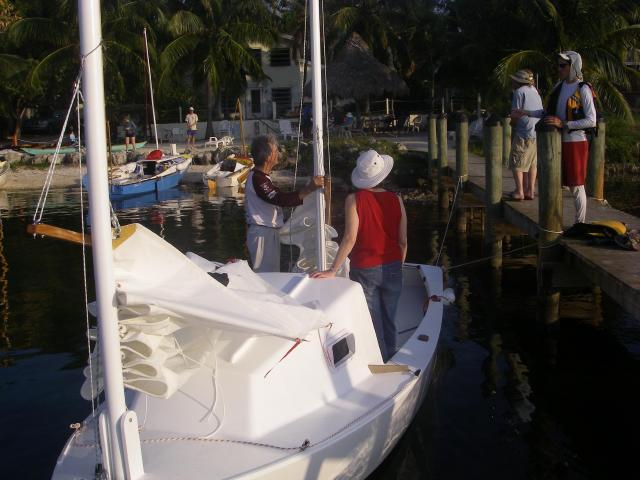
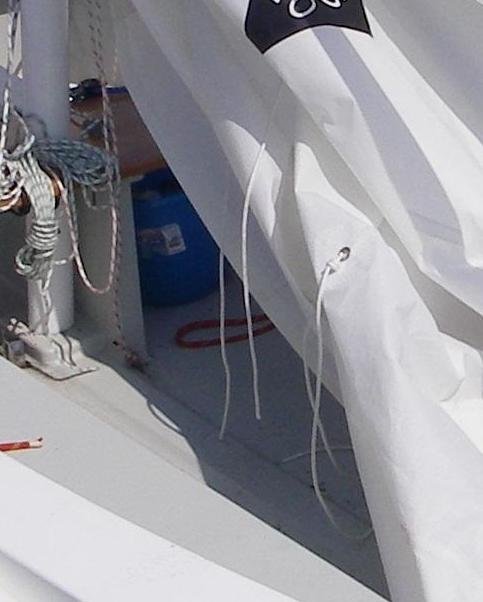
1. Downhaul. 2. The reefing lines are roughly about 5' long? If so, you may be talking about the short lines used to bundle the folded, lower part of the sail when reefed; see the photos below. 3. Radio-controlled rocket launcher? If so, see bottom photo -- maybe Joe can ask this guy where he found his launcher.

-
Norm, Congratulations! I'm very happy for you. Well done! --Paul
-
It's great to hear all the above points and counter-points re sounder issues. Thanks! For several months I too have been trying to decide whether or not to have a sounder, and if so, which strategy. (Even if "just for fun".) Graham, Pardon my ignorance but which 'Tom' would it be that installed the shoot-through transducer in the EC22 and would he like to share with us any tips (or lots and lots and lots of tips) about how to go about "grinding down the ply" without accidentally damaging the 6oz skin? Tom, Any comments? Wes, I hope you decide to go with a grind down to-but-not-through shoot-through installation so that you can try it first and let us know how it goes. ;D. Just kidding. Better yet, some practice might be a good idea for anyone who decides to go that way: take a piece of plywood and prepare it just as the target section of the hull was prepared with epoxy, glass, and even primer and paint on one side; allow to cure/age enough; then try the grinding process and see how it goes. If the practice doesn't go well then back to the drawing board. We do know something about the thickness of the hull. So it should be possible to use/make some kind of "gentle" tool/jig that is set to grind down to only a target depth --and no further! Some miscellaneous experiences I had while building our CS20 lead me to believe that it might be possible to do it very slowly and carefully using small, sharp hand tools. The inside of the glass skin is tough enough to tolerate some scrapping (but not puncturing) and the plywood could be picked away in small splinter. Again, wondering what Tom would recommend. Sounds like he took a "grinding" approach. Ray makes a strong case (esp for those of us with slow reaction times) for it not being necessary to shoot-through near the bow, although that may be one of the better locations for other reasons. How far from the centerboard must it be: if fore? if aft? New question: What if you grind the inside to-but-not-through and install a shoot-through transducer and later that transducer goes bad? That is, the transducer fails but the display unit is fine. Is that possible / probable? If it happened, seems like it might be nearly impossible to neatly remove the dead transducer ---because it is embedded in the hull within a bed of epoxy, right? Perhaps you could simply disconnect it, leave it in place, and install a new transducer near the one that failed. Is that right? One more: This is waaaaaaaaay out there, but.... a (transom mount) transducer might be of a size for temporary use hanging part way out the exit hole in the Anderson bailer (and blocking water flow in) but the centerboard would have to be up. Right? Okay, you can stop laughing now. Really. Now would be good. Any time now.
-
...You're not sure how long you've been at it, but the sun is coming up, and the task at hand is getting epoxy in your hair and you think that's okay.
-
 Charlie, Stop it, you're killing me ... that's a good one! ;D Bet you have lots of other good ones from your experiences. I was wondering.... what advice would you, and your professional boat building/designing peers, give to a young person who wants to do boat building/designing; say, a college student currently studying engineering, or a high school student leaning in that direction. Is it a challenge to find customers who (a) appreciate the fact that there are no big birds craping out custom boats at a factory, and ( will actually commission a boat build/design? Does most of business come from contacts at boat shows? Any advice on getting started? Things you wish you had known when you started? Any comments appreciated! --Paul
-
Exactly! But...... On the to-do list is making a removable hatch-like lid to cover that "foot well" area just inside the door and then the whole interior can be one large flat berth. So many fun projects; so little time.
-
Jeff, The to-do list of problems to solve and things to repair, correct or improve on our CS20 is ridiculously long. And it is supposedly "finished"! I could easily spend ten full days on it right now. Seems the alternative would be to buy a stock plastic boat. But where would be the fun in that!? It would be nice to achieve "perfect design", whatever that is, but the truely important achievement is experiencing the challenges and rewards of building, sailing, and trying to improve your own personalized, customized sail boat. With your kids! So I'd say you've got it exactly right, Jeff. (Memo to anyone considering building a boat: I know Jeff would agree that we both highly recommend the experience of building and customizing. For those doing lots of camping a hard-top cabin is great. The day-sailor probably doesn't need to dedicate space to a cabin and may want to opt for a larger, more flexible cockpit layout -perhaps with some kind of Bimini-top sun shade. Occasional campers and those who want to strip down to light-weight configuration for racing speed might prefer a removable dodger/pop-top cabin. Keeping it as simple as possible with no sheltering will suit many. Looks can be traditional or modern. The options are endless... ) Yes the benches (berths) in our cabin are almost even with the cockpit seats. They are about an inch or inch and a quarter lower than the cockpit seats. Makes for lots of storage space under the births. Going an inch or so lower would probably have been ok. We are planning to do more finish work inside the cabin and will post some good photos of the inside after that. In the meantime here are some old pics.


-
Inboil, Thanks for the post. After 6 months of UV exposure here in Chapel Hill, NC, the plastic finish is starting to flake off of the cheapo huge floppy 30'x20' tarp drapped over our CS20. Seems to have let a lot of moisture go through during the most recent hard rain. I think I've got a workable hoophouse plan and will need to give that a try. Challenge is that it will be visible from the street and I'll have to make it look attractive / presentable to the neighbors. Hmmm..... Ken Potts ideas (a few posts back Aug 13) are sounding good. --Paul
-
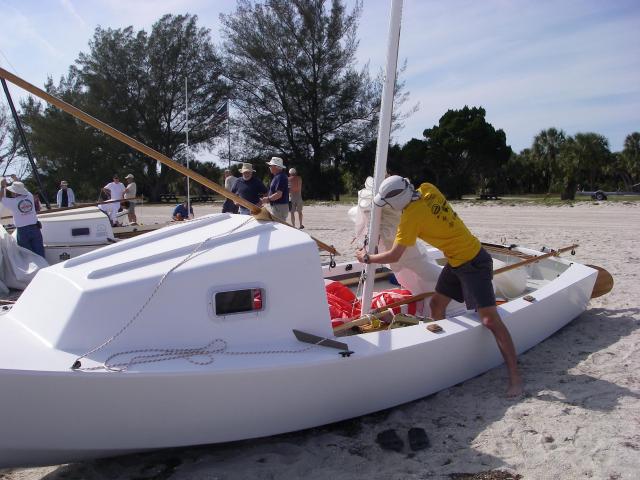
wwbaginski, We don't have dedicated topping lifts. What looks like topping lifts are actually just the main and mizzen halyards. I untied the end of the halyard from the sail and moved it to attachment on the end of the sprit boom. With the halyard on one end and and the snotter on the other (and the downhaul still attached to the sail) there is much control on the sprit boom. Jeff, We're very happy with the boat and its cabin. We think the cabin is a success. It is good living space inside, and has a number of other advantages. Experience so far: We've day-sailed our CS20 a half-dozen times since March 1st when my son, Alan, and I took it through the EC'08. My wife, Dawn, and I are aiming to spend a week sailing/camping on the NC coast some times during the next month or so. Space inside is good. The berths are 7 feet long for stretching out. The space is small of course but the headroom feels generous. During the EC we prepared meals in the cabin, and took turns sleeping 2 or 3 hours at a time. Once we dropped anchor and both slept in the cabin for 4 hours. The space is fine for two people. Alan and Dawn and I have all had opportunities to sleep in the cabin and found it very comfortable on therma-rest pads. Of course, during the EC any sleep we could get felt like heaven -- probably could have slept comfortably anywhere and we did nap in the cockpit at times. Dawn slept in it most recently and found it very comfortable. One of the things I like most about the cabin is that it stays very dry and is a great place to go to warm up or change into dry clothes. It is a great place to toss things that we want to stay dry, but we try to take the time to keep -everything- in dry bags anyway. The cabin also helps keep the cockpit dry when spray in coming off the bow. Certainly a cabin changes your forward view from the cockpit but we've gotten very used to the cabin and found that reduced visibility is not an issue. The cockpit is roomy enough that the pilot can find plenty of comfortable sitting positions. The pilot / crew often sits up on the sides of the boat (hiking out) rather than sitting on the benches, especially in better winds. In very light air, slowly coming up to a dock the pilot might be standing. We move around, the boat moves around, and there's a lot more to consider in the 360 degree view than any one tiny bit of the horizon. In brief, seeing around the cabin is not a problem at all. As for aerodynamics, I can't give you any data on the effects of the cabin (vs. no cabin or some other cabin). I don't think we sail directly up-wind as well as a dedicated regatta racer (e.g., flying scott, buccaneer, 505, thistle, lightning, etc.) On the other hand general performance seems good. We sailed the 300 mile EC'08 in ~3.5 days. We finished within an hour of an expertly-sailed Sea Pearl 21 (cat ketch with no cabin) that came in third, and within 6 hours of Graham's EC 22 (cat ketch with cabin) that came in 2nd. (A catamaran got 1st place.) Design choices are loaded with trade-offs and compromises. If you lower the height of the seats (berths) in the cabin then you can lower the roof, but this shrinks the length and width of the seats (berths) due to the v-shaped bow. If you sacrifice being able to sit upright in the cabin then you can lower the roof and keep the height of the seats (berths) to preserve the length and width of the sleeping area but then you have to crawl around in the cabin. Alternatively you could put a sliding hatch over the companionway to allow sitting upright


-
Dawn made this photo of our CS20 while camping at Jordan Lake. --Paul

-
Norm, Congratulations!. Loved the photos. Great lookin' boat! Sounds like you don't have to etch the HID into the transom as we do down here in NC. If you get a chance, I'd love to see a close-up photographic tour of the boat --lots of pics of all the various details, rigging, hardware, trailering configuration, etc. I've never seen a Princess 22 in person. It's true (as Dave Finnegan on "Hirilond
-
Charlie, Are there photos somewhere (we can see) of that GPS box on the Skimmer? Thanks.. --Paul
-
Wes, Congratulations on the birth of your beautiful shiny new CS20! She needs her play clothes, eh. --Paul
-
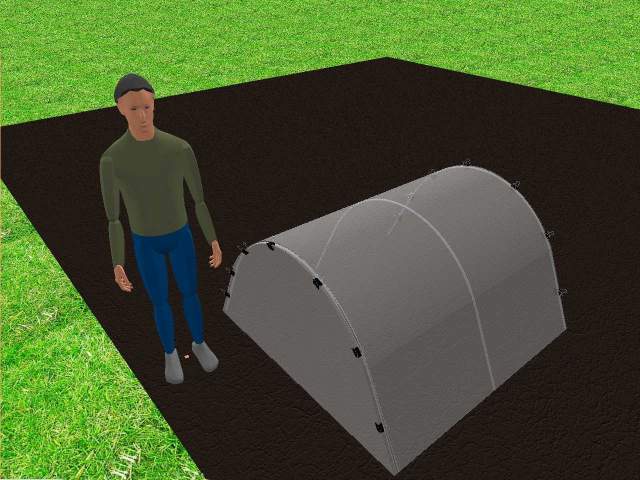
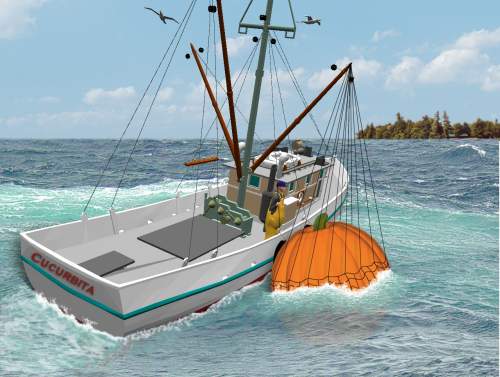
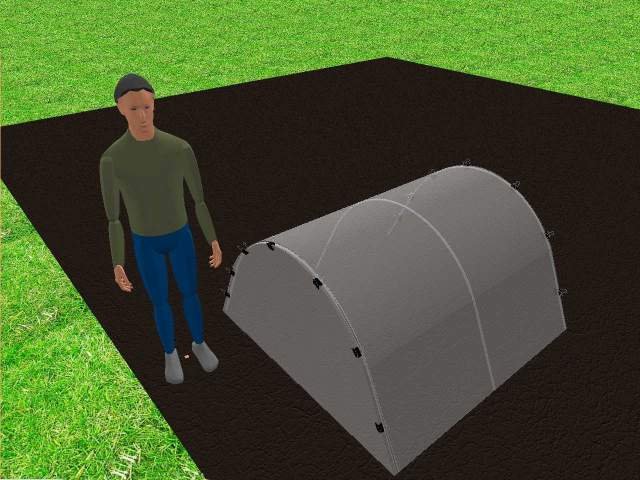
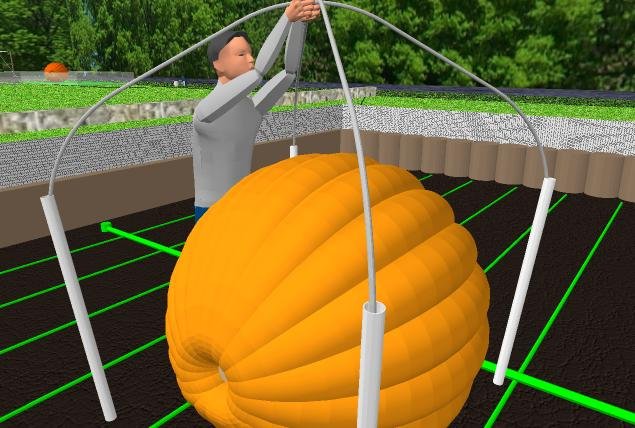
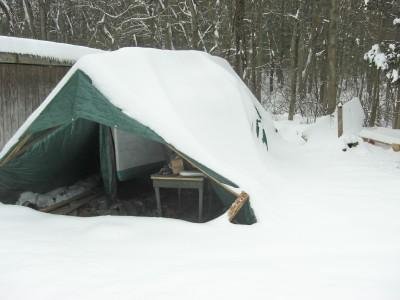
Oh you know, Ray. Yer basic hoop house. The plans for building a couple of em are right there on the Maine Pumpkin Growers Organization website: www.mainepumpkins.com/hoophouse.html. (Their illustrations, shown below.) See, you can store yer boat and/or pumpkin. Yep, before they flood the field to harvest the pumpkins with their boats, they use hoop houses to shade their pumpkins and/or boats. Apparently they have to put a motor on the really big ones to bring them into port to market. The thing about a hoop house though is that it seems seasonal: what do you do when a blizzard, Nor'easter, or hurricane comes through? (Last illustration is from Norman Coulter; a man who knows blizzards.) Currently, we have a 30foot by 20foot tarp over our CS20. Looks like a puppy sleeping under a rug. It is essentially a hoop house without the hoops. We would need an extra-strong hoop house design to stand up to big winds. Inboil?


-
Stuart, I second that recommendation! Based on our experience building CS20 #103, I can verify that Charlie is exactly right. B&B is hard to beat just as he explained. We investigated the purchasing options and were very happy with the high quality and low price B&B delivered in providing all the right stuff. --Paul
-
Frank, Ta da! I'd say Messing-About.com is now perfect. Thanks for all your efforts! --Paul
-
Oh boy, can't wait ! A real southern (hemisphere) mess-about where the Bay River and Vandemere Creek come togetha t'form th Pamilco Sound --the true source of the Atlantic Ocean. --Paul
-
That would be great !!! The Dawn Patrol and crew want to participate ! --Paul
-
Graham wrote... http://www.messing-about.com/forums/index.php?topic=5901.0
-
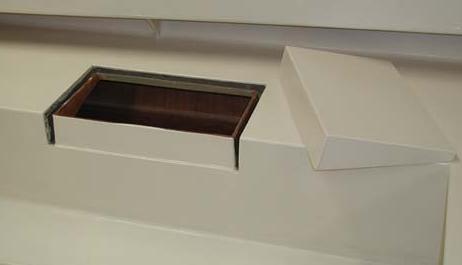
Wes, Just to throw a few more ideas out there... I can envision a wide variety of ways of creating a locked area within the storage space accessed by the hatches. The pad-lock might be inside the space. One example would be a plastic lock-box or pelican box blocked (by some mechanism and pad-lock) from being pulled out of the hatch. Another example would be a hinged panel that swings between two positions --out of the way, or to block off a secure space in one end of the space: sketch below. You can probably think of many better versions of the general idea.


-
Rod, No problems re. sitting on the hinges in the CS20 #103 "Dawn Patrol". When the hours in the cockpit are long, as in the EC'08, we had to sit on cushions anyway. --Paul
-
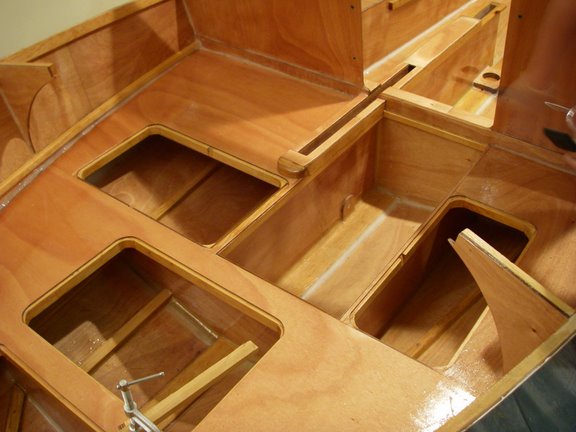
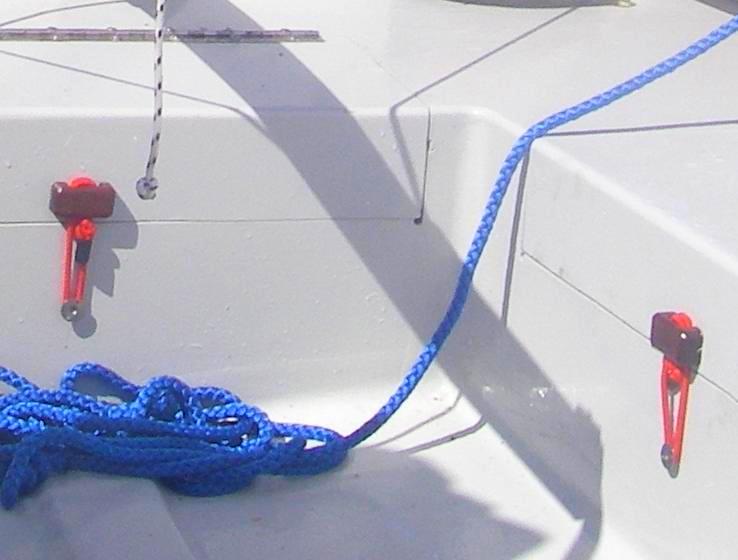
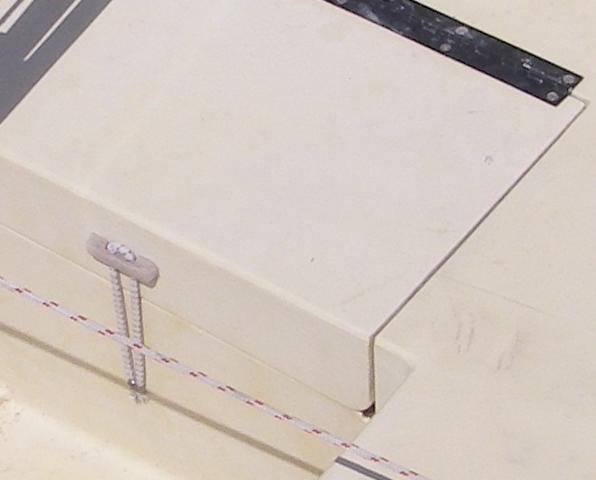
Regarding Hatch Latches: Wes, Here are a couple of picture of the latches on CS20 #103: varnished babinga-wood blocks holding the red bungee, bungee looped over a SS T-nut held by a SS screw. I still need to install a neoprene/rubber gasket on the insides of the lids. Also, my drain holes at the bottom corners are too small. I'm planning to enlarge them so that the fiberglass gutters will drain at maximum speed. Also below, a photo of the bungee latch that Graham was using on the EC22 (don't know if he might have changed it.) The ends of the bungee are lashed/whipped together with small line. Another photo shows the parts with the lashing omitted. This latch system (that I tried to emulate) is light-weight and simple. Note the adequately large drain holes at the corners of the hatch. Your ideas about lockable latches is intriguing. --Paul


-
Jim, When our CS20 #103 is on the trailer, the forward end of the fully-retracted centerboard (CB) is held firmly in the boat by the pivot pin and the aft end rests on the trailer's middle roller. The trailer has 3 rubber rollers: one under the stern, one under the bow, and one mid-ship. I had not given any thought to whether or not the middle roller would support the CB --it just turned out that way. Works fine. Have not needed to remove the CB for trailering. By the way, to lower the CB while the boat is on the trailer (e.g., in order to examine/repair/remove the CB) requires sliding the boat backward on the trailer several feet so that the boat almost falls off the back end of the trailer. Of course the tongue of the trailer must be anchored down or hitched to a vehicle for this maneuver and it is best/essential to have a separate 4th roller mounted on a stand to support the stern as the boat slides backward. Trailer: http://www.messing-about.com/forums/index.php?topic=5825.msg51577#msg51577 --Paul
-
Wow.... Oooooooooooo.... Aaaaaaaaaaaa.... well done! Thanks for sharing the photos. Wouldn't mind seeing even more. It's wonderful to see your art and craftsmanship shining through in this very traditional treatment of the CS17 design. The traditional treatment is an eye-opener. What kind of finish is on the spars and wooden rigging parts? Oil? Varnish? What is your method and intention regarding water flowing over the hatches (try to make them waterproof; make the storage spaces be self-draining; no worries --dry the hatches after sailing) ? Have a close-up photo of the closures for the seat-hatches? Are the floor-boards (easily) removable? Does the tiller rotate up? - - -Just curious! Thanks.