Designer
-
Posts
1,758 -
Joined
-
Last visited
-
Days Won
182
Content Type
Profiles
Forums
Events
Everything posted by Designer
-
Rann, Fred is building a CS17 mk 3 near Seattle. I would call that the North West.
-
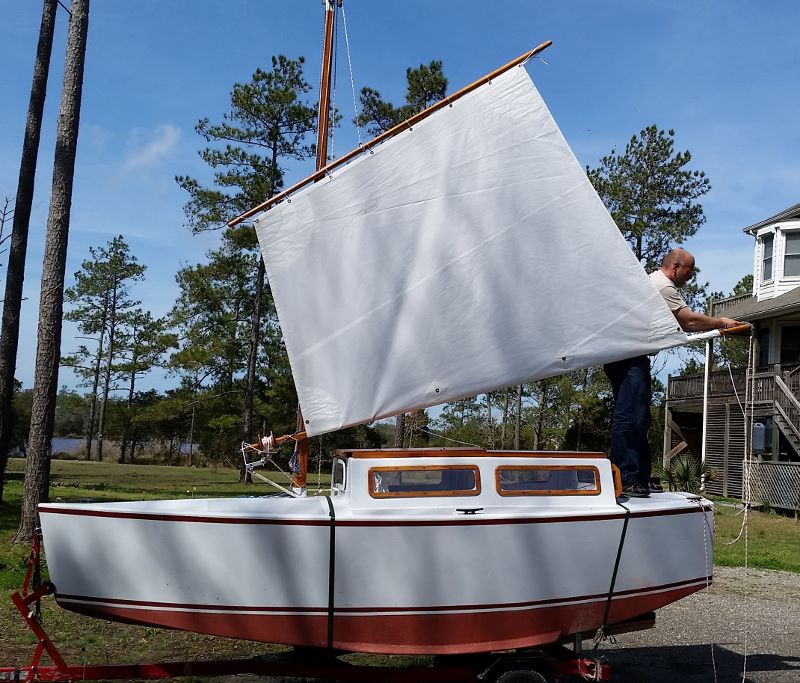
Technically a bigger main and smaller mizzen would be slightly superior upwind to the mk1 rig. There are many compromises to consider when designing the rig but the main reason that I had to move the mizzen further aft was so that the boat could be rowed. If one carried that logic to it's limit, you would dump the mizzen and go cat rig. Then you would give up the wonderful handling characteristics of the cat ketch rig. This was another reason that I leapfrogged the mk 2 and did a completely new boat for the mk3. John, I noticed that I had a favorable south flowing current as I worked south to Cape Sable. I never saw anymore crab pots after I turned east but studying the behavior of the whitecaps I wondered if I could be lucky enough to get a fair current in both directions.
-
Jay's rubrail is probably the best solution. Teak is running at about $30.00 a board foot which is a bit rich for me. Afromosia looks something like teak and is often substituted for teak. It is probably harder but is not as oily as teak. I am using some mahogany that I have hoarded for a long time. It will be covered with stainless hollow back. Because I will be showing my boat a lot I feel the need to go with a "yacht" finish rather than the more practical "work boat" finish.
-
Then there is the argument about whether the rub rail should be caulked on or glued on.
-
The pintle straps just need to be bent. It is not hard, I can open them out with my hands.
-
Remember that motors under about 4 hp do not have reverse gears. They rotate the motors 180 degrees for reverse. The exhaust sweeps aft but sweeps forward when reversing which can foul the transom/ bottom. The long shaft extension fits below the exhaust which means that it will not solve the problem. The short shaft motor will stow inside the cockpit locker. The 2.5 Suzuki will fit on the CS17 mk3 transom as Chick and I have done but it is a delicate balance between between the exhaust clearing the bottom of the boat and the underside of the motor clearing the top of the transom.
-
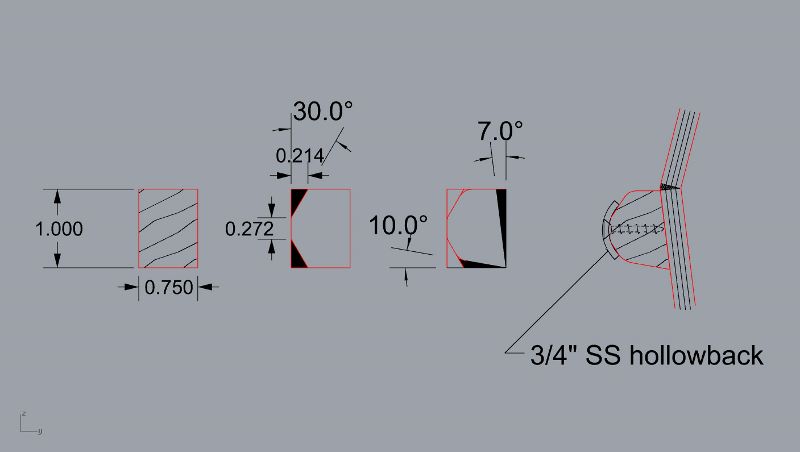
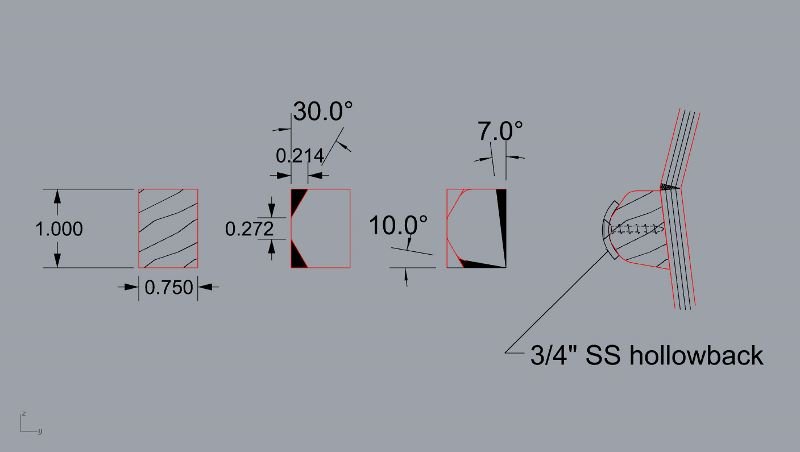
There has been a lot of discussion on rub rails for the mk3's. Here is what I am going to put on Carlita. I am going to use mahogany and 3/4" stainless hollow back. It is an essential part of the boat. It has been stressful using the boat without it as it will not take much of a bump on the dock to damage the boat. Hollow back is lighter and a lot cheaper than solid. For some strange reason 1/2" is more expensive than 3/4". I also do not think that 1/2" is not tough enough for a hard hit. I do not want the rub rail to be visually heavy. I like what Jay put on his boat but I think that this will look better.
-
Steve, I believe that I mentioned that I bailed the tank full. I showed a picture earlier in the Carlita build of the 3/4" PVC tube that I set horizontally through the fore and aft tank baffle and into the trunk to let in the water. It filled the ballast tank to within about 3" - 4" of the top before I needed to bail. To empty the ballast tank, I opened the bailer and the tank fill until the water dropped to where it stopped filling and then the transom drain plug was reinstalled. In spite of John's comment that he needs 6 knots to make his Anderson bailer work. I emptied the tank while doing 3-4 knots. The fill tube was installed in the trunk to save parasitic drag rather than going into the bottom. It is reached, just to the left of the hatch. I am happy with the installation. I was pleased with the height of the cockpit and drains. In the worst conditions, I did not have water running back into the cockpit from the drains. I enlarged the 3/4" PVC pipe to take standard transom drain plugs, I can plug the drains if she back floods with a bunch of people sitting in the cockpit. I have not seen the need so far. I have since had a four people plus Mandy in the cockpit with the tank full without issue. I also have a diaphragm pump but ran out of time to install it. I will see if I ever get around to it. As I mentioned earlier, I like to fill the tank all of the way. This is to prevent the water from going to leeward as the boat heels lessening it's effect.
-
Don, Congratulations, she looks really great. I hope that she gives you as much enjoyment as mine has given me.
-
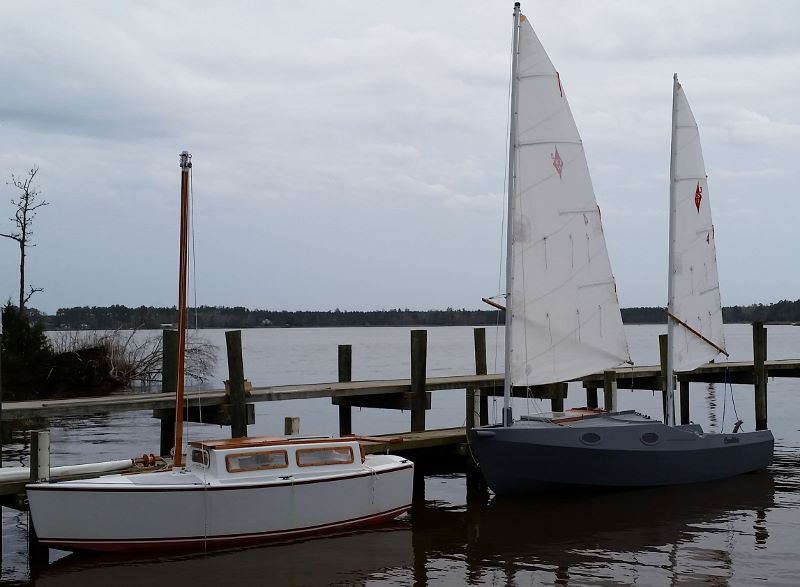
Southern Skimmer is still one of my favorite boats. I sailed her hard for many miles and I found her to very well mannered but she is a big boat. I have capsized her three times, the first time, I had gotten so comfortable in her that I walked around to leeward to study the depth of water when an extra puff caught me down wind. The good news is that the cabin prevents her from inverting, she is quite easy to right. The last time I capsized her was when sailing alone, I was up forward putting the anchor out in strong gusty winds. With my weight forward in her fine bow I had reduced her stability when a big gust filled the mainsail and the main sheet caught on something in the cockpit and would not let the sail out and over she went. I am sure that if someone was about it would not have happened. No water gets below in a capsize. Tom Beth and I won the Summer Solstice race on a Saturday. Sunday we had a big family gathering, I took a bot load of kids for a sail. She was fast enough to keep them interested. After a while someone asked about a swim. I stopped her, sheeted the mizzen tight and she was parked. They dived, climbed back over fairly low free-board, dived again for about half an hour. They could go below and dry off. They came ashore all happy and excited about their great time. I started to think "what a great family boat". Beth, Marissa sailed the first Texas 200 in her. She was clearly the fasted boat there. We typically left around 8:00 and reeled the 40 - 50 miles legs off before noon each day. Of course it was mostly in reaching conditions. Our only problem was that we did not always know where to go and spent a bit of time finding the right place.
-
Tom, I did not realize that it is next week. I have no alternative but to go, Carla and Beth have decreed it. Carlita will have to go in her undergarments.
-
Yes she has boom roller furling. It is quite clever but does have some issues.
-
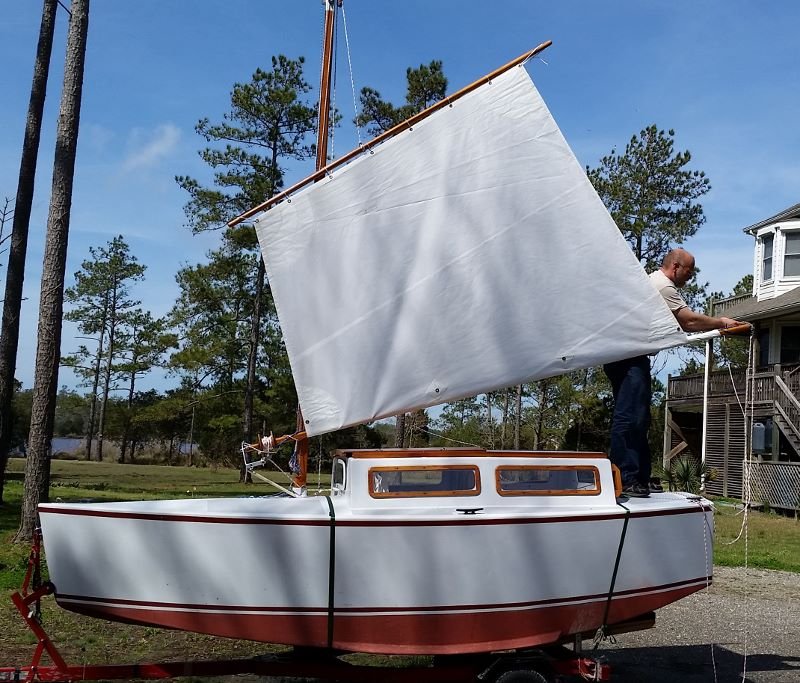
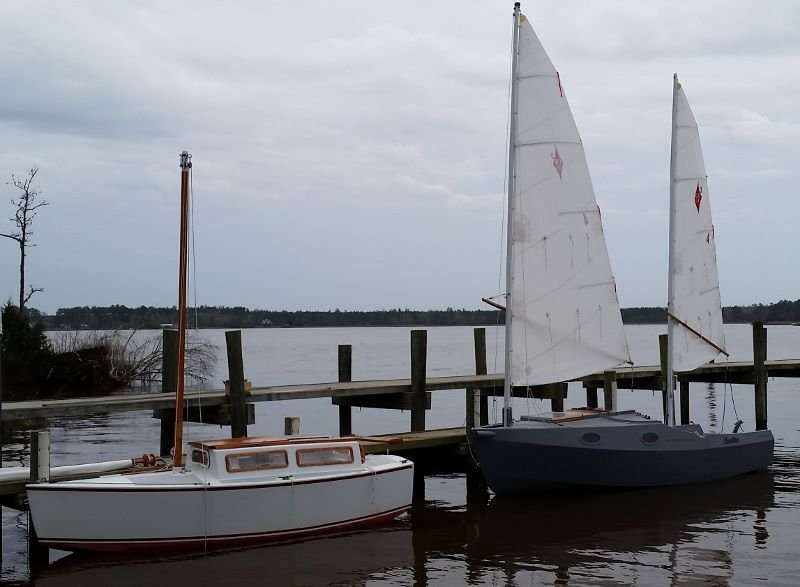
Carlita gets a visitor. Fortuitously we got a visit this weekend from Vlad "Crazy Russian" who with his partner LRock beat out Alan in the Ultimate Florida Challenge. Behind his car was a Matt Layden 14' Enigma with chine runners. We sailed both boats at different times. I am still amazed that the chine runners work as well as they do but my best guess was that she tacked through about 120 degrees. My GPS batteries battery was flat, I was inside and forward because there is no cockpit, trying to get some readings on my cell phone. It was windy and during a bad jibe she capsized and came close to a complete inversion. It would have been easy to swim out through the submerged hatch but I was trying to save the phone, there was a pocket of air so that I could breathe and keep the phone dry. Vlad worked the boat more on its side by the time Nat arrived in our dinghy. I was able to pass the phone out to through the now above water hatch to Nat in the dinghy. Nat rowed us back to the dock as we got the sail down and I cut down a plastic water bottle for a bailer and started bailing. The phone is still working so far. Alan took some pictures of the capsize, he might pot a couple. We had a short sail in Carlita late yesterday in 10 knots of wind. After studying the GPS track I was pleased to see that she made good about 100 degrees between tacks. It is raining all day but tomorrow afternoon looks good to do some testing. For those builders who have already finished their build, I would live with it for a while see if the tacking is acceptable. I am still going to extend my board and trunk.
-
Core Sound 20 Mk 3 -- #4 "Chessie" . .
Designer replied to Pete McCrary's topic in B & B Yachts Forum
Pete, Alan is correct. The aft end of that little piece of foredeck ends 2" forward of the fore side of the forward bulkhead. There is no aft rake in the stem or bow profile, it is a fair line all of the way to the upper sheer. If the bow end of the sheer strake has an aft rake, you have something wrong. -
Phil, Mat's chine runners was to be one of my tests. I was going to attempt to hot glue one on one side of the boat and go out and compare the course made good on the GPS verses the heading on each tack and compare. Mat's boats have flat bottoms with vertical sides, he runs the chine runners out horizontally. Because we have a V bottom and the sides have flare, I was going to try different angles below horizontal. I never expected them to be that good but I saw one of his boats tacking in light air and it was better than I expected. I carried the mizzen staysail on the bowsprit. To cancel out the lee helm I fitted a small bow board. it did appear to eliminate the lee helm but it needs more testing.
-
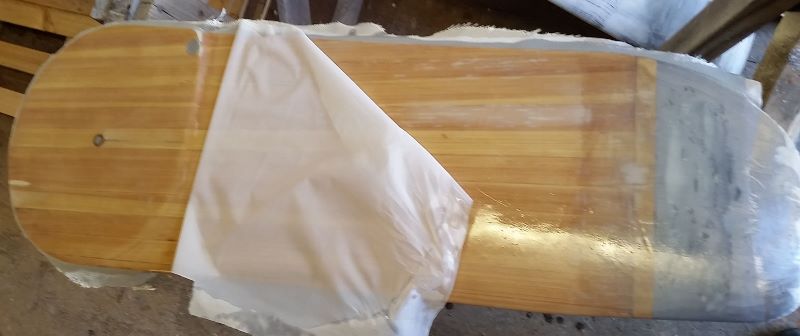
Chick is right, reducing sail area will not solve the problem. Here is a picture of my board. You can see that it has been glassed and the the peel ply is being removed from left to right. I felt that the board was under sized and I maxed out the length that my trunk would take. You can see the 7/8" spacer between the lead and the board. There is room to increase the chord which I did not do under the press of time. It is a very good foil, being machine cut, so we can rule out that question. You could also increase the chord so that it was maxed out in the trunk plus you could allow a couple of inches to always protrude from the bottom. That would increase the size of the board a fair amount without cutting into the trunk. Par is right that deepening the outside keel will not help a lot. I had a 3/4" deep sacrificial keel on the outside. I did not have time to put on the SS hollow back and it looks pretty scruffy now, but it did it's job. Alan will be back in a few days, after he recovers I am sure that he would like to help me do some on the water testing of some ideas that I have. I can screw on a temporary keel extension to see how much it helps.

-
Chick, I am off to the shop. I will answer tonight.
-
Official Watertribe EC/UFC 2016 event discussion.
Designer replied to Alan Stewart's topic in B & B Yachts Forum
Alan has pushed on into the night and passed Lrock and Crazy Russian at about 11:30 pm. He will need some sleep soon. -
Lakeland, I thought that I covered the wind vane. I have not seen a Navic for 20 years or more but I recall that they were a horizontal vane driving a servo pendulum blade. We built a vertical vane driving an auxiliary rudder driven by a trim tab. I have found that this system has more than enough power for these boats. The main trick is getting the proportions right and getting the right feed back in the linkage to prevent over steering.
-
I Think that the video is fixed this time.
-
Chick, I showed how I put in a PVC tube through the trunk side and the tank baffle to where I could reach it through the hatch and capped it with a transom plug. I just used gravity and topped it off with a bailer. I used the Anderson bailer to empty it. Look further up this string for the picture. I will be detailing my conversion.
-
Bill I am working on it.
-
Bill, I edited the link, try it now to see if I fixed it.
-
Steve, I need more lateral plane, not stability. I did not notice a problem with the 20 mk3 centerboard when I sailed them. I am working on the plans and kit files for the 17 mk3 right now increasing the board size. I have been wracking my brain trying to figure out how I screwed up on the board area of the 17. We created the 20 mk3 files first and I think that I must have used the wrong scale when I scaled it down.
-
Joe, I could not imagine any other solution to anchoring in this situation. With breaking waves close to leeward I had to hold my position while the boat was crippled. The anchor is a Danforth copy called a Hooker. There are no markings to indicate a size but I will weigh it. It has worked very well for me except Florida Bay which has a lot of weed. I had intended to install a Florida Bay anchor but ran out of time. For those who do not know what a Florida Bay anchor is, it is a 1" id tube mounted vertical near the bow, through which you shove a pointed fiberglass rod down into the bottom. The Fortress anchor has a large fluke area and can hold a large load when everything is good. Light weight and anchor is a bit of an oxymoron.