Pete McCrary
-
Posts
692 -
Joined
-
Last visited
-
Days Won
40
Content Type
Profiles
Forums
Events
Everything posted by Pete McCrary
-

Spindrift 10, #1329 -- "Seabiscuit" . .
Pete McCrary replied to Pete McCrary's topic in B & B Yachts Forum
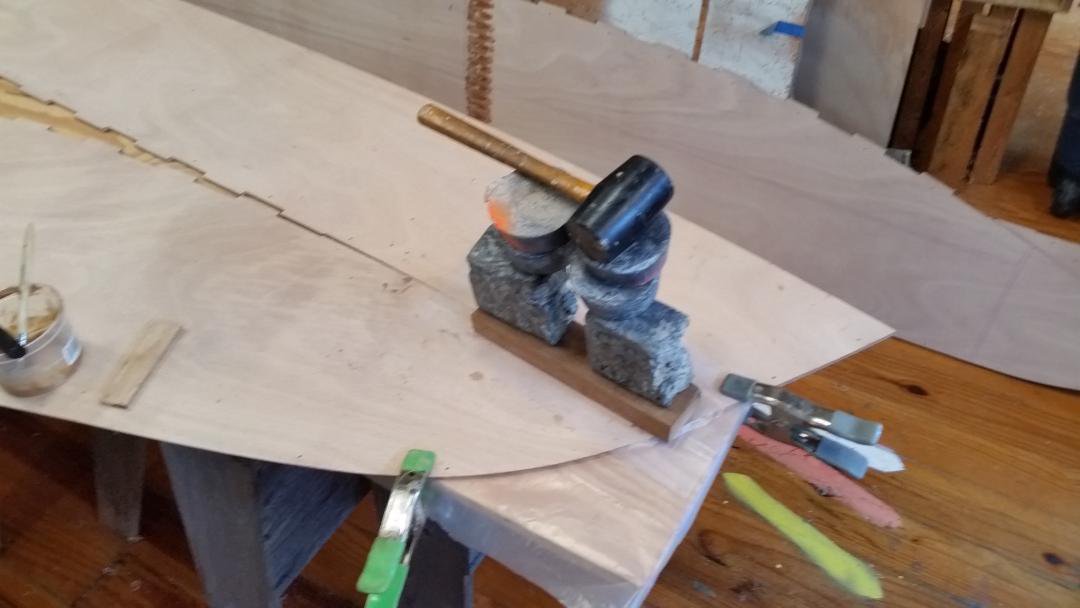
Everything was ready — so I just did the puzzle joint for starboard side panels. That’s about 40 lbs on about 20 sq.in. Tomorrow, after dressing the cured epoxy, I’ll do the the port-side pair right over this pair. Then two more days applying the FG tape.

-
Spindrift 10, #1329 -- "Seabiscuit" . .
Pete McCrary replied to Pete McCrary's topic in B & B Yachts Forum
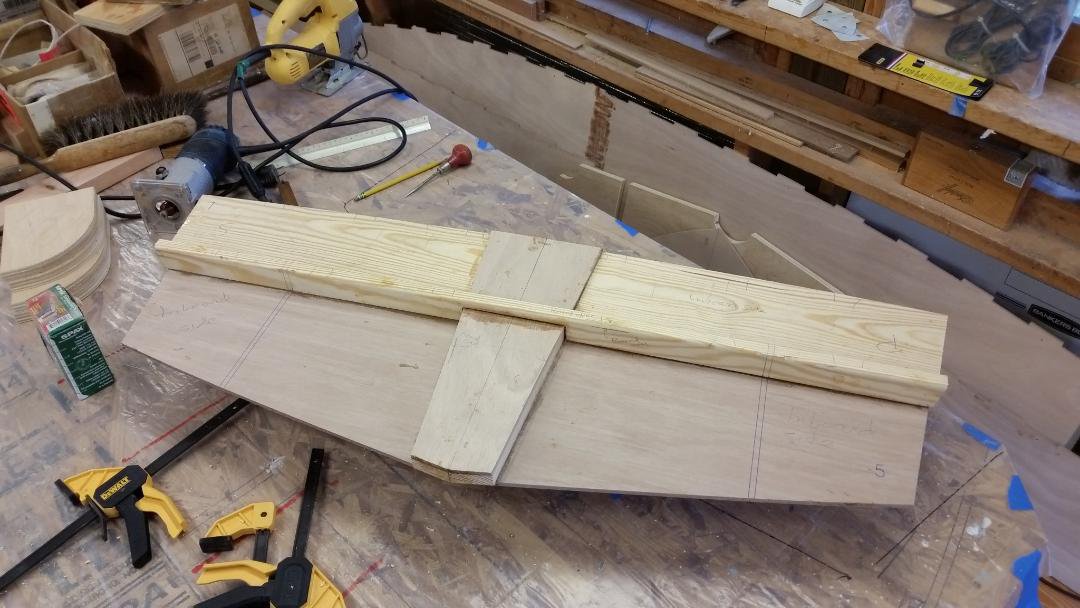
The transom cured overnight and all glueing surfaces appear to be properly aligned. It’s now ready to serve its role in the “butterfly” transformation into a 3-D boat. The construction cradle forms have been attached to an extra pair of sawhorses. Note that the legs were trimmed so that the interior of the boat is at a convenient height for filleting, etc. After the puzzle joints have been glued up, each horse and cradle form will be “trued-up” fore & aft and the legs screwed to the floor. I was originally going to glue up the puzzle joints on the floor. However, thinking of my knees and the effort of multiple “getting-up-off-the-floors” — I just had to figure another way. So I’m trying a “dry setup” shown here: The forward ends are supported by a pair of store-bought sawhorses (providing a firm surface width of two 2 x 6s) covered by a leftover 8’ panel of 3/4” ply. Another [transverse] 8’ panel at the aft end is supported by a pair of [height-adjustable] table saw extensions. It should work out OK. Should any forum member see possible problems — please let me know what to lookout for. I probably won’t start the process for a day or so.


-
Spindrift 10, #1329 -- "Seabiscuit" . .
Pete McCrary replied to Pete McCrary's topic in B & B Yachts Forum
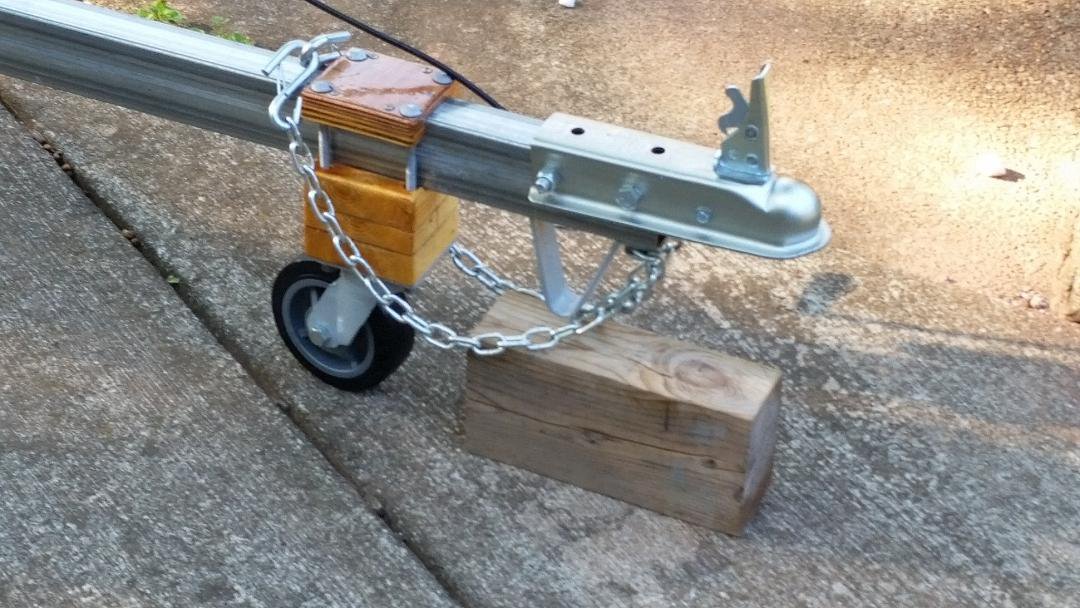
Yes, it is, Don. But I didn’t want it in my way when stepping over the tongue. If this doesn’t work out, I’ll have to go that route. Here’s the installed caster using 8” carriage bolts: Making progress. All CNC cut parts have been “dressed” — removing burrs and connecting bridges and bumps left after the CNC process. And all finger joints have now been glued up and are ready for the butterfly puzzle joints. I plan to do the “puzzle” glueing job on the level wooden floor of my garage with plastic sheets under and over the glued-up puzzle and all that covered with a flat 3/4” ply and lots of weight. After an overnight cure (and trimming [squeeze-out]) of the joint (both sides), I’ll recover the fresh joint with plastic and glue-up the 2nd butterfly right over the first one — assuring identicality. Next, after an overnight cure, I’ll move the top butterfly enough to expose the joint [on the bottom butterfly] AND epoxy the 3” FG tape (on the exposed side) of each. And, after another overnight cure flip both — and epoxy the 3” FG to the other sides. I figure it will take 4 mornings followed by 4 overnights. COMMENTS and SUGGESTIONS please. Is there a way to shorten the procedure? Presently, the transom is dry-fitted and all’s ready for gluing. But it’s after 10am and the shop is already 86 degrees and reaching for the mid-90s. I’ll probably just do the horizontal pieces today — leaving the verticals for tomorrow. An EDIT update: now, after lunch, temp only 87 — so I did the WHOLE glue up! Saved almost a whole day. I’m probably on-target to launch Seabiscuit at the MASCF.


-
Spindrift 10, #1329 -- "Seabiscuit" . .
Pete McCrary replied to Pete McCrary's topic in B & B Yachts Forum
Today did the finger joints for one side of the bottom (## 3 & 4). The trailer didn’t have a drop-down wheel on the tongue, so I’ll be attaching the 6” caster wheel shown on the panel. There are grease nipples for the roller bearings for both the vertical and horizontal axix. Here’s a close-up: Tomorrow will do the fingers for the other side of the bottom.

-
Spindrift 10, #1329 -- "Seabiscuit" . .
Pete McCrary replied to Pete McCrary's topic in B & B Yachts Forum
Finally — getting started on actual assembly. The finger joints are now set in thickened epoxy for port and stbd ## 9 & 9a and 11 & 11a. Tomorrow panels ## 1 & maybe 2.
-
Spindrift 10, #1329 -- "Seabiscuit" . .
Pete McCrary replied to Pete McCrary's topic in B & B Yachts Forum
The shop is mostly clean and ready for building Seabiscuit. The shipping crate has been emptied and disassembled. All kit parts are “present or accounted for” sir. Here are photos, the first showing panels requiring “finger” joinery. At left are the transom and foredeck parts, then dagger board, with rudder at far right. Temporary bulkhead and the cradle ends. View of Seabiscuit’s garage building space with shop in background. Next will be stowing all parts to be easily retrieved as building progresses. Then glueing up all finger joints.


-
I feel the same about leaving the helm unattended. Even when she’s sailing balanced and “hands free Mom.” But that changes when your weight shifts to the bow. And that’s why I sprung for the auto tiller pilot. So useful for a solo sailor.
-
I rigged Chessie so that the fwd hatch cover could be opened and closed from the companionway. Notice the gray 1” strap leading from the center of the fwd edge of the hatch back aft. That strap can be reached by standing in the companionway. If the dodger is deployed its top can be zippered open. That also allows tending of the reefing pendants. The next photo shows the hatch open, but limited by a strap on the port side which prevents chafing of the dodger. It is made fast to the hatch cover by snap-buttons, which are adjustable for several different open angles. Below you can see the strap left dangling in the dodger opening. Of course, in order to make use of the strap for opening the hatch, it [the hatch] must not be locked down from the inside or out-of-reach from the companionway. Chessie’s hatch is held fast-closed by a bungee,, which is engaged from inside the cabin. My practice was to leave it free to open except when trailering or for security if skipper and crew were locking the cabin while absent. I suppose there is risk in leaving it unlashed while sailing, but I think that risk is much less than tending lines while standing or kneeling on the cabin roof. Even if the boat experienced a knock-down, it is very possible that the on-its-side waterline would be “below” the edge of the hatch opening. But Graham would have to acknowledge or dispute that. But someone falling off the cabin roof is almost inevitable. Especially if he must pay close attention to a rigging task while in motion and not constantly aware of surprise wakes, waves, wind gusts, etc. And the reefing pendants don’t need to be tied immediately in order to have effective reefing. All but the most forward can be tied from the companionway — and the other one later, when conditions are convenient for going into the cabin.


-
Spindrift 10, #1329 -- "Seabiscuit" . .
Pete McCrary replied to Pete McCrary's topic in B & B Yachts Forum
The big tractor trailer arrived at my driveway about 5pm, the driver's last stop. He remembered delivering the Two Paw 7 three years ago. He was very helpful and volunteered to haul it into my garage (in the backyard) on a hand-powered fork lift. At the dip in the driveway we needed my two-wheeled hand truck to get beyond the dip. I'll organize everything tomorrow. Hope to see some of you all (with Seabiscuit) at the MASCF.
-
I second that! Especially sailing solo and on the tarmac.
-
Steve, ... Before Chessie’s maiden voyage I had a tent made for deployment between the masts. I never “fined-tuned” it because an early May snow-fall carted the 3/4” pvc roof braces to collapse. I replaced them with 1” pvc, but never made use of the tent. It had standing headroom when standing on the cabin sole — and sitting headroom before the mizzenmast. The fore and aft “curtains” snapped in place and could easily be stowed in the cabin. And the roof and sides could be rolled around the longitudinal 3/4” pvc centerline and side braces — if rolled tightly, that package could be stowed in either cockpit coaming. It was flexible enough to fit thru either aft opening of the comings — but not easy to do on the water. I think the sides were attached to the top with Velcro and rolled up with the end pieces and stowed together in the cabin. The tent went with Chessie when sold to Erik. Maybe he can make some use of it. Actually, I was disappointed in [my] design. Deployment and stowage while cruising, in my view, was completely unsatisfactory — I didn’t ever try to deploy it (except in my driveway). See photos. I’d recommend a design much lighter weight and somehow split at the mizzenmast to also cover some of the aft cockpit. Maybe bowed braces that are foldable like campers tents I’m thinking of something like that for the Spindrift 10. Suggestions welcome.


-
Spindrift 10, #1329 -- "Seabiscuit" . .
Pete McCrary replied to Pete McCrary's topic in B & B Yachts Forum
My wife, Annie, liked that! Seabiscuit’s boom was cut from a leftover piece of 2 x 8 Douglas fir — trimmed to dimension, sanded, marked for the rigging hardware, and edges rounded over. Waiting for the kit’s arrival — I’ll next cut the parts requiring 3/4” stock. I like yellow pine that builders use for stair case “risers.” They come in long lengths up to 16 footers. All of it straight grained and nearly all clear — the few knots are tight and small. It has to be [clear] because wooden residential stairs are never painted — they’re finished natural with varnish, like ladders. If you ask sales people [at builders supply] for yellow pine, they’re likely to say “Don’t have any.” Then ask for stair riser stock — and check it out. -
My guess is a lot less. Take a scrap piece of ply, mic it, and do one side — mic it again. Then you’ll know half the add’l thickness. But I wouldn’t bother. As Paul says, the helm is quite light and In normal usage the stresses are too. And if a glazed and much stronger rudder is over stressed by encounters with the bottom, rocks, docks, other boats, or highway traffic — the unyielding rudder could over stress other parts of the rudder/tiller assembly. Easier to replace just the damaged rudder.
-
That rudder was on “Chessie,” which I sold to Erik on July 10. Learning of its failure troubled me not just because I had sold a defective product, but because I wanted a better understanding of the cause of failure. I just didn’t believe that failure to apply fiberglass and epoxy was the cause. I kept thinking about it over a day or so — and then I remembered an event that may have been a probable cause. I’ll describe it here along with my analysis. First a diagram for reference: On Tuesday, June 9, with Chessie fully loaded and prepared for an overnight cruise on the West River — the pickup, trailer, and Chessie were parked at the curb in front of our house. An Amazon delivery truck passed [heading opposite direction] and apparently [not seen by me] pulled in behind the trailer as shown in the sketch. The driver approached me [sitting in the pickup] wanting to hand me a package. I told him to place it up on the porch of our house — which he did. Then, in order to pull from the curb, I needed to back up a few feet, and while slowly doing so [and not knowing he was parked at an angle closely behind the trailer] I heard soft sounds of collision. Immediately I stopped and got out to inspect — finding the situation as shown in the sketch [except that I had pulled forward a few feet]. There was a deep scratch on the side of the Amazon truck caused by the aft end of the rubrail — and the rudder/tiller assembly was displaced a few inches (it had been set on the centerline with the tiller clutch engaged). There was no damage to the rubrail but the boat’s keel had been moved an inch or so off the center of the most aft roller. I removed the rudder cover, and there was no apparent damage to the rudder, although I did not make a close inspection. I released the tiller clutch and re-centered the tiller/rudder assembly — and proceeded to the launch site on the West River. The launch, sail and motoring (appx 10 nm), and recovery all occurred without notice of any problems with the rudder, its raising/lowering or effectiveness in operation. Chessie was trailered and sailed on one other occasion in June as well as a demo-sail on July 10 — all without notice of any problems with the tiller/rudder assembly. My analysis is that the rudder (held tightly in position by the tiller clutch) — was stressed to the point of significant damage, but not showing displacement. Then, by ordinary usage, during the overnight cruise, a day-sail, the demo-sail on July 10, and the sail in New Jersey— the flexing of the rudder (side-to-side) in regular usage, further weakened the rudder to the point of complete failure. If the tiller clutch had not been engaged, there would have been no damage. If the rudder had been glazed, the rudder wouldn’t have been damaged, but the forces on it might well have transferred to the cheeks, tiller, and the gudgeons or pintles — damaging some or all. It is my opinion that an unglazed rudder made of 18mm marine plywood would hold up well under all the limits of normal usage. Pete McCrary The embarrassed builder of the broken rudder.

-
Spindrift 10, #1329 -- "Seabiscuit" . .
Pete McCrary replied to Pete McCrary's topic in B & B Yachts Forum
Chessie, my Core Sound 20 Mk 3, #4 has been sold! Pleased to say, to an owner who will take good care of her. Upon consummation and delivery of Chessie, I promptly ordered the kit for a sailing with reefing, non-nesting Spindrift 10. Plans have arrived and kit should arrive within a week or so. We've decided on the name "Seabiscuit." BradW had suggested "Jetsam," which I liked -- but Seabiscuit won out. Sorry BradW. We also ordered a CE Smith Multi-Sport Trailer which came as a kit -- delivered to my grandson, Nathan. He has assembled it and will deliver it carrying the Sailfish that I built back in 1971, which needs a bit of restoration. The Sailfish and Seabiscuit will share use of the trailer. Paid $1,320 (shipping included) for trailer kit. Great grandson Luke . . Nearly finished . .


-
Core Sound 20 Mk 3 -- #4 "Chessie" . .
Pete McCrary replied to Pete McCrary's topic in B & B Yachts Forum
Yes, Mike. Our city’s waste management contractor has a truck scale that we can use when traffic is sparse. There is a large digital sign on the side of the scale office that constantly shows the weight. I’ve weighed [separately] the trailer and trailer with boat [configured for cruising] — first, the trailer axle only, then lowering the tongue wheel (to the scale) and jacking the hitch off the ball to get total weight, the difference being the weight carried at the tow bar (tongue weight). I just photo the four weights since I don’t need officially “certified” tickets. There’s no charge if you don’t need a ticket. They claim accuracy of + or - 20 lbs. If you know (or with an educated guess) the “unsprung” weight of the trailer (i.e., axle, suspension, wheels) and positions on the trailer of the boat and axle — you can calculate the centers of gravity (separately, boat and trailer). -
Core Sound 20 Mk 3 -- #4 "Chessie" . .
Pete McCrary replied to Pete McCrary's topic in B & B Yachts Forum
Greetings all. The selling of Chessie is now under contract. Today I'm preparing her for delivery sometime this month -- removing personal items. However, she will be transferred intact with all safety and cruising equipment to an experienced sailor. I'm sure she'll be skifully sailed and well cared for. Building Chessie was as much a pleasure as sailing and cruising with her. For others who may be (or may consider) building a Core Sound 20 Mark III -- I'm attaching here her Owner's Manual (in three parts to keep file size reasonable) and Equipment List. My next project is a sailing Spindrift 10 (my boat #11). I just might have it ready for this year's MessAbout, if there is one. Prt one OWNER's MANUAL, pgs 1-12.pdf Prt two OWNER's MANUAL, pgs 13-24.pdf Prt three OWNER's MANUAL, pgs 25-35.pdf Equipment List.pdf -
Spindrift 10, #1329 -- "Seabiscuit" . .
Pete McCrary replied to Pete McCrary's topic in B & B Yachts Forum
Brad, thanks for the suggestions. I like “Jetsam.” Presently, you are in line for the SURPRISE !! There’s a story about that sailfish. In 1959 a colleague built one and had great fun with it — and I just couldn’t wait to build one myself. But marriage, new job, and four children just kept getting in the way. Then in ‘68 living in Massachusetts with water nearby came my time to build one. But Alcort had switched to fiberglass and was no longer selling plywood kits. I called all around the Bay Area trying to find a kit. Finally, I found one at a lumber yard south of Boston. The owner said he had kept a kit in his loft for years and I could have if for his cost (he guessed about $200). Of course we made a deal. The kit had everything needed — even the bronze fittings, spars, sail, lines, fastenings, and even glue. I had to replace the glue which had gone bad. I still have some of the leftover bronze boat nails. Now my grandson has the boat — which his three kids (my great grandchildren) will soon be old enough to enjoy. -
Greetings fellow builders, ... Last Saturday I sold my Penobscot 14 ("Anna") and "Chessie's" tender ("Catnip') to my nephew. I already miss them, but at least they are still in the family. Next will be "Chessie" herself (Core Sound 20 Mk 3 [#4]). I'm still cruising her and she's available for demo sails and inspections by interested buyers. If not sold by October, I plan to bring her to the B & B MessAbout. Maybe a buyer from the south could take delivery at the messabout. We'll see. I'll be placing ad's this week. As soon as "Chessie" is sold, my plan is to order a kit for a Spindrift 10 and have her ready for the 2021 sailing season. Being only about 100 pounds, it should be much easier to launch, row or sail, and recover. This will be my 11th boat-building project. My other boats: 1 -- 1963, "Outcast,” an 11 ft 1 in sailing dinghy from plans by Popular Boating. 2 -- 1971, "Sandi," a Sailfish from a kit by Alcort. 3 -- 1972, a DN Iceboat (sail # 2141) from plans. 4 -- 2003, a 15 ft cedar-strip canoe (a Bob's Special) plans from Canoecraft by Ted Moores. 5 -- 2005, "Anna," a Penobscot 14 sailboat from plans by designer Arch Davis. 6 -- 2008, "Copycat," a 7 ft 7 in Nutshell Pram by J. White, kit from WoodenBoat Magazine. 7 -- 2009, "Tattoo," a 14 ft 10 in PocketShip sailboat, a kit by Chesapeake Light Craft. 8 -- 2011, "Pluto," an 8 ft "nesting" sailing dinghy, a kit by Chesapeake Light Craft. 9 -- 2017, "Chessie," a Core Sound 20 Mk3, a kit by B & B Yacht Designs. 10 -- 2019, "Catnip," a 7 ft "nesting" dinghy, a Two Paw 7 kit by B & B Yacht Designs. 11 -- 2020, "Seabiscuit," a Spindrift 10. #1329 . . . Name suggestions for the Spindrift 10 would be welcome. For the selected name -- a nice SURPRISE !! At this point I'm searching the internet for a light-weight trailer. Recommendations from other Spindrift 10 builders and owners would be appreciated.
-
Mark, ... The bottom tread on the one I built for “Chessie” was a little lower than yours — and was “ok” (but a stretch) for this (then 86 yr) old man. I agree with Chick that yours will be fine for stronger young people. You can see my ladder on page 42 (about 2/3rds down) on my build for Chessie:
-
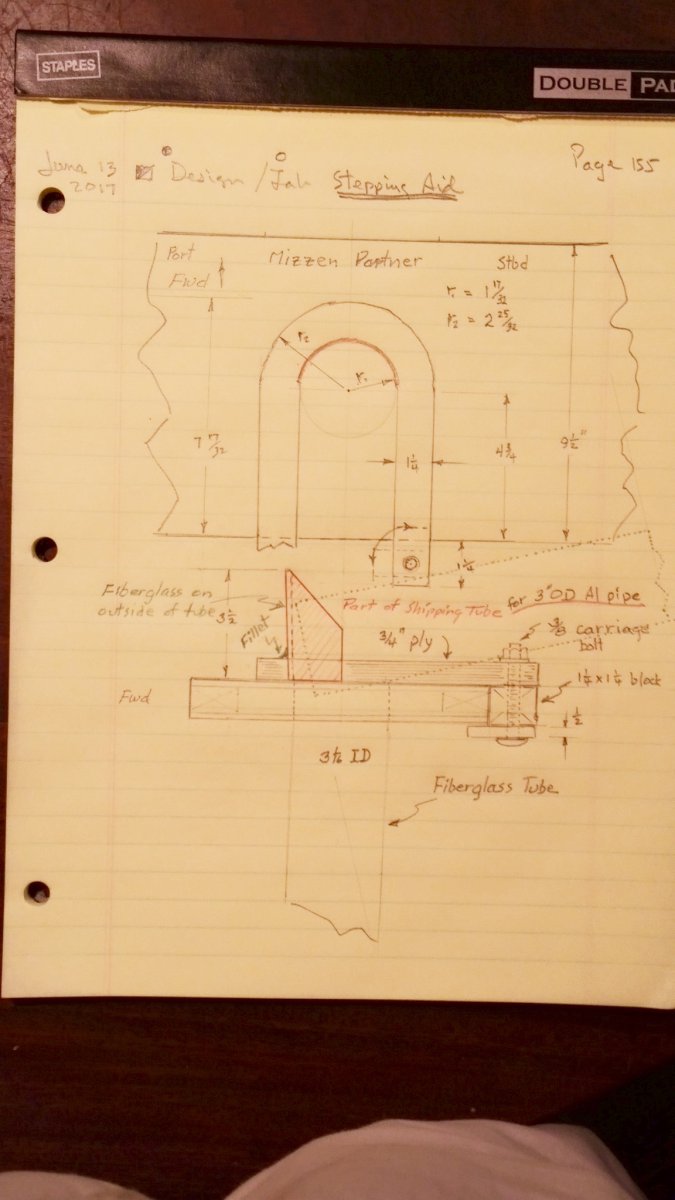
Jim — Have a look at my posting for June 13, 2017, on “Chessie’s” build and the various replies posted by members and myself. CORRECTION, I made a posting on June 13, 2017, but it wasn’t on “Chessie’s” build. It was on someone else’s build. You can find it by searching “stepping aid” on this forum. The little gadget described in that posting has worked well for me. The 22 lb mast weight isn’t the problem — it’s the unsteadiness! Once one gets the mast heel in (or close to) that funnel-like cup, then one feels much more in control for the rest of the job. And I like the concept in the photo you posted. I think it might just work quite well. The stub heel of the mast should be as short as possible [for its purpose of getting the mast heel (just) into its partner] — so that when fully into the partner, the distance from the pivot to the underside of the mast partner is as long as possible — keeping the leverage on the pin and heel stub to a minimum. You didn’t mention it, but the mast needs to be held upright after stepping while someone (you or crew) inserts the pin. Good luck! I’d like to see your final decision. Here are a few photos of my stepping aid:


-
Core Sound 20 Mk 3 -- #4 "Chessie" . .
Pete McCrary replied to Pete McCrary's topic in B & B Yachts Forum
Hi Carter. Love the “High Desert” of the west. Spent the summer of my 20th year on a Shell Oil Company seismic crew working out of Riverton, Wyoming — elevation 7,000 feet. To get there from Virginia was a 2-day bus ride to Rawlins, Wyoming, where the bus station clerk said I’d have to go the rest of the way by “stage coach” — fooling with an eastern greenhorn. Actually it was an all-day ride in a big station wagon with 4 passengers plus the driver [baggage on the roof]. The wagon did have painted on its side “Rawlins — Riverton Stage Coach.” Boarded with a hunting & fishing guide and his family. All meat served (‘cept breakfast) was wild — mostly elk, some antelope. Made enough $$ to fly home (Riverton [DC-3] — Denver [Lockheed Super Constellation] — Washington, DC). Best summer of my life. Sure, I’ll send you a “pdf” version of the Owner’s Manual. It’ll be in two files. First (within a day or so) I’ll try to attach it to an email within this forum. That worked when I sent a draft to Jay. If it doesn’t, we’ll try something else. Thanks for the kind words regarding “Chessie’s” build. -
Joe, There isn’t any “if” about loosing a fraction of [our] strength! It will happen, and in a major way, as we age — most noticeably approaching the 80s. Although I consider myself physically fit [for my 86 years] my strength has very much diminished since I started building Chessie 5 years ago. I haven’t actually measured it, but [for example] it is now impossible to standup from a squat (or even from sitting on a low stool) without arm assistance. So, for example, taking two-stair steps at a time requires [for me] a railing, preferably one on each side. Although I’m sailing Chessie solo for at least another season, I’m consciously approaching it at a slower less demanding pace. Sailors, especially skippers, should perform in-water re-boarding practice early each season. Without that, an full understanding of the physical challenge is not likely.
-
Core Sound 20 Mk 3 -- #4 "Chessie" . .
Pete McCrary replied to Pete McCrary's topic in B & B Yachts Forum
Thank you all for the kind words. Of course I’ve informed the few people that have shown an interest in possibly buying Chessie that she is now “off the market.” They also have had kind words of understanding and expressed a continuing interest in Chessie. And the whole family is happy about my decision to not [presently] sell Chessie. I’ll keep all up to date. -
Core Sound 20 Mk 3 -- #4 "Chessie" . .
Pete McCrary replied to Pete McCrary's topic in B & B Yachts Forum
Jay,... I’ll be happy to share it with forum members. I’m up to page 10 with about maybe 15 or so to go. It’s being drafted in WordPerfect format — which I’ll convert to a “.pdf” format. I don’t know if our forum platform accepts anything other than photo “jpg” files. I could always forward copies by attachment to email requests.