Bcone1381
-
Posts
137 -
Joined
-
Last visited
-
Days Won
1
Content Type
Profiles
Forums
Events
Everything posted by Bcone1381
-
Jeff, Could you engineer all the frames to be free from the center post to allow allow better storage behind the seat? Brooks
-
How much does she weigh?
-

What kayak to build - first time builder - limited kayak experieice
Bcone1381 replied to Cris's topic in Kudzu Craft Forum
Ravenswood. -
The red stitching is very appealing! If you think your Vardo and Long Shot drew attention, this one will put the on-looker over the top!
-
John, I like your long shot! You did a real nice job, and boy, that's a Long Boat! Tell me again the covering system you used...was it 11oz poly coated with marine varnish? It's got an appealing color to it! I also wonder how the Long Shot compares with you wife's Vardo. Are they real similar in speed, or is their a noticeable difference? Brooks
-
Lisa, show us those paddles when they are complete. I am impressed with your mortise and tennon joinery plans!
-
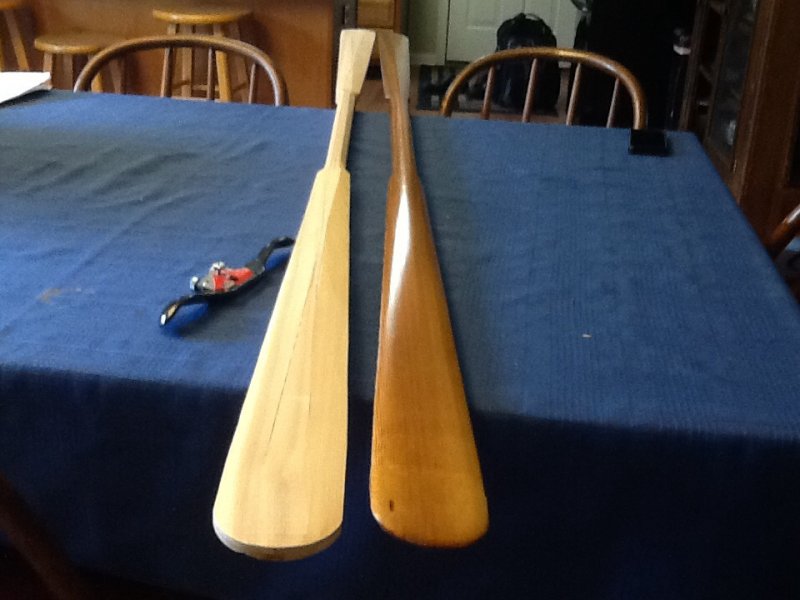
I need a second paddle, and am making this out of Western Red Cedar. It's two 7 foot 1x4 glued together, roughed shaped with a band saw and further refined with a spoke shave. Dave Finnegan at Charlestown Boatworks showed us has some fine works of art on this website (and at a very good price) that I do not try to live up to. These are very light, are a joy to use, but use soft lumber that will get dented, and marred easily. (Broken in!). A worthy improvement would be an oak tip and blade edge. At my level of skill I submit to the Keep It Simple mentality. A combination of frugalness and enjoyment I get in making my own gear drives my ambition that some of you may share. The spoke shave (on the left) is a great tool for this task. http://www.qajaqusa.org/QK/makegreen2.pdf
-
Jaguiler, what your looking at is kind of a gooned up area of the covering system that the photo exaggerated a bit. I covered the Ravenswood with 3 oz uncertified aircraft dacron, then dyed and sealed it with epoxy. It then was covered with 3.75 oz fiberglass. I sewed up the dacron at bow and stern, but a better choice would have been to glue the seam like I did where the deck and the hull covering meet. I could not get the glass cloth to lay right over that area. Although no destructive testing of The covering has been done, it is tough and tight like a drum. Sealing the dacron with epoxy after dyeing it turned out very nice. Thank you you for the nice comments., JReed
-
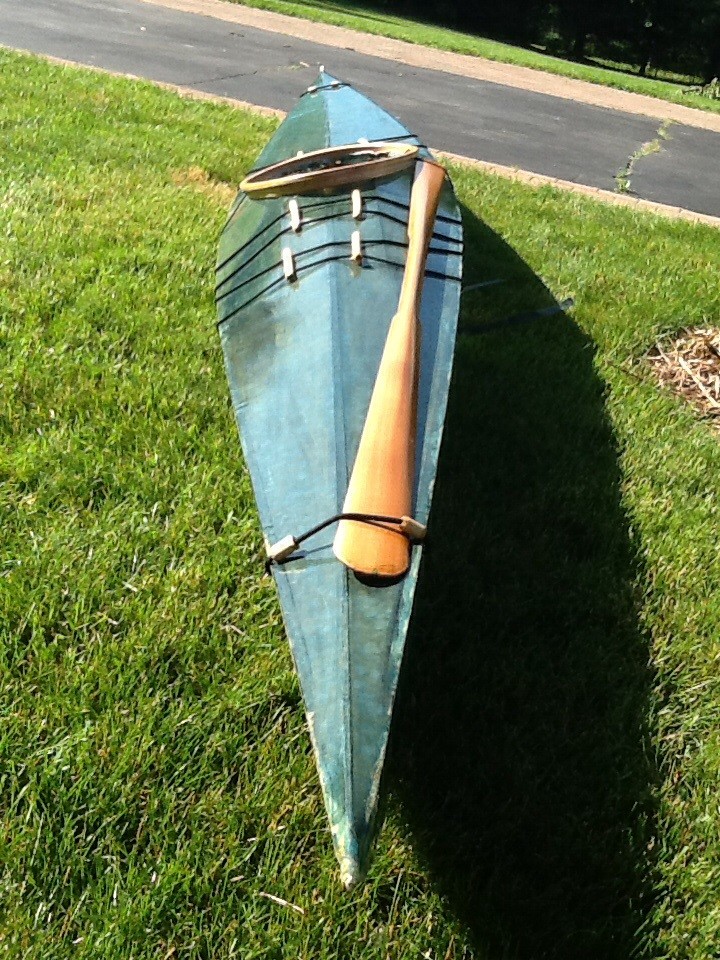
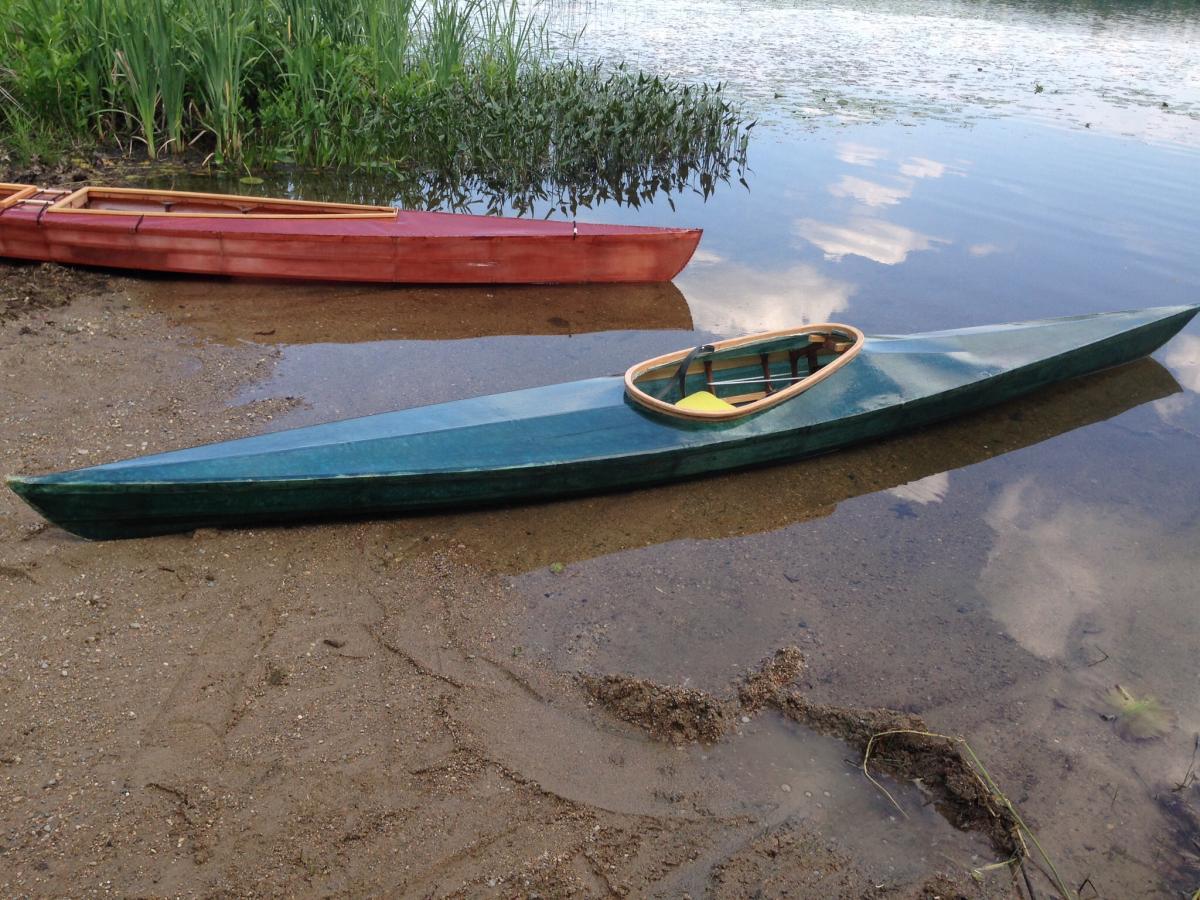
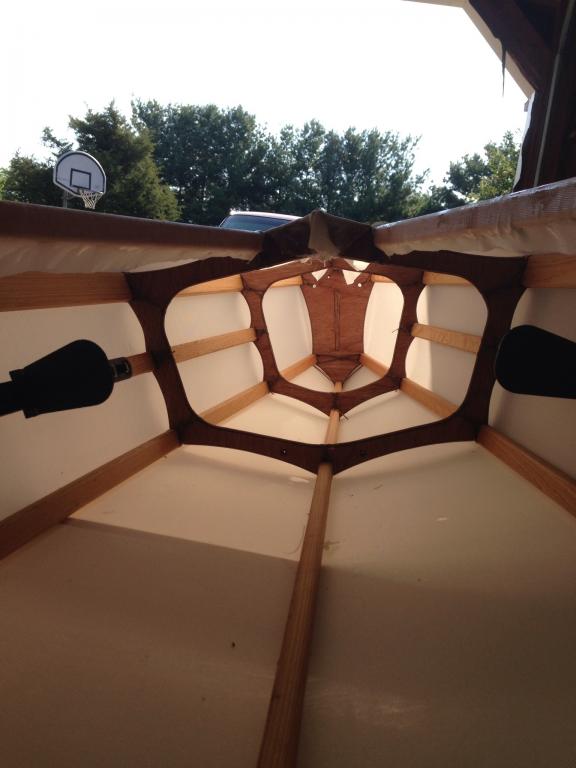
This Ravenswood was first launched last week.


-
I built one coaming from oak using strips that were 1/8" thick and built the coaming to a thickness of 1/2". The coaming feels sturdy and not the least bit fragile. It flexes slightly with a 30-50 pound force applied to it.
-
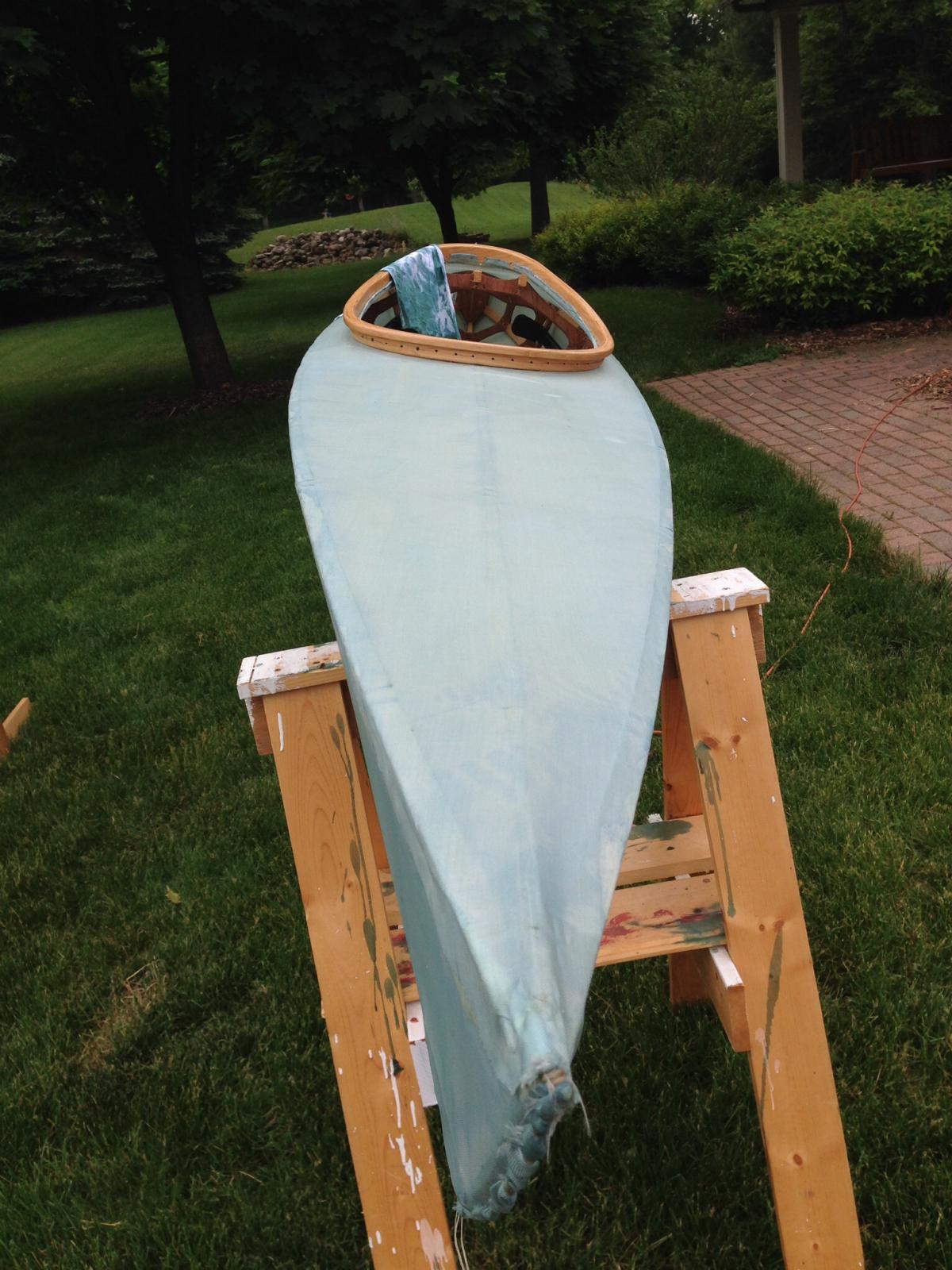
I had not heard that one should not use acid dye with poly, but I may be finding out, for two hours on the water resulted in slight dye transferring to my clothing and onto the wood frame. Would there have been more if the Dacron had not been sealed with the epoxy? After seeing the rains drops effect it I think so. "Don't try this at home...yet" should be our attitude I think. I will varnish the interior cockpit in an attempt to stop this slight transfer. I now sense that dye penetration of dacron is way different from cotton as shown by this photo after the first dye application and wiping off excess dye with this rag.

-
Lastly, she weighs in at 29 pounds. The fabric is drum tight and plenty flexible. It has a nice ring when pinged with a finger. The covering is superior in my opinion to the first kayak I skinned (which I liked at the time.....Cory's Goop over a loose weave 8oz polyester.). Time will tell if the skin relaxes, but Reports from others tell me it won't. I hope the epoxy sealing of the Dacron keeps the dye sealed up too. If she is not sealed, and rain drops impacted the dye, then the color will wash out of her. At this point I think I am ok. A little green dye got on the right pant leg, nowhere else and we were out about 45 Minutes today.
-
The next step was to seal the 3oz Dacron with epoxy, add the 4oz glass cloth/epoxy top coat, then Protect the epoxy from UV rays with spar varnish. The epoxy brought out the color to a deep rich green, and the varnish gave it a nice but textured appearance. I wish I had a close up of the rain spots....makes it look a bit like a Speckled Trout...sorry. The kayak was built for my wife. We have little to no experience kayaking, so we had a concern about stability. If this was going to be a little bit tippy, even for the first 15 minutes, it would probably be the last time she would paddle it. Jeff, from the first stroke, my wife paddled the Ravenswood with total confidence. It was stable, and a joy for her to handle and she really scoots without much effort! From the start she was focusing on the Blue Haron's, Mallards, and Lilly Pad flowers. Stability was not even a thought. On the drive home my wife said she was amazed I could build something that paddles so well, goes so straight, and is so comfortable with so little building experience. I told her it all in the plans and the designer.


-
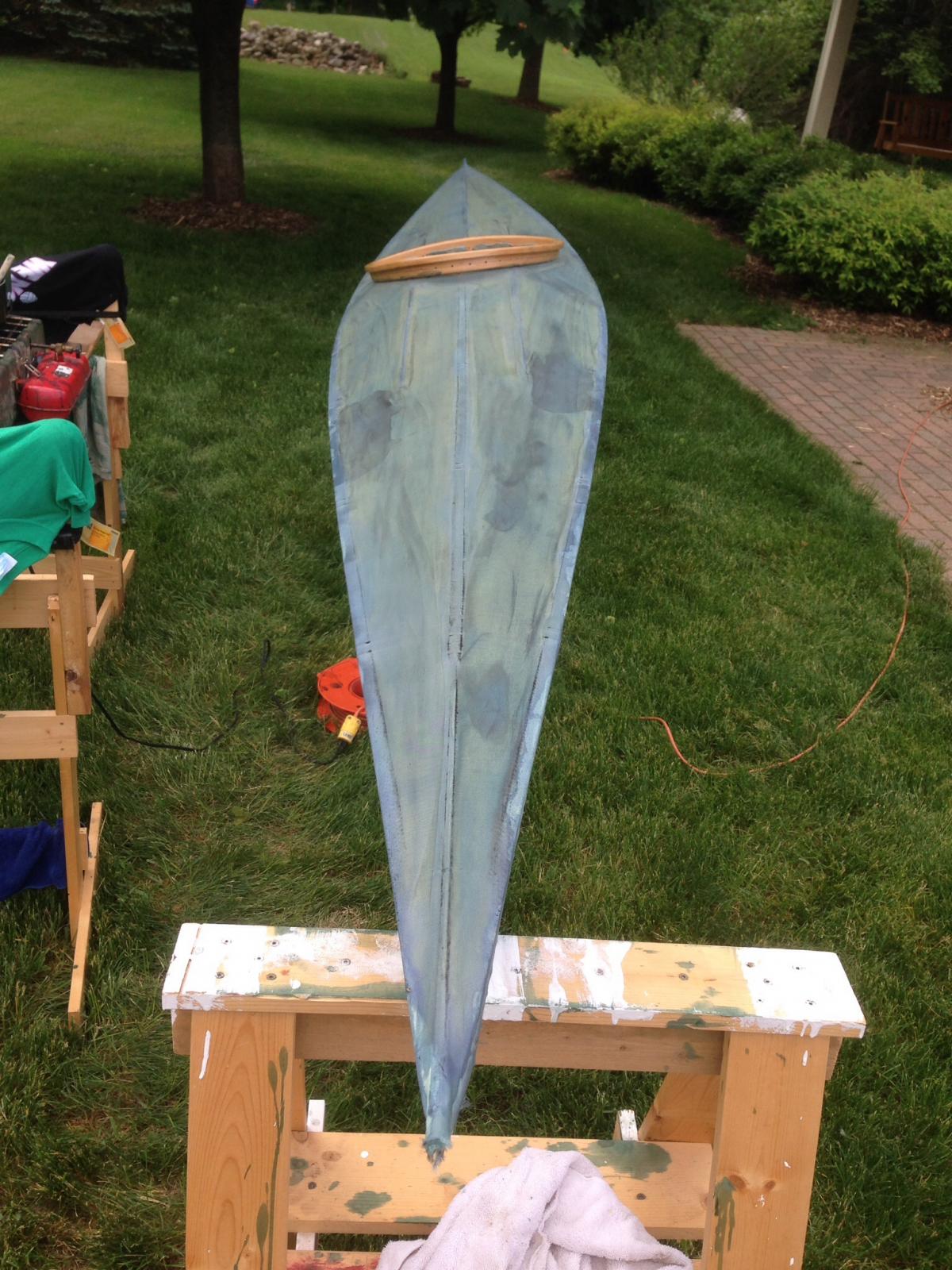
It's been a while since I updated, and I lost track of time and cost, got behind, but persevered and got her in the water today. The covering system I experimented with time used non-certified light-weight aircraft fabric top coated with fiberglass. The Ravenswood started out whited, then I dyed it with Jacquard Acid dye. I choose the color Spruce, and after my first attempt the question of the day was "Brooks, Why did you choose that color?" It was just ugly with a capital U! Steeley blueish gray with a hint of green. The next day I mixed up another batch of dye, heated it to 180F, applied it and immediately ironed it into the fabric with iron set at 250-280F. An uneven streaky look turned out, but it was closer to the dark green I was hoping for. As it sat outside drying, an isolated rain cloud moved over, and sprinkled large drops onto the Kayak. I saw my dyed hull fabric become spotted! Well, it looked kind of cool, so I turned it over so rain could spot the deck too. It was like dying Easter eggs...the more I did, the better it looked...impossible to make it look ugly if you just keep trying things.


-
I like Pirates...it's the guy thing of adventure and calculated risk taking.
-
The Kudzu Craft website list's a revision/correction for the Poco Barta. (I Googled Poco Barta to find a picture to view and ran across the correction.) below I cut and pasted the Revision below for you. POCO BARTA BRACKETS Bracket for frame #1, the 4 7/16" dimension should be 5 7/16"
-
I have wondered about using a sqeegee to press the first coat of paint down into the weave of the fabric. It might help penetrate the weave and lay down those pesky little fibers.
-
I don't have enough experience or time on my kayak to have an opinion about the pure Tung Oil that I used. However, I saw these excerpts on another forum and thought it gave some apparently sound advice on the topic. POST 1 While film finishes such as varnish and epoxy work very well in many applications, SOF frames is not one of them. The reason is simple: You cannot maintain the finish once the skin is on the boat. Film finishes will wear through an/or crack over time and water will get into the wood, where it becomes trapped under the remaining finish, causing rot. Oils are breathable, so while they are not truly waterproof, any moisture that is absorbed by the wood can also get back out. I prefer tung oil (pure oil, not the bogus "tung oil finish" products from big-box stores), as I have seen mold/mildew problems with boiled linseed oil, but I do occasionally use my boats in fresh water. For 100% salt water use, you don't need any finish with solid wood, but you should protect plywood POST 2 I recall reading somewhere about saltwater "seasoning" the frame. So if saltwater still gets into the oiled frame it'd help preserve it, correct? Not the case with freshwater? And I imagine if damp/waterlogged upon reskinning it can dry out and be reoiled...
-
I used an old kitchen knife, and heated it up with my propane torch. Once the blade is hot it melts the fabric like an expensive hot knife. I tried the soldering iron and hung it back up.
-
From the UPS Website...(108 inches = 9 ft.) "Packages can be up to 150 lbs. Packages can be up to 165 inches in length and girth combined. Packages can be up to 108 inches in length. Packages with a large size-to-weight ratio require special pricing and dimensional weight calculations."
-
I thought I would share this link to the outdoor swimming society. It would particularly useful for the person who wants to learn about acclimating ones body to cold water. http://www.outdoorswimmingsociety.com/index.php?p=swimming_tips&s=cold_waterv
-
Please instruct us how to dress for a fresh nice spring day of kayaking. The best I have at the moment is Non-cotton long johns and pants, wool socks, non-cotton shirt, polypropylene fleece, nylon wind beaker...it sounds like I am at risk without a dry suit investment.
-
Never mind, we are talking about a canoe, not a kayak. The other idea I have thought about is to build a sealed hollow tube that goes through the hull just above the water line. Using a paddle that has a fitting that breaks it down into two pieces one could insert the paddle into the tube opening on each side creating outriggers.
-
This spring I hope to try using my existing paddle. and deck rigging to stabilize things for stand up fishing. Using a main paddle on one side, and a storm paddle on the opposite side with water wings, or foam attached to each blade might work. The crown of the deck would allow the paddle to slide out and hopefully contact the water at a reasonable distence from the kayak.
-
Jeff, Your original color draws the eye to the Beauty of your wood frame.