Dogdad
-
Posts
27 -
Joined
-
Last visited
Content Type
Profiles
Forums
Events
Everything posted by Dogdad
-
Thank you! How much does the hull weigh?
-
Just saw the new design on the B&B website. Looks like a faster build than the Spindrift. Hull design is simpler, and uses an unstayed lug rig. I'm wondering what the tradeoffs are, especially under sail. http://www.bandbyachtdesigns.com/mandy.htm I know it's a question for the designer, but thought the answer(s) would be of general interest. Thanks!
-
If you like audiobooks, the O'Brian series as read by Patrick Tull is excellent. My wife accumulated the whole series -- unabridged -- from audible.com, and we pick up some new nuance of the writing every time we listen. Other good reads: The survival of the bark canoe" by John McPhee "HMS Ulysses"(WWII novel) by Alistair MacLean "Structures" by J.E. Gordon. A wonderful introduction to the basics of tension, compression, torsion, etc., written with a sense of humor and a minimum of math. It reads like a pub conversation with your favorite professor. Among other things, it introduced me to Rudyard Kipling's delightful short story "The ship who found herself". http://www.readbookonline.net/readOnLine/2414/ Other nautical Kipling short stories: "Bread upon the waters" http://www.readbookonline.net/readOnLine/2408/, and "The devil and the deep sea" http://ghostwolf.dyndns.org/words/authors/K/KiplingRudyard/prose/TheDaysWork/deepsea.html
-
How is getting caught out after dark dealt with?
Dogdad replied to Greg Luckett's topic in B & B Yachts Forum
COLREGS(international rules) -- local laws may vary Rule 25 Sailing Vessels Underway and Vessels Under Oars (a) a sailing vessel underway shall exhibit: (i) sidelights; (ii) a sternlight. ( In a sailing vessel of less than 20 meters in length the lights prescribed in paragraph (a) of this Rule may be combined in one lantern carried at or near the top of the mast where it can best be seen. © A sailing vessel underway may, in addition to the lights prescribed in paragraph (a) of this Rule, exhibit at or near the top of the mast, where they can best be seen, two all-round lights in a vertical line, the upper being red and the lower Green, but these lights shall not be exhibited in conjunction with the combined lantern permitted by paragraph ( of this Rule. (d) (i) A sailing vessel of less than 7 meters in length shall, if practicable, exhibit the lights prescribed in paragraph (a) or ( of this Rule, but if she does not, she shall have ready at hand an electric torch or lighted lantern showing a white light which shall be exhibited in sufficient time to prevent collision. (ii) A vessel under oars may exhibit the lights prescribed in this rule for sailing vessels, but if she does not, she shall have ready at hand an electric torch or lighted lantern showing a white light which shall be exhibited in sufficient time to prevent collision. -
How is getting caught out after dark dealt with?
Dogdad replied to Greg Luckett's topic in B & B Yachts Forum
I've used detachable battery-powered LED nav lights on our kayaks for night paddles on the local lakes -- a red/green on the bow and a white on the stern. We've had compliments from powerboaters who appreciated being able to see us. A flashlight shining up on the sail is very visible. -
A large-diameter thin-wall tube is much stiffer per unit weight than a small-diameter heavy-wall tube because there's more material working in the area of highest stress. The downside is that a thin-wall tube is more vulnerable to buckling. http://aluminium.matter.org.uk/content/html/eng/default.asp?catid=213&pageid=2144417026 My favorite book on structures for non-engineers is J.E. Gordon's "Structures: Or why things don't fall down". It's a bit dated, but it reads as if you're sitting in a pub with an enthusiastic retired professor. http://www.amazon.com/Structures-Things-Dont-Fall-Down/dp/0306812835 Among other things, it lead me to Kipling's engineering short story "The ship who found herself" http://www.readbookonline.net/readOnLine/2414/
-
Special preparation for various materials Cured epoxy- Unless you're using WEST SYSTEM's blush-free 207 Special Clear Hardener, amine blush may appear as a wax-like film on cured epoxy surfaces. It is a by-product of the curing process and may be more noticeable in cool, moist conditions. Amine blush can clog sandpaper and inhibit subsequent bonding, but this inert substance can easily be removed. To remove the blush, wash the surface with clean water (not solvent) and an abrasive pad, such as Scotch-brite 7447 General Purpose Hand Pads. Dry the surface with paper towels to remove the dissolved blush before it dries on the surface. Sand any remaining glossy areas with 80-grit sandpaper. Wet-sanding will also remove the amine blush. If a release fabric is applied over the surface of fresh epoxy, amine blush will be removed when the release fabric is peeled from the cured epoxy and no additional sanding is required. Epoxy surfaces that have not fully cured may be bonded to or coated with epoxy without washing or sanding. Before applying coatings other than epoxy (paints, bottom paints, varnishes, gelcoats, etc.), allow epoxy surfaces to cure fully, then wash and sand. http://www.westsystem.com/ss/surface-preparation/
-
In almost any sailboat, I'd rather broad reach with a jibe or two than be on a dead run. More stable, more predictable, and the speed gain usually balances out the extra distance.
-
There are some "builder assist" programs for kit aircraft that do exactly that. The builder doesn't have to order, unpack, set up, build fixtures, decide what to do next, clean up, etc. The paid staff does that. All the builder does is build. http://www.twoweekstotaxi.com/about.html For an aircraft to be legally registered as amatuer-built -- and hence free from commercial certification requirements -- the builder must doument that they did at least 51% of the construction. The builder assist centers help folks meet the letter of the law in the most efficient way. The spirit of the law -- building for "recreation and self-education" -- may suffer.
-
[quote author=Hirilond
-
In response to a question, I got an email from Carla saying that there was a kit for the Spindrift 12. Don't know about any others.
-
I'm imagining a black hull with red trim. The black is finished with a red-tinted clearcoat so all the reflected highlights look red....
-
Regarding cleanup, white vinegar works suprisingly well at getting uncured epoxy off your hands and other important things. It's friendlier than some of the solvents folks tend to try.
-
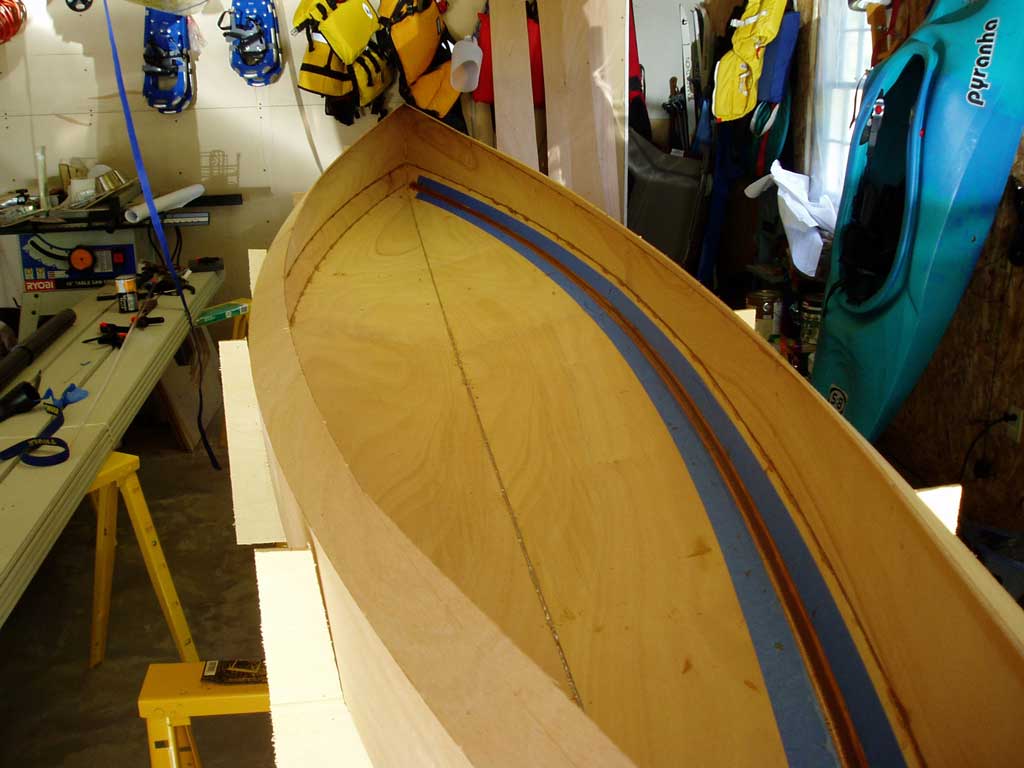
Welcome! When I built my S&G canoe I did mask the seams before applying the thickened epoxy fillets.(see photo) It saved a lot of cleanup. Other labor saving: It's tempting go do something else -- like sleep -- after a big epoxy application, but you can miss the period when it's "green"(not completely cured) and easy to clean up with a knife or scraper. It's good to take notes on how long it takes for your epoxy to cure at different temperatures. If you're comfortable with scrapers and sharpening cabinet scrapers, you're ahead of the game. Scraping epoxy is usually easier than sanding it. I did make some test joints with scrap plywood before I started the boat. It was a good confidence builder, especially when I saw how strong the joints were. This is a good reference -- they're pushing their own products, but there's lots of good general information: http://systemthree.com/members/literature/The_Epoxy_Book.pdf Another interesting source: http://www.epoxyworks.com/

-
If you don't want to make your own, one source for fiberglass tubing is high-power model rocket suppliers, such as this one: http://www.hawkmountain.ws/ The rocket folks also have lots of information on techniques for making your own tubing.
-
You're changing the mix ratio to slow hardening? Does the epoxy manufacturer say that's OK? Most sell a slow hardener for hot weather. Changing ratios is usually not reccomended because it alters the properties of the cured epoxy.
-
Fairing the hull Questions for those Who Have Gone Before
Dogdad replied to Maria CS20 104's topic in B & B Yachts Forum
The System Three Quikfair epoxy works well and is very easy to use, but is usually more expensive than mixing your own. Time vs. money... http://www.systemthree.com/p_st_quikfair.asp -
I just used a basic 5" Porter-Cable for my S&G canoe project. Worked fine, no complaints, but I don't have much experience with other makes & models to judge. I did get an optional soft pad which helped on the curved surfaces. If I preparing for another build I'd replace my shop vac first -- it's a cheap Craftsman and is ridiculously loud.
-
Spindrift kits are a possibility, according to a recent conversation with Carla. They're still working out the details and will make an announcement when they're ready. I'm excited about that. I've done one S&G project, and for me the layout and cutting was the most anxiety-ridden part. I kept thinking "if I do this wrong, it'll be wrong, even if I do everything else right." With known good panels, I figure that the basic hull shape will be correct even if I do everything else wrong.
-
"But, I need to remember what someone told me last month, a good afternoon sailing can be ruined by trying to beat another sailboat. " It all depends -- I learned to sail on a racing team in high school, and then spent a lot of happy hours chasing other boats in my Sunfish. Even now the racing mentality still lingers. I have a hard time going more than a couple of minutes without wanting to adjust something. Mixing "cruisers" and "racers" on the same boat can get ugly. The cruisers want to sit and relax, happy if the boat's moving well and there's nothing obviously wrong. The racers want the trim to be perfect and keep jumping up to make half-inch adjustments. If you're a cruiser and you get a racer on board, try to be patient. Understand that to them, seeing a badly trimmed sail is like hearing fingernails on a blackboard, and all the fussing and tweaking is their idea of fun. If we were all alike it'd be a boring old world.
-
Thank you for the writeup! There are some interesting articles on sailing canoes here: http://www.westsystem.com/ewmag/16/index16.html
-
http://www.epoxyworks.com/16/index16.html, "Evolving the sailing canoe rig for cruising". Probably more complex than needed for dinghy duty, but gives a wide adjustment range(small kids to large adults?), and does break down compactly. I've found the back issues of Epoxyworks to be a great resource for ideas about working with epoxy and working on boats.
-
Since you all seem to like photos, here's my current project -- my first boat. http://good-times.webshots.com/photo/2165917960087581313PpGwDA http://good-times.webshots.com/photo/2077171480087581313JpiQDg http://good-times.webshots.com/photo/2827769310087581313jnVYCa Nice plywood makes anything look good! It's a stitch & glue version of John Waters' Osprey solo canoe, brought to life with help from the folks at Newfound Woodworks in Bristol, NH. They've got a CNC plywood cutter if anyone can think of a use for one.... It's 4mm plywood, 4 oz. glass inside & out, Silvertip epoxy products used throughout. Progress has been slow, and I've made all the beginner mistakes, so when I finally got the inwales attached I clamped a couple of temporary thwarts in place and took it for a spin on the local pond. I think it's going to be fun!
-
Thanks for the replies! I'm in west/central NH near Lake Sunapee. Grew up near Squam Lake (http://www.squamlakes.org/) and did most of my sailing there, and also crewed for some folks racing bigger boats on Winnipesaukee. I did contact B&B for information on area builders. I've heard back from one person building a CS17, and would be delighted to see any others within a reasonable driving range.
-
That's a good point -- a boat that's still balanced and behaves well when reefed is important. I've sailed boats that seemed to only go sideways after the first reef went in.