PeterP
-
Posts
407 -
Joined
-
Last visited
-
Days Won
16
Content Type
Profiles
Forums
Events
Everything posted by PeterP
-
Howard, don't over engineer this. The line has to take epoxy and has to be synthetic. It has to take epoxy so you can stick it to the board. It has to be synthetic so it does not rot when it cracks under impact. And crack it will no matter what line you use. Sort of like a sand bag. Keeps taking the bullet impact getting worse looking each time and when it gets real ugly you replace it. You have been around sail boats long enough -just look in that box of odds and ends and chances are you already have a piece of line that is too long to throw away yet too short to be practical. Just use it. I would not buy anything special. Cheers peterP
-
Howard, I have used 5/4" corner board -a lot -which should be available. Because it is milled to 5 1/2" wide you may have to do more glueing to get wider stock. I can tell you getting fired up -BTW- PeterP
-
Scott, that stuff got recycled. The guiding block was made out of couple 2x4s screwed together - dadoed in the centre to guide the bar. Bottom trimmed off to the angle of the shaft inclination. The bar is a piece of 3/4" black pipe with two 1/4" holes tapped in the end- opposite each other- to take two 1/4" bolts - with heads cut off and sharpened to give good shearing action. Screwing those in and out fine tunes the bore diameter. In all honesty I spent way too much time on that. Saved a buck on epoxy and wasted hours on labour. If I were to do it again I would rough out the bore the quick and dirty way -slide the stern tube in and get it lined up real good then back fill the gap with epoxy. Nobody will ever know how slick your bore turned out. Glad you mention cranking up your diesel. I was going to drop you a line -guy on ebay has a listing for a two stick engine control ( 10 -WAY below regular price). I am going to order mine today and I wondered if your engine package came with that stuff or not. Also- I don't know if you want to let that engine just idle for an hour without any load on it. Bad for diesels.PetrP
-
Best of luck Howard!
-
Well, at least you making money - that's always good. I'm going to start dipping into my cruising stash soon. Scary thought.
-
Glad to help. I can guess how you feel. Can't work on your dream 'cause you're up to your butt in cold and nasty weather for next eon and a half, taxes going up, lottery not coming through -seems like the only bright spot in life is Dolly & Kenny singing Islands in the Stream. If you have a full set of plans( which I doubt somehow) you could work on do-ahead-stuff like rudder, tabernacles, you could make some molding(s) which you're going to need a bunch of. Rip up some laminations for your cabin beams. How about knocking out some rails&stiles for your doors. Laminate your engine beds - oversize,of course- so they can be trimmed and put in the boat when ready. Pour the lead keel maybe? That'll keep you busy for a while. If I sound too clever by half don't take it wrong -I'm way behind schedule myself. We'll get it Scott - one of these days. Cheers PeterP
-
Scott -you right- where does the time go?! Well, I got a few things done. What I am most proud of is the diesel. Aligning the shaft with the engine is supposed to be the bugbear. I spent a lot of time procrastinating but in the end it all just came together and so well I almost felt -too easy- like the shop gremlins are setting me up for something. Beta engineering was a big help. The shaft coupling and the engine flange are machined to fit together - lip on the coupling & groove on the flange. If they fit together you're centered. And I was -first try. Then it's a question of left/right up/down. Turns out I just needed a couple of turns on the rear engine mounts and she was done to 0.01in recommended tolerance. Unbelievable! Of course we'll never know until she floats - they say that sometime the boat settles in the water funny and throws the alignment out of whack. So the diesel is all in: raw water intake, exhaust line with muffler and a water-lift. PSS dripless all in. All 3/8" bolts torqued up to 35 ftlbs. All I need now is to run the fuel line and return and 12V wiring, main panel hook up and a throttle line. Second picture shows the underside of the cockpit sole with the drain plumbing and my home made discharge tube. The last picture shows the hatch. Looks a bit dull as I have just sanded it - there is a cold front headed this way so I'll move inside and varnish a bit. You can also see the cockpit sole is down and down for good. Not a minute too soon as I was getting sick and tired of climbing in and out of that hole.


-
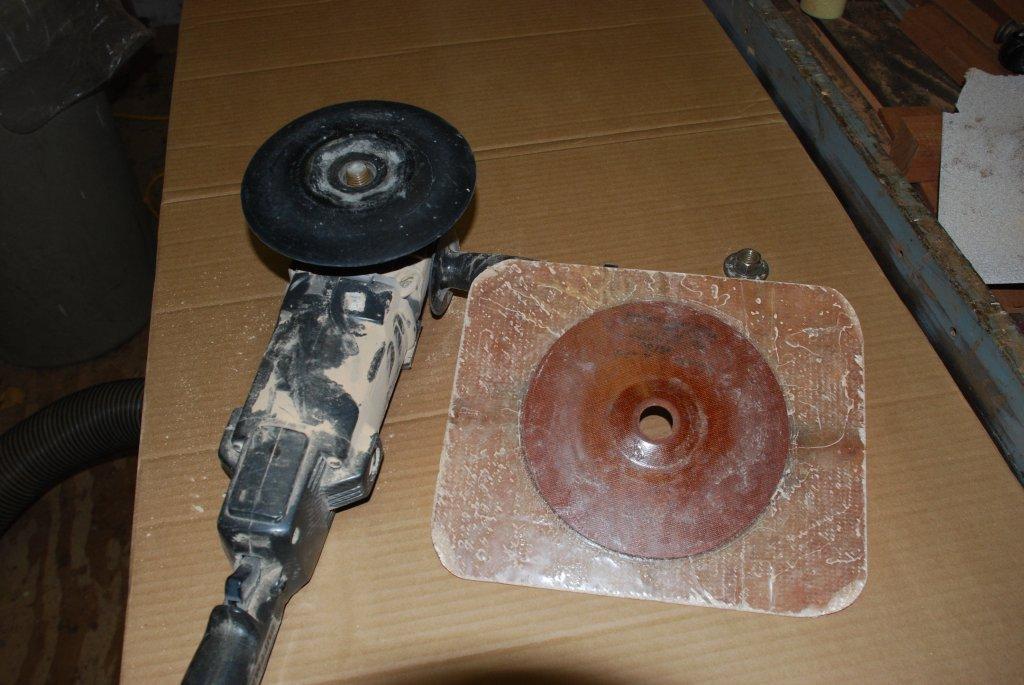
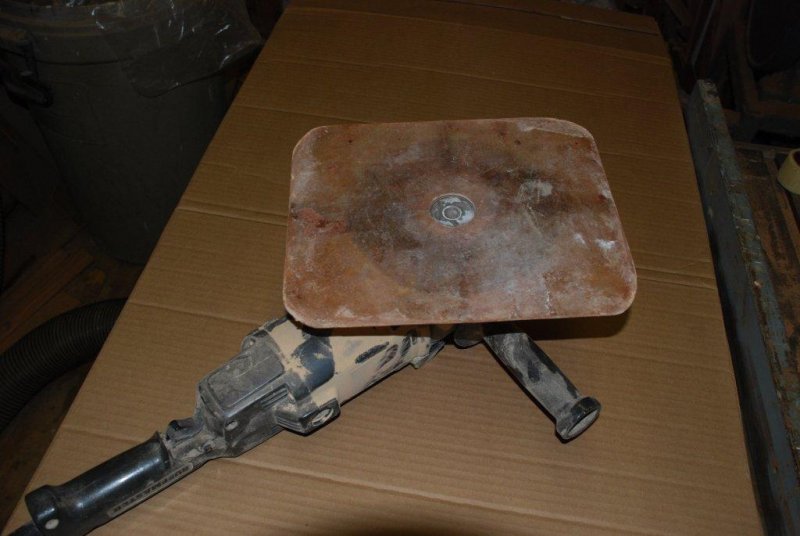
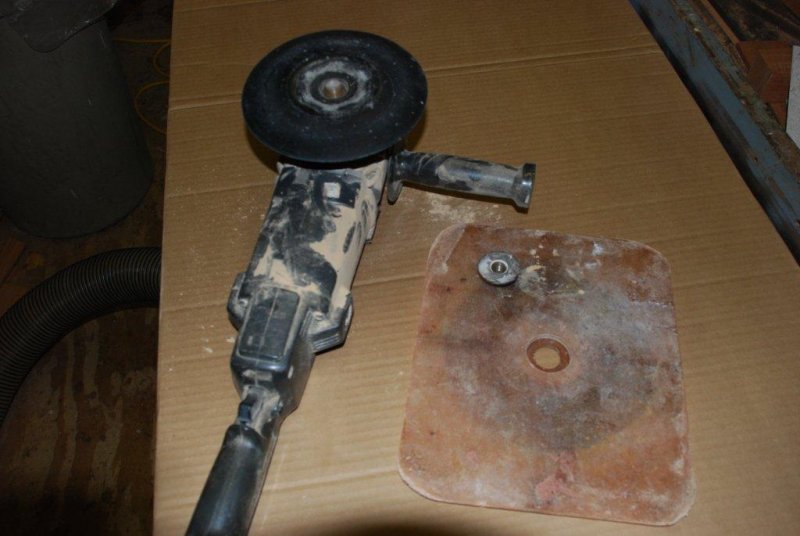
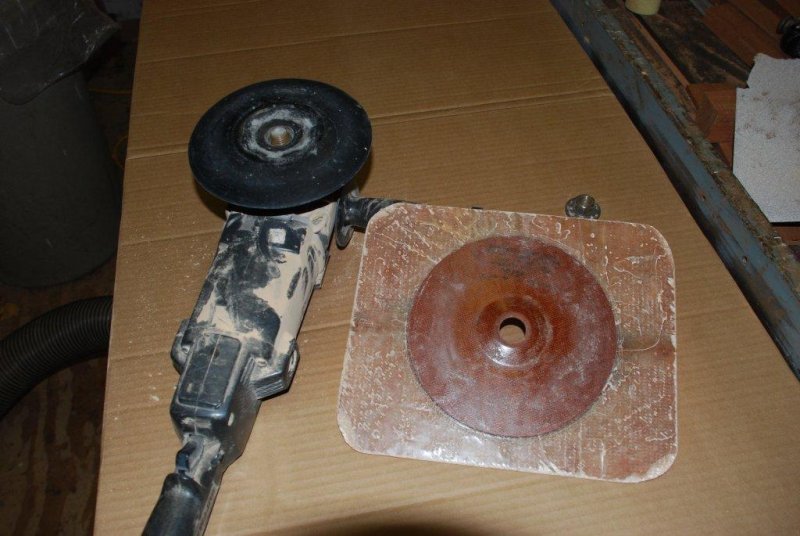
Scott, hope you find this helpful. The platten is 1/8 in. thick made out of leftover 17oz biax. I like 'glass for this purpose because it won't shatter like solid plastic when you hit something. And believe me you will. Please take a good note of the rounded corners. Think saw blade with four teeth. The phenolic disc I bought from auto paint store for a few bucks - it is epoxied on. As you can see from the pictures I have to keep the rubber pad on when I put the large platten on - it is the only way to tighten things up. Yours could be different. What paper do you use? I really like Norton A275 80grit. I bought a sleeve from Jamestown and I've gotten a good mileage out of it. I was looking for a 60 grit at the time but nobody carries that in sheets anymore I guess. But the 80 worked really well for me. It takes a lot beating and moves a lot of dirt between changes. Wearing a heavy duty apron while using it is a good idea. Also, I switched from safety glasses to a full face mask when using the sander on account of the huge cloud of 'glass dust bothering my eyes. Good luck and Merry Christmas. PeterP
-
I kind of agree with Peter. I put a strip of paper on the screen and it almost looked like the mast isn't bending sweet. Do you have enough heel inside the aluminium section? It almost looks like a dog leg in that joint. Probably just my perspective. To stiffen the lower part of your wood section you could run a carbon sleeve - say 2-3 ft. To tell how much exactly is beyond my ken. Personally, I would try a third of the section length on ONE MAST to begin with -and if it turns out too stiff I would work my way down with a sander until it looked good. I also have to tell you that my 17 year old sails look whole lot worse. Some things you can get used to given enough time and tight budget. I keep promising myself a better set for the 28.Good luck PeterP
-
The way I read it Peter HK is essentially saying the same thing: re-read his post. Don't run your screws into thickened epoxy plugs as it is too brittle and will chip and flake. Better to run the screw in, back it out, soak the hole in neat epoxy to waterproof/strengthen the fibre then re-set the screw. United in purpose, divided by common language? PeterP
-
Chick, I had my 17 at Cape Lookout while back. It was a really good camping trip. Put in at Harker's Island and sailed out following the channel. Spent the first night right at the lighthouse and if you've never been bitten by a bug this THE PLACE to make up for lost ground. The rest of the week we tented on the beach at the Hook. My kids have fond memories of that trip. Drinking water can be an issue as you probably know. There's none to be had. I would be very interested in doing something like that. You could also consider making a base at Neuse River camp ground and making day trips i.e. New Bern, Oriental. There's some very nice sailing to be had on the Neuse. Another nice trip I remember doing with TSCA was from Atlantic across to the banks. I don't need to remind you that if the wind pipes up there's nowhere to hide there. PeterP
-
Scott, Milwaukee used to have a deal where they would recondition any of their tools for a flat fee. Used to be $75 when I had my Sawsall done. With a bit of luck you could get a used one on eBay for a $100 and it would do the boat for you. If it dies then you could bite the bullet and get it reworked and it wouldn't be a total loss. Get a buffer/polisher with speed dial up to 1700-1800 RPM. Regular sander will run way too fast for your needs. PeterP
-
Howard, I like it a lot. I have a quite a bit in my Princess. I buy the 5/4 corner board (1x4.5 in) and rip/laminate as required. People object to Doug/fir because it will check and split. SYP is just as bad if not worse. Make sure it is well coated to keep it stable. Half the stuff I buy looks like D/F and as you say the price difference is substantial. PeterP
-
Scott, my tabernacles don't penetrate any deck so sealing is not an issue. Strength is a different problem altogether. The mizzen has two wraps of 18oz glass, the main has 3. We'll see. Aluminum would be nice but I'd have to pay someone to make it and that eats up money real fast. Besides, a couple of years ago I went through a maritime museum in Holland and it was all wooden tabernacles. Pretty amazing scantlings. As for the lightning protection mine runs down mainmast through the anchor well to the foremost keel bolt. It is not a direct path but the wire sweeps a very easy arc - ^ 3 ft radius.PeterP


-
Atta boy Joe and that leather apron is a REALLY SMART piece gear for people NOT needing an appendectomy. Looking forward to seeing all at the meet.PeterP
-
That's right. Sander/polisher so you can dial the speed down so as not to melt the epoxy and a home made platen that takes full sandpaper sheet. The platen is made out of 18oz glass. Description & pictures are on my tread way back when I started sanding ( page 2). PeterP
-
Scott, I really feel your pain. If you don't have one of those full sheet sanders consider getting one. Mine really did some good work for me. Save your shoulders for long boarding. Scrapers are great and you can re-sharpen them which you can't do with sand paper, but if you want to see stuff come off that hull in a hurry go power. PeterP
-
Acetone is a good solvent and so is vinegar at fraction of the cost. Wire brushing after good rinse gets most of the gunk out. Consider making your own tip-out "brushes" by cutting up foam rollers. Works out whole lot cheaper than disposable brushes. PeterP
-
Thanks, I am relieved that I won't have to use anything "marine". For my potable water (which is non-pressurized to discourage excessive use) I used regular 1/2in PEX - crimp on since the "marine" 3/8in is hard to find and substantially more expensive. I'll look for your Gasoila ( sounds a bit like a gated community Dick Cheney would gravitate to) PeterP
-
Thanks David, never heard of Gasoila but I have tons of dope and tape.PeterP
-
What do people use for tread compound on throughhull to seacock joints? Will regular plumber dope work? PeterP
-
Scott, to be honest about that hatch I am still undecided. I am thinking the way it is now I can put a wind scoop in there when at anchor and get all the draft I need plus I'll be able to leave it cracked open when under way and get some suction going. Whatever happens they are easy to unscrew and turn around. That roof is a piece of work. Getting all that stuff to line up half decent was not easy. I hope you have easier time with it than I did. The Blueboard is much better stuff to work with than regular Styro. Sands well too. If I had known how good it was to work with I would've made my lead shoe plug out of it. PeterP
-
This one is for Scott I guess. I did not feel like I had made much progress to justify a post but since he asked for pictures there it is. I got both tabernacles made, re-made, modified and tweaked then finally put in. Lots of glass on those things - didn't want to do Travis on my masts - so I beefed everything up big time. Put the lid on the coach roof and lo and behold it turned out pretty slick after all the headaches it's given me. There were five small dishes in all - all along the edges scarcely 3/16in deep and the biggest one about 10in across. Will have that faired in no time. The last shot shows her as of this this evening: two Bomar hatches in and all the portlights cut out - 8 rectangular opening and 4 round fixed. Will be running some 12oz glass next. Cheers and cheer up Scott! PeterP


-
Chick, if you get your paint in New Bern talk to George -he is the manager. He'll get you squared away on your spraying. Basically, you thin for the gun. Find out what your gun likes (seconds through viscosity cup)and then everything gets thinned to that figure be it latex two part poly what ever. That's what he told me and it really works. I still get occasional curtain but that's because I am an old idjot who will never learn to be patient and always try to "fix" stuff while it is still too wet. Anyway looks good from here. PeterP
-
This seems to be a recurring motif on this forum. In fact I have seen this same phrase so many times I wonder if B&B really stands for Boats&Basements PeterP