JeffM
-
Posts
1,019 -
Joined
-
Last visited
-
Days Won
1
Content Type
Profiles
Forums
Events
Everything posted by JeffM
-
I probably scraped and sanded off half the epoxy I used! I know I didn't stay anywhere close to Graham's estimated need.
-
Big size difference. therefore weight and handling differences. How easy is it to get to the water? An s12 could probably be car-topped, a brs is a trailer boat. How do you picture yourself sailing? How many people? Sometimes family becomes crew, but often the builder ends up sailing solo most of the time. I haven't sailed either of these (though my cs20 is a descendant of the brs), but I imagine the brs to be a good deal more costly to build. It would be good for you to experience different boats, even if they're not these boats, just so you can see some of the range. If you've never sailed, consider getting a small used boat or building a small, simple design to start. A small boat is useful enough that it is seldom unwanted, even if you later go on to something bigger. Jeff Michals-Brown
-
Chris, i don't see that the VG20 meets many of the things on my wish list.
-
My last possible trip of the season scuttled by predictions of gale winds (and possible snow), my imagination drifts from trips that must be 5 months away, to boats of the future. My daily commute takes me over the mouth of the Taunton River: a mile wide where it enters Mt Hope Bay, and draining a large part of south eastern Massachusetts. I have many times looked down on sparking waves from the heights of the Braga Bridge and wondered why the adventure must end simply because the wind driving those sparking waves is at 40 degrees and rain is predicted. Wouldn't it be cool to head out in a Layden Paradox, in which I could adventure in comfort, retreating at will from cold wind and rain simply by sliding a hatch closed and sailing on. But the Paradox is a one-person boat and Matt is a fairly small person and a thorough athelete, whereas I am a tall, ample sailor only one step up from couch potato, and I usually sail with a boy or two. The attractions of the 14' Paradox are many: comfort and safety in a wide variety of weather conditions and seasons, self-righting, shoal draft in the extreme, can be beached level, proven coastal cruiser and short passage maker. It is possible to expand the design, though I know of no one who has. A plus-size Paradox big enough for two or three would be enormously heavy, since it owes it stability and pointing ability to a well-ballasted and well-immersed flat bottom and vertical sides with Matt's signature chine runners. I can't imagine handling and trailering such a behemoth. John Welsford's 18' Swaggie is an attractive design that offers some of the same features as Paradox: sail from inside, sturdy design, strong self-righting moment, but can also take up to four sailors and looks much more roomy and comfortable for this old man. An aft deck big enough to relax on is an added draw. Ideal! But it has at least one very serious drawback: the ballasted shoal keel that gives it stability would make it very difficult to trailer and to put in at many ramps, and impossible to beach. What to do? I am thinking of a big (say 18') Paradox-shaped hull, with its flat, rockered bottom, but beamier to add initial stability, and not so heavy in proportion. Chine runners wouldn't work with so little hull immersed, so some sort of lateral plane would be needed. Along with that, some other way to gain good self-righting. I am thinking of either weighted leeboards (Michalak-style, so that either or both boards could be used on either tack), or a weighted centerboard, which could be put well-forward to intrude as little as possible in the living space. The leeboards might have some advantage as dynamic balance, since the raised weather baord would be well-placed to help keep the boat upright. A small mizzen would give the advantages of balancing the helm, and heaving-to head to wind. This boat wouldn't have a Paradox's sailing ability in thin water, but might be an adequate compromise in other departments. Perhaps better still, could a Swaggie be made with an adequately heavy centerboard, in liu of a ballasted keel? Finally, are there any other designs with a similar mix of features that I haven't considered? Thoughts, anyone?
-
I tried various mickey mouse tents, but was unable to work one out to my satisfaction. I finally went with a solid top because I wanted permanent dry storage, a place out of the weather underway as well as at anchor, privacy in the head, and some hope of increasing safety in a knockdown. Note that I most often travel with one or two kids, and seldom day-sail. My cabin is removeable only in theory: it is well-bolted on and thoroughly caulked. If I ever decide to remove it, I won't likely put it back. Having said that, I'm fairly happy with it. Kids and short people have sitting headroom. (Not me, unfortunately.) Spray stays out of the cockpit. A big forward companionway gives easy access to the foredeck, though so far I seldom used it. It is kind of almost weatherproof, and in a capsize keeps some water out of the boat and (ballasted with two deep cycle batteries) aids stability. Knowing what I do now, I would have preferred to have built it with the cabin in the first place, so I could lay out the interior better, etc. But if I had known what I do now, I wouldn't know what I do now--if you know what I mean!
-
Sorry, grj. Jeff
-
That's good to know, Dale, since I also have USAA. and I had given up when I heard about the surveys. But I wonder how they would value our boats?
-
Being a belt-and-suspenders man, I have one under each side of the thwart. I am always a little unsure how much I can run the motor before shortening battery life too much. So if i think one is getting a little low, I have another. Also, I can run the nav lights and motor at the same time. I slide a battery aft when I want to use the motor, having been warned how much dc current is wasted by long wire runs. The thwart is very near the center of floatation in my estimation. A piece of pool noodle (which doubles as a fender) wedged atop each battery keeps them in place even in a knockdown, and adds much to the boat's reserve stability. Rigged as I am, the boat is nearly self-righting from a knockdown.
-
Captured by wood? In the plans, the mast tube is made of epoxy and fiberglass, fabricated by wrapping the saturated glass around the mast itself (with spacer to allow the right amount of play). (This was a bear at the time, but now we know the tricks to it.) Then the open-ended tube goes through the partner and is fiberglassed atop the thickly-glassed step. I wouldn't expect the middle of the tube to take much load, either--unless a wind gust caught the mast when you were in the middle of stepping or unstepping. I suppose a pvc tube, if properly buried in glass and epoxy, would stay put, and at worst perhaps leak water into the forepeak. But I can't think why you'd want to use it. A proper mast tube is a safer choice and isn't very expensive to make, I don't think.
-
I wouldn't, if I were you. Epoxy doesn't stick well to pvc, and I wouldn't want to have to do repairs in a place so difficult to access.
-
Any CS can reduce sail area either by traditional reefing, or (if the option is built in) by furling the main and moving the mizzen to a middle step. For my rig with its luff sleeve sails that furl and reef around the masts, I prefer moving masts. Can you really take 4 fishing in a S12?
-
Extremely cool! I had no idea what Alan was up to. I knew he was an accomplished racer, but had no idea he could lead a trip like this! The 'rents must be proud.
-
I think doing this trip in one day is nearly impossible: 6kts is just over hull speed--never mind the current. A wind stiff enough to plane in continously all day is the sort of wind that I would not want carrying me out of sight of land. On the other hand, why is it important to do the whole thing in one day? I've sailed many times at night (though not in the open sea). The boat has plenty of capacity for trips lasting days. My longest so far was 5 days and 4 nights with two of my boys. On that particular trip, we sailed part of the 25nmi across Cape Cod Bay (some of it out of sight of land) after dark, and dropped anchor after midnight. I still remember being alone with all the stars and the Milky Way that night, after the boys were asleep. In your place, I'd plan it so as to avoid shipping lanes and keep in open waters until daylight. (On one night trip I got a little lost, hove-to to consult the chart, and only then heard the breakers directly under my lee.) I'd have good powerful nav lights. I'd carry my vhf radio and monitor it; I'd keep a sharp lookout for ships that don't. I'd program the course on gps and carry a spare, also programmed. A tiller lock would take a lot of the work out of it: she'll balance nicely with the wind ahead of the beam. (I've read books at the helm.) I'd wear a harness as well as my pfd, and have a good way to get back into the boat from the water. Then I'd look for a safe weather window: no thunderstorms and winds of 5-10 so there would be little danger of capsize. (I'd have already practiced capsize recovery anyway.)
-
90 miles is 18hrs at at average of 5mph course made good. If everything goes exactly right. And you don't have to spend any time at either end getting away from or into port, etc. I would never count on being able to do that in one day. I have no idea what winds are like down there, but around here I don't trust the meteorologists to get much right--except maybe the times of sunrise and sunset. (When winds actually arrive from the forecast direction at the forecast speeds, I picture those guys breaking out the champagne.) On a decent day (winds peaking 5-10), I've found I can count on making 3-4kt course made good as a daily average--less with all windward work. I definitely can't picture doing 90mi myself.
-
Looks nice, Chris! What are you going to use her for? And where?
-
I can't even imagine having standing headroom inside. Before I settled on the solid cabin I built on my Core Sound 20, I tried a number of other things, from a sort of dodger, to a pvc-framed polytarp creation, to a solid-top with cloth sides that could hinge upwards to provide full sitting headroom at anchor. The pop-up feature on that last I virtually never used (too fussy to set up), which is one reason I finally decided to build a conventional roof. For simple practicality, I've found nothing that beats just sliding open a big main hatch when you want more room. I periodically imagine a cloth thingy that would cover the open hatchway and make it possible to actually sit up straight (I'm 6'2"), but I'll probably never get around to it, since it would only be useful at anchor on long rainy days.
-
Nowadays I follow and post to several other forums beside this one, but this is definitely the best! Frank has set it up to perfection. (Probably has something to do with all the complicated rules he thought up.) And now all the caring people here make it simply the nicest place on the web for boatbuilders to hang out.
-

Capsize test of a Birder 2 (or: I meant to do that!)
JeffM replied to JeffM's topic in B & B Yachts Forum
I've seen an inflatable paddle float advertised; with float on one end of double-paddle and other end across kayak, you have a sort of boarding handle that doesn't overbalance the boat. I don't think it would work for me: even on my big, stable Core Sound I need a step low on my rudder just to heave myself to the waterline. On the other hand, I might have been able to roll myself in with the cockpit flooded, then lay still while I bailed out the water and got some stability back. Maybe -- if solo paddling. But here that would have meant leaving the boys in the water longer. Even if their bigger surface area/volume ratio hadn't made that too dangerous, I think they would have freaked out. -
Took Trevor and Stephen out into the cool, wind-whipped waters of Assonet Bay this afternoon for a little testing and crew training. Assonet Bay is really just a wide bight (maybe two miles long by less than a mile wide) of the Assonet River, tributary to the mighty Taunton River. It was too breezy to my taste to go sailing on open water, but nice for paddling more protected waters. I cleverly concealed my plans from the boys, (knowing they'd insist on staying home rather than go swimming in mid-October), telling them instead that we'd spend a few hours exploring this very pretty and largely un-developed shoreline. I had left the folding seats behind, and what gear we had was in dry bags. We paddled from the ramp under the highway and on out into more open water. Only 20 minutes out, paddling into small waves and with a considerable breeze coming over the port bow, we capsized briskly to starboard. Trevor, who had never floated in his pfd before (believe me, I've tried), came up sputtering and clawing at me. Stephen was a little calmer. We all got hold of the boat pretty quickly, and I rescued anything I could see floating within reach. We were perhaps a quarter-mile from shore. It took some effort from the boys to be calm enough not to overturn the boat again but they gradually mastered themselves. With the boat nearly half-full of water, bailing took a long time; but finally we were ready to go back aboard. Stephen, being lightest, went first, then he and I kept the boat steady while Trevor hoisted himself aboard. The boys were in terror of capsizing again if I tried to get in, and I had little confidence I could manage it anyway, so Trevor began paddling the boat downwind, towing me behind. Stephen was cold, and decided he had done his bit. In only a few minutes my feet touched mud, and in a few minutes more we were in water shallow enough that I could get in without upsetting again. I paddled us the rest of the way back to the ramp, and left the boys in the car to warm up while I strapped down the boat. In all, we had probably been in the water perhaps 10 (in the case of the boys), or 20 minutes. On the way home, we took inventory of our losses and our gains. Lost: a nice afternoon trip, one (loose) pfd, a paddle, and one shoe. But the boys gained a little confidence in the water, a healthy fear of hypothermia, and the idea that capsizing is not the end of the world, maybe. I realized only after we got ashore that it had not even occurred to me to pull the tab on my fancy-dandy new inflatable vest, and that getting back into a Birder is tricky at best. I know I will never take the kayak out into more open water. I can also be sure that my boys will not be so quick to panic next time--if they ever consent to go with me again. Of course, all of this was according to plan.
-
Quite a little rocket! Do you know where her waterline will be, fully loaded and crewed? I'm looking at that shallow transom and wondering how you're going to keep your feet from being awash.
-
Looks to me like the force of snotter and sprit are bending the mast. Not necessarily a bad thing, since that flattens the sails. In light winds, you might want to ease the snotters for more draft (deeper curve) in the sails. In strong gusts, my masts bend at the tops. BUT my masts are 3 inch diameter aluminum tubing at the base, 2.5 inch in the middle, and 2 inch at the top.
-
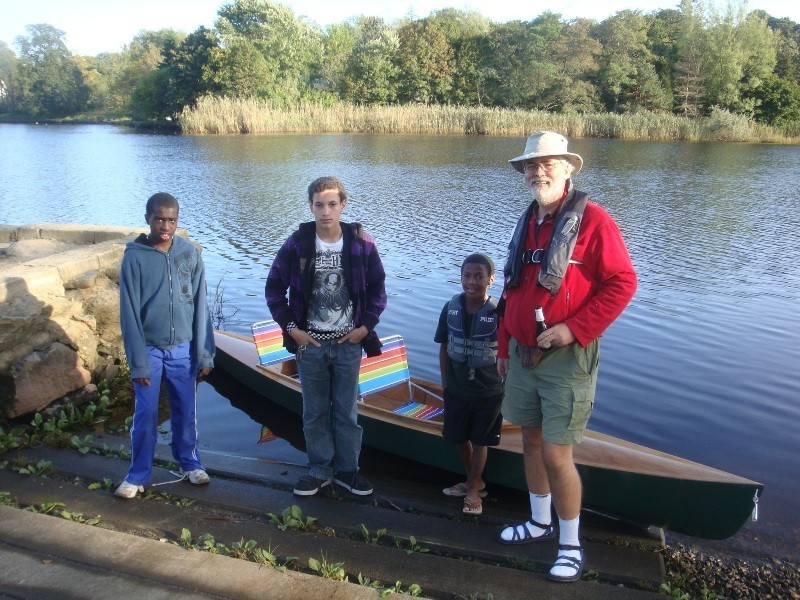
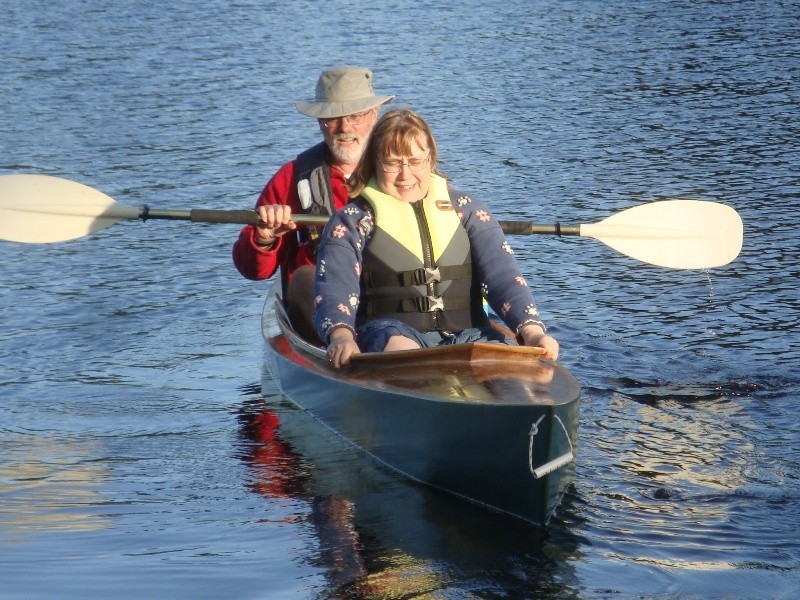
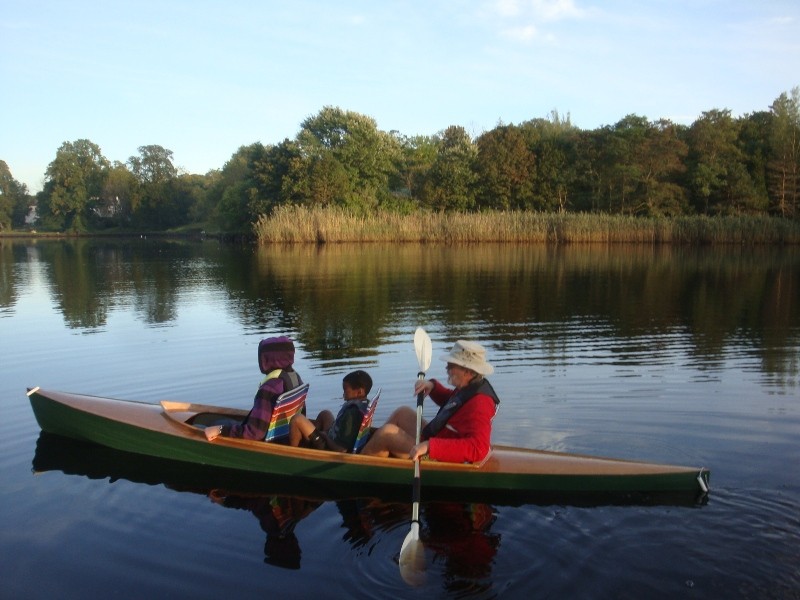
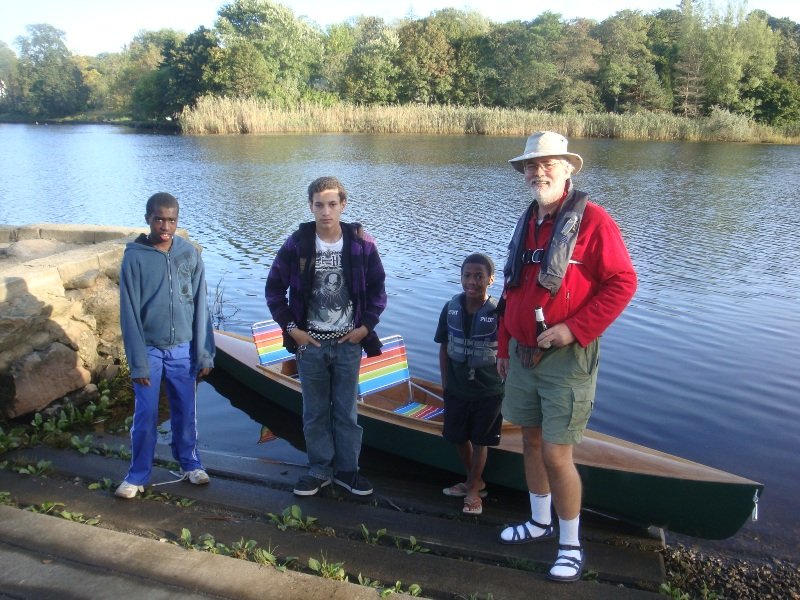
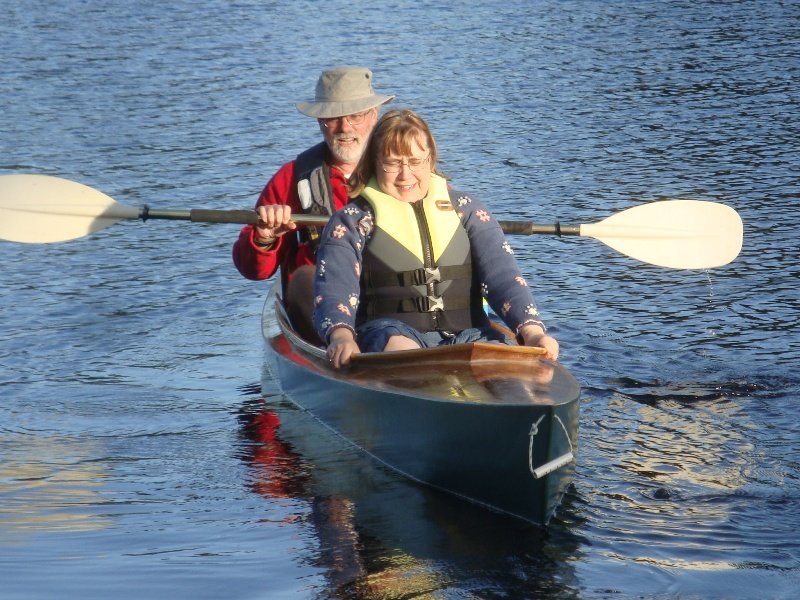
Yesterday was glorious weather: cold in the am, but warming up to shirt-sleeves by early pm. Boat basically done, cradle for the roof rack serviceable, and high tide about 4pm, it was time to launch! Here are photos: 1. putting it in the water. 2. Me and the boys. You can tell the teens--Trevor and Aron--by their world-weary expressions. The cute little bottle of champagne in my hand went first on the boat, then a few thimble-fulls to each boy, and the rest to Captain and Admiral. 3. Pride of place goes to the Admiral, of course. A short and symbolic ride, though, since Beatrice is world's greatest white-knuckle boater. 4. NOW she smiles--seeing dry land ahead. 5. Last ride is a short jaunt with 14-yr-old Aron and 9-yr-old Stephen. (Didn't get any photos of a long ride with Trevor.) I'm not used to boats with so little freeboard: with my hands on the side decks, my sleeves got wet. 6. Aron started having fun once he convinced me to hand over the paddle. My land-lubber eldest child even thinks he might like to go again!



-
Bob, my dimensions almost exactly. My cabin, being farther aft, has a bit more leg room, but the berth top, continuous with the seats in the cockpit, give just short of 33" at the highest point under the closed hatch--all the height the rig will allow, plus a little. But at 6'2", I can't sit up but have to stare at my bellybutton. (I blame my parents.) My cabin isn't walk-through, since I have a solid chunk of roof between main and fore hatches. But I can get easily to the fordeck without going around the side decks, which are very narrow on my boat. Having said that, I very seldom resort to going through the cabin. My boys sometimes go through, liking to hang out on the fordeck in gentle weather. More relaxing for Dad in all ways. My reasons for building a cabin are the same as yours, including keeping spray out of the cockpit. My cb up and downhauls originally left out the bungee because I knew the stock design would interfere with raising the port floorboard. But I found I liked the positive control over board position, and I added the releasing clam cleat to have the best of both worlds. (I sometimes still have to ease the pressure on the board to move it, though.)
-
My rudder stays down fine. Same system as Dawn Patrol, I think: Duckworks releasing clam cleat on rudder downhaul. I have a second one on my cb downhaul. I can beach the boat practically "no hands." Re-setting the clam cleats is a simple matter of pushing them back into place--work of two seconds.
-
You can sit up in the after part of the cabin? I wish I could in mine. How did you manage this? And, if you don't mind my asking, what is the max. distance between the berth tops and the highest point inside the cabin? Do you find yourself tripping over the thwart on the way in and out of the cabin? Is the space between thwart and cabin comfortable for sitting?