Designer
-
Posts
1,758 -
Joined
-
Last visited
-
Days Won
182
Content Type
Profiles
Forums
Events
Everything posted by Designer
-
The current plywood list for the BRS 15 is, 6 sheets of 1/4" 6mm and 3 sheets of 3/8" 9mm ply. Graham
-
Core Sound 20 Mk 3 -- #4 "Chessie" . .
Designer replied to Pete McCrary's topic in B & B Yachts Forum
Steve, Peter asked us to assemble the hull far enough along so that he can trailer it home. He will assemble the cockpit module at home and install it in the hull. We will not glass in the transom, he will unscrew the transom so that he can spread the sides to insert the module. The keel and chines will be glassed. If you look at the video that Alan posted on installing the CS17 mk3 module you will see how it went. I was very pleased that we needed to make no adjustments to the panels, every part fitted. -
Mike, you will have to check with your dealer. The size of wire depends on the load and the length of the run. The fact that you will have the start battery aft means that the run will be short enough that you will not need to up size the wire. For instance on my 30 hp Suzuki, they asked for a #8 wire. Because my battery was at the forward end of the consol, I had to run a #4 back to a terminal block and take a #8 into the engine. Why I did not take a #4 wire right into the motor? There is not enough room for wire bigger than they recommend.
-
I just got a call to say that the surgery went quicker and better than they had hoped. She is resting comfortably.
-
Marissa (eco 18) went to Europe !! photos of build
Designer replied to Lotus's topic in B & B Yachts Forum
Lotus, It is people like you that make the long hours I put into this very worthwhile. Congratulations on a great job, I know that she will repay all of your hard work. -
Registering a Boat is different in each state. I have heard that Florida is one of the more difficult ones. They are trying to stop boat theft. It would be fairly easy to make some modifications and say that you built it. Fortunately there is a pretty good record of your build right here.
-
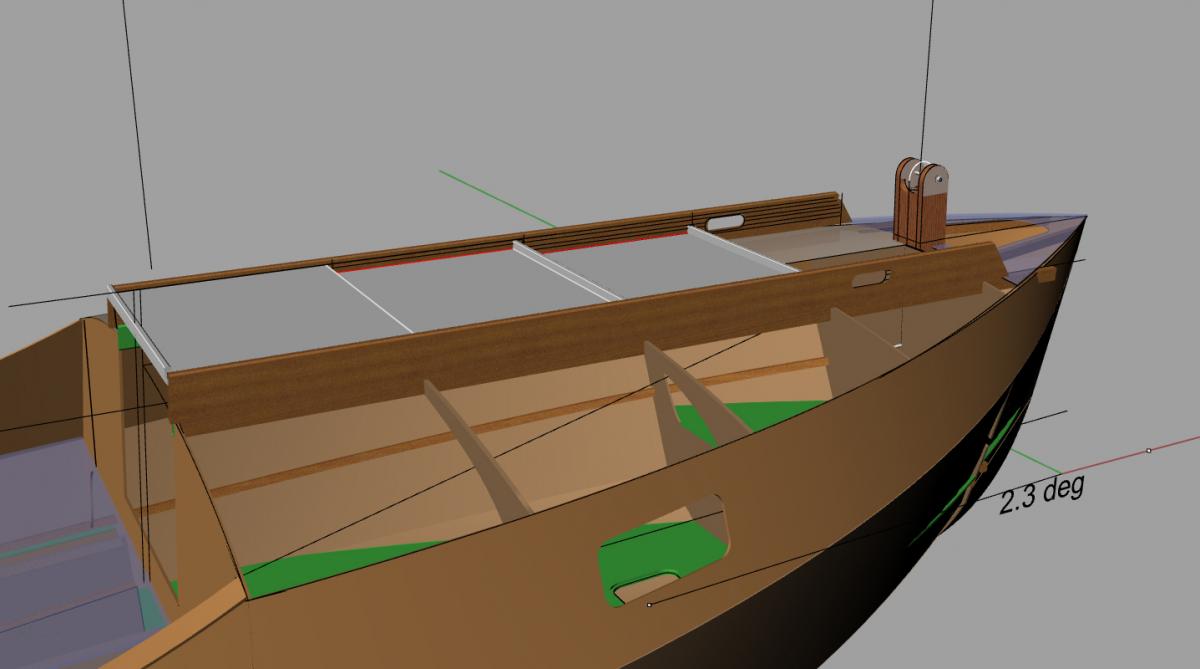
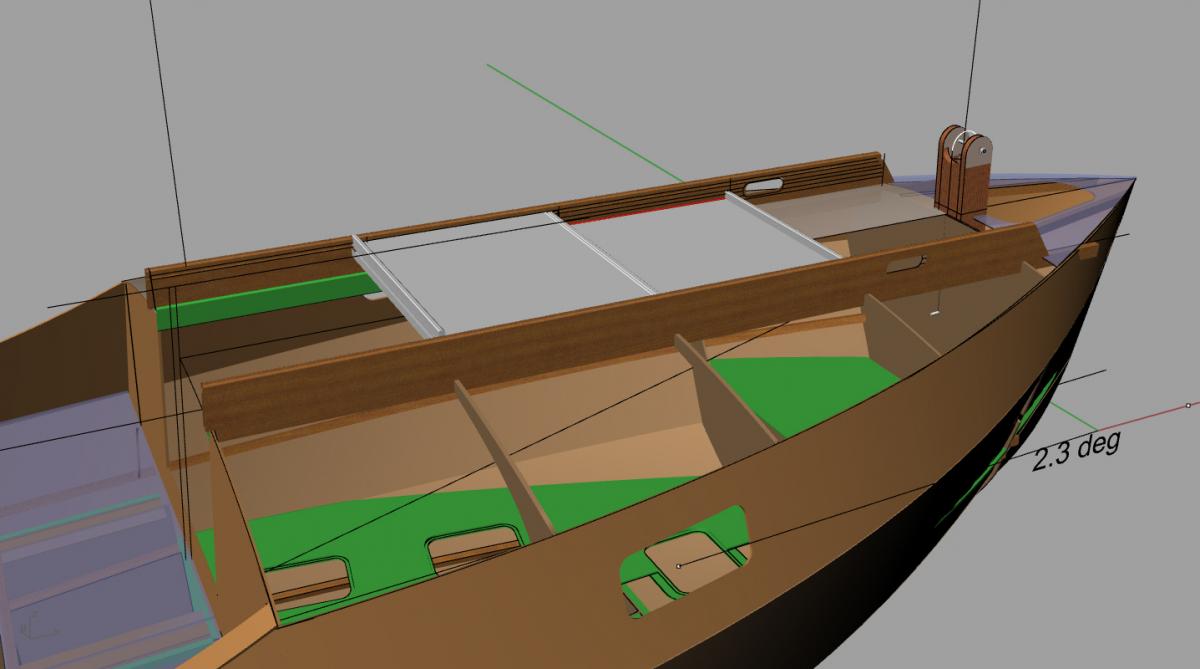
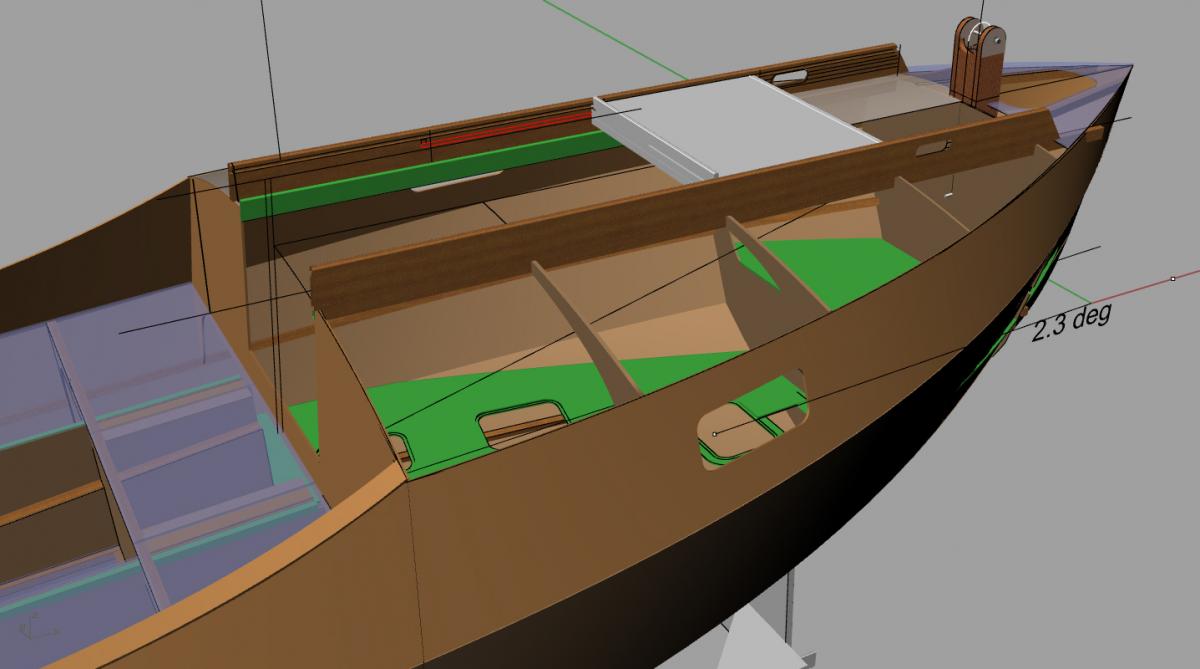
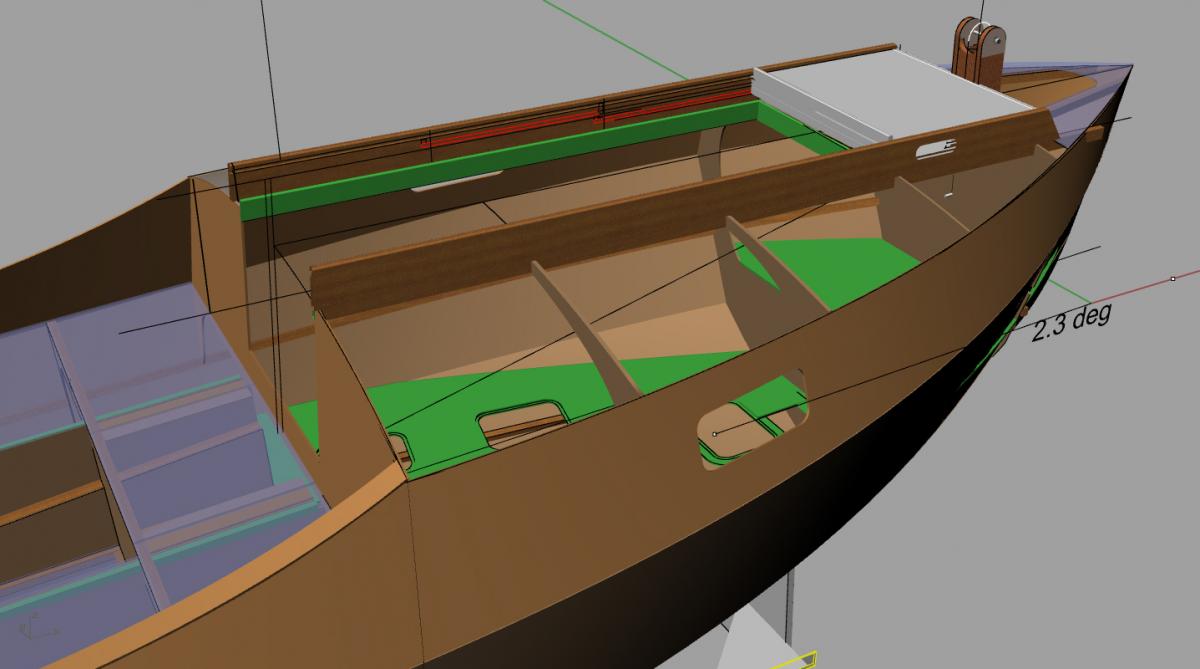
While on my trip I got to go flying. As the hanger doors slid by each other I thought, I should revisit the cascading hatch. Alan and had discussed it and it was dismissed. My main criteria was that it must not leak at highway speed in driving rain. Here is what I came up with. Three hatches made of 3/8" ply. Each one has one has cleats front and back that stiffen the hatch and overlap its partner so that when it is pushed open it collects it's partner as it is pushed open or closed. The cleats will have some weather stripping which will compress against it's partner when the hatch is closed, There will be a sweeper strip of rubber or plastic on the front of each cleat that bears down on the hatch or deck below. The green piece is a coaming that surrounds the trench perimeter to keep any water out that gets by the hatches. The rails are 3/4" ply with grooves cut for the hatches to slide.


-
Thanks for your support. Carla is going in for the second stage of her back surgery. It is not a relapse or anything wrong with her previous surgery. In fact it turned out to be excellent and she healed perfectly. The only problem was that she picked a bug called C-diff which nearly killed her. She will have the same surgeon but at Dukes other hospital. It will be done in two stages. Monday is about a 2 hour surgery and Tuesday will take between 6 - 8 hours. We are optimistic that it will go better this time. She will be out of the office for up to a month. If anyone needs to get up with us they need to contact Alan or me.
-
Next year Dale.
-
I thought about the viability of a CS15 mk3 a lot after talking to Chick today. I spent some time in Carlita's cabin, trying out the bunks and imagining a smaller sister. I think that it is feasible but I do not see the point. It would have almost all of the same components and steps to build. The rudder, centerboard, ballast tanks, tabernacle, the masts are the same but cut down etc.. It would cost nearly as much, take almost as much time to build, to get a slightly slower boat with a cramped cabin. It does not get into a lower class of towing vehicle. According to the owners manual of my 1900cc vehicle, a loaded CS17 mk3 with trailer is well under the recommended limit. I agree with Bob, most people are bigger and need a bit more space. About sleeping so far forward, that is why I wanted the feet under the cockpit. The water ballast would make at more stable with someone sleeping forward.
-
It is not hard to put your boat on a trailer. You have a winch on the trailer and a bow eye on the boat. Just line up the aft roller on the trailer with the keel, crank up the front of the trailer as necessary and winch the trailer back to the front of the cradle. If you have some help you can use them as ballast to keep the front of the trailer down while you disassemble the front end of the cradle. Alternately you can block up the boat amidships first so that there is no weight on the trailer until you get the trailer back to the mid blocking. Remove the blocking and crank the trailer back until the boat is part of the trailer adjusting the front height of the trailer with the wheel jack as necessary. It is easy to manhandle that boat and trailer on a good surface.
-
chick, The ballast does not run to the transom. It is only between bulkhead 3 and 4. I had intended you to sleep head forward. Alan suggested that the bunk top be raised forward so that it would trim level when being used. This would also widen it slightly forward as well.
-
I think that I might have been taken out of context on the 1" backing plate. I agree with Dale.
-
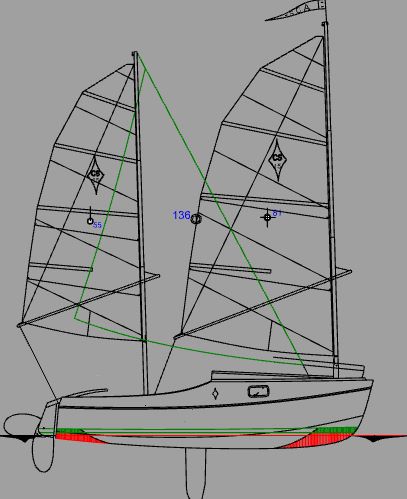
Chick, I am not a magician. I have to obey the laws of physics. I can't bring the bulkhead aft because that brings the water ballast tank aft as well as forcing the crew aft. The poor thing would be dragging it's tail like an abused dog. The WL is only 14', the overlapping of the bunks and cockpit is the only way I can make it work. The transom does rake forward slightly. Yes it does lengthen the WL but it gets some volume aft as well as encouraging the crew to be more forward. It is not much but we need to optimise everything to make a decent boat out of a teacup. All you need is a wedge on the transom to make the outboard work.
-
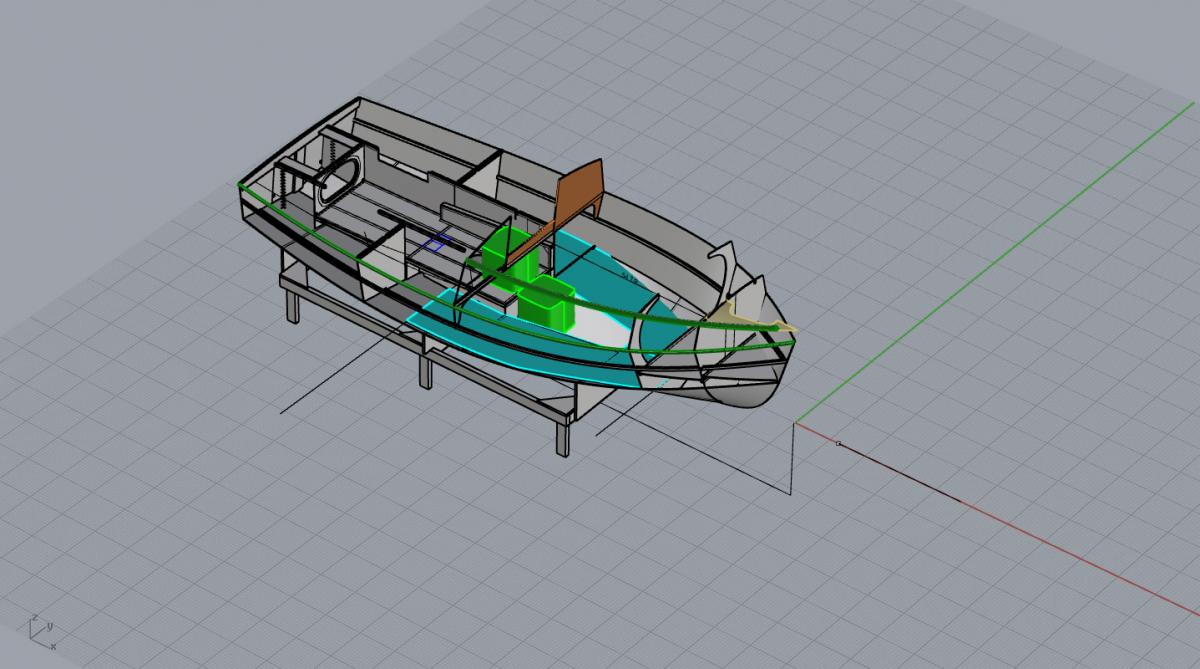
Whoa Chick, there is still a lot to do. I had already ruled out no foot well. The bunks that I drew in are 6'3" long but they could go all of the way back to the bulkhead. It appears that the small porta potti will fit under the bridge deck, see the green cube. It will have to be moved to use it. When I have someone on board our OB20, I move it to the cockpit at night to save the other person from being disturbed during nocturnal visits. It should be possible to fit the Zuki in a well but it will be a squeeze to stow it in the cockpit locker with the narrower beam.

-
Hey Chick, The cold weather is not all bad, I found a small window to start fleshing out the CS15 mk3. I decided to make it 15' 3" long rather than 15' even to better use up the 2 sheets of ply for the side planking.

-
Joe is mostly right on the evolution of the different marks. We did the mk2 for Chick which was a mk1 with a cabin with enough adjustments to make things work. It showed so much promise and there was a lot of interest shown in the boat and requests for kits. I decided that because there was so much work to develop a new model and get the tool pathing perfected, the building method optimized and a good building manual, it was worth starting from scratch rather than just adding to the mk1. CLC claims that it costs them about $100k to fully develop a new model to full production. Compared to the mk1, she has exactly the same rocker, the freeboard is 2" taller, the chine beam is a couple of inches wider to carry the extra load. All of the bulkheads are in a different position and the hull structure is different. The mizzen mast is further aft to create a rowing station. The sail area is larger because of the increased stability and the centerboard is in a different position. There are a lot of other small changes. I get a lot of calls asking if they can turn their mk1 into a mk3. The short answer is no. We are now at about 1 1/2 years since we started to create the mk3 series. If it was not for Alans help it would not be nearly as far along. I think that it was worth all of the effort because it has really worked out well. This does not mean that the mk1 is obsolete, it is still a great boat.
-
Marissa (eco 18) went to Europe !! photos of build
Designer replied to Lotus's topic in B & B Yachts Forum
Lotus, You are overthinking it. The 10 hours will go by soon enough. 13 " pitch will be pretty close and operating in break-in speed you won't notice much difference. -
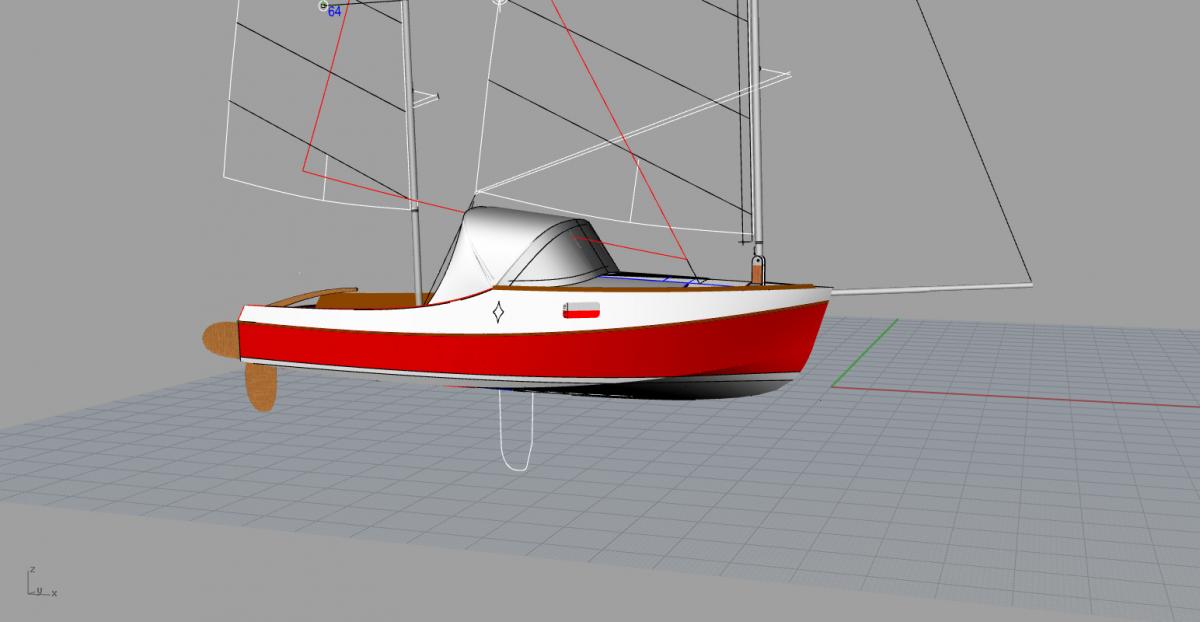
We are excited about the quality and detail in the manual but as Alan said, it takes time. To get the thread back on track here is the way I intend to finish Carlita. I have opted to put in a sliding hatch and cockpit dodger, big boat style and a fore-hatch that will give me access to the mast through the fore-hatch. I have enjoyed the protection of the dodger in bad weather a lot over the years and I am trying to turn her into my ultimate micro cruiser. It comes at the cost of having to duck down to go forward but it will allow me to keep the main hatch open in rainy weather when it is hot. It also allows me to stand up in the hatchway. Being petite I think that red will be fun. I forgot to mention that the dodger can dropped in moments which is the way that it will sail in good weather.

-
I found a window of opportunity and epoxy coated and glued down the bunk tops today. I can now wire up the second sheer strake and begin work on the cabin.
-
The paint manufacturers do not recommend using polyurethanes under water. I know that these are trailer boats but some are left in the water for long periods. I always do my bottoms with epoxy paint only and I can add antifouling paint if I want to leave a boat in the water. Remember that in the summer you will have barnacles in a week.
-
Lennie, It is for the staysail eyestrap. It is to space the halyard block away from the mast so that halyard does not get squashed against the forward side of the mast when it is loaded.
-
Don, You are over thinking it all. Just use the lace on sails and forget about the reefs. The one time I might have reefed my BRS in 12 years was during a race in open water with wind against the tide. The wind was more than I could use and I had to feather the sails a lot. With the steep sea I was taking quite a few splashes over the forward rail and every now and then I would misjudge a gust and ship some water over the rail. It got to the point that she was starting to stagger in the gusts and slow the boat down, the upshot was that the bailer could not keep up with the water ingress. It was obvious that I had to stop and bail or sail the boat under, I was leading the race and did not want to stop. Procrastination is one of my better traits but common sense finally prevailed. I bailed the boat and carried on, the fetch shortened as I beat to windward and the chop lessened and everything was fine. I hove her to and to park her which made it easy to bail. If I was not racing I could have done what Alan and Paul did when they lost their mast, heave-to roll up the main and sail under mizzen alone and rake the centerboard to reduce weather helm and leave the masts where they were. If I was reaching or running and there was too much wind, just let the sails go forward until I was depowered. I always thought that the third mast step was not to be used while alone and underway. It can be rigged before going out or if the shore is handy go shore and rerig it if necessary.
-
I left out a sentence. You roll up the sail and park it. The reefing is only using one sail.
-
It is not Zipper reefing i is simply a zipper luff. If it was not for the sprit we could use a zippered luff like we use on the Sprindrift's. I am not prepared to give up on the sprit or wishbone because they make the sail so much more controllable especially in strong downwind conditions. This means rolling up a sail to reef in smaller boats or sail track and jiffy reef in the larger boats.