JeffM
-
Posts
1,019 -
Joined
-
Last visited
-
Days Won
1
Content Type
Profiles
Forums
Events
Everything posted by JeffM
-
Hi, Gregg. Ouch! How's your rudder box and motor?
-
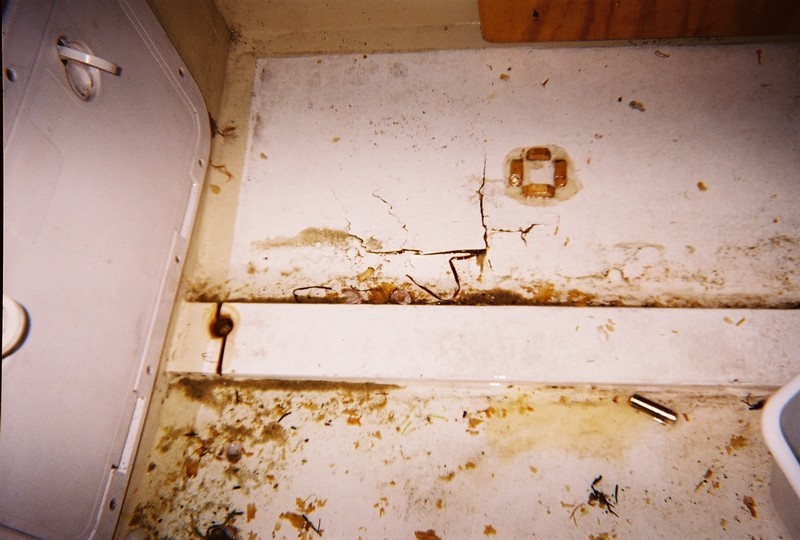
I'm guessing no one will be very surprised by this question. I have a hole in 9mm okume in the bottom and in 6mm okume in the side. The one in the bottom was immersed in seawater for 4 days, give or take. I'm expecting I'll make the holes rectangular and butt in patches with glass on both sides.Come to think of it, maybe diamond shaped would be better in the side, which has a slight curve.) What I don't know is what, if anything, to do about the water that infiltrated the wood, and whether the salt will have any consequences. (The boat was rinsed, and has now had 4 days drying out.)
-
Part IV I couldn
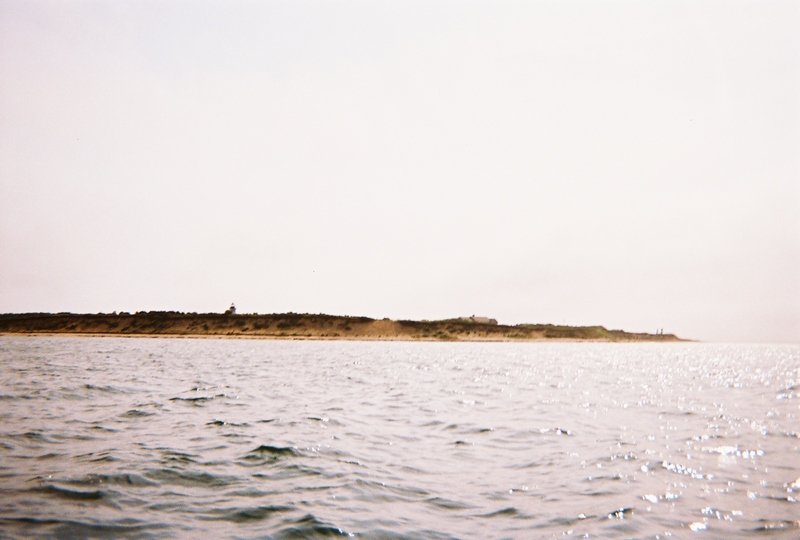


-
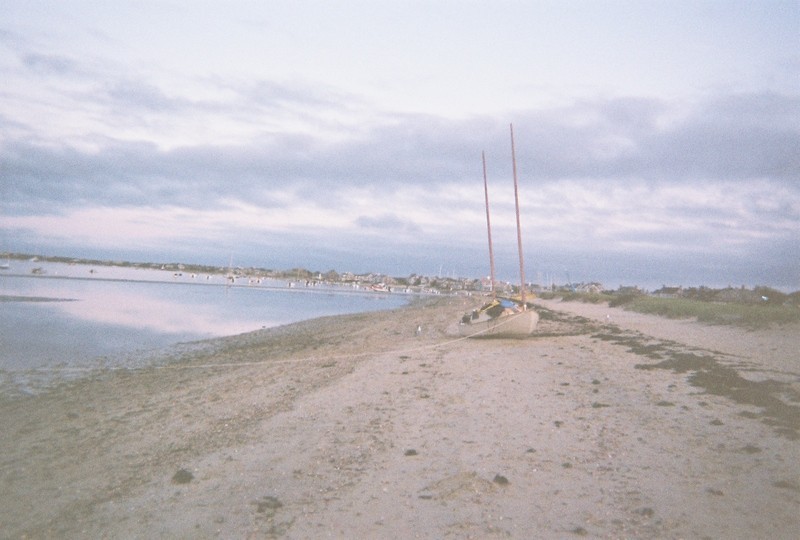
Part III We got the harbormaster
-
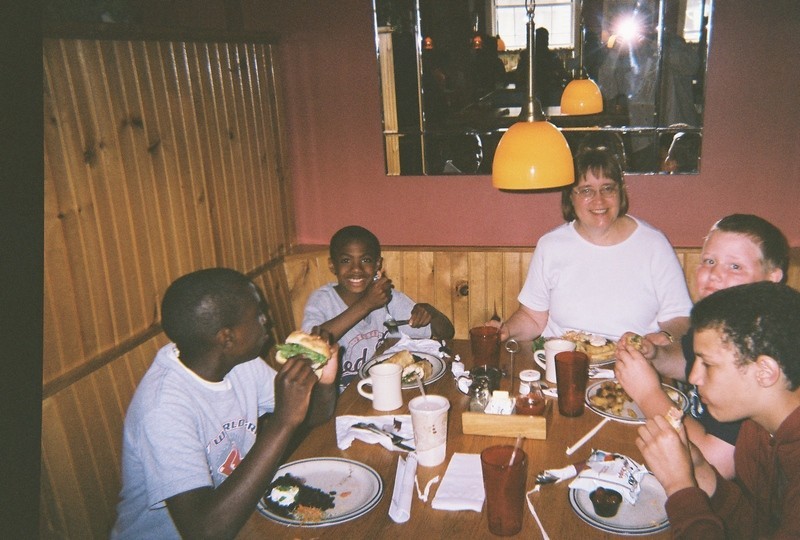
More photos: 1. The family in Fog Island Caf
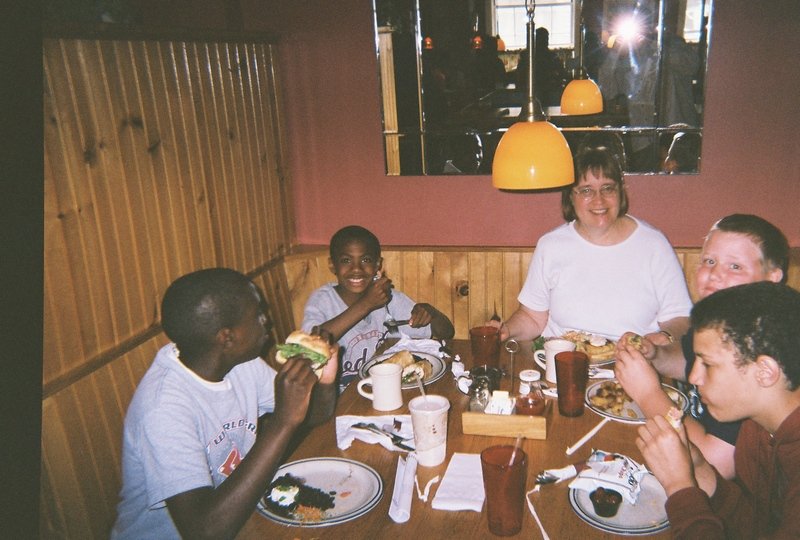
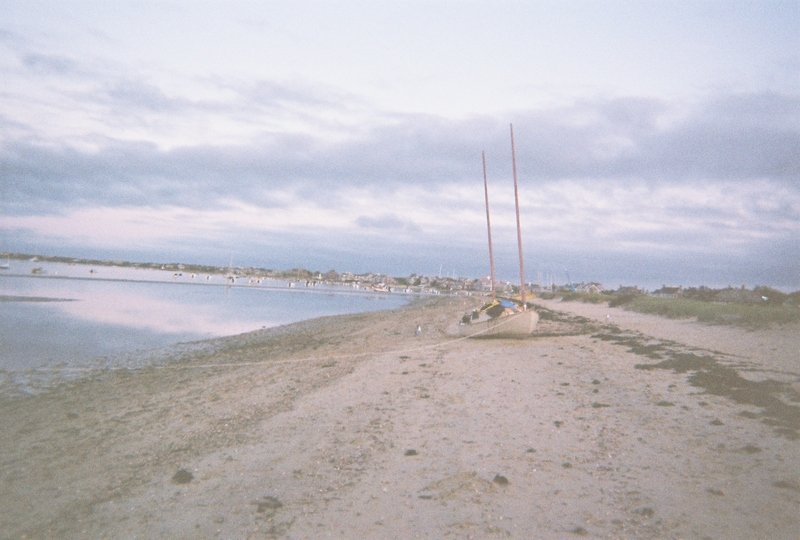


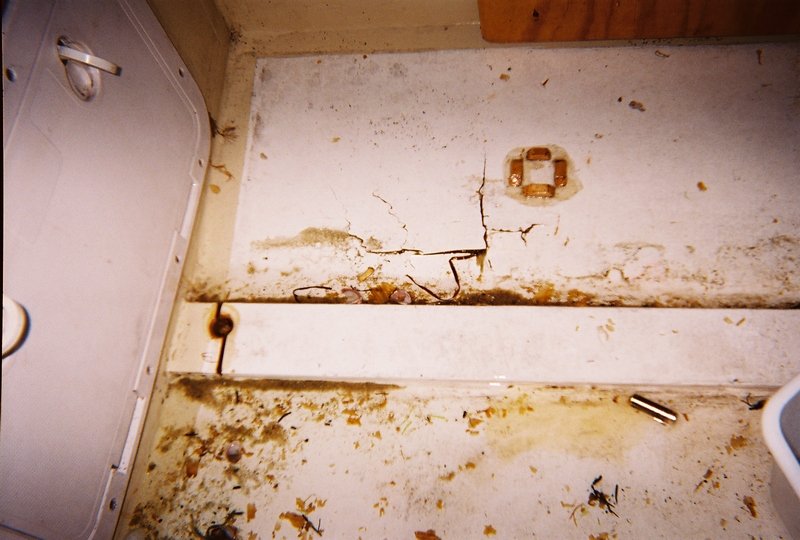
-
Tom, what's the purpose of the swivel block? Does it avoid the need for a block near the foreward end of the sprit? Oops! Just realized that, with the mizzen in the reefing step, this system wouldn't work. I suppose I could unreeve the Brent-style sheet and attach the mainsheet in the conventional way...
-
Sailed Snark (styro) and Dad's Sunfish as pre-teen and teen, giving it up during college. Gentle sort of mid-life crisis re-ignited interest: visited Old Mystic Seaport, joined boat club, felt limited and wanted own boat, became fascinated by Sea Pearl "low resistance sailing," scared off by price, lured by Web siren song of "you can build a better boat than you could buy," then happened upon Graham Byrnes' Core Sound. Beatrice gave whole-hearted endorsement, bless her! The rest is history.
-
Regarding the mizzen sheet rather than the staysl: That's a question I have, too. Brent clearly puts the fore block on the sprit. How does he reef? Also, is the block & cleat arrangement on the mast or the thwart? I can't see it clearly in the photo. I have snagged at some VERY awkward moments, and would like to try Brent's system.
-

Re: "MORE Misadventures with Capt. Jeff" -- reader reaction
JeffM replied to paul_stewart's topic in Main Forum
Sorry about the suspense, Paul! In my youth I wanted to be a writer. And I figured a disaster like this has to have more silver lining than just teaching me to mark my anchor line! -
Ahoy! CS 17, #218, "Lady Grace", has LAUNCHED!!
JeffM replied to SUKIE's topic in B & B Yachts Forum
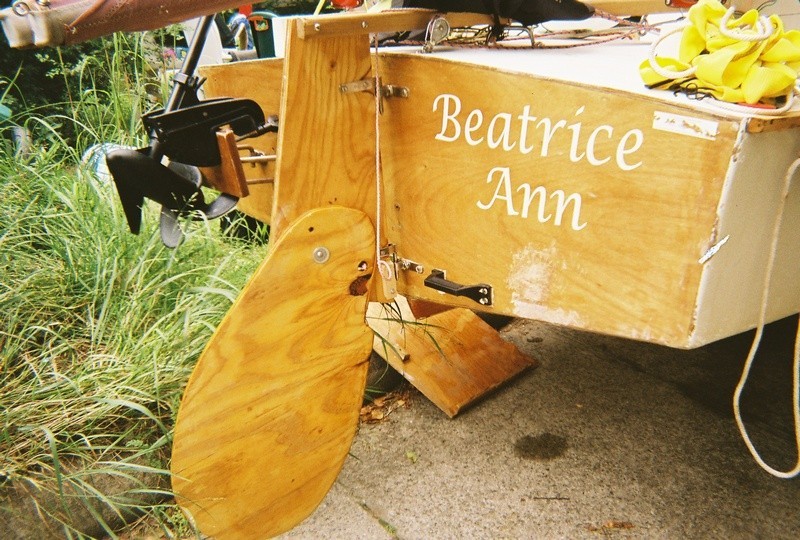
Congratulations!!! Sukie, a board would be the simplest solution, but I found my ancient gas motor (short shaft) and my little trolling motor needed to ride pretty low on the transom to stay submerged. I got one of the tripod mounts from Duckworks. (They look pricey until you price the alternatives.) It goes on and off pretty easily and I'm moderately satisfied with it. -
Part II We paddled back to the town pier and harbor master to ask for help. One good thing about a Core Sound is that it doesn
-
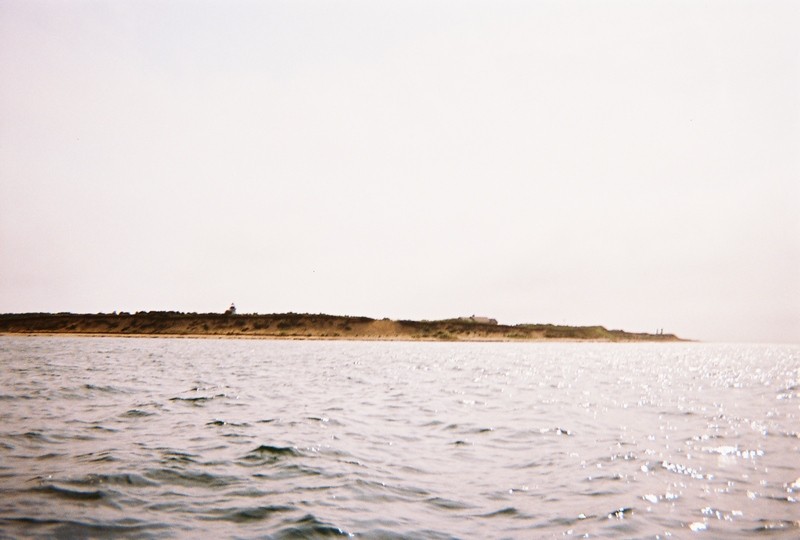
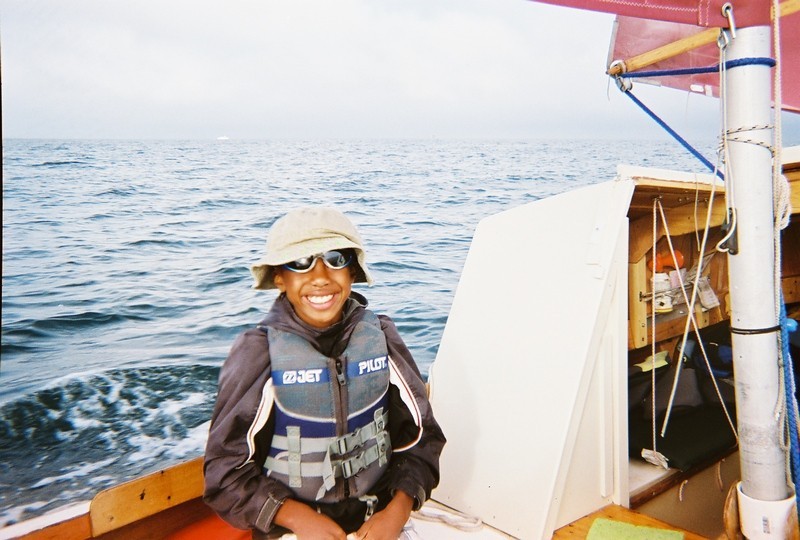
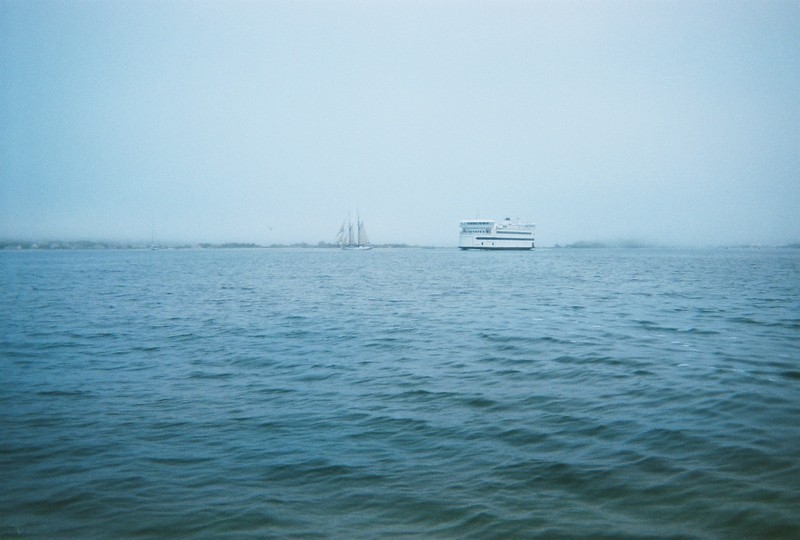
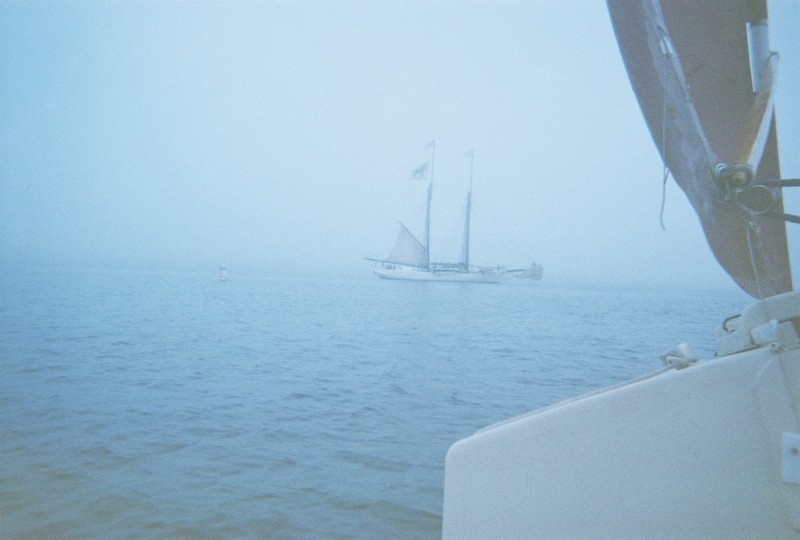
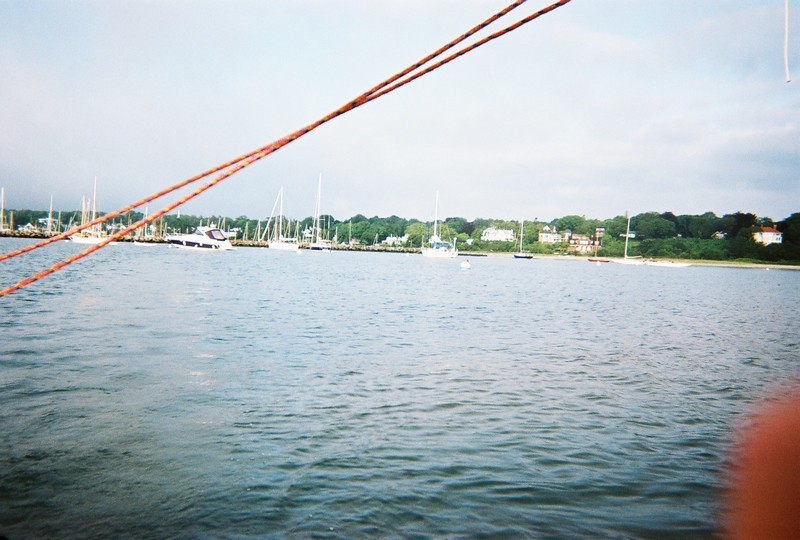
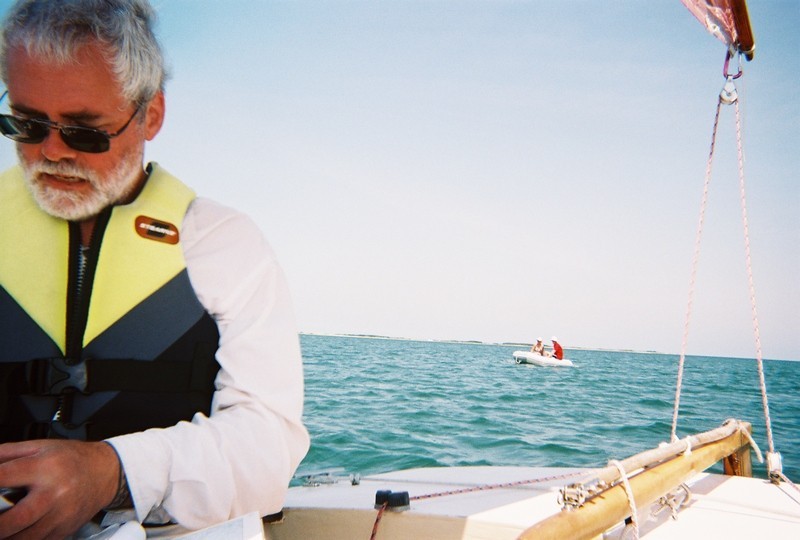
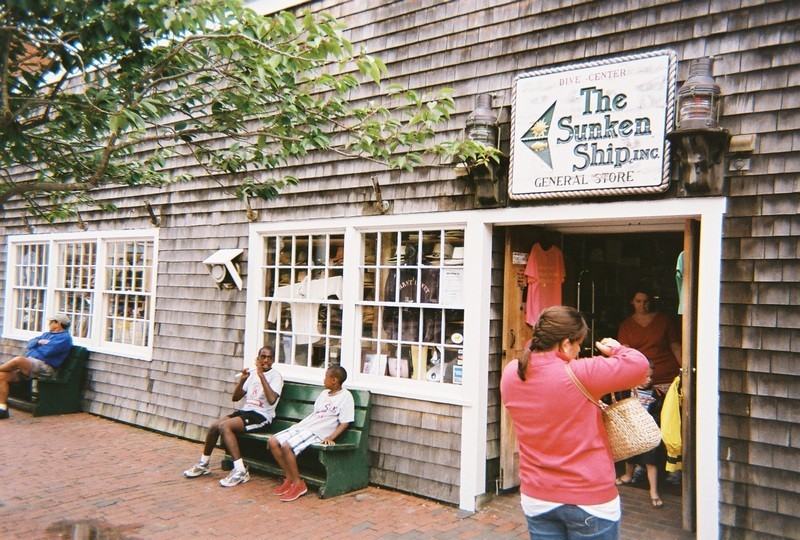
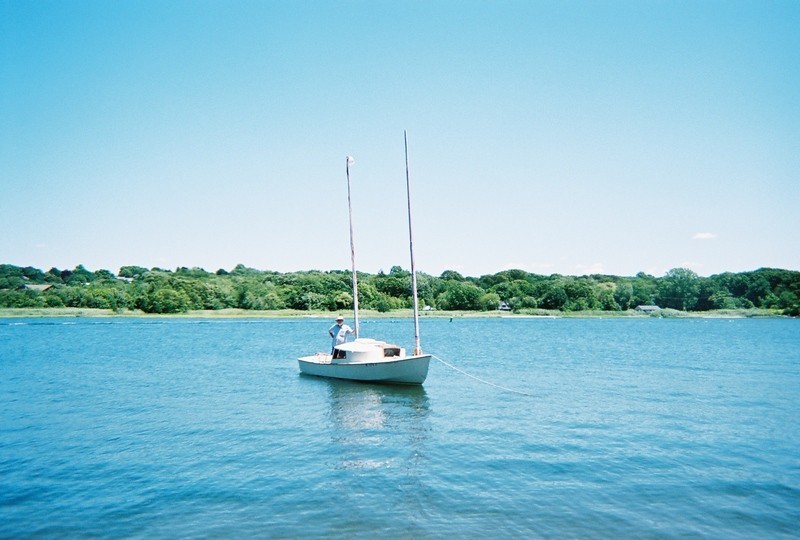
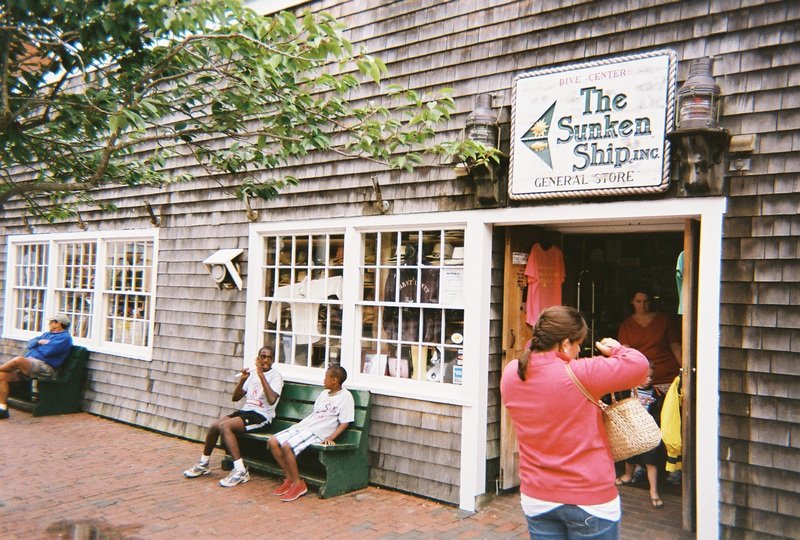
Sorry to be behind: technical difficulties sent me to bed. Photos for Part I 1. Stephen, in shades he chose himself. 2. The schooner Black Dog is coming into port in Vineyard Haven s car ferry departs. 3. We got to watch her furl her sails one at a time. 4. My favorite place to anchor is at the right hand end of the breakwater in the distance. It's tight, but well-protected and very close to shore and downtown. 5. Just anchored in Nantucket Harbor, the Old Man watches the gps to make sure the anchor bites. 6. "Have you ever known a bad omen to be wrong?" (The boys have had a successful shopping expedition.)


-
(Being a Serial in 3-4 Parts) Part I New Bedford to Nantucket was to be the big trip of the summer: the farthest off shore, the longest open water passage, even the starting point of Melville
-
I was confused, too--trying to imagine how you'd raise the yard, where you'd run the sheets with no mainyard below, etc. But I try to keep an open mind! (I was rather disappointed to find that's not what you were talking about!)
-
I just finished O'Brien's Aubrey/Maturin novels--actually, I've been rereading most of them so I'm not really finished. I love the technical details (though I haven't quite puzzled out how a full-rigged ship is tacked) as well as the main characters and story. O'Brien has recreated a rich world for me. I wish he had lived to finish the 21st.
-
Paul, the way I figure it, if I can get to the boat at all, I can probably walk my hands along the gunwhale to get to the point I need to. Flying is so safe partly because pilots are schooled and constantly thinking about "what if?" disaster scenarios. I take this lesson to my sailing. My nighmare scenarios (in no particular order) are (1) capsizing and being unable to right, (2) having kids in the water panicking and getting separated, (3) being in the water and unable to catch up with the boat, and (4) being unable to haul my carcass back aboard, and (5) having any of these happen far from help. I think I might have #1 in hand, #2 calls for drilling the kids, #4 is solved by both a (Duckworks) boarding step low on the transom AND a hefty bolt through the rudder blade low down to act as a first step. For #5 I have a hand-held (waterproof, buoyant) vhf radio and a waterproof gps, and in a pinch both can be secured to my pfd. To deal with #3 I have considered: training the kids to heave-to, somehow having swim fins in easy reach, tying myself to the boat with a safety line, and trailing a big length of line over the stern that I COULD get to. My current favorites are well-trained kids, and (especially when single-handing) a safety line. My new fancy-dandy inflatable pfd even has a built-in safety harness. On the other hand, I am probably most at risk of going into the drink when balanced on the foredeck fussing with flapping mainsl, snotter and sprit while reefing in a good breeze--not sure how to secure myself in that situation.
-
Thanks for the compliments, all. I'm quite proud of my work. Ken, I watched my boat come up with a snap--I know I couldn't move that fast. Good point on the drift rate: I nearly always check the gps while hove-to--even in moderate winds it drifts at over a knot. I'm no kind of swimmer, especially in a pfd. I look at letting go of the boat like an astronaut letting go of his spacecraft: sayanora!
-
Graham suggests wetting out the wood, then letting it set (so you know the wood is done absorbing it) before gluing with thickened. That way you also don't get a problem with the prior unthickened epoxy mixing with and thinning the thickened stuff.
-
Paul, if I had it to do over again, I'd lead lines from both mastheads. The mizzen is much nearer the center of resistance, but with bow and stern both restrained reducing the load on the mizzen would be a good idea. I had expected the boat to go over about as easily as when I tested it 4 years ago. (Mizzen appears to be okay.) Absent flooding of cabin, I don't think the boat would turtle. A good breeze against the bottom in a port capsize could make a difference, though, so I will run a fat float to the masthead in risky conditions. As far as realistic testing goes, I didn't want to endanger my stuff, and I didn't want the predictable tumble of loose gear. I was relieved to see the batteries stay high and dry--didn't want them to short in saltwater! I will be adding turnbuttons to my seats to hold the raised bunkflats in place. When I first capsize tested, I had the boat empty but fully rigged. I decided that the sails confused the issue a bit: slowing the turtling and also slowing the righting. I was also reminded that the mainsheet must be released before righting--boat tried to sail onto rocks with me clinging to transom! I will be interested to see how your test goes; I'm guessing your narrower cabin won't hit the water until much further over, but you have much less opening to worry about.
-
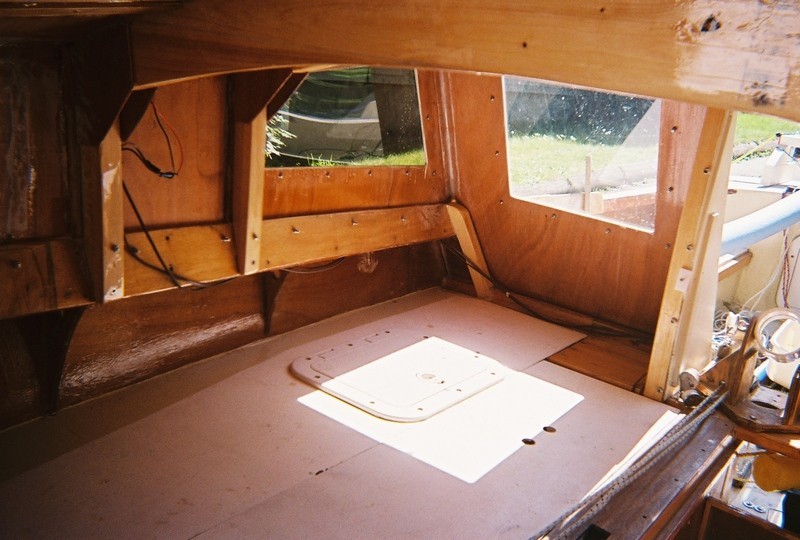
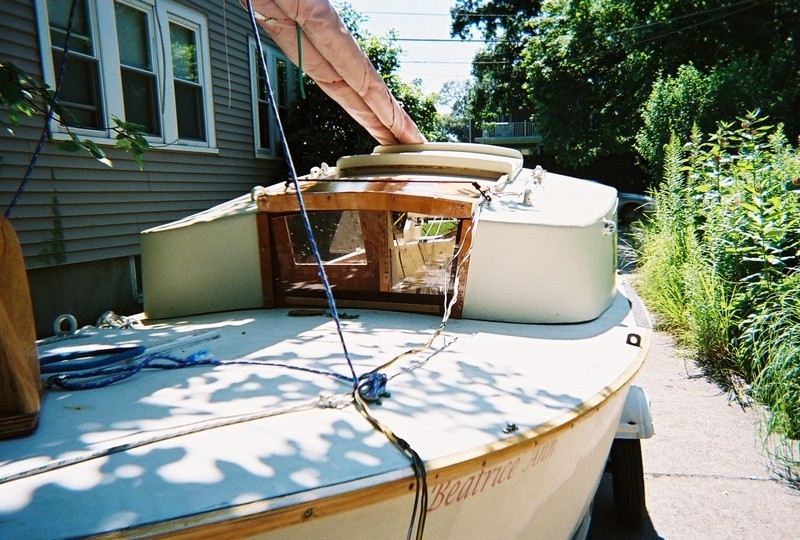
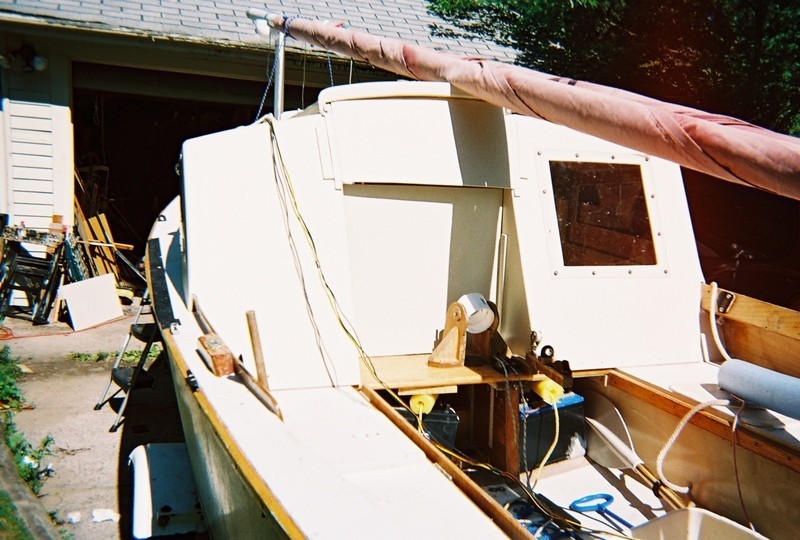
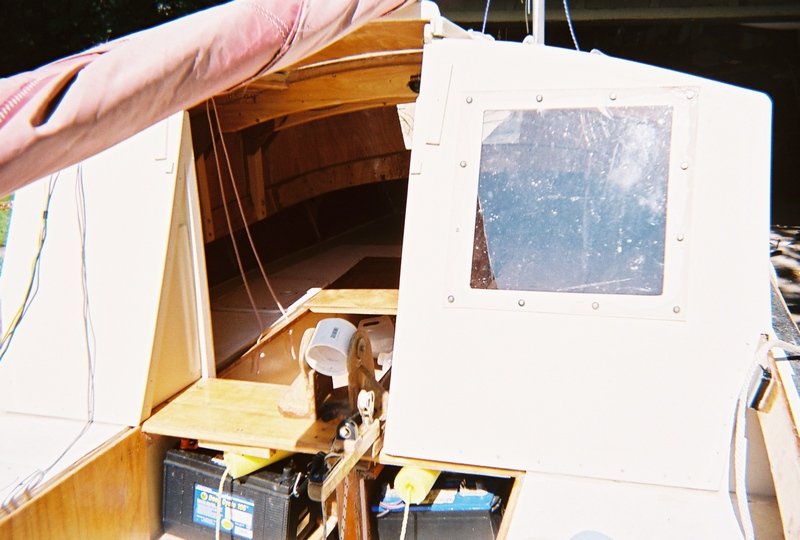
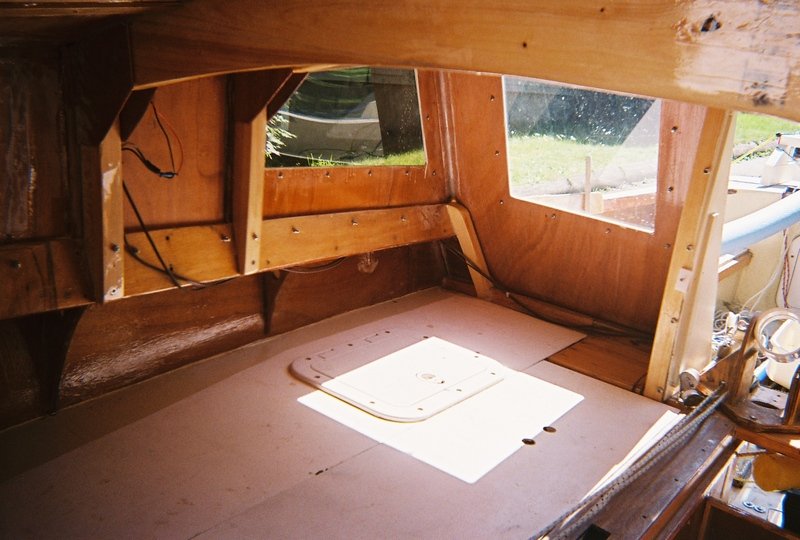
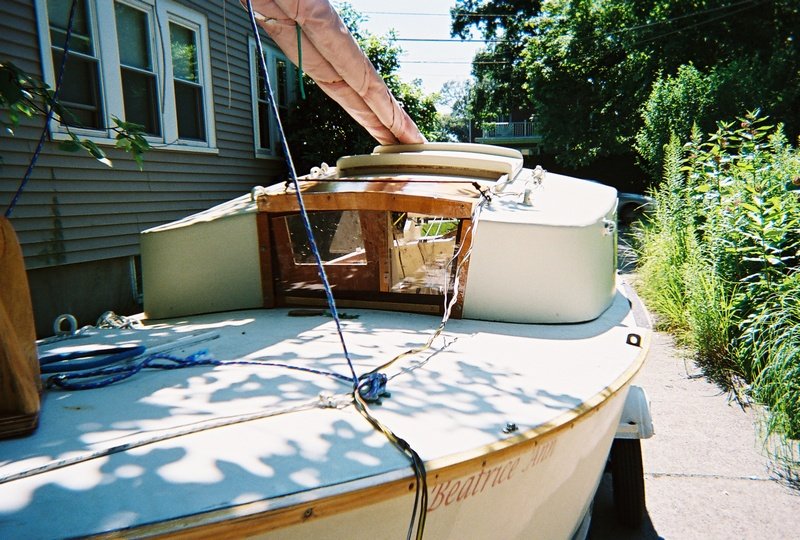
The cabin in detail. 1. looking in from the cockpit. The aft bulkheads are anchored with screws to cleats glued to seats and thwart, and also to small under-the sidedeck bulkheads permanently installed. The big plexi window allows me to keep an eye on kids when they're in the cabin, and lets me look up at the stars at night. 2. The skipper's berth flat, looking aft. I leave this starboard floorboard in the raised position, giving me room for the inflatable kayak, its pump, & fenders. The two roof beams (made from 2X4s) are also visible. 3. the forward companion is closed by a tinted Lexan drop board that makes a very respectable front window. (Side windows are the same stuff.) The fore hatch cover simply lifts off. These are usually closed against spray. 4. The low bulkhead under the thwart should allow us some sleep during as much as an inch of rain without flooding the cabin. Another bulkhead is out of sight on the other side of the cb trunk. (When I have both boys out in bad weather, the youngest must sleep on the floor. In good weather, the skipper sleeps in the cockpit, leaving the regular berths to boys.) 5. Buttoned-up tight. A little rain drips in off the thwart; I haven't decided what, if anything, to do about it. Bug screens can close off the space you see between the upper and lower companion covers, the spaces under the thwart, and can also replace the fore (Lexan) drop board for more ventilation. Most of the time, the main companion covers live under the mattress on my berth. The sliding main hatch overlaps the fore hatch without touching. For more ventilation, the fore hatch cover bungees on top of the main hatch cover.


-
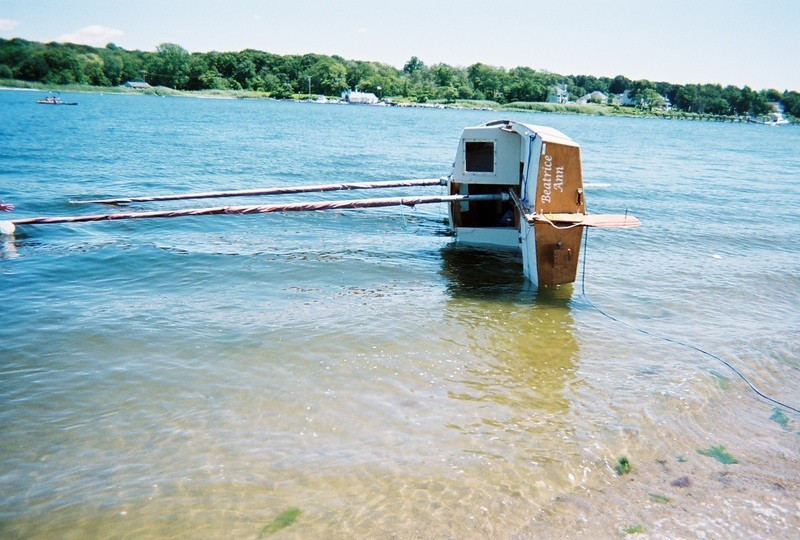
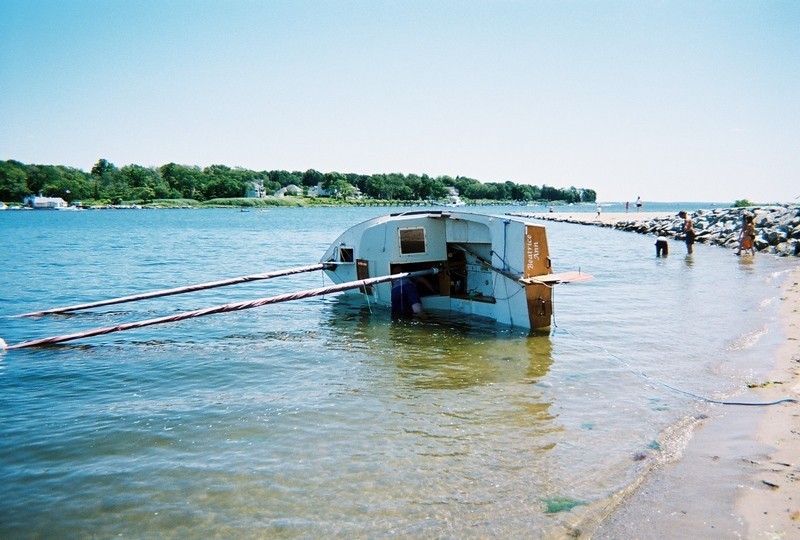
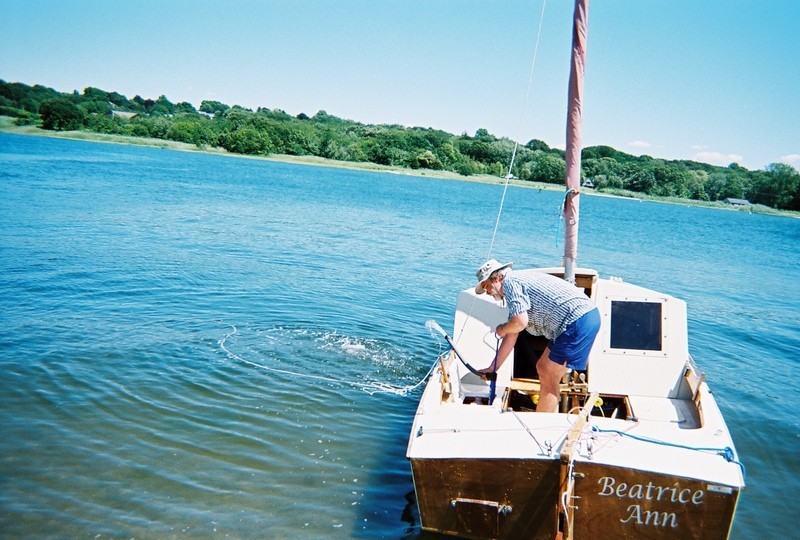
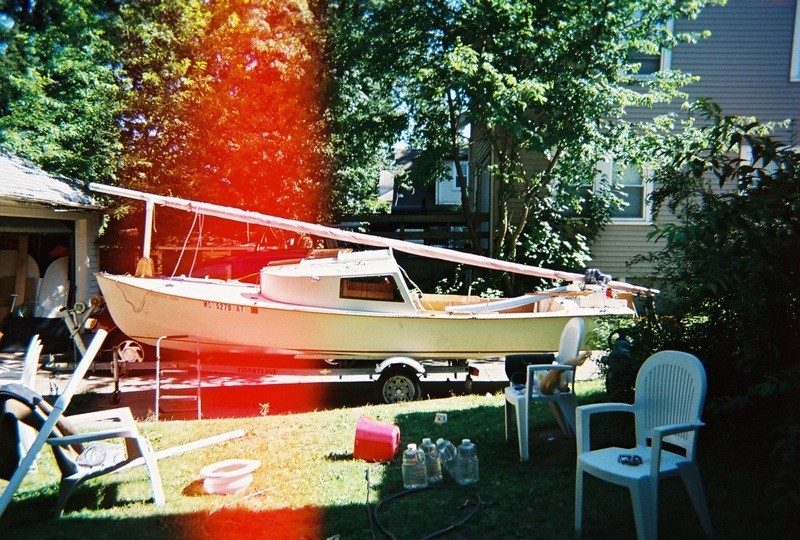
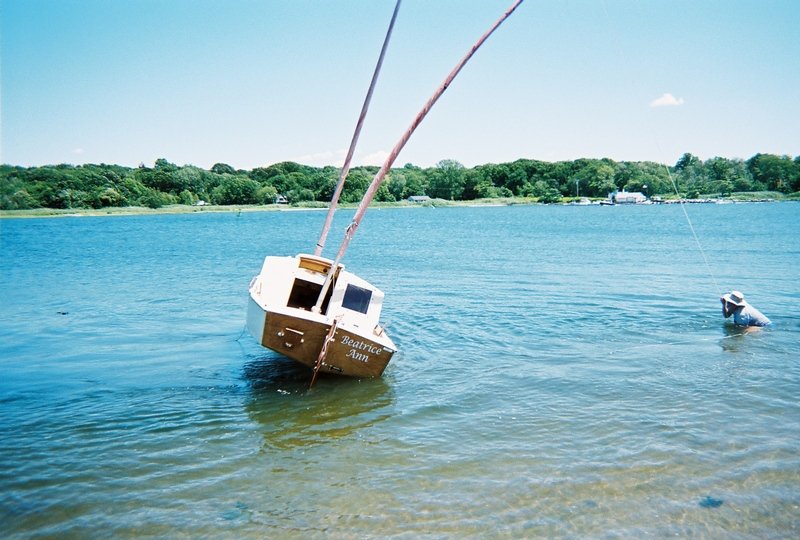
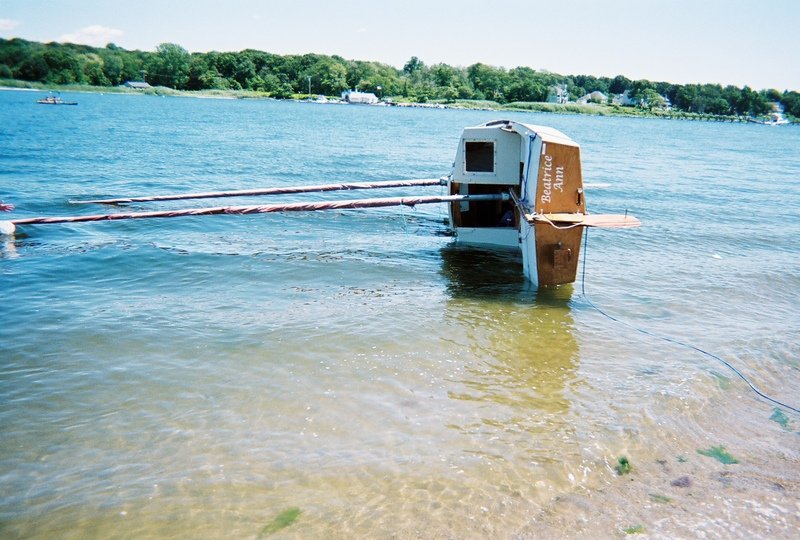
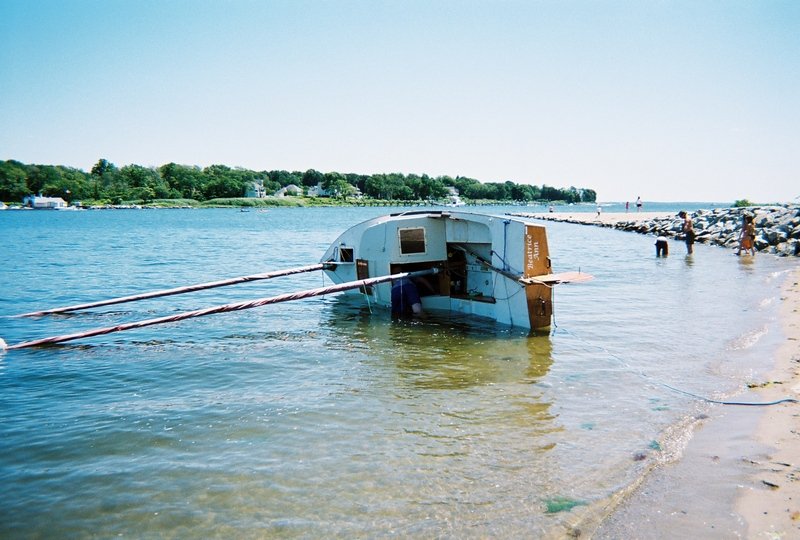
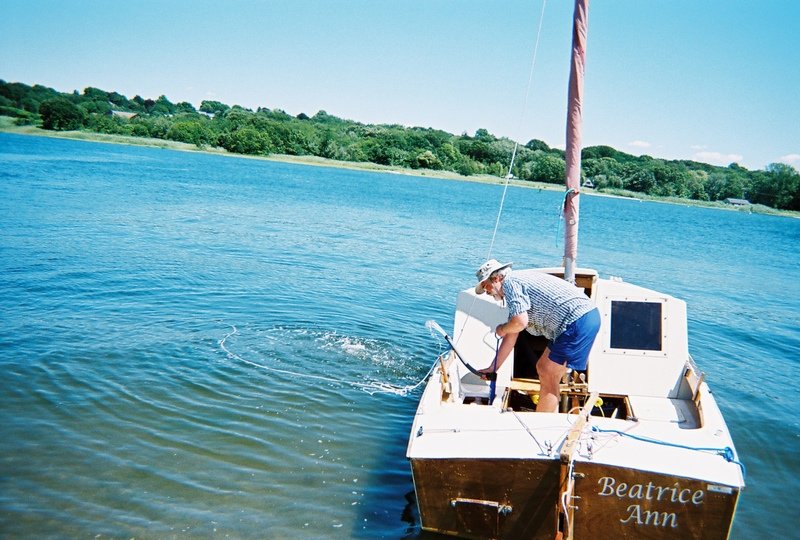
The test itself. I'd originally planned several subtests: starboard capsize with locker hatches taped, then st with hatches allowed to flood, then port, etc. But difficulty of getting the boat over led me to go on to port capsize. (Since my dad was busy holding stern, he got no pictures of the that process.) Photos: 1. before. 2. this would have scared me, had I had this view. 3. masthead touching water, hatch edge still well clear. (Bottom drops off fast; at no time while capsized did any part of the boat touch.) 4. I'm trying to find the source of a leak into the cabin. (It was coming in between coaming and cabin edge. Garden hose has since shown me I have more cauking to do.) 5. Pumping out the seat locker. Unfortunately I got no photo with the seat locker flooding, but I was impressed that the hatch didn't get much closer to the water. I may add flotation anchored against the hull side in this locker so that it cannot take in so much water. 6. back in the driveway after the test.

-
My cabin finally done, it was time to see how it would handle a capsize. I built a cabin because I wanted: (1) privacy, (2) a dry place to sleep, (3) a refuge from wet weather, (4) something to stop the spray, and (5) a place for kids. I also had an idea that a cabin would maybe reduce the amount of water that came aboard in a capsize and help prevent turtling by providing buoyancy high up. These last were very iffy: my two large hatches are offset to port, placing them directly above the sole on the port side of the cb trunk, and I feared the hatch edge would be at or below the water in a port side capsize. The boat was unloaded, the usual gear weight replaced with 13 gallon bottles of fresh water, about equally distributed between the space beneath the forward seat and the lazarette. Only the anchors in the forepeak and the two deep cycle batteries beneath the thwart (important as ballast) were left aboard. The boat was anchored, cb down, sails furled, and my father held a stern line when the boat refused to stay put when I pulled on the mizzen stays
-
My Anderson bailer is right beside the keelson on the opposite side to the centerboard. I've long been dissatisfied with it until I learned by observation that it needs a quite specific speed: just over 5kt. Much above 5kt and it sucks so hard you can hear it. Until I pass 5kt I don't open it. At lower speeds it will take in water, but not so fast that I have to pay attention to it if my speed keeps changing. Below 5kt I suppose you don't get much spray, but of course if its raining...
-
I put Xynole on the Birder 2 I will someday finish. Rough, ugly stuff. My grinder seems barely to scuff it. But it drinks epoxy like there's no tomorrow: by using it I'll bet I added several pounds to the weight of the boat.
-
Wow, is she pretty! Congratulations! I like the bright deck with green hull. Do I see a place for rubrails masked out?