sanmi
-
Posts
58 -
Joined
-
Last visited
-
Days Won
9
Content Type
Profiles
Forums
Events
Everything posted by sanmi
-

Electric or gas motor for a core sound 17 mark 3?
sanmi replied to Samantha Ritchie's topic in B & B Yachts Forum
I have a short shaft. It has worked fine so far, but I have never had to use the motor in waves. -
Electric or gas motor for a core sound 17 mark 3?
sanmi replied to Samantha Ritchie's topic in B & B Yachts Forum
Congratulations Sam! Good Morning looks beautiful. I think an electrical outboard can be better than a combustion engine outboard, but it really depends on how you use your outboard. Rather than a binary yes or no, it is all about tradeoffs. For years, my wife and I had a suzuki 2.5hp outboard on our Core Sound 20 Mk 2. We prefer to sail or row and only use the outboard in busy harbors or when the wind dies in a ship channel. I don’t think we’ve ever motored more than 7 miles at a time. We switched to an e-propulsion spirit just before we took a 2 week cruise in the fast moving waters of the Puget Sound in May of 2022 . We only went into port one time, and we only charged the battery twice. If we had brought the solar charger, we would never have had to plug in at all. A few factors that made cruising with the electric outboard a success: We had a flexible itinerary, so we could wait out storms (a gale came through one day). There typically isn’t a lot of wind in May in the Puget Sound (except for storms), and there was plenty to explore in the San Juan Islands, so we didn’t need to go far. We rowed a lot and were meticulous about choosing favorable tides and currents. Over two weeks we sailed 56 miles, rowed 12 miles and motored 11 miles. We also did a lot of hiking and even hired bikes. We had a packraft for a dinghy which allowed us to anchor out or stay at a mooring buoy while still being able to go ashore. We used the motor a handful of times, usually at a very modest 150 watts to cross a ship channel, avoid ferries or get past a headland. For example, our longest time under electric power was to cross Rosario Straight in a dead calm. Rosario Straight has fast currents and big ships and it was our first time, so we were extra cautious. We crept up the east side of Cypress Island in a tidal eddy up to the tip of the island. At that point we increased power (more than 500 watts) for a few minutes to get through the strong current at the point and out into Rosario Straight. Then we crossed the ship channel at 150 watts, going 2 kt forward and 3 kt sideways until we caught the tide into Peavine Pass at 6 kt (2 kt motor, 4kt tide). As I mentioned before, we prefer to row or sail, but it would have been impossible for us to punch past the eddy by just rowing - our boat is too big and we aren’t strong enough. If we hadn’t had a motor, we would have missed the tide window and had to stay one more night on Cypress Island. This story illustrates the tradeoff we have made: we use the motor for cruising flexibility while still staying mostly human and wind powered. In exchange our boat is cleaner, more quiet, less smelly, and we don’t have to worry about motor maintenance. I am always surprised by how powerful the ePropulsion spirit is. It is so quiet that I don't get any engine-noise feedback to tell me how much throttle I've put on and if I'm not careful, I will jerk my 20', 400kg boat forward like a toy. When I first got the outboard, it took me some time to get used to it. My boat handling was very jerky while getting into a slip - start, stop, start, stop, etc. It is a bit like an electric car in how quickly it can go from 0% to 100%. If you need maintenance, a regular outboard shop won’t be familiar with the motor, but then there is almost no maintenance, so I haven’t been worried about that. A few weeks ago, I ran into some levee rocks in the Sacramento river delta and damaged the tilt device. It didn’t stop me from using the motor, but the reverse feature (which I love) didn’t work. I like working with tools so when I got home, I used wrenches, screwdrivers and a small hammer to remove the part, and then I ordered a replacement online. I am pretty sure a regular outboard shop would be able to do the same even though they aren’t an “authorized dealer” Here’s a video that just came out about electric outboards on small sail boats: https://www.youtube.com/watch?v=WomwETaSUmU&t=1s The electric motor is working out very well for us. I’ve just purchased the solar charger so next big trip, we will be even more self-sufficient.
-
Also, there are dinghy cruisers in the UK that put a car-sized battery in a box and use to to power a chart plotter. Like Roger barnes: https://www.dinghycruising.org.uk/uploads/7/6/9/7/76979649/my_seagoing_dinghy_roger_barnes.pdf
-
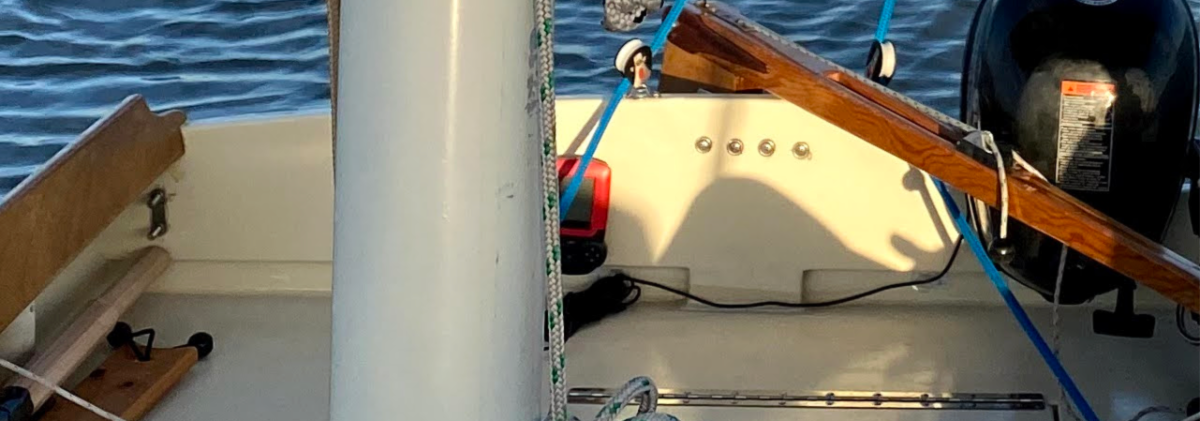
For decades my centerboard was my depth sounder. Then a few years ago we took our Core Sound 20 to the Columbia River, where there are 9ft tides. I bought a battery powered hummingbird with transducer mounted at the transom and the display also on the inside of the transom facing forward. It was an amazing improvement. It came in handy when transiting the shifting sand banks where charts aren't very accurate and I was surprised at how useful it was when anchoring. I was looking at it so much that I got tired of always looking backward while sailing or anchoring. Then last year we went to Puget Sound where there are 15' tides. I upgraded to a full chart plotter with a transom mounted transducer and put the display under the mast step. Another fantastic improvement, but this was a lot more work to do because it takes about .5 amps while it is running, so it pushed me to add an electrical system to my boat (which has other advantages).


-
We have a Bimini on our core sound 20


-
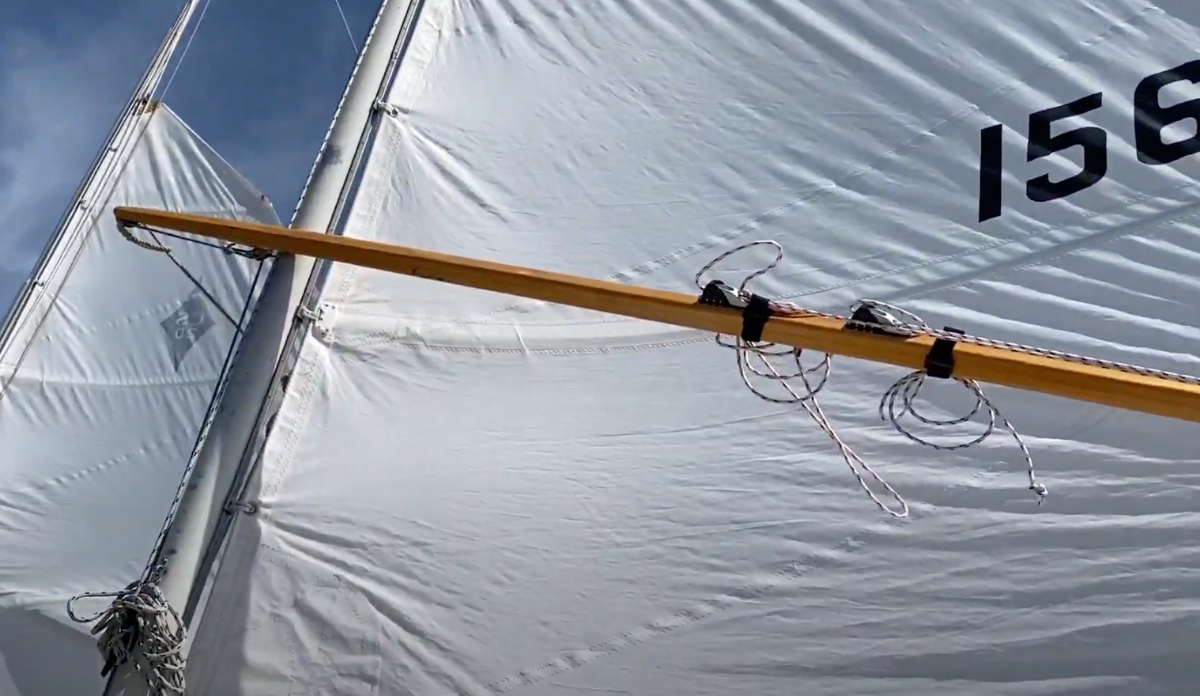
I use wrap-it super stretch velcro straps. https://wrapitstorage.com/collections/super-stretch I take one wrap around the boom and through the eyelet and then the second wrap captures the coil. Sometimes it can be a bit fiddly to capture the flying line, but for the most part I can do it with one hand holding the boom and the other hand wrapping the coil. I use them on both mizzen and main booms. With this setup, I can singlehanded take in a reef in both sails in a few minutes. My sequence is usually some thing like this: * heave-to and reef the main (mizzen tight, tiller hard over) * come back into the wind and fix the tiller to a close haul (I use a tiller-clutch) * reef the mizzen

-
I'm gravitating toward this solution. I also like the idea of being able to store the motor when not in use for long periods (e.g. in the wilderness for a week or two) to keep the motor from fouling the mizzen sheets. There is a place next to the centerboard where it might fit. However, if I'm going to be in the wilderness for a week or two, I'll probably want to use all of my storage for supplies. So maybe storing the motor isn't that important?

-
My centerboard popped open at the mizzen thwart, probably because of road bumps bouncing the board while on the highway. I glued and bolted a stop just like you.


- 1 reply
-
- 2
-

-
@Wommasehn I'm interested in your setup. * what kind of boat do you have and where do you put the battery? * I'm not sure where to put a battery in my cockpit. I could just put it on the cockpit floor, and run the cable to the motor. Or maybe, just keep the battery in the locker until I need it, and then pop it on the motor. Seems like moving around with a 20lb battery wouldn't be too bad. Especially since I intend to use the motor only rarely.


-
I like that idea. I don't rely on my motor as a safety feature so I don't see a downside to storing the battery when not in use. I only use the motor when there is no wind or approaching a crowded marina, and in those cases there should be plenty of time to prepare. The main downside is that taking the battery on and off increases the chance of loosing it overboard. The ePropulsion battery floats, but the torqueedo battery will sink like a rock.
-
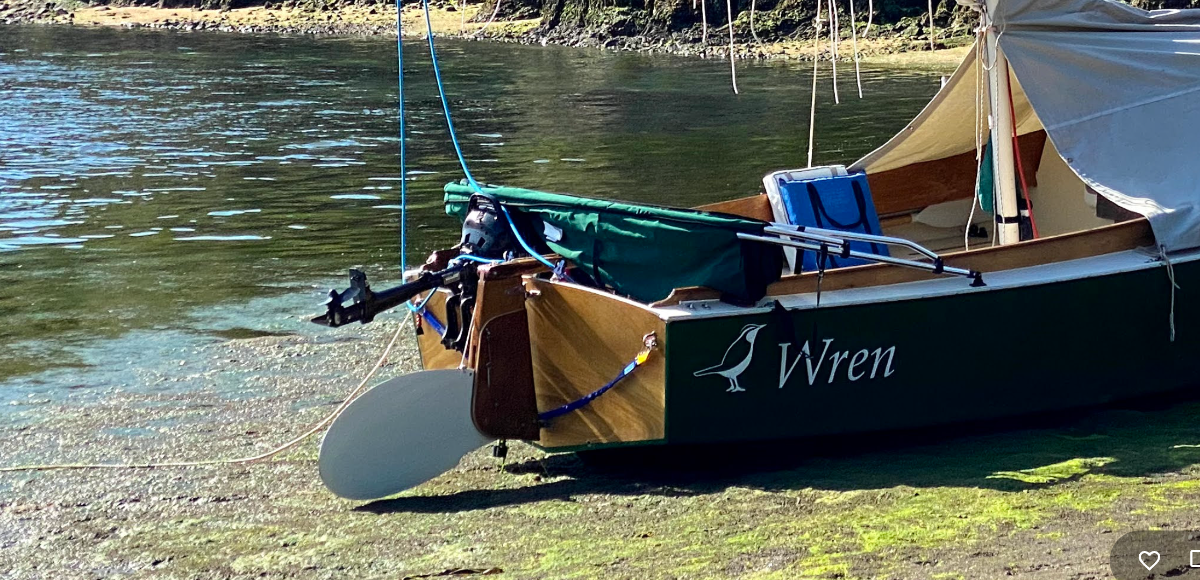
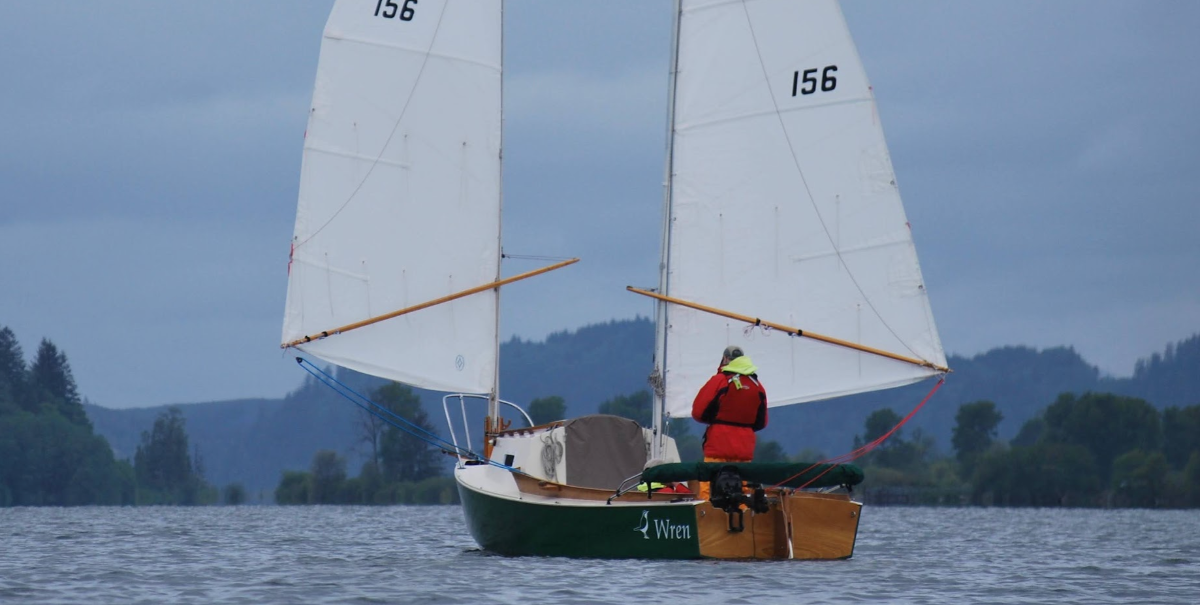
I want to get an electric outboard but they weigh more than my Suzuki 2.5 and I'm concerned about the added weight to the transom. A Suzuki 2.5 which only weighs 28 lbs. A torqueedo is 38lbs and an e-Propulsion outboard is 44lbs (bigger battery, more range). How much weight on the transom is too much weight? Here's a picture with me standing at the tiller and my wife sitting close by. Even with a light outboard you can see the transom is low in the water.

-
First time builder - Core Sound 17 Mark 3
sanmi replied to Samantha Ritchie's topic in B & B Yachts Forum
I guess I should think about adding interior hatches to our CS20 you built since we sometimes are caught out. ? -
Keeping a CS 20 in a slip for two months in Pacific Northwest
sanmi replied to sanmi's topic in B & B Yachts Forum
@DesignerGraham, thank you! My preparation todo list is quite long and having those dimensions and your instructions takes a weight off my mind. @Randy Jones Thanks for bringing this up. Where I live in California there are restrictions but I think the local West Marine seems to be on top of it. I googled Washington state bottom paint and found lots of conflicting info on the a 2011, 2018 and 2020 law. The summary is that Washington passed a bad law in 2011 banning copper bottom paint, reassessed it in 2018 and then again in 2020/21 and now has suspended it until 2026 with a plan to come up with a better rule - so pleasure boat owners can still use what the rest of the US has. https://waggonerguide.com/copper-bottom-paint-in-washington-until-2026/ Our trip is broken down this way: six weeks of part-time training in Olympia while I work remotely. The boat will be in the water walking distance from where we are staying. The goal is "certify" Julie as a skipper - so she can operate the boat single handed (MOB drills, docking, sail handling). We expect light winds and lots of rain. Then, we will do a two week full-time cruise at the end of May, possibly in San Juan Islands, Gulf Islands or lower Puget Sound. Maybe we can meet up at some point? Frank -
Keeping a CS 20 in a slip for two months in Pacific Northwest
sanmi replied to sanmi's topic in B & B Yachts Forum
How many Amp-hours per day were you getting from your solar charging system on your DelMarVa trip? I have a SunPower 50W flexible solar panel https://www.expertpower.us/products/sunpower-50w-solar-panel. I intend to mount it on the cabin top in between the hand rails which will give me room to move it about 10” port or starboard depending on where the shade is. I'm liking idea of a tricolor masthead light more and more. The main benefit in my mind is that it eliminates the need to route so many wires, especially the wire to the stern, and I won't have to pop as many holes in my bulkheads and deck or drill into my transom. I'm also adding a 12V receptacle in the cockpit for hanging a separate anchor light from the main topping lift. Current favorite is NASA Marine https://www.nasamarine.com/product/supernova-combi-tri-and-anchor-l-e-d-mastlight/ Thanks for the connector recommendation. It looks better than the SAE connector I've been planning to use elsewhere. Regarding the comments about a steaming light, I don't foresee a lot of motoring at night, especially since we will only carry an electric outboard, but if the need arises I will mount my backup NaviSafe battery powered LED on the bow pulpit. Back to the bottom paint. Any ideas how to find the fore/aft strike positions on my waterline without putting the boat into the water? There are no scum lines that give me a hint.

-
Keeping a CS 20 in a slip for two months in Pacific Northwest
sanmi replied to sanmi's topic in B & B Yachts Forum
I like that idea. I’m thinking I could use epoxy or 3M 5200 to seal the hole where the wires exit the mast. I’m using Waterproof cable glands elsewhere but those are too bulky for the mast. -
Keeping a CS 20 in a slip for two months in Pacific Northwest
sanmi replied to sanmi's topic in B & B Yachts Forum
Also, I haven't decided whether to go with a masthead light or deck mounted lights. If I choose a masthead light, I'll either need to dismantle it every time I put the boat back in the driveway or get a new boat cover because our custom cover fits snugIy over the masthead. There are port and starboard nav lights on the cabin, but I am concerned a transom light may be too low and will get obscured by waves. I'm also concerned about night vision. We won't plan to be sailing at night but it might happen. There will probably times when we have to start rowing before dawn . Any opinions? -
Keeping a CS 20 in a slip for two months in Pacific Northwest
sanmi replied to sanmi's topic in B & B Yachts Forum
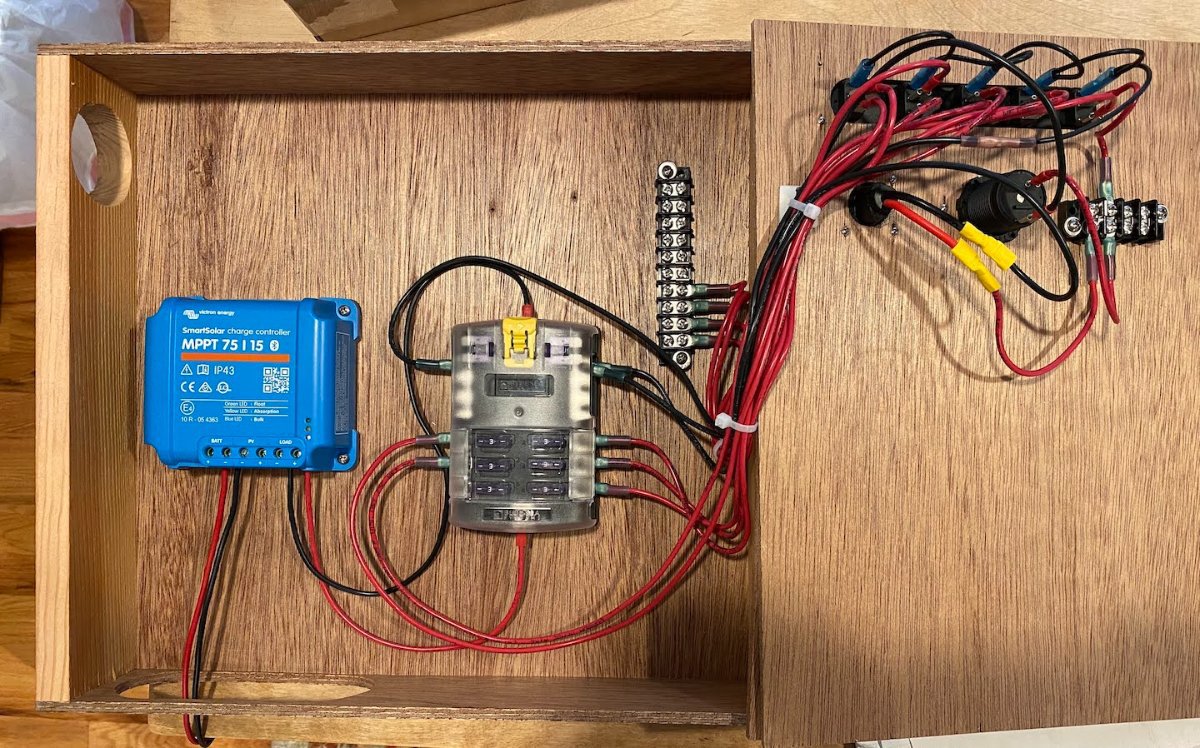
Graham, If I follow your 90% / 25% rule of thumb, then it leaves me 90 - 25 = 65 amp-hours of usable energy. I'll factor that in to my plans, My 100Ah system is intended just for the Chartplotter/sonar, anchor light, and charging portable electronics. Here are my calculations: Load per day .7A * 8 hr = 5.6AH - Echomap 74sv w/ dual beam transducer (spec for .8A with side beam transducer) .2A * 10 hr = 2 AH - Anchor Light 1.5 + 1 + .3 + .3 = 3.1 AH - Charging two phones and watches Total: 5.6 + 2 + 3.1 = 10 AH per day Solar Charge per day Assume most days will be cloudy = .3 of rated power 10 hours sunlight per day in the summer in the high latitudes 50 W * 10H / 12V * .10 = 12 AH So if my estimates are correct, I should be able to power my electronics just from the panel and still have some left over for maybe adding a powerful VHF. But with 65AH usable energy, that is still 6.5 days with zero solar charging and more like 12 days if we are staying at anchor (which would be likely if there was no sun for a week!). If we only get 5AH from the panel, that still gives us 13 days of power and, if we need to, we can save power by turning off the sonar, switching off the chart plotter for extended periods, only charging one phone, etc. Also, given the constraints of wind and tide (see below), I doubt that we will be navigating for 8 hours per day. I haven't found a great place to put the solar charger so I made an extra large circuit panel and added some ventilation. Any other ideas? As far as propulsion goes, our main propulsion will be oar and sail. The tides in British Columbia are 10 to 15 feet with 3 to 6 kt currents. There are long periods without a lot of wind, and the wind doesn't always coincide with a favorable tide, so our itinerary needs to be very flexible. We will have to plan our day by the tide tables and the summer wind patterns (which are fairly consistent). For example, on windless days we will be happy rowing for 4 hours with the tide to make it 10 or 15 miles to our next anchorage. Depending on our start date, and direction of travel it may involve getting underway anywhere from 5am to 3pm. On windy days, our boat can take us much farther. A friend of ours did 400 miles in six weeks in the inside passage without a motor (https://smallboatsmonthly.com/article/southing/). He traveled with the tide and had no fixed schedule, and that is our plan too. His boat is lighter and smaller than ours which lets him row against the wind and tide in places where we can't, so we think we need something to help us into and out of marinas where the wind or tide won't be in our favor. But I am pretty sure we can be safe and happy while hardly using the outboard. On a five day cruise last year in the Columbia River, we used the motor for a total of about 1.5 hours. We would love to get rid of the smelly gas, oil and noise. Plus - it has reverse speed!

-
Keeping a CS 20 in a slip for two months in Pacific Northwest
sanmi replied to sanmi's topic in B & B Yachts Forum
I'm sold on Lithium but not an expert. Here's what I've learned: LiFePO4 is pretty common in adventure vans and off-grid applications and I found a bunch of good you tube videos. In one video, the reviewer discharged a 50Amp-hour battery completely (until the battery management system cutoff) and confirmed that he actually got all 50 Amp-hours out of the battery. There is a wide range of prices. I chose something at the upper end with more features and a cold weather cutoff. It weighs 29lb and I can put it in the boat with one hand. https://www.renogy.com/12v-100ah-lithium-iron-phosphate-battery-w-bluetooth/?gclid=CjwKCAiAl-6PBhBCEiwAc2GOVLodgw1keEBLpi_bVVzZ-fAwRef4L3rZRDKwknswHTKXU1ZKlf5jahoC570QAvD_BwE Smart chargers meant for Lead-acid batteries won't work for LiFePO4 (e.g my old Guest battery charger) so I got a Victron charger 15 amp charger https://www.victronenergy.com/chargers/blue-smart-ip65-charger For solar charging, MPPT chargers are more expensive but also more efficient so you theoretically charge your battery faster. However there are some sources that claim that MPPT doesn't make much of a difference for small solar panels like my 50W panel. I chose a 15A Victron MPPT charger https://www.victronenergy.com/solar-charge-controllers/mppt7510 -
Keeping a CS 20 in a slip for two months in Pacific Northwest
sanmi replied to sanmi's topic in B & B Yachts Forum
I don’t have a steady hand. I like the look of a boot so I guess I’ll just have to mask three times! -
Keeping a CS 20 in a slip for two months in Pacific Northwest
sanmi replied to sanmi's topic in B & B Yachts Forum
Good point about the windage, maybe I'll make a streamlined mooring cover instead. I used to have something like that when I kept my Drascombe longboat in a slip in Sparrows Point, Baltimore. Unlike my CS20, the Drascombe was fiberglass so I didn't worry too much about leaving it in the rain. But my CS20 does have a self-bailing cockpit which will make it easier. Also, the house we are staying at will be a five minute walk to the slip and we plan to get a lot of early morning and evening short outings as part of our training. I'm glad you mentioned a bilge pump, because I'm adding a complete electrical system with a 100Ah lithium battery, 50W solar panel, Nav Lights and Chart Plotter with sonar for a depth finder. A portable electric bilge pump would also make it easier to empty the ballast tanks. (I don't want to start a battery technology rant, but after years of lead-acid batteries I am sold on lithium batteries. Initial cost is high, but I plan to keep it for a long time and in the end it will be cheaper - it is amazingly lightweight, lasts for 2000 cycles, is usable for all 100Ah, has a cold weather cutoff and even has bluetooth.) Our 2023 goal is to be able to cruise the remote parts of British Columbia where we may be away from resupply for up to two weeks. We will also bring a lightweight packraft for a dinghy since we like to explore on shore but, with 10' to 15' tides, you have to be careful how you get to shore. Also planning to ditch our gas outboard motor and mostly row with periodic assist from a torqeedo outboard. -
Keeping a CS 20 in a slip for two months in Pacific Northwest
sanmi replied to sanmi's topic in B & B Yachts Forum
Thanks! I should have checked the old messages first. I think the thread you linked has everything I need except the actual dimensions for where the waterline location on the bow and stern (since my boat is the only one that was ever built and there were never any plans, I may have to do some guessing). -
I'm getting our CS 20 Mark 2 ready to stay in a slip in April and May in Olympia, WA (training for a cruise up the inside passage of British Columbia next year). I’m a little nervous about putting the boat on a slip because the boat has always lived on the trailer in a garage or under a full boat cover. The first challenge is to put on bottom paint, since the boat has never had any. I’m thinking I’ll jack up the boat and take the trailer out from underneath in order to do the prep and painting, but I’m not sure how to draw the waterline. Since it rains constantly in Olympia in April, I’m planning to use our camping tent while the boat is in the slip. Any recommendations for drawing the waterline without putting the boat in the water? Any other advice for keeping a plywood boat in a slip? Thanks, Frank San Jose, CA

-
I don't think you need a cabin or bimini to build a tent like this. Fiberglass hoops, aluminum tubing or even electrical conduit would be a suitable frame to the tent.
-
I'm thinking about getting rid of the bimini because we rarely use it except at night and it gets in the way when I want to sit up on the rail to get a better view of the water ahead of me. If I do that, I'll probably cut up the aluminum tubing and add connectors to work like tent poles so I can stow the frame during the day. I use eye straps along the gunwale for tying down the tent. At first I was reluctant to put in permanent fittings but they are just so convenient - good for fenders too. "The Dinghy Cruising Companion" by Roger Barnes has a whole chapter on making a tent for your boat.

-
A friend wrote a nice article about our May 2021 cruise in the lower part of the Columbia River. I had never subscribed to Small Boats Monthly, so I joined up and am loving that magazine. https://smallboatsmonthly.com/article/a-quiet-time-in-a-big-estuary/