Brent
-
Posts
564 -
Joined
-
Last visited
-
Days Won
3
Content Type
Profiles
Forums
Events
Everything posted by Brent
-
I did not do the design calculations, but I do sail a CS20 agressively. I believe the seat sides and tops are an important element to total boat stiffness. There may be ways to get the same stiffness with other methods, but runing the seats from bow to stern bulkheads delivers that stiffness with simplicity. Keep in mind that with that large main sail up front and the ballast (crew )sitting aft there is a great deal of twisting force through the hull. A stiff boat will translate that force into forward motion. A twisting hull - not good.
-
Thanks for the input folks. We used the bleach treatement and seemed to get good results. I like the Kilz idea too.
-
I am helping a friend remodel a bathroom. We found some black string mold. So we tore out the dry wall and flooring to get it all exposed. Now all we have to do is kill it! Any experience or recommeneded resources to get a sure kill of the mold? We already plan to replace the easy to get to wood components, but there is some mold stains on the structural supports and in crevices that are going to be impossible to get without taking the entire wall, studs and all, out of the house.
-
My boat has radiused coamings made from a single thickness of 1/4" ply. It was less difficult than I expected getting the ply to bend. I find the 1/4" ample, but a double thickness would be easy to do. I think a nice way to get a thicker top edge (which will take the brunt of abuse) would be to add a 1/4" thick strip of mahogany along the forward edge. These coamings stand about 2.5" above the deck in the front (making the total coaming piece height about 4.5"). These pieces are sculpted slightly to get the bottom edge align with the deck beams. My coamings taper to flush with the deck on the sides. I did this to make sitting on the side deck comfortable, but find I ship a bit of water in the forward area of the cockpit. I endorse carrying back the the 1/2" coaming until maybe 18" forward of the mizzen to keep the cockpit a little dryer. These side coaming on my boat are about 2 " tall and are made from straight cuts of ply slightly taller than the final dimension, and trimmed to uniform curve along the deck using a router. Up where you are (I am thinking lots of cool water temperatures) a dodger would be very nice. Think through a dodger design before finalizing the coaming design, so there is a place to secure the dodger.
-
Howard, I believe the Core Sound and Princess boats will significantly outperform a flatbottomed sharpie. That rounded hull design is a vast improvement both in performance and comfort. FWIW, my Core Sound 20 points better than half the boats out there and has been known to climb higher faster than 40 foot cruising boats. Had this experience even with the boat laden with gear to get me through a week out on the water. I have got to believe that a well crafted Princess will reward with good performance. I understand Travis's Pilgrim made a statement about speed at BEER.
-
It is not unusual to be approached by friendly and inquisitive strangers when launching or retreiving my boat. More precisely, it would be unusual if someone did not approach and ask "what kind of boat is that" followed by "where did you have to go to buy that". With that background the most amazing thing happened Sunday afternoon. I was putting up the boat after a lazy afternoon on the river. A man cruised up on roller skis (sort of a cross between cross country skiing and rollerblades). This guy says "Is that a Core Sound?" I was stunned! He knew exactly what he was looking at. I have met people that have heard of Core Sounds before, but this is the first person I met who could identify one out of a fleet of possibilities. Turns out this guy had sailed on a Drascomb out of Fort Desoto with the West Coast Trailer Squadron about three years ago. He remembers a green Core Sound 17. "By any chance would that be the boat called Sawdust?" I asked. Which he recalled was indeed the boat that had imprinted him with the Core Sound design.
-
Jeff, I also find that the helm can be balanced by trimming the sails. If the mizzen is over trimmed ( to close the the boat centerline) the boat will want to head into the wind, if mizzen is undertrimmed the boat will bear off the wind. Either could manifest as pressure on the helm, especially noticeable as the wind builds. In fact it is possible to balance the boat out in light conditions so that the helm is completely neutral, allowing me to take a hand off the rudder for brief periods to attend to other concerns. This is in addition to having the rudder position set up for best balance as Graham mentions.
-
A few years ago, within 5 minutes of moving into a new house my 2 year old had managed to close the door to her new room and trip the lock; everybody else in the family being on the wrong side of the lock. Daughter could not follow the instructions on how to unlock the door and starts to cry. No going back to a logical responsive 2 year old now. Mom is getting hysterical too. Couldn't get to third story window. Didn't know a soul in town. Called the fire department just to see who they knew that might be able to help ( I was thinking local lock smith who could make a quick house call). The Fire Department was there in 3 minutes, had the door open 30 seconds later, and even had a little something to help Mom's nerves. (I gathered enough tools to have the lock permanently removed from that door 2 mintues later.) Ever since then I have been amazed at what fire fighters really can do.
-
I did something very similiar to Tom's approach: held the keel down with temporary screws while the epoxy set, then removed the screws and filled the holes with epoxy. Nice big fillets connect the keel to the hull. Three years, ok so far. I did not glass the keel, but doing so is something to consider. I found that over time small curves formed in the wood keel that exactly match the size and location of the keel rollers on the trailer. I recommend doing something to protect the keel from this type of damage and the abrasion that comes from grounding the vessel. I ended up with a UHMW strip along the bottom of the keel, which is OK. If I was doing it again I would consider using a sacrifical hard wood strip on the bottom of the keel or maybe even a brass strip. The boat slides up the trailer very smoothly with the UHMW strip bearing the load. The problem with glassing the keel is that if there is damage as described above the glass could end up holding water in the wood leading to rot. Glass will provide considerable abrasion resistance, but would need to be monitored and repaired as necessary.
-
I looked briefly at the flagpole option, but did not find a good match. For tubing check out http://www.onlinemetals.com. I believe they ship to anywhere in USA. They are usually cost competitive. I got my alum tubing from a midwest metals house http://www.shapirosupply.com/ which gave me excellent service. Highly recommend them, but check shipping costs to where you are.
-
I haven't built the Diva, but have built three canoe/kayaks of similiar size. The bulkheads are very important for stiffness. I think you may find internal ribs are not a substitute for bulkheads, especially with the type of boating you describe. BUT, the bulkhead do not have to be watertight! Consider leaving a 1 inch gap at the top and bottom of the bulkhead to let water flow in/out. Some of the boats I have built have rigid flotation foam behind this type of free draining bulk head. I took care to insure that water would not be trapped behind the bulkhead - eventually leading to rot. The boats are unsinkable.
-
Knock the corners off a standard 2 x 4 for a snug secure fit in the 3" hole.
-
Congratulations! Keep us informed on your transition from the build stage to the world of using the boat.
-
Howard, I was wondering about similiar things. I have seen the masts on my boat bend way over in powerful gusts, and this significantly moderates the impact (by depowering the sail). I was wondering if a mast intentionally designed with more flexibility in the top third may provide the latitude Torleif was needing.
-
Thanks all for the comments. I enjoyed sharing a small taste of the adventure I found there. The Apostles has been simmering on my must do list for quite a while, and the islands were even better than I had imagined. Scott, this area would make a great place to meet up with a few other like minded sailors. July next year sounds like a good target
-
The last day we covered 30 miles averaging 7+ knots. My earlier concern about making this long distance in a timely fashion faded into an opportunity to anchor for a swim in a warm cove, explore Hermit Island, and take a leisure lunch, still getting to the dock in plent of time.

-
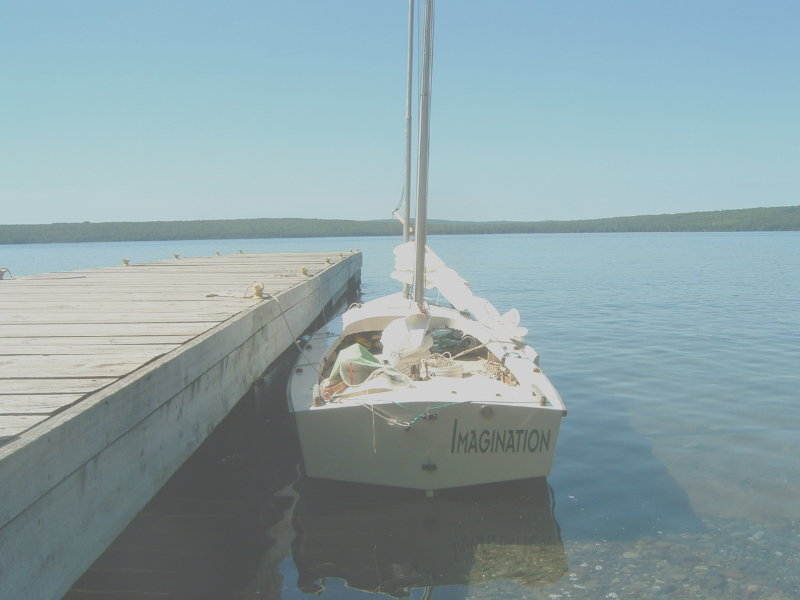
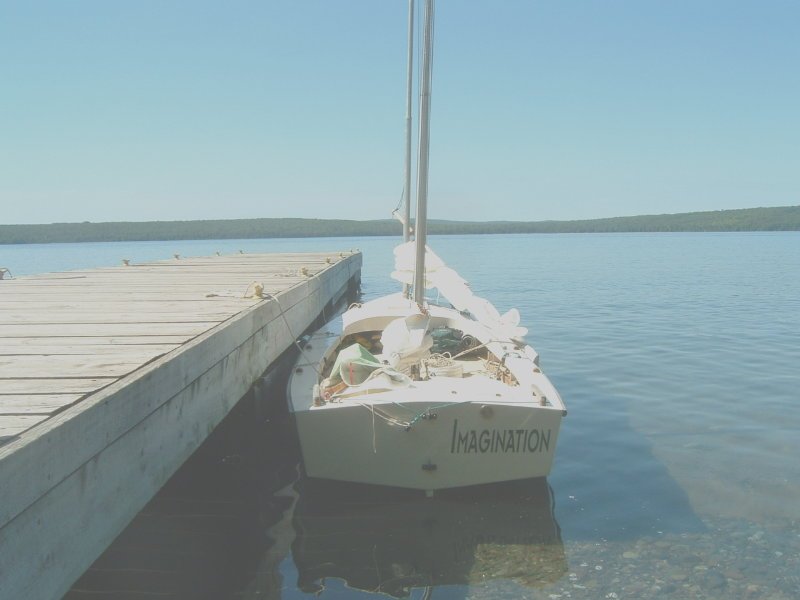
I enjoyed a long run over to Devil's Island, surfing down the waves on the long open water fetch. The harbor over on Devil's Island had boats tied up at all the deep water slips. Imagination found a snug berth in 6 inches of water at the front of one of the docks. On just the other side of the dock the waves pounded the rocks all night long, but I slept well to the gentle rocking in this snug corner of the harbor.

-
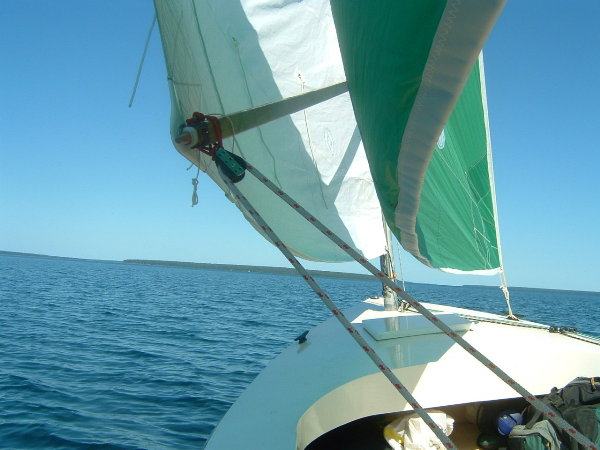
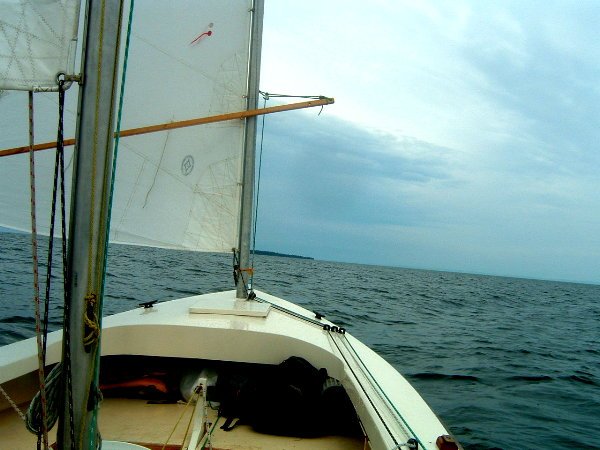
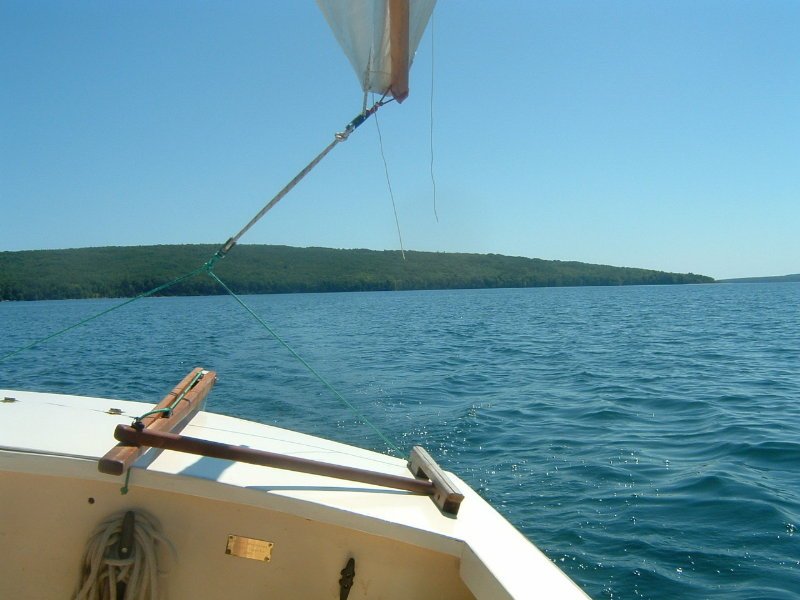
The trip from Rasberry Island up to Rocky Island was in light wind conditions. I was glad the staysail was on board, as it made the 15 mile trip much more tolerable, and got us into the harbor in plenty of time for a supper. In light to medium conditions the cat ketch rig is easy to balance out, making it possible to leave the helm to move about the boat.

-
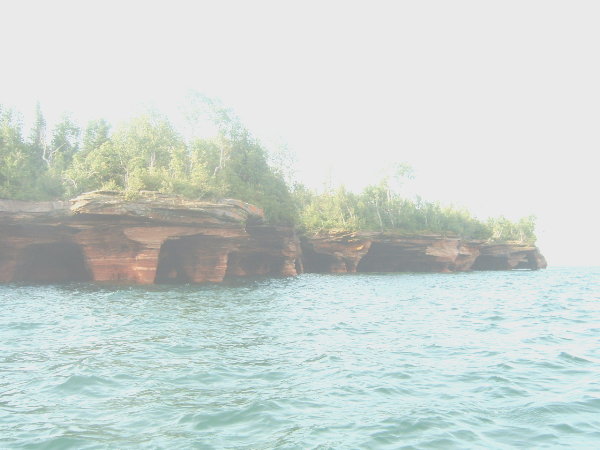
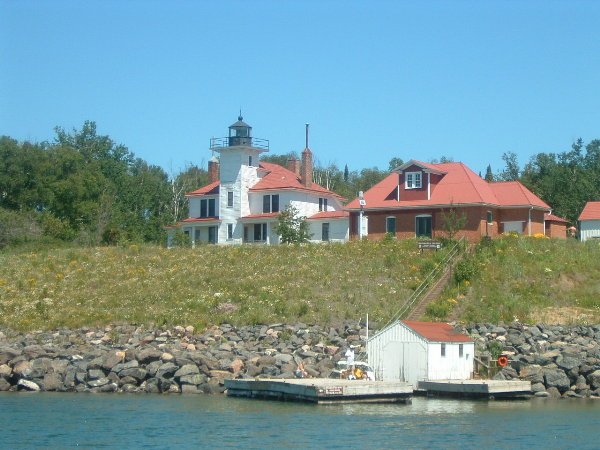
Later we visited both the Rasberry Island and Devil's Island lighthouses, which are interesting reminders of days gone by in the history of great lakes shipping. Devil's Island has some interesting sea caves which produce a moaning sound as the wind and water flow through them.

-
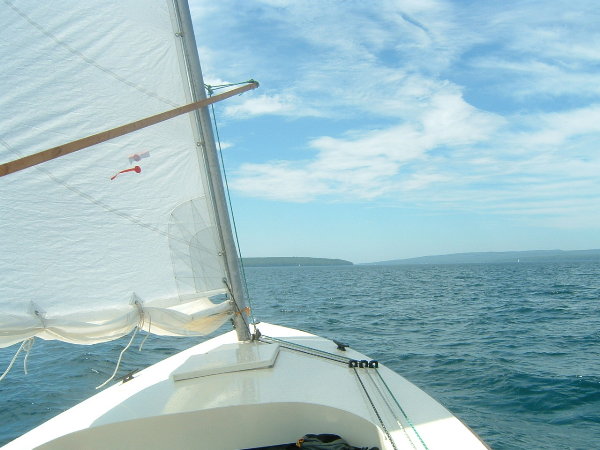
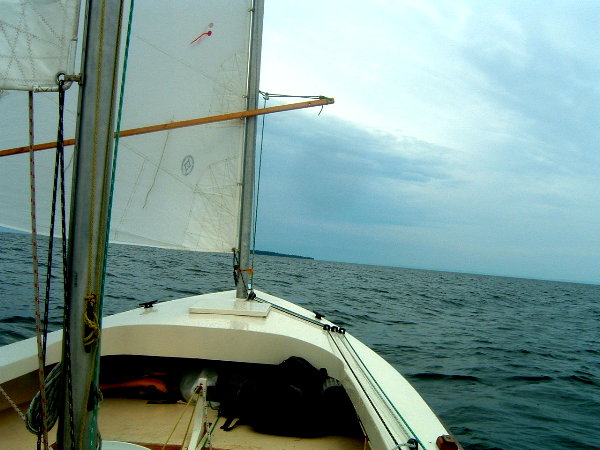
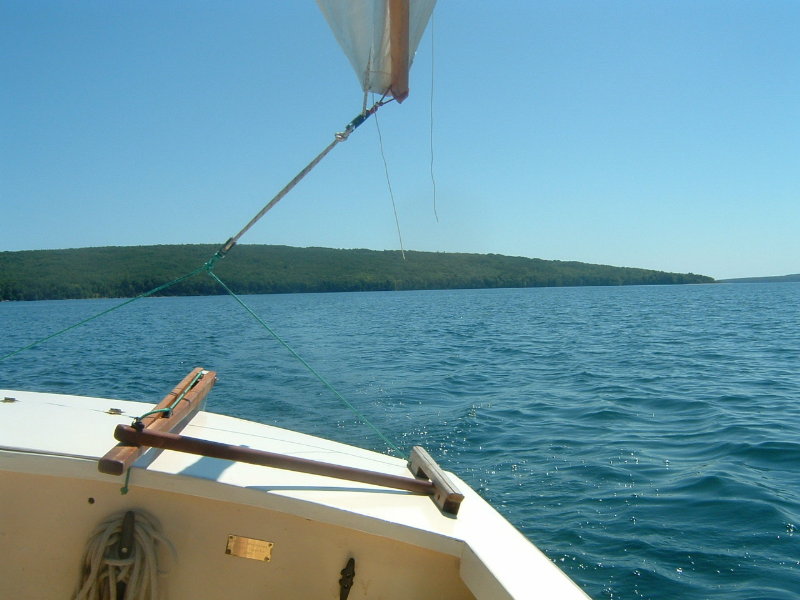
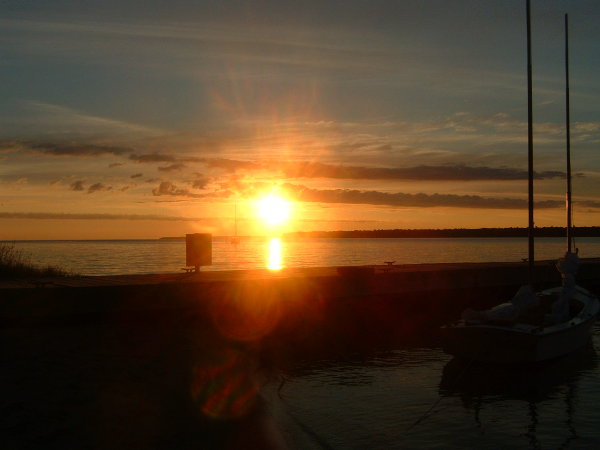
Imagination has just returned from a few days in the Apostle Islands of Lake Superior. This was a solo trip, just the boat and I, with the mission of seeing a few lighthouses, and exploring the islands both by boat and by foot. During our time here we experienced everything from wisper winds to steady 20+ knots. The sailing was superb. The water is clear and cold. Swimming was minimal. The boat went into the water at a place called Red Cliff on the Ojebwe Indian lands of northern Wisconsin. Before getting started a couple of Ojebwe filled me in on the ancient stories of the islands, and warned me about the good spirits and bad spirits that inhabit various places. After cruising up the channel and into the National Park waters, and cruising around a bit we ended the day at Oak Island which has spectacular sunsets.

-
Congratulations Ricardo! The boat looks great, and I see you are enjoying her sweet characteristics. Looks like you have a beautiful place to sail her.
-
Having bumped into a few things with my centerboard I have come to really value the shock cord feature on the downhaul. Just over the weekend I was in some waters new to me, and it helped my confidence to know that if I bumped into something while crossing the bank the chances of serious damage where minimal. The rigid stick is clever. If you could integrate a shock cord or similiar flexible compenent into the design you could have the same confidence provided by the ropeworks. Give it a try. Worst case seems to be that if it doesn't turn out to be what you want you can always add a rope system later. I kept the clearance between centerboard and truck very close to the specifications, and it worked out that there is enough friction there that under most conditions the centerboard stays put without tension on the lanyards.
-
An unforgetable morning sail in mY CS 20
Brent replied to Bruce Leonard's topic in B & B Yachts Forum
Bruce, I know exactly what you are talking about! :wink: You are now an official member of the Double Digit Sailing Speed Association -
I frequently sail solo on my CS20. The boat and I have been out in conditions where the wind blows the beards off the whitecaps, yet I have never gone over. We have gotten the rails wet a few times. I weigh 150 lbs, so heavier guys should have fewer concerns. Heavy weather sailing is a hoot, lots of spray and speeds in the double digits. I find the boat less tender than most centerboarders, which I attribute to the hull design and low center of effort. The boat certainly handles conditions that keep the other centerboarders on the shore. I consider a good reefing system essential equipment for the kind of sailing I do. There are a few salty tweaks to keep in mind in heavy weather sailing, but maybe that is another discussion.
-
My boat has rowing stations both ahead and behind the mizzen. The forward station gets used for the serious long distance rowing, for the reasons Graham mentions above. Because the boat sails well in even a wisper of wind the forward station actually is used only rarely. The aft rowing station gets used in those short maneuvering situations...typically rowing while facing forward with the rudder between the knees. The most common example being rowing the boat onto the trailer, which is very convenient when the wind is fowl or the ramp crowded.