JeffM
-
Posts
1,019 -
Joined
-
Last visited
-
Days Won
1
Content Type
Profiles
Forums
Events
Everything posted by JeffM
-
Don't know. I do know that epoxy doesn't stick well to pvc. I'm guessing that the result would be significantly heavier than the recommended aluminum for the same strength. There was a thread within the last year started by a guy who sells simple kits for making carbon fiber/epoxy masts. Not to complicated to do, if I remember right, but not too cheap, either.
-
Beautiful pc, Cap'n Bud! Magnolia looks like a handy little boat. Do you know how it handles and moves compared to a Weekender? The cockpit looks a bit cramped for more than 2 adults. How about cabin space? I'm very curious about the off-center boards: how handy are they in shallow water? Do you typically leave only the leeward board down?
-
Jeff, I can see no magic number to "adequate space." The more you have the more comfortable you'll be, and the less often you'll resort to strong language as you try to maneuver lumber, climb in and out, look for places to put things down, etc. You could do it with only a couple of feet on each side, but you might not be safe around your pets or loved ones! My enemy was clutter-- I never cleaned or put things away until I was forced to (time I spent cleaning I'd rather spend building!) On the other hand, my sloppy habits probably cost me a lot more in frustration time trying to get space to do things, find tools, etc. And its hard to do your best work in awkward space.
-
Thanks, PAR. I was guessing the steadiness of offshore trades was one key to Slocum's success. I don't think he was luffing much, though, since he could average 6kt for days on end. In the back of my mind is getting my own cs20 to do a little modest self-steering-- say, a few minutes at least. It is a very light-weight hull with centerboard, but it does have a divided rig. The scalloping course is okay with me. I will keep messing with bungees of different tension, and different sail trim and cb position.
-
Lots of good info here! Thanks! So you built and sailed a "Spray" PAR? Very cool!!! (no matter what you say about how slow she was). Were you able to leave the helm for long periods? I am impressed that Slocum's boat maintained that ability even after he modified his rig several times.
-
My garage (about the size of Terry's) was too short and too low for a 20, but I can close it for the winter if I put the boat in corner to corner. I couldn't have built it without the caster trick, and even then it probably would have gone much easier and a bit quicker with more space. Basically, I could only make a reasonable work space on one side of the hull at a time by rolling it back and forth. In the winter, I learned to get from one side of the boat of the boat to the other by swinging and ducking under the bow. Otherwise I had to cross through the cockpit. Finishing the transom had to wait until I could poke the bow out the door. would have been happier with more work space, but for various reasons I wasn't willing to build a full separate shelter for the project.
-
Brent, I was blown away by the exact same inquiry: the day the Beatrice Ann first went into the water, a trim, middle-aged man paddled a beautiful home-built kayak up and asked, "Is that a Core Sound?" At my astonished look, he explained he'd seen them on the web. At the time I was busy trying to look competent and set up the boat while surrounded by relatives, so I never did find out who he was. I wonder if he is one of the silent majority around here?
-
Let the neighbors talk--give them something to do, poor dears.
-
Nice, Scott! If I were you, I wouldn't put her into the water until after the ice melted...or at least, had broken up enough not to ding that nice stem! :wink:
-
Brad, I seem to have an old version of this page: "Work forward of the (center) frame until it begins to draw the stem together, place and wire the forward bulkhead. Continue to wire and tighten stem until the bow comes together." I'm glad the instructions have been improved or clarified.
-
Reverse-curve keel? you mean sort of concave down? Whatever the keel looks like, there's got to be more to it -- some set of features in the rig that not only balance the helm but give it dynamic stability, so it always comes back on track after being knocked off course a bit by all the random effects constantly at work.
-
Brad, I wired the bulkhead to the bottoms before wiring the chines -- following the plans, rather than the pictures on the CD. I had two problems: 1. the bottom refused to take the curve of the bulkhead, so there was a substantial gap at the keel. 2. the bow wouldn't come together with wires alone (I broke many). In the end, both problems were solved the same way: I bought threaded rod. One threaded rod went through the bulkhead beam and through the keel line into a piece of 2x4 for purchase. This didn't completely close the gap, but it almost did. A second threaded rod went through the sides in the same place I had blocks to reiforce the original butterfly butt joints. I may have set myself up for these problems by epoxy-coating all the pieces before I started. If I had it to do over, I'd leave the outsides of curves uncoated. ps: I've never cursed like a sailor -- a minor handicap at times like these!
-
Let us know how you manage getting the foreward bulkhead wired in. I found that to be rather difficult, even though I put it in before wiring the chines. Good luck!
-
Hurrah for the Captain (and his long-suffering wife)! When he has some experience with her, I would like to know if this boat can be made to duplicate the amazing trick of holding course for long periods without attention to the helm. I am fascinated by that capacity of Slocum's boat, and wish I knew what characteristics of the boat made it possible.
-
Thanks, Brent. Although helm balance was not my main problem, I would find it very useful to get her to self-steer some. I bungeed the tiller on a close reach in light winds on one of my first trips and was able to putter about the boat for nearly 10 minutes before she went much off course. I haven't been able to repeat that, though--maybe it was a chance coincidence of conditions, sail trim, cb position, etc. I would like to be able to single-hand conveniently, but find myself often turning over the tiller to my son for everything from taking photos, to studying the chart, to putting up the staysl.
-
Graham, that was my first experience with helm problems (of half-a-dozen or so trips). We were surfing obliquely down waves on a broad reach and a run, and the boat was slewing first one way then the other. It was this instability that had me a little concerned. I took a straight edge to the cheeks: no, my leading edge is only a half-inch ahead of them. Sounds like a need for winter mods.
-
My uncle is here from Minnesota for his high school reunion (maybe 60th?) and asked for a ride--I didn't need persuading. He was a Sunfish sailor like myself (his home-built of plywood long ago) until he gave it to his daughter a few years ago. Beatrice Ann was today sporting her name on the transom in vinyl lettering, a compass recycled from my old Sunfish, and a sturdy handle on the aft deck to help me get aboard using the transom step. The keel I'd chewed up on rocky beaches was all patched up. Forecast couldn't make up its mind between 5kts and 5-10kt, but reality finally settled on 10-15kt. So I didn't get to show off the mizzen staysl, but we did get the fastest ride yet. We reefed at the ramp, but I quickly discovered I hadn't rolled the sail tightly: it stretched and bagged terribly and we had poor handling and made little progress. When the wind seemed to slacken a bit, I shook out the reef (got to learn to do that gracefully!) and we took off. We were 2 adults and 3 children, maybe 600lb total. We headed out of Oakland Beach, looped around Patience Island, headed for home on a broad reach with following rollers. We sailed a measured 2 nautical miles in only 13 minutes, for an average of 8kt! It was fun, but I almost needed both hands on the tiller to maintain course surfing down the rollers. My stalwart uncle got very wet; I joked that I'd try to put more water under the hull than over it. I wish I'd taken pictures, but we were much too busy!
-
I use one of the above-shown releasing clam cleats to hold down my unweighted centerboard. I've now hit bottom enough times to say I'm very satisfied with it: at its lowest setting, the board has never come up without touching bottom, but has always popped without fuss on contact. My board remains undamaged.
-
Gorgeous boat, Adla. Congratulations!
-
My masts are take-apart (for garage storage). All sections are 8' (plans call for 6' top section), and my top section has wood plugs epoxied at both ends. If I did the math right (couldn't find a calculator), each of my top sections has an interior volume of about 1/3 ft3 and so a buoyancy of 20# or so. Foam may only weigh 2#, but that weight is in the worst possible place. I could only make sense of installing foam if it filled at least the top two sections: in my recent capsize test, the top two mast sections submerged, and my rig was almost adequate to keep the boat from turtling. For my part, in heavy weather I'll haul up a float on the mizzen staysl halyard.
-
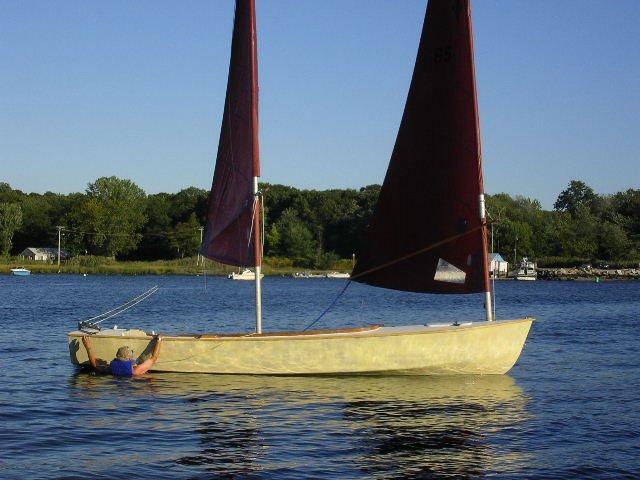
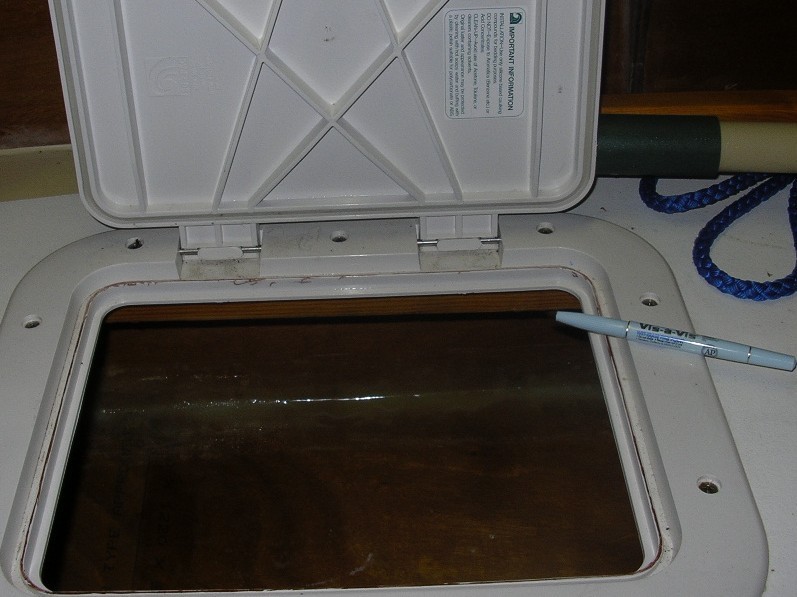
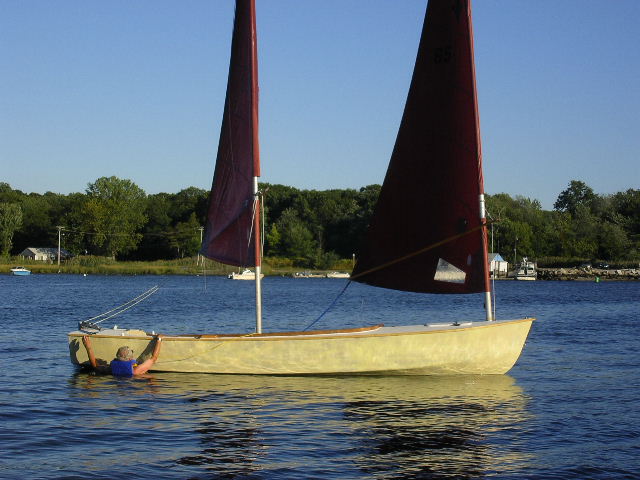
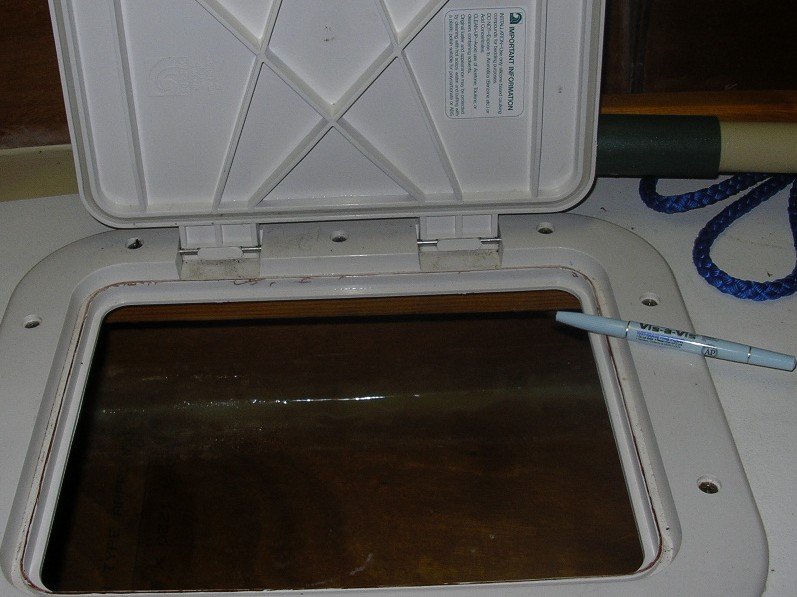
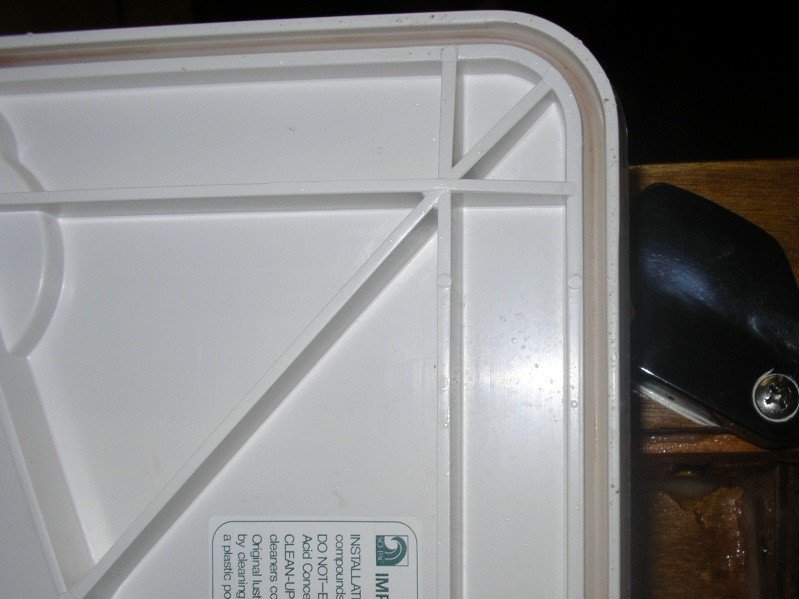
Finally got around to a little testing--precipitated by flooding of lockers during a capsize test of CS20 #65 Beatrice Ann. In a nutshell, there appear to be places where water can get around the hatch frame (so inadequate caulking on my part), but since even a locker that was fully caulked ALSO leaked badly, I decided to test the gasket seals of the two seat lockers that flooded most recently. I used a wash-off marker (meant for making overhead transparencies) and ran it around the frame edge that is supposed to seat against the gasket in the hatch. Then I closed and latched the hatch, careful not to push the hatch harder than necessary for latching. On re-opening the hatch I looked at the gasket for marker ink transfer. On both hatches there were long stretches with no ink--so the gasket did not meet the frame edges there. On one hatch, the hatch seated on three sides, leaving the entire hinge edge unmarked, on the other hatch, only the corners and the latch edge seated properly! I expect similar results from at least three other hatches. I am not pleased with my pricey So-Pac hatches: I really counted on both dry storage, and the security of water-tight floatation compartments.
-
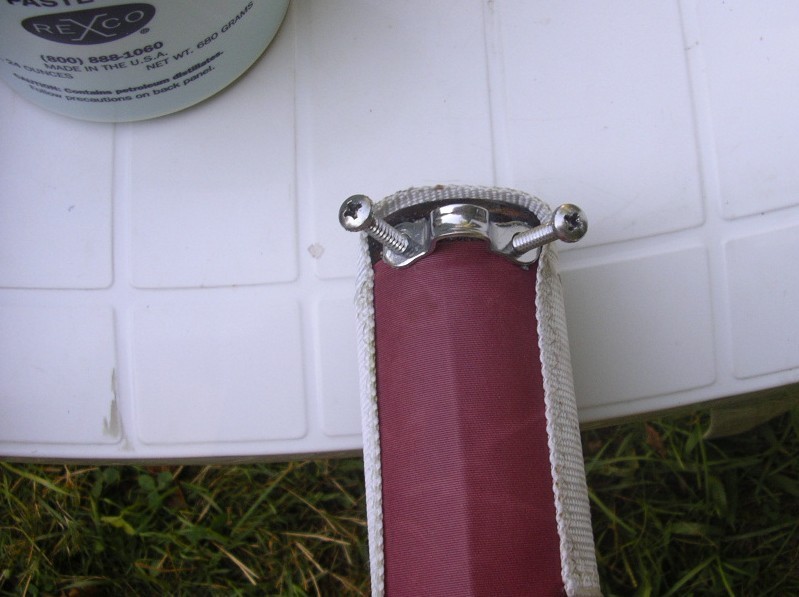
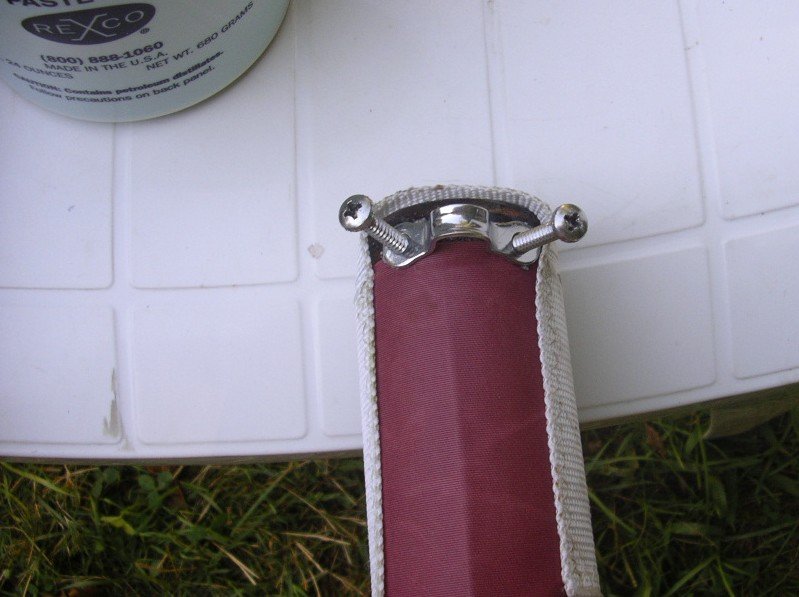
Joe, A piece of webbing closes off the top of the sleeve so the sail won't slide down the mast. But I found that the space left was rather small. I didn't want to mount hardware through the sail sleeve, but I was forced to mount the eyestrap for the halyard block in such a way that it definitely overlaps the sleeve. Right now I have heavy line for halyard and sheet and a hefty hardware store block for the halyard (I was thinking of the size of that sail), but when I (belatedly) checked Graham's posts on the subject, I discovered he recommends very lightweight stuff. When I get around to it, I may replace the big block with the same Racelite block that is called for in my cb uphaul and downhaul.
-
I weigh about 200lb. I mountaineered myself almost out of the water with my feet on the bottom, but my sense is that it didn't need quite so much of a pull--I was just a little impatient. I can't imagine a good breeze being anything other than a hindrance, especially with associated waves. And of course I'm unlikely to capsize in "5kt seas <1ft." But I haven't enough experience to say how difficult it would be. May be others will chime in. Note that my upper mast sections are plugged at both ends for buoyancy, and 8' long (plans call for 5 1/2'). I don't think the boat was in any hurry to turn over completely, but in a stiff wind I'd probably be on the safe side by running a float (pool noodle) up the mizzenstaysl halyard. I can't see gear making much difference. If it were enough to push the hull down a bit more it might slow the turtling a tiny bit by reducing the angle of the masts to the water. The boarding step--available from Duckworks--was someone else's brilliant suggestion. I fixed it low on the transom beside the rudder, through-bolted to a big piece of 5/4 pine stair tread for strength. It isn't easy to use--too high up to get my foot on. The one time I actually had to climb into the boat in earnest I needed the boarding ladder as well (also Duckworks) and still looked pretty foolish. I plan to put a low-profile handle on the aft deck just this side of the tiller and as far forward as I can reach. Otherwise I have nothing to hold onto but a cleat that's off to one side.
-
A new thought: the mainmast is held in place by the snotter run to a block on the fordeck, then aft. But unless I remember to pin it in the step (I keep the reefed mizzen from turning by running a pin through the side of the step and into the wooden plug), the mizzen could, theoretically, come un-stepped in a capsize. Another new thought: I need a handle of some kind on the aft deck. Something strong but low profile.
-
the rest...