JeffM
-
Posts
1,019 -
Joined
-
Last visited
-
Days Won
1
Content Type
Profiles
Forums
Events
Everything posted by JeffM
-
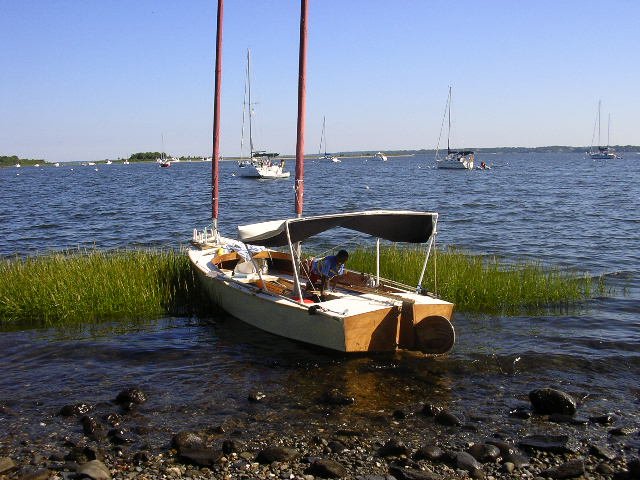
Did a short test on Saturday. Wind about 5kts. Boat almost totally empty. Put boat in thigh-deep water, pulled over using halyard. Masts were nearly horizontal before boat went over on its own. Note from photos where water comes on seats. Masts appear to have had just barely enough bouyancy to prevent complete overturning (I don't think they touched bottom). I took about a minute to get around to the bottom and begin pulling on line over coaming (tied to gusset). It took hauling nearly all of my body out of the water to get the boat upright, and I had to prevent my feet slipping off the bottom to lever myself out of the water. (In the end, it might have come upright with more patience and less weight.) One important error on my part: I should have released the mainsheet as soon as the boat came up--it tried to sail off with me as I tried to pull myself up on the boarding step. Cockpit had a lot of water and took several minutes of fast bailing. Finally, lockers proved to be substantially flooded: a couple gallons or more in each seat locker even though they were only submerged for a few minutes at most. In my judgement, righting the boat --at least in light air--is easier than boarding it! I may have to keep the boarding ladder handy in stiff winds. I find even the boarding ladder difficult to use, though--there just isn't much on the deck to hold on to. Graham's idea of keeping a knotted line to throw over is a good one. I might even toss it over in heavy winds as a precaution.
-
A couple more. Order again reversed.


-
Another attempt to load pictures... Thanks, Frank! Whoops! Pictures are in reverse order!


-

first sail of the year, tyvek sails, trolling motor, ...
JeffM replied to tdrown's topic in Main Forum
Frustrating, I'm sure! I hope you get a good opportunity with a good breeze before you have to quit for the season. After just half-a-dozen trips on my new boat, I'm looking at the end of the season soon, myself. Jeff Michals-Brown CS20 #65 Beatrice Ann -
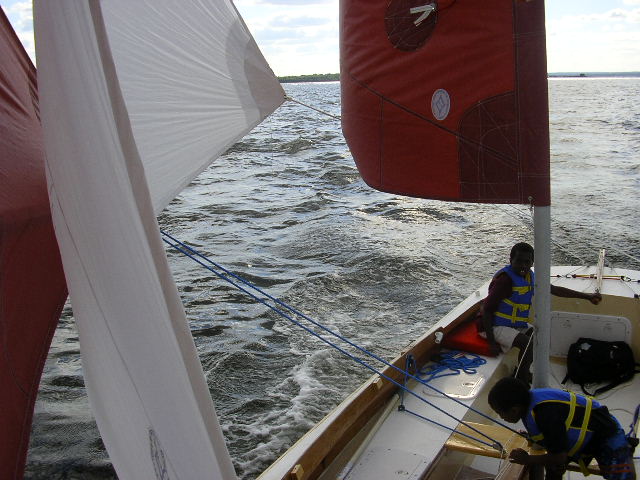
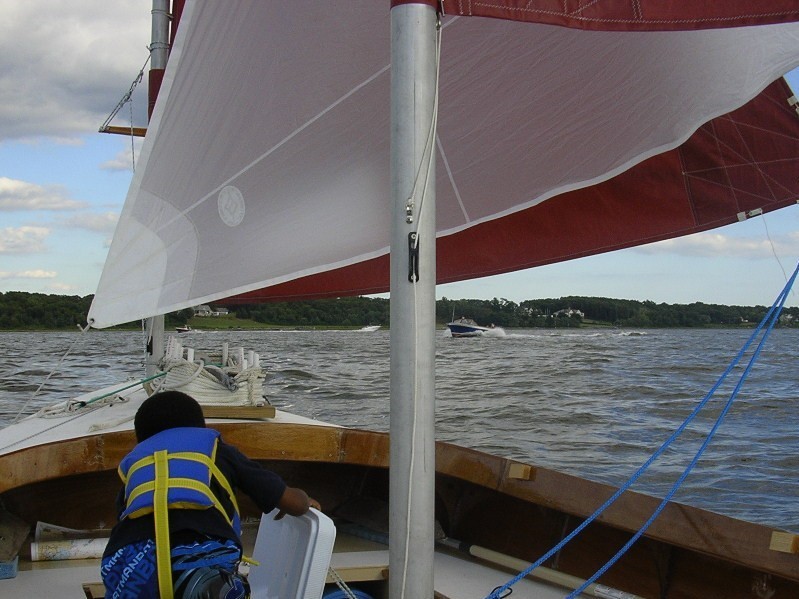
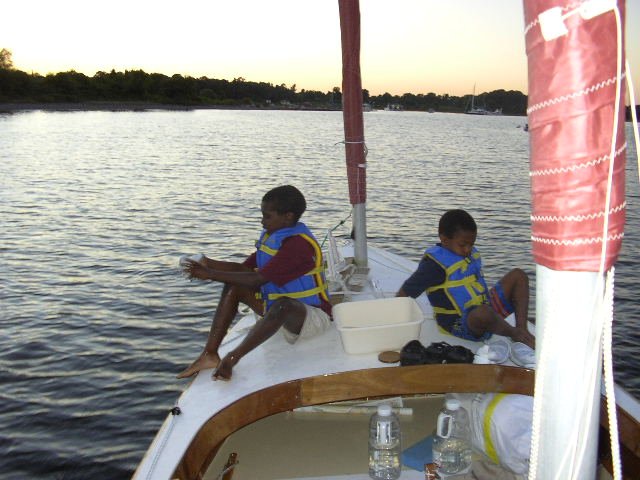
Took my two younger boys, Trevor (eight) and Stephen (5) for a two-day circumnavigation of Prudence Island in upper Narragansett Bay over Labor Day weekend. We launched Saturday from Oakland Beach public boat ramp in Warwick, RI early in the afternoon and made a comfortable two-hour passage to Potter Cove (popular anchorage) on Prudence Is. Got a nice long reach to try out the new mizzen staysail. It handled nicely in the 5kt wind, behaving well enough so that I had no fear leaving the tiller in Trevor
-
Update: After putting DAYS of putting headbanging effort into my custom-designed pin-and-tooth cb hardware, I put it into place on trunk and thwart to admire it and... was horrified at how big and clunky and ugly it looked. So I decided to delay a decision by putting in the minimum of hardware: the uphaul. (I'd figured the board would naturally go down about halfway, and need mainly to be hauled up.) It turns out that my doug fir cb floats completely retracted, so it's a downhaul I needed more. For a few trips I just put a bungee on the horn and brought it to the cam cleat, but it didn't work very well. Now I have a proper downhaul, but with bungee omitted, and the downhaul cleated to a releasing clamcleat from Duckworks. $21 but worth it: its an easy rig to manage, and at the lowest setting, the cleat released without fuss at a gentle touch with the bottom. At no time in an extended trip did it release without the cb making contact.
-
Tom, I found screws were essential in getting the keel tight against the bottom. My mistake was in not waxing the screws first--some of these plain exterior screws are now permanent parts of the boat. I took the advice of others not to glass the keel so as not to give water a place to hide in a banged-up keel. I did use 3/4 brass half-oval, as suggested in the plans--a very good idea. Only problem is that the keel (being 5/4) projects a bit beyond the brass on each side, and my careless beachings on pebbly and shingly beaches has chewed thru the epoxy there. I plan to grind the wood down closer to the brass edge and re-coat in epoxy. White oak sounds like a good choice--mine's doug fir.
-
Thanks, Graham. I wasn't thinking of a line from the cb, but lines dragging from each side--I wasn't sure if I would have time to toss a line over if capsize were unavoidable. I've plugged both ends of each 8' top mast section for buoyancy, and I could use my staysl halyard to raise a pool "noodle" to the masthead, roughly doubling the floatation over mast tops alone. This would be ugly, but not mess up the air flow too much I hope. I'll post results tomorrow.
-
Planning to capsize Beatrice Ann in shallow water tomorrow to find out how long it takes mast tops to sink, whether a noodle at mizzenmast head will prevent that, where water comes on seat tops, etc. Most importantly, I want to see how I might right her when I'm shoulder deep in water. Suddenly occured to me to ask what other info people (those building or thinking of building, and maybe Graham) would like me to collect. One issue is whether I can even REACH the cb in a boat this big. A line hanging the high side would give me something to haul on, but I don't know how to make it practical --rig them without dragging them in the water all the time. Ideas on capsize testing? Righting?
-
Thanks, Jake. My wife found those photos early on, and has managed to identify her parents house. The neighborhood is flooded, but roof appears to be mostly intact. I'd be willing to agree with you on shooters, but not necessarily the looters--what would you do if you were trapped in a city with all the grocery stores shut? But it's certainly true that New Orleans has long been a very poor, drug-ridden, violent city... I agree that the blame game is starting too soon. People have an unrealistic idea of how fast help can be mobilized. Even so, I'm guessing that there'll be more than enough blame to go around. Barry, what the government ought to do as part of the rebuilding is divert parts of the Mississippi to bring in sediment to raise up and rebuild the low areas and the rapidly-disappearing gulf coast wetlands. There are successful pilot projects ongoing, but plans to do this in a big way have been sitting on the shelf. The whole of coastal LA is river sediment, and it slowly settles as it sits. Before New Orleans was ever inhabited, the Mississippi channel naturally wandered over the whole delta region, depositing new sediment in low areas. By jailing the Mississippi between levees, New Orleans protected itself from these unpredictable floods in the short term, while dooming the whole area in the long term. Of course, it doesn't help that global warming is both increasing storm intensities, and also raising sea levels...
-
My wife grew up mostly in NO, and her parents and youngest brother still live(d) there. All are out of the city and safe, though they're not sure about some friends. My wife watches web sites, trying to find out whether the flooding reached the neigborhood, whether the house has a roof, whether looters have left anything. We watch the death, destruction and chaos from a distance, pretty much powerless. It's so hard not to know anything for sure. And even if there is something to salvage, when, if ever, will NO be habitable again?
-
No curbs and gutters; hatches stand about 1/4" tall above the surface. Hatch has an edge on frame fitting into a channel on underside of hatch that has a soft molded-in gasket. I expect water sitting in groove between hatch and frame is coming in under the gasket.
-
...the one that ran in magazines with a photo of the car floating in a lake? The caption had a little asterisk, which led to the fine print at the bottom, something like, "The Volkswagen Beetle definitely floats, but not indefinitely." After all the rain we've had in the last day-and-a-half, I might make that part of my forum "signature." Went out to the driveway, sponge in hand, to dry out the lockers. Opened up my new fancy-dandy So-Pac hatches and discovered the sponge would be inadequate: I ended up siphoning 14 gallons of rain water from my 4 seat lockers. Mind you, all of them had been latched. To be fair, the forepeak locker had only a cup or so. The hatches had not shown any leakage while underway (not a fair test, since fair weather and moderate winds), nor had they taken on much water when I had hosed the boat a few days ago. In fact the forepeak locker still had dry construction dust all over it until this rain. I've yet to properly leak-test the lockers, but my sense is the water is coming in under the gaskets rather than under frames not well caulked. It may be that my seats are not entirely flat, leading to slightly warped frames. Even so, all four leaked, and the amount of water in those lockers was staggering!
-
I originally thought to leave a bare glass edge hanging out the bottom of the trunk and then epoxy it around to the bottom. Easier said than done! I quickly gave that up, and simply used Graham's tape to glass the trunk/bottom seam after I had rounded the edge well and filled voids. I also trimmed the edges off the tape to avoid their tendency to stick up, and angled the strips over the curve both to increase strength (more fibers cross the seam), and make going around the curve easier. MY problem is a trunk that turned out (despite my best efforts) to be a little twisted... Fortunately, my board must have the same twist--it fits well and moves smoothly! Jeff, CS20 Beatrice Ann
-
Thanks, Graham. I can't wait for a chance to "scurry around the boat like a mad thing." Maybe I can reduce the need a bit by loosely cleating off the foot on a likely windward side before leaving the ramp. Anyway, all is in readiness; already have the hardware in all the right places and stopper knot adjusted. By the way, my sail came from you with a bag of cloth bits and a piece of self-adhesive material--I have no idea what they're for. (The bits might make good telltales.)
-
Thanks, Bruce. I don't know if that trick would work for putting up or dousing the mizzen staysl. Have you ever used one?
-
Thanks, Graham, for the info. I am finding that, single-handing even in 5-10kt winds, I find myself grabbing that main sheet once in a while. (I count sailing with my youngest kids almost as single-handing-- they don't know much yet and weigh even less!) But mast height can't be the reason if its only a 5% difference. I'll leave it as is for now and learn to sail the boat better. Yesterday I was out in winds forecast as 10-15kts, but turned out to be light and variable. Made me think of the staysail that arrived from you folks a couple of days ago. (Thanks!!) I've already replaced most of my homestore-bought rope with the new lines, and have started to get the staysail hardware in place for the next light air day. A few questions: have you used your staysail single-handed? If so, how do you heave-to so you can mess with halyard, tack, sheet and such? What I know about heaving-to in sloops involves backing the jib; how do you manage it without one? Got any other single-handing tips I haven't thought to ask about? Thanks again for everything!
-
Neat work, Terry! I'll be interested to know how well 9' oars work on the CS20. I decided they needed to be longer, and finding long oars awkward to store, I made a pair with paint roller extension handles that telescope from 6' to 12', screwing on blades made from leftover 3/8" ply. After a few times out, I find they are poorly balanced and rather flexible, but I decided to weight the looms and keep them, since I don't expect to need them often.
-
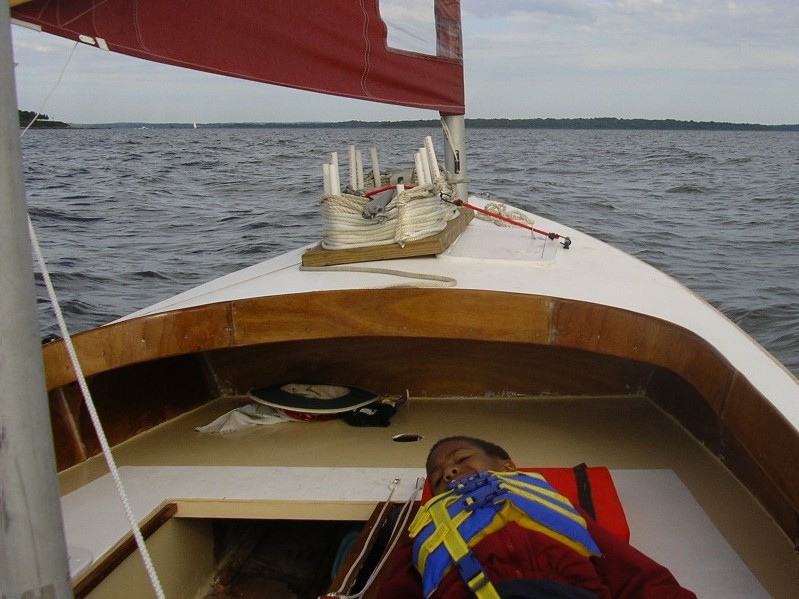
Went out again yesterday, taking 5-yr-old Stephen (unhappy I left him behind the first time). Gave my mother a ride, too (she used to crew for my Dad on his Blue Jay most of half-a-century ago). Intended to give Mom a nice but not too exciting time. Then the wind, forecast at 10kt, turned out to be 15. And I decided not to reef. And we heeled a good deal. And I soaked the whole family with spray. Oh, well... (After I dropped Mom at the ramp, I did reef on the beach, and the boat rode much more securely. I shook the reefs out when the wind slackened half an hour later. I may need to think about lowering my rig: the masts are currently 6" taller than designed in order to leave me more dodger/bimini headroom. Does anyone have any experience with the difference a few inches might make?) Stephen, Trevor and I had a nice adventure for the next few hours: everyone got turns steering, we reprised some of our earlier trip as well as going to some new places, I showed the boys the bell buoy that began and ended many of my teenage adventures long ago, and we watched a beautiful evening sky. I tried to calibrate my "speedometer" by timing a charted run--and ended up losing the whole rig overboard. (I was quite proud of it: about 13' of poly rope dragged astern off a delicate spring scale; the faster we went the higher the spring scale registered. Got to make another one!) By the way, my hand-held anemometer is the cheapest/best I've found: a Dwyer Wind Meter available from Science Kit and Boreal Laboratories for about $20. We got in after 7pm. The boys were sound asleep on the long ride home.


-
Thanks for all the warm thoughts. This is one time I'm glad the picture resolution isn't that good--talk about your 50-yard-finishes! I hope to get out another time or two this week and get a few more pictures. Bruce, It'd be nice to sail together, but I don't know when I'll be free with the school year about to start. By the way, were you able to keep your daughter in her current school?
-
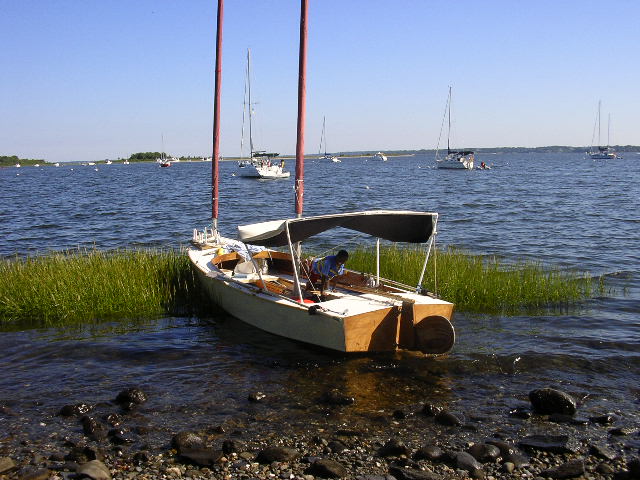
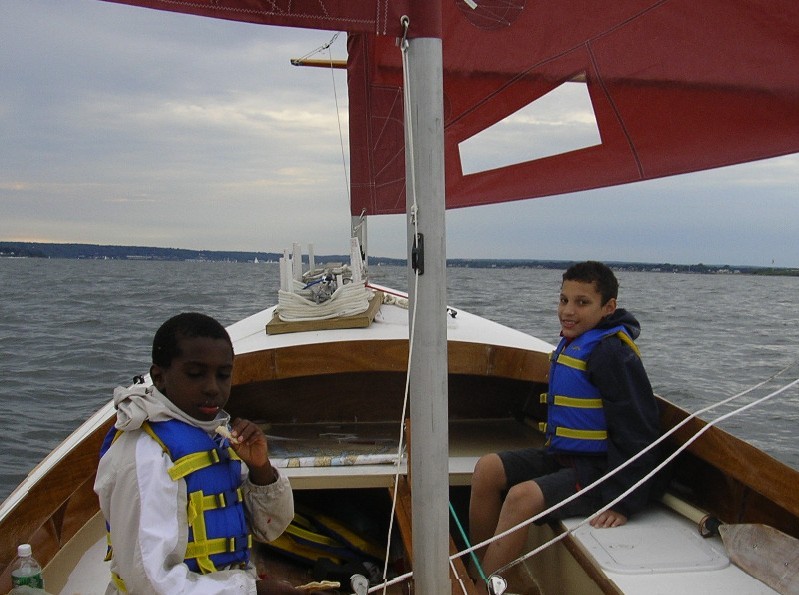
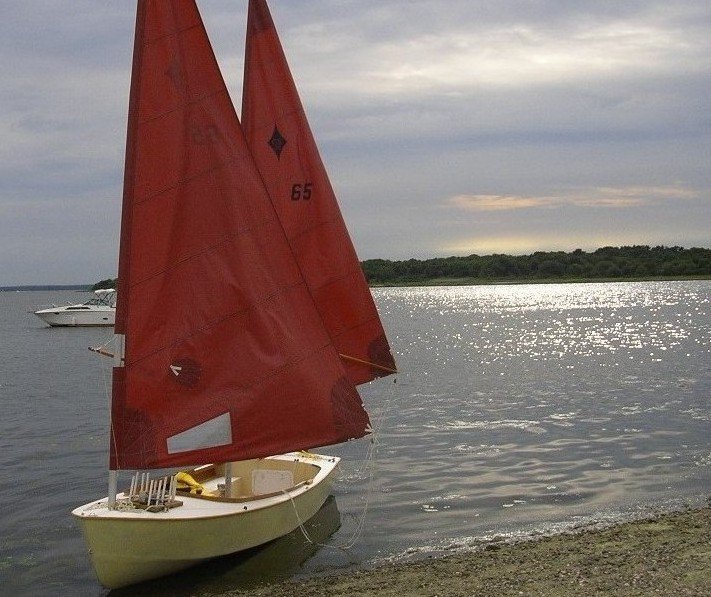
No, she isn't QUITE finished, but I just HAD to get her in the water this season! The Beatrice Ann was christened late yesterday (she got a bit, but we actually drank most of the home-made peach wine!), and then put into service giving 5-minute rides to the relatives in attendance. Several people stopped to see her (one little sloop under power actually doubling back for a closer look), and an older guy in a very handsome home-built kayak made my jaw drop when he asked, "is that a Core Sound?" But the real adventures began today: my two older boys and I took Grampy out for an hour's sail-- my 80-year-old father has been waiting for this day. Then, after dropping him back at the ramp, we headed out a couple of miles for a promised trip to Prudence Island for lunch. Graham, everything I've heard about this design is true: she's light, responsive and fast but so placid to handle that I left the tiller (though not the main sheet) to my boys for long periods without fear. Tacking and jibing were no more difficult than turning circles in a car. I even got her to self-steer: with a few adjustments to a bungee on the tiller, she steered a close reach without interference for the better part of 10 minutes! My 8-year-old son Trevor has always been enthusiastic, but I think my older son, 10-year-old Aron, is getting hooked as well. Thank you, Graham, for an excellent design! And thank you Frank, and thank you all, for the great education and help I've gotten here!



-
CS20 #65 is a few days from launch, but my cloth top is still in the design phase. Graham made a nice dodger for his cs17, pictures and details in http://www.messing-about.com/forum/viewtopic.php?p=31488#31488 but I'm getting more of my inspiration from "canvassing Core Sound 77" in http://www.messing-about.com/forum/viewtopic.php?p=31488#31488. I've invested in some 1000 denier coated cordura (white, to beat the heat) from the Rain Shed. I figure to use 3-part pvc pipe bows attached as double 7 did. The hatch in my starboard forward seat locker is so arranged that I can stow pvc pipes up to 6'3" inside, so that's the max length I'm using. Like Rob, I want to avoid ugly hardware, so my working plan is to hold the edges down over the coaming (mine is over 2" high tapering to 1") on eye-straps. Since I'm 6'2" tall and want comfortable sitting head room, my masts will be about 6" taller than designed. (If heeling forces prove to be a problem, it will be a simple matter to cut the masts down a bit.) The shelter will be sectional: the forward dodger can be used under way. The remaining sections will be higher, requiring the sails be furled. (I haven't decided whether to end the tent at the mizzen, or go all the way to the aft deck.) The sections will velcro together. Graham had a tent on his old BRS, and liked that he could raise and lower parts of it independently at need. Like double 7, I want a hatch giving access to the foredeck and windows. For fair weather camping, I have enough no-see-um mesh to make an entire tent of that alone. When I've worked out the compromises in the design, I'll let you know how it comes out.[/url]
-
Here's a less error-prone way to figure the volume: my dictionary has the density of lead at 11.35g/cm3. There are 1000cm3 in a liter, which is a little over a quart. That's 11350g, or 11.3kg/liter. A kilogram is a bit over 2 pounds (2.1, I think). So lead weighs in at about 24lb/liter, so a 400lb keel would have a volume of 400lb/24=16.6 liters, or 4.4 gallons. (I owe that last conversion factor to many visits to urinals that use "3.8lpf.") It does indeed sound like you're just outside the range of a propane tank.
-
Dave R1: "Adding a larger headsail will decrease weather helm (increase lee helm). The boat might tolerate or like some decrease in weather helm but you don't want neutral or lee helm. If you ever fall over board the boat will take off on you." A little off-topic, but I've been wondering about this. The way I figure it, even a boat drifting head-to-wind might easily drift faster than I can swim. I don't know how likely I am to end up in the water with the boat still upright, but it might be worth considering some sort of harness--even if I'm not single-handing, my kids aren't ready to come about and get me! Maybe a bowline around my waist with the other end around a stern cleat on windy days. (I already have a boarding step/handle on the transom.)
-
Jamestown Distributors in RI has it for $20/qt. I put it on my seats and deck under two coats of Interdeck (their non-skid). I don't have anything to compare it with, but I will say that I ignored their advice to sand it with 220, instead using 100 grit and getting good results. It fills minor defects pretty well. Roll it on, or else you'll spend hours sanding the brush marks out.