Fishman38
-
Posts
340 -
Joined
-
Last visited
-
Days Won
9
Content Type
Profiles
Forums
Events
Everything posted by Fishman38
-
In reference to your (pic) post on 17 Feb '13 (pg 4) pics 1 & 2. Maybe a dumb question, but I'm getting ready to install the transom and trying to think of a reason there should not be limber holes in the bottom stringers at the transom. Seems obvious they should be there but doesn't appear that you had cut any there at the time the pics were made. Maybe you added them later? Or is there a reason they should not be there? J.O.
-
Rusty, is your transom built according to the plans, i.e. did you add any doublers etc? From the pics it looks like where the motor mounts (motor board?) it is according to plan, about 1 1/2" thick. What size motor do you plan to use? Do you expect to do much trailering? For my build, my concern is mainly the load on the transom while trailering as where I live requires lots of highway miles to get the boat in the water. Info on transom specs vs engine/boat size is hard to find.
-
Finished gluing up the doublers today.


-
Looking really good Dave. Your pictures really help me with my project! J.O.
-
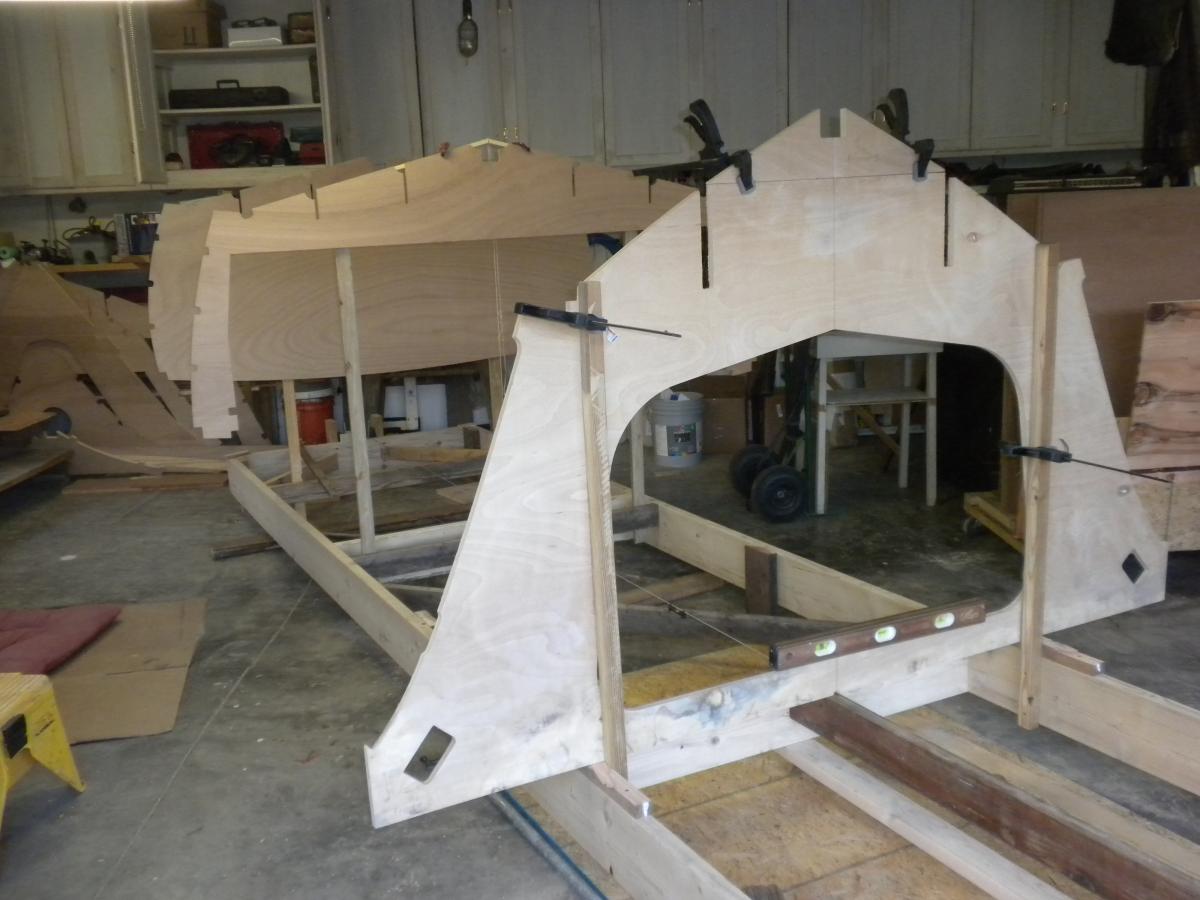
By beefing up #6 & #7 frame supports I was able to take out most of the kink in the keel. I used Gordy's suggestion (pictured) to take out the rest while the keel/frame epoxy set. Will probably set it up again when I mount the transom and when one sideof the bottom planking goes on. Took most of today to get the bottom stringers faired and glued. Got a surprise when I gave one of the outboard stringers a swat with the palm of my hand to seat it firmly into place. It broke at the narrow 4"(+/_) span above one of the slots. I should have (more gently) tapped it directly above the slot. Probably would have been ok. Something to be more careful with. I glued and clamped it into place and will add a gusset or two to strengthen it. (Are there "gussets" in boat building?)


-
I'd probably try that but might end up hanging myself in all the cords and hoses.......... Seriously, sounds worth a try. I use a shop vac on my table saw when working inside. Makes a pretty good dust collector. My shop is small so I have to keep my power tools mobile so a regular dust collecting system not very practical.
-
Back in the day when I was in the USCG what you stood on on board ship at least, was a deck. Today, at least on small boats it is apparently a sole. Go figure.
-
Maybe someone could start a "glossary" thread for terms commonly used in the trade. I have three different boat builder glossaries in my "Favorites" and still occasionally find a term, such as "beard line" that appears in none of them.
-
Thanks Gordy. You're right it is the sort of thing that would drive me nuts just knowing it was there. Since I posted about this, I've done further investigating and find that it isn't going to take as much force to correct the problem as I first thought, so maybe beefing up the frame supports (risers?) a little, plus some bracing such as you describe until the stringers etc and the first of the planking is stuck down is all that is needed.
-
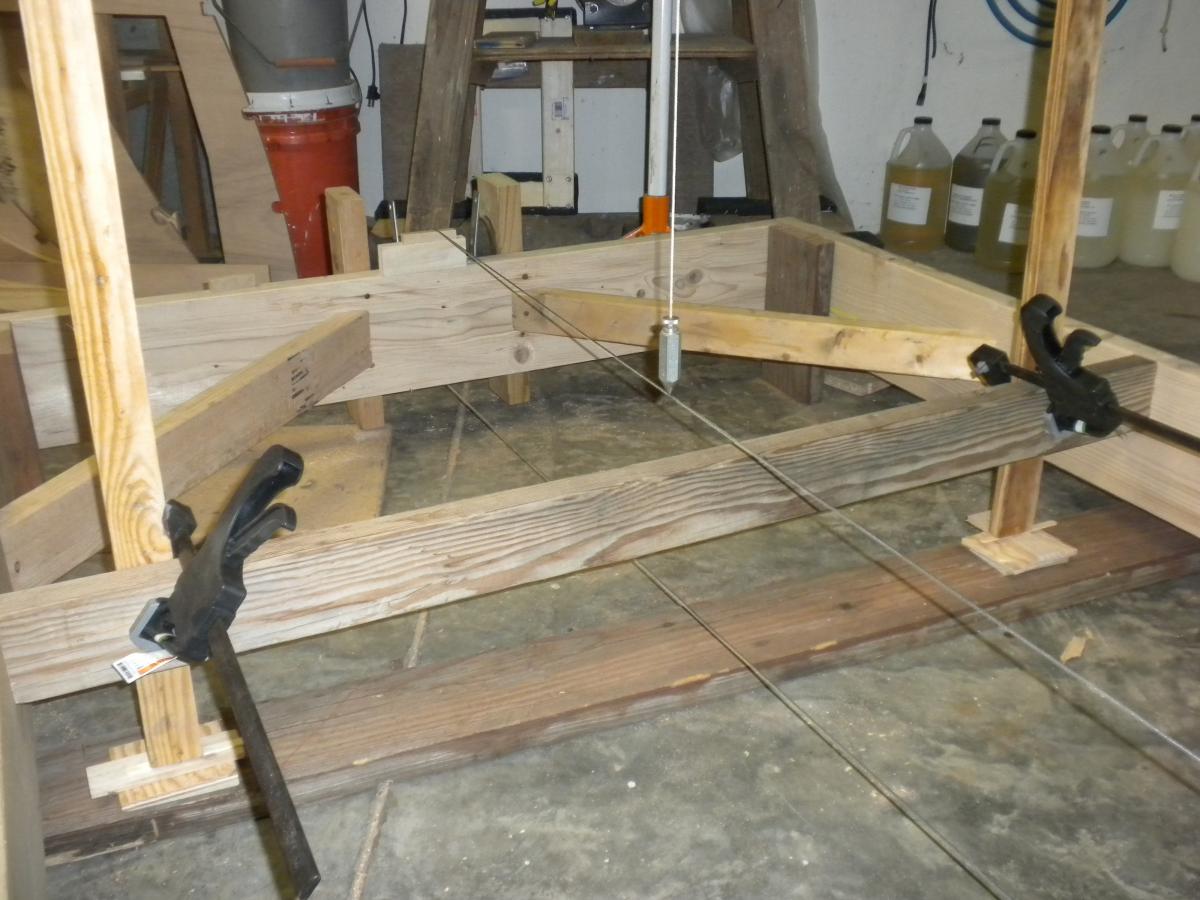
When I inserted the keel in the frame notches, I notice I have a bit of a "dogleg" in about the aft 10 feet. I think it must be straightened before gluing it to the frames. Best method I can come up with is to, with it held straight with clamps, glue a strip of (3/8 or 1/4) plywood to the flat top side over the full length of the bend. I could either cut away enough of the keel to make room for the ply or deepen the notches in the frames. Any suggestion are welcome.

-
Coming along.

-
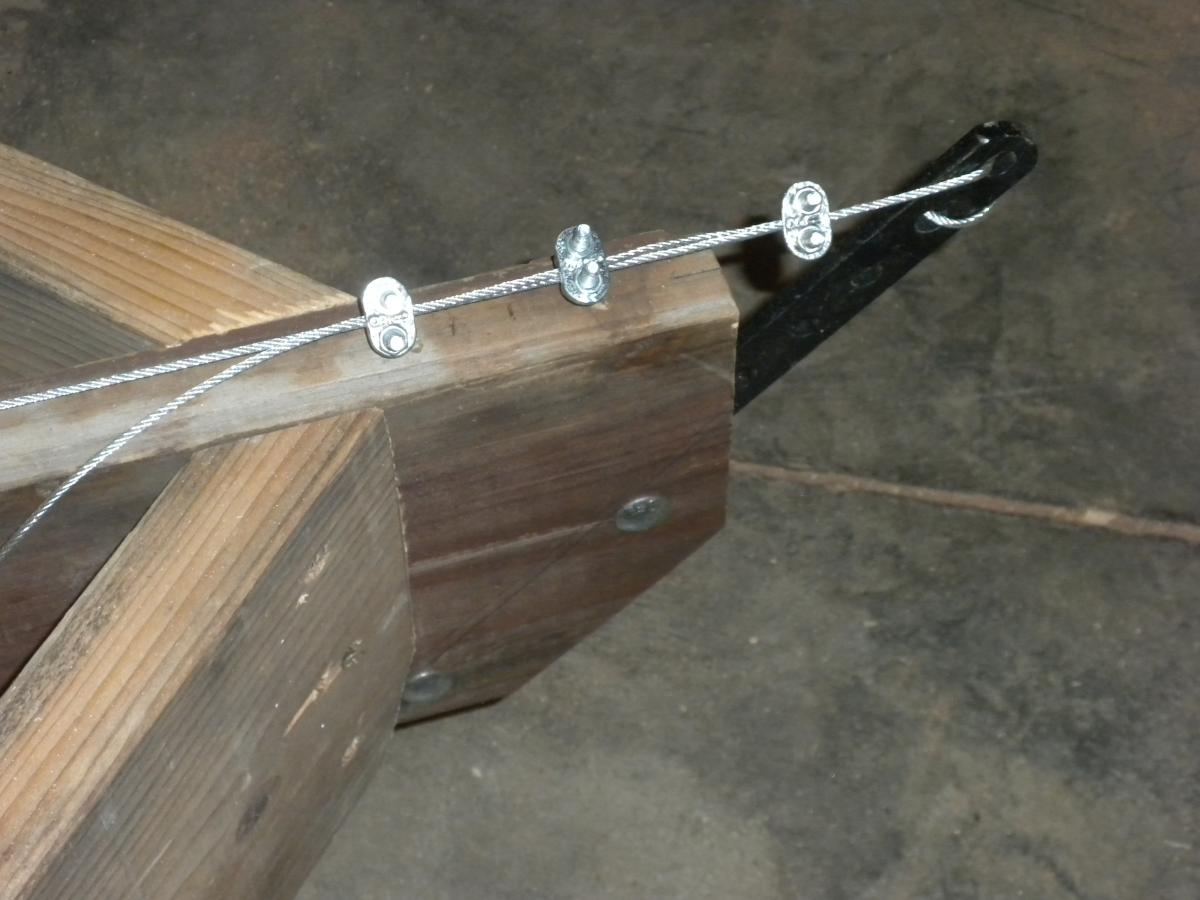
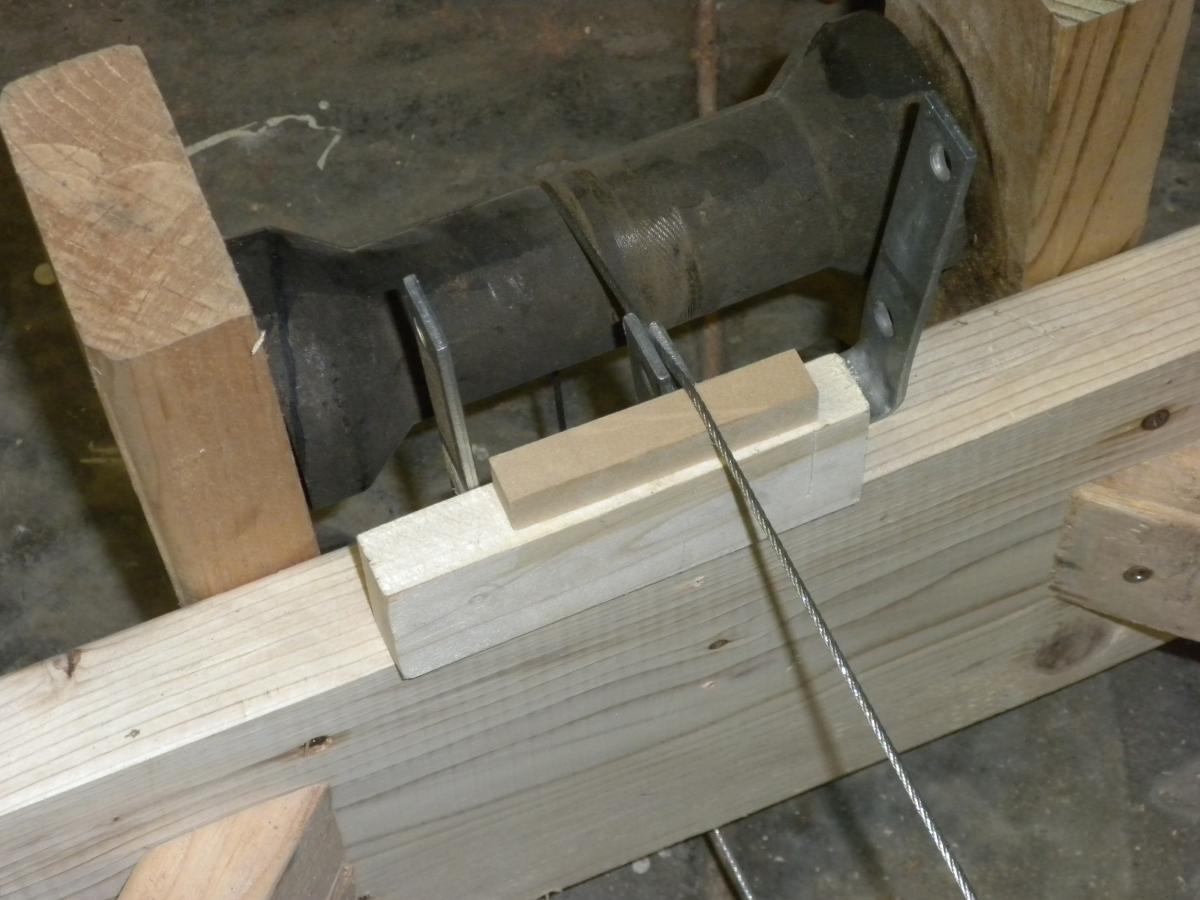
No metal fasteners, even at each end?
-


-
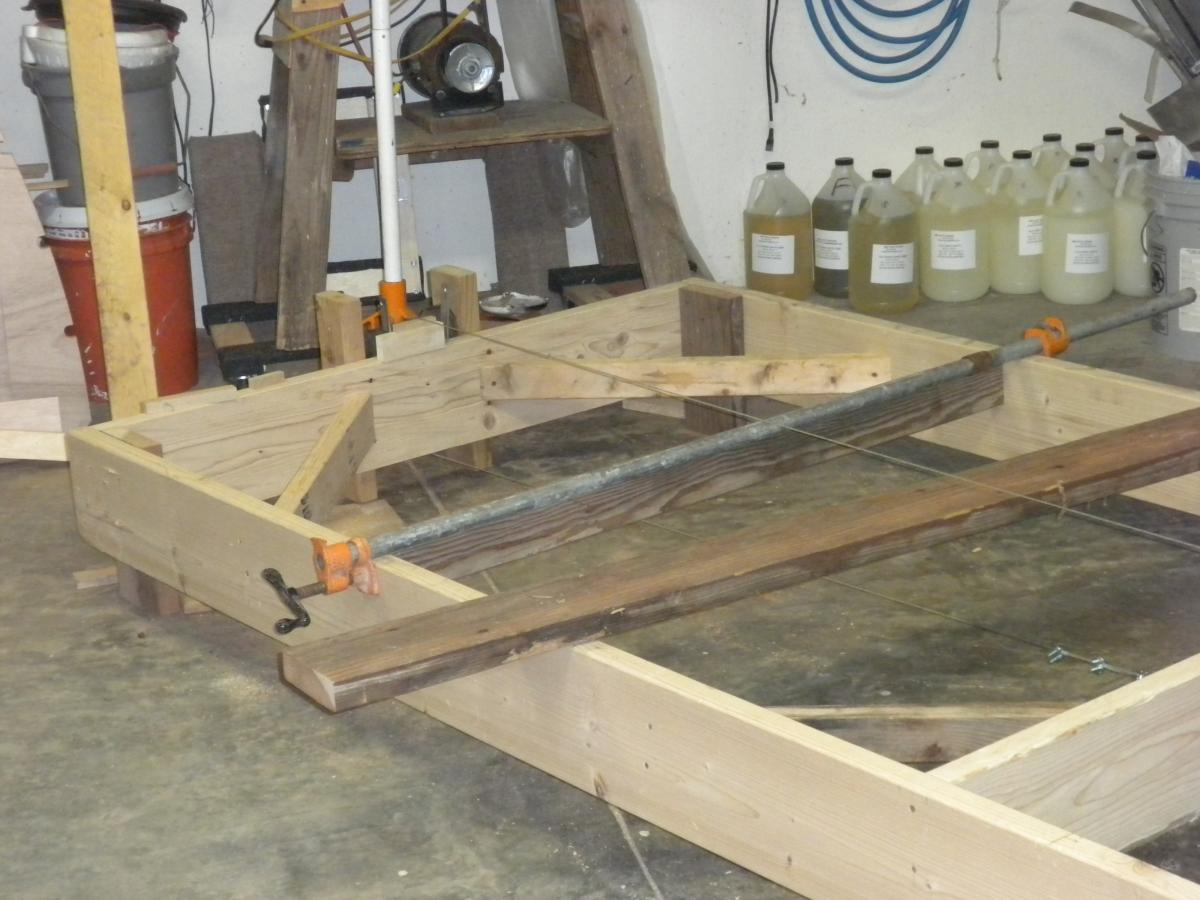
Cut off at the knees. I was concerned that "several hundred" pounds (per Gougeon) on the baseline would distort the strongback. This is one of a couple of steps to avoid that. Finally, the beginning of a boat.


-
On second reading, this sentence doesn't make any sense in the present context, so am deleting it. Thanks for the tip Miyot. I'll track down a copy of the book.
-
Another, well maybe not dumb, I'll call it a "novice" question: The inside corners CNC cut notches in the frames are rounded. My inclination is to round over the inboard corners of stringers and chines end to end with a router. So should I round over end to end or just where the stringer contacts the frame. I think I prefer the latter.
-
My green cypress lumber on the drying rack, along with the keel/stem


-
Thanks Hirilonde, the sketch helps. So to make one you just would make the two cuts on slightly different angles, depending on how big a dogleg you need.
-
Miyot, I'm sorry but I guess I would have to have a picture to understand what this means....I just can't picture which angle is 90 deg. I'm also trying to imagine what a dogleg scarf looks like, although as Hirilonde says I'm mostly concerned with the chines and stringers at the moment. But out of curiosity I tried to find the term "dogleg scarf" in all the references I have to no avail. Incidentally, I'm finding that my radial arm saw does a pretty good job making the scarf cuts. By turning the blade slightly off the horizontal it even works on up to 9mm ply. About 7 deg off the horizontal plane (the table) yields the 8:1, about 5 deg for 12:1. Got the idea from the Gougeon book. BTW, I'm still a long way from installing chines and stringers. Took forever to get all the plywood and solid lumber rounded up. Finally gave up on finding suitable fir locally and drove to Louisiana and hauled back a couple of 2x10x16' cypress planks from which I'm ripping material for chines and stringers. More knots in it than I had hoped for so it's still going to require a deal of joining, most of which I hope to get done before cutting the legs off my work table to start assembling keel, frames, stringers and chines.
-
A couple of questions regarding scarfing: Is it correct to say that, as a general rule the the plane of the scarf should cut across the wider dimension of the piece being joined. But what if the piece, the chine for example, is to be bent in a direction parallel to that plane? Does it matter long as one adheres to the 8:1 to 12:1 ratio? Not sure if my description is correct. If not I may be able to to post a sketch.
-

Short documentary on wooden boat repair carpenter
Fishman38 replied to Garry's topic in B & B Yachts Forum
I mostly hate videos but this is cool! I'm sure the wedges he fashions in here are made for a purpose but it escapes me. -
I intend to start laminating the transom tomorrow. The West User Manual says to wet both surfaces with unthickened epoxy, then spread thickened epoxy on one of the surfaces. The manual doesn't say so but my inclination is to spread it a little thicker (coarser notch) if applying to only one surface. Would I be right? Is the amount of epoxy per sq inch quantifiable, ie which notch should one use? On the other hand, I just re-read the Gougeon book on the subject and it says to use a roller and coat both surfaces. It also implies you can laminate several layers at once. Since I plan to use plastic staples, it seems necessary to do one layer at a time and remove the horizontal part of the staple before applying the next layer. What say ya'll? One more thing, any thoughts on the number of staples per sq ft I should use?
-
I found an Earlex Steam generator, which was reviewed by Wooden Boat mag a couple of issues ago (#229) for $56, free shipping. Just ordered it today and I'm always leery of online buying until I actually get my hands on it but have been doing it for years with no problems. We'll see.
-
Miyot when you steam I assume you must fit and clamp it in place then give it time to dry before gluing? Thanks for the tip to make the scarf 12:1. Otherwise I'd probably have made them the normal 8:1. I could hardly believe it but the grain on the stuff I looked at was very straight. I couldn't see anything that looked like run-out. Hopefully it's as good as it looks. Of more concern to me is it seemed to be very dry and will pro'bly require steaming because of that. That (steaming) will be another new experience for me. I'll have to figure out a way to do that. Once again thanks to you and to John for the input. It is all very helpful. This forum is amazing. I'm just wishing there was a way to catalog all the info!
-
I've located a local source for clear douglas fir, They stock only 16 ft lengths of 4/4 material but tell me they may be able to get some in 20 ft lengths thus eliminating the need for scarfing to make the stock for stringers, chine etc.. Making the scarf is no problem but how much of a problem for fairing the hull does such joints cause? In other words should I wait for the longer stock if they can get it and maybe pay a little more or will it make that much difference? Anyone?