

Tom Lathrop
-
Posts
1,351 -
Joined
-
Last visited
-
Days Won
24
Content Type
Profiles
Forums
Events
Everything posted by Tom Lathrop
-
Ray, If I don't think I can build a wishboom strong enough to take the compression load without significant bending, I won't do it. I don't think that other than a straight sprit is worth the effort unless you are racing against other competitive boats that don't have them, OR, you are just a hardware geek like some are and I used to be. I find the straight sprit to be a handicap coming out of a tack, whether in light or strong wind. Same is probably true at other times but it was not as dramatic or as provable in racing. Even when my straight line speed was equivalent to or even a bit better than another boat, acceleration out of a tack, particularly coming onto port was inferior. That is a distinct handicap when racing and often causes less than ideal tactical choices. I believe that is still true even taking into account the slower tacking of a cat ketch relative to a sloop or cat boat.
-
I think the whole beauty of a sprit boom, whether straight or wishboom, is simplicity. The half wishboom and the gooseneck type kind of defeats the intent. Paul's gooseneck is novel and elegant but I don't think I would go that way.
-
That's right Ray. It's a discussion, not a conclusion and that is the point. My thinking is the same as yours and, as I said, it depends on your sailing objective whether the added complexity of a wishboom is justified. At Rock Hall, I would have liked to have had them. On the other hand, I would have also have liked more sail area because most of these boats are underpowered for racing against one design boats as I was. Most one design racers of the same size have from 25 to 60 per cent greater sail area. Its a matter of design objective and I think Graham opts for a more wholesome rig which is highly suitable for the uses most of us put these boats to. He built a turbo rig for his Spindrift 10 with lots more mast height and sail area for some competitions. For instance look at the big difference in sail area of a CS17 and a similar sized Thistle. That is 119 sq ft of the CS versus 191 sq ft plus a 220 sq ft spinnaker. Even my Windmill which is smaller than Lapwing has 119 sq ft sail area. I may never race Lapwing again but still may build the wishbooms for my own interest. While this may seem off topic, it isn't because I am discussing performance enhancement.
-
You missed the main thrust of the thread. Yes a birdsmouth spar would be not only difficult but no advantage on a wishboom. Take the hint and read the whole thread which drops the birdsmouth quickly.
-
There is a thread on the WoodenBoat forum that may be of interest to our cat ketch builders and sailors. http://forum.woodenboat.com/showthread.php?134646-Curved-birds-mouth-spar Read on past the part on bird's mouth spars.
-
Plain epoxy with cabosil as a thickener (it is not a structural additive)has been used very well in loaded pivot points for years with no problem. Milled fibers would strengthen the bushing but might increase friction and wear on the pin. Fumed silica and cabosil are the same thing.
-

Spindrift 10N keel and tape bubbles questions
Tom Lathrop replied to my36's topic in B & B Yachts Forum
If you sand the tape down on the transom joint, you might as well not have put any tape on in the first place. The glass fibers that cross over the joint are the only reason for taping it. It looks like enough roundover to me and I suspect that the tape should have been pressed down better as the epoxy was setting up. Any way, it should be fixed. I'd grind off all the offending tape in the bubble area and put on new. Never, ever, sand directly on a glass tape joint since that can destroy it's effectiveness. Sand only on the tape edges. -
The older NC July 4th race from Oriental to Beaufort has been sailed in a BRS15. Actually was won in a BRS15 so the boat is certainly capable of doing it. That race was approximately 80 miles. The original BRS LOON has made several multi-week camp cruises along Baja so a couple days is no big deal.
-
Launching neither of these boat should be looked at as daunting in any way at a decent ramp. At a bad ramp, anything you can't lift can be a problem. Ray's comment about the relative size of the cabins and location of the motor makes sense. I prefer an outboard outboard but that is a subjective preference. P22 should be a bit faster with a longer waterline and, to my eye, is the better looking boat.
-
For fine work with a jig saw, I use a fine tooth metal cutting blade and no orbital action. This works on curves and its what I do when cutting out a hatch where the cutout is then used as the hatch cover. The blades without set in the teeth are good for straight cuts but won't make an arc without burning or drifting out.
-
The different experience of Randy and Allan may be related to the difference in the hull shapes of Southern Skimmer and the CS20. Skimmer has a very broad and fairly flat aft run while CS had more V which might help in keeping the dog bone aligned. CS20 is also lighter and of lesser beam which helps in nanhandling also.
-
The lower part of the mainmast tube is structural and one of the four highest loaded points on the boat. It must be made strong enough to handle the levered load of the mainsail and must be anchored securely to the hull. The deck entry part of the tube is less stressed since it is supported by the kingplank and deck that support the load. The other two highly loaded points are the aft thwart hole and the mizzen step. All these need critical attention to their strength.
-
Here is a photo of the strips with plastic wrap over.

-
Everyone had a lot of trouble removing the tubes so I came up with the idea of the narrow strips of plastic to free the FG tube from the mandrel after it sets up. The strips should be about 1" wide, not a lot wider. Put a single layer of strips on first, taped individually well beyond the working area and then wrap with plastic sheeting. The strips have nothing to do with the rest of the procedure and only allow easy removal of the finished tube. Wrapping the tube with tape like Peter suggests is the easiest and cleanest way to do it but full sheets work too. If you use sheet FG, a final layer of spiral wrapped tape will make a neater job of it. I start FG sheets dry and add resin as I wrap. Any excess resin on the inner layers squeezes up through later ones and prevents all that sagging and running resin. When finished, pull the strips out one by one and the the tube will just slide off. If you make the tube a bit too large, just add a thin collar of FG to the mast at top and bottom. Sand to fit and add wax to allow the mast to rotate freely.
-
John, there is a gasket in the metal sandwich base. I rebuilt an old one many years ago but cannot remember the details except that it had to be taken apart. I made a new gasket but that was before Andersen took over from Elvstrom. I think the gasket is a soft rubber rectangle and is probably available from Andersen. Mine on Lapwing does not leak a drop. Heavy grease can often cure small leaks.
-
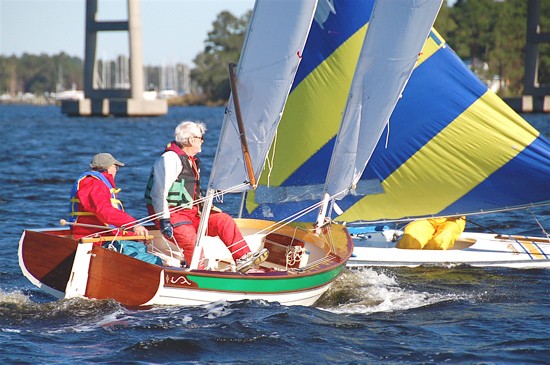
I sailed Lapwing with the WoodenBoat Regatta in 9 races at Rock Hall Saturday and Sunday. Winds varied from a drifter in one race on Sat to good wind up to about 15 or 16 on Sunday. The boat was much better in the higher wind but is under powered with only 105 sq ft for racing against real racing boats. We were only competitive in the higher wind and did not need to have both crew on the rail very often. Close tacking with sloops and catboats should be avoided as our ketches do not come out of tacks very fast and we always loose in these situations. Our starts were timed at the windward end of the line on starboard to allow us to tack and clear a our air right after crossing the line since we could not point with the other boats. Of course, we already knew that. Lapwing performed beautifully and we had a great time for a couple of old farts. While some labored in the higher wind, we just cruised and never needed any hiking straps. I have rigged straps a couple times but have not used them. One thing noted was that the blocks on the sprits should be fixed instead of swiveled to prevent twisting of the sheets, especially on the mizzen with a central cleat just aft of the mizzen mast. Racing in close quarters with other boats really verifies the wisdom of the centrally located swivel cleats for both main and mizzen sheets. Another item is that, if you want to race a sprit boom sail competitively, you do need full wishbooms. Not important for most of our sailing but vital in close competition. The boat is noticeably slower with the boom interfering with the sail and the trim must be adjusted on each tack to allow for a significant change in angle of attack due to the boom holding the sail. I may not add such finery, but would if I planned to sail Lapwing competitively.
-
This question is best left to the designer but the quick answer is that the topsides of the OBX20 have compound surfaces and are not developable in sheet plywood planking like Marissa.
-
Wax or not? Actually wax is the opposite of what most experts think of in a wetted low friction surface (think fish slime). Soap is a wetting agent and wax is a non wetting agent where water beads up on. I think that none of us could tell the difference as long as the surface is fair and smooth.
-
And if you boat is shaped like a golf ball, dimples are recommended. Forget the sandpaper and especially 600 grit and go sailing like the others advise. That kind of stuff is for the anal retentive and reserved for the top flight competitive bunch. Even for them it is more just a way to work of pre-race jitters.
-
It is very easy to get a bad reference from a few bits of questionable data. Having raced and run many such regattas, many at the Carolina Sailing Club, I also think Allan's guess of 85 is way low for a CS17. If I had to make a guess, it would be about 95. If you beat a Thistle in any condition of course, boat or wind, it must be either great luck or a poor skipper on the Thistle.
-
Congratulations to the forums newest American Citizen
Tom Lathrop replied to Ray Frechette Jr's topic in B & B Yachts Forum
Forgot about Graham's trip to get sworn in yesterday and tried to call them a few times. Congratulations, I think Now complaints about the guvment are legitimate, but as Ray says, just not here. -
All these boats balance with movable ballast in the form of crew. Some of us have more ballast than others. Right Ray?
-
feasibility of motorized skin on frame cs 17?
Tom Lathrop replied to DanSkorupka's topic in B & B Yachts Forum
Wanderer, A 16 or 18 foot boat that will plane with 7 people aboard powered by a 6hp Mercury. I am in awe and would love to know its design. -
feasibility of motorized skin on frame cs 17?
Tom Lathrop replied to DanSkorupka's topic in B & B Yachts Forum
The main reason speed and trim angle of the same boat under sail and power is so different is the location of the center of thrust as mentioned earlier. A sailing rig applies thrust at a point well higher than the highest point of the hull. Therefore the thrust applied at this high point forces the bow down and allows the hull to generate lift from the wider area of the bottom well forward of the stern. An outboard applies thrust from aft and well under the hull. This forces the bow up and lift must all be generated from the smaller area of the bottom near the transom. In addition, the bow high attitude makes more waves that those generated by sails and that robs a lot of energy also. Just the opposite happens when we try to make a sailboat out of a planing powerboat. The big wide and flat transom that works great under power generates a lot of drag in a sailboat. You are neither the first nor the last to want to change one into the other. It can be done, as Graham did in the BRR and BRS, but you need to know what modifications will result in a decent boat of another color. As usual, there is more to the story, but this is the basics. -
Question about hull numbers and hulls built
Tom Lathrop replied to MisterMoon's topic in B & B Yachts Forum
It would be very nice if such a thing were possible. Unfortunately there is no way to know how many boats are actually built. Many designers will say that 10% of small boats plans resulting in boats built is normal. We do know that B&B is well ahead of that but many plan buyers just don't communicate.
