Tom Lathrop
-
Posts
1,351 -
Joined
-
Last visited
-
Days Won
24
Content Type
Profiles
Forums
Events
Everything posted by Tom Lathrop
-
There is some coverage of Marissa and the PT Skiff as well as the winners of this year's design contest winners on Proboat's website. http://www.proboat.com/
-
Not sure where you plan on putting the boathook but getting it caught in your sleeve or pants will ruin your day. I almost capsized from the simple cork ball that some fit on commercial hiking sticks. Death on the mainsheet in a jibe or tack too.
-
The temporary wedges I used were made of wood and are similar to what may be found on many boats manufactured. Their purpose is to lift the stern and promote planing in boats that were not designed quite right. The builders and dealers may say otherwise but that is my opinion. I don't really recommend that you mount such under your boat unless you are willing to do some experimenting. I don't have the lines to these boats on hand and Graham is in Maine for a couple weeks. Since your boat is already formed and glued up, I'd recommend waiting to see what he says. I don't want to be involved in butchering your boat or Graham's design by remote control.
-
It depends entirely on what you expect the BRS 17 to do. If its just a little get home power you want, anything from the little 2hp Honda up would do fine. If you want to run as fast as the 17 will reasonably go, a 9.9hp would be about the limit. I did try a 9.9 on my BRS 15 LOON and was able to get it to go faster than the 8 would do but it was not happy and I needed to stick on some temporary wedges under the stern to get the bow down. This is primarily a result of Graham's design of the aft bottom on these boats. The concession toward sailing ability in the BRS limits the planing ability. The Bay River Runner is the planing and non sailing version of the same boat that has flat and parallel aft buttock lines. The BRS is an optimum design for sailing, rowing and powering utility boat that will do just about any task and do it well.
-
Marvelous for the youngu'ns Ray. They will have a great experience. Graham and Beth finally got off with the Marissa for Mystic late yesterday. The wiring was the last thing (mostly complete) and a final dab of varnish on the rub rails. Looks great. Did not have a chance to launch it with the Suzuki 30 for time constraints and a lack of proper fuel connector. Working in temperature in the high 90's and humid is great fun. It will be ready to go up there though.
-

Bending hollowback stainless around bow
Tom Lathrop replied to Scott Dufour's topic in B & B Yachts Forum
Paul, I have been using hollowback on boats much larger than the CS and have not had any problem with denting the material. Scratched from hitting concrete docks and such, yes, but solid would not fare any better in this regard. The only problem related to the hollow shape I've found is that it will dent the wood behind more than the solid stainless would. I would never choose the very heavy and very expensive solid strips based on 20 years experience in some rough service with the hollow strips. We often put 3/4" hollowback on both keel and mid chine area of BRS boats to prevent damage from concrete ramps and dragging over oyster bed beaches. I have considered filling the back with epoxy to prevent the backing wood from denting though. I doubt you would hit anything hard enough with a CS to dent the hollowback more than solid would. That last is to cover the case where both the rub strip and the wood are deformed by a heavy contact with something solid. -
If you sail a small boat near its limits, capsizes are part of the package. My first capsize came early on and I learned not to fear one. When I taught sailing, I insisted that all sailors be able to right their boats and sail on without outside assistance. Of course, its best to sail a boat that can survive a capsize with only minimum danger to the crew. All my small sailboats can do that as well as all the smaller B&B sailboats.
-
Bending hollowback stainless around bow
Tom Lathrop replied to Scott Dufour's topic in B & B Yachts Forum
Ditto what john said. In any case, I don't think trying to crimp or spread hollowback is what I would want to try over more than an inch or two. Sounds difficult. If your stem flat is too narrow for the 3/4" material, I think I would either go with 1/2" all the way or end the 3/4" under the bow where the stem starts to narrow. Can't really tell without seeing the boat though. -
Bending hollowback stainless around bow
Tom Lathrop replied to Scott Dufour's topic in B & B Yachts Forum
No problem with bending hollow back stainless. Just fit it in place starting with the sharpest bending area. No need to pre-bend, insert one screw at a time and it will be fine. -
Outboard Motor/Motor Bracket for BRS15?
Tom Lathrop replied to ricknriver's topic in B & B Yachts Forum
Bite your tongue I am not as serious about this as it may appear and, like many, when I first started sailing, I thought of putting a small motor on my first 15 1/2' Windmill. Never did it though. After sailing many years in the Beaufort area, I never felt that a motor was needed on a small sailboat. Learning to work the shallows against a strong tidal current is good for the soul. I do understand schedules though or at least, I used to before retiring. Some locals use one of the small ultralight Honda outboards on boats such as an Ensign to get to races on time. They seem ideal for this kind of use. -
Outboard Motor/Motor Bracket for BRS15?
Tom Lathrop replied to ricknriver's topic in B & B Yachts Forum
The transom of a BRS is strong enough to support a small outboard as is. The 3/4" plus plywood across the top and reinforced by the aft seat under that. Very strong and no knee needed. I sailed my BRS on the rivers and sounds of Eastern NC and never felt the need for a motor. It is a sailboat and will move in very little breeze. Oars can suffice in a pinch but never needed them either. -
These kinds of discussions always go the same way, with margins of recommended safety always increasing. On boats as small as the CS series, I think most of the recommendations are overkill. In the EC Graham uses a small Danforth, probably about 5 or 6 lb. On the Main trip last year, I borrowed the 9 lb Danforth, 8' chain and rode off my 22' Hunter sailboat and we used that for both Southern Skimmer and Lapwing overnight, tied together bow to stern. I use the same kind of anchor on the Bluejacket 24 powerboat, Liz. For our trip to Canada I added an 11 lb Bruce and 8' of chain just as belt and suspenders. For many years, I used a 12 lb Danforth as the only anchor for a 30' Alberg keelboat along the NC coast, always without serious issues. On the BRS 15, Loon, I fitted a 4 or 5 lb Danforth into a well on the foredeck that will not take a larger one. As far as I know, the current owners of Loon still use that anchor on cruises in the Sea of Cortez and Great Salt Lake. Small and lightweight boats like the CS don't put a lot of load on an anchor. On Lapwing, I don't have any chain but then, I don't expect to be anchoring overnight in hazardous conditions which is why the 9 pounder with chain was taken to Maine.. I would not fault anyone for going further than what I have used but there has to be a reasonable limit somewhere.
-
The main thing to remember about these joints is that they have very little "stand alone" strength. They are not really a complete joint by themselves. They depend on the covering board or plywood to distribute the load to the main timbers. What they mainly do is to minimize stress concentration that would occur with a simple butt join. The 45 degree cut and tang is about as good as can be had in this situation. Never seen the half lap version used on a deck beam other than on larger boats where the joint is visible overhead..
-
The most serious problem I had with an Andersen bailer resulted from launching from the trailer with the bailer down. The reason is that a transverse support bed is often the best for some boats and the bailer hit that. I didn't think anyone else was dumb enough or forgetful enough to do that. Keel rollers are another main culprit for damaging bailers.
-
Paul, Having used Andersen (and Elvstrom before that) bailers for over 40 years, I have never had that problem. Had several other problems related to damage done by the crew though. The bailer relies on the internal gasket to offer enough friction to hold the bailer in whatever position you put it as well as seal the edges. I find it odd that the bailer won't stay down but does not leak. Is it possible that the sides are bent inward just a bit toward the top? All the foot traffic might cause that.
-
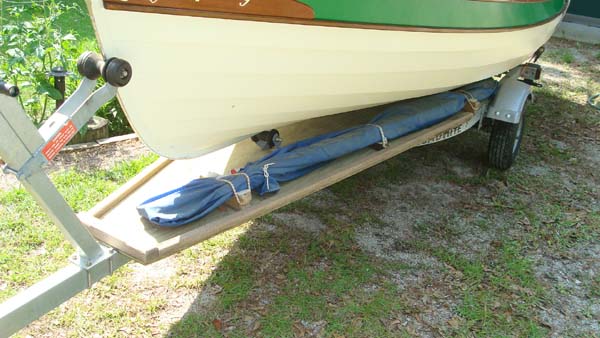
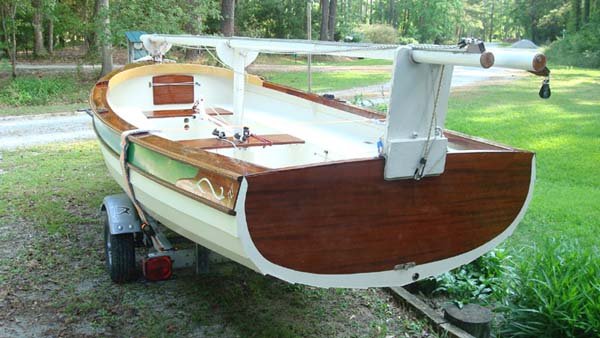
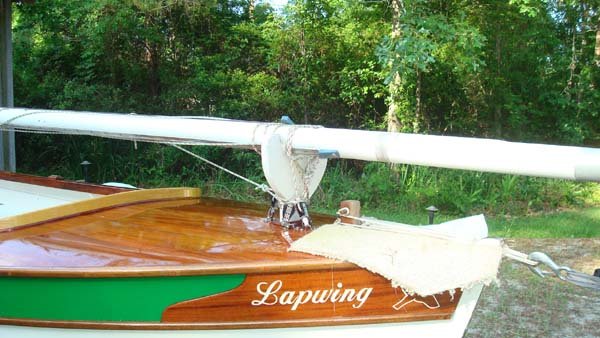
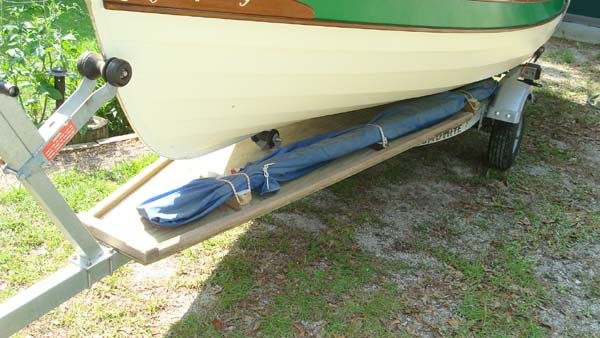
The transom crutch is a sort of saddle over the top of the transom and ted down to the rudder gudgeons. Everything that can rub is cushioned with carpet. I use a samson post on the bow instead of cleats and a bow eye. Had to raise the winch quite a bit of course to get a fair lead for the bow tie down. I also like to mount a sheet of 1/2" treated plywood on the trailer which makes a secure place to store sprits, rudder and tiller for trailering. It also makes secure footing if you need to get on the trailer for launching or retrieving the boat.
-
The best all round system I have found for these boats is to make a crutch for the two mast locations and one mounted on the transom. All are to be at the same height equal to about 12" above the foredeck. If you roll the sails on the masts, I like to make a single Sunbrella sock to cover both masts and secure the combination on the crutches for travel. For storage, I lay a tarp over the boat with the masts acting as a ridge pole. For masts with sail tracks, the masts should be set in separate notches to keep them from rubbing on each other. Cushion the notches at the top of the crutches with carpet. Have been using this system for over 40 years and many, many miles with no problems.
-
Survivability of the boat and crew is not at stake in any of these boats when well handled. Both CS and Lapwing in equal LOA are easier on the crew because of a higher sheer, greater volume and a dryer hullform when sailing. The BRS is a great combination of power utility, work boat, fishing boat as well as sailing and rowing. Neither the CS nor Lapwing will handle the utility, work and power part nearly as well as the BRS. It depends on the use the boat is intended for that will determine which is the better boat. In my opinion, the BRS is better as a sailboat than the CS or Lapwing is as a work and powerboat. Hull shape of CS and Lapwing is dictated by construction method and personal choice. Hull shape of the BRS is greatly influenced by the need to handle more power and still sail well.
-
Beautiful Tony, just beautiful
-

-
JH, I'm not sure what you mean by "tough". Probably not what I mean by that term. If you mean surviving bashing into stuff and things, the BRS15 or 17 is far the tougher boat of the three. Since Lapwing's bow is formed of overlapped 6mm ply it is probably tougher than the CS 17 which has a single layer of 6mm in the bow. None of these boats are meant for ramming into things but the BRS is much more capable of surviving the impact that the others. The bottom is usually 9mm, extending all the way to the bow which has a heavy blunt stem timber. If you mean ability to handle rougher water, the CS15 and Lapwing should be about equal while the CS17, being larger, should be more capable in that condition. In all cases, seamanship is more important than specific differences between these boats. Just look at where my old BRS15 LOON has gone and what it has done in some very trying conditions and it is the least big water friendly of all of them. Don't over analyze this stuff. Get the boat that appeals to you more and be happy. All are tried and tested designs.
-
Sailing appeals to different people for different and very personal reasons. Some, including me, cant stand a boat that does not sail well in a performance sense. Some others could not care much about the performance aspect and just enjoy being out there in their own sailboat. Whether the Weekender appeals to you depends a lot on which camp you fall into. There is no reason to look down on either from whichever vantage point you occupy. I'm a performance guy and so the Weekender does not appeal to me for many reasons. Personal opinions about the many different boats and kinds of boats are the stuff of discussion and the internet would be very dull without such give and take. Many groups want to be very protective of "their" turf and exclude outsiders. I have a friend who was asked why he brought a beautiful Ken Basset Rascal to a messabout dominated by Bolger boats. Not what I'd call friendly.
-
Spindrift 11N finished. Now what about mast and sail?
Tom Lathrop replied to rotroman's topic in B & B Yachts Forum
An old Laser sail will work well on a Spindrift. That is what I did on a Spindrift 10 years ago and only cut off the lower portion to get the proper area. It worked well enough to win a lot of races. Ideal would be a new sail from B&B but when money is tight, why not. If an old Laser mast is available, use that too. -
I have Gordon's book and you are right. It reads like a novel and offers a lot of knowledge in an interesting and simple format.
-
Howard, such a structure would add very little to the stiffness of a mast since it is located near the center of the bending axis where the stress is minimal. It would not pay its way in weight vs added stiffness. At the center of a mast, there is zero stress. Stress varies exponentially with distance from the central axis. That is why a hollow mast is the most effective in weight vs stiffness. Its also why a thin wall aluminum tube is so difficult to beat for a mast.