Joe Sundstrom
-
Posts
34 -
Joined
-
Last visited
Never
Joe Sundstrom's Achievements


-
I think that building wooden boats in this age of high technology is a very worthwhile thing. And hanging out with your dad is even better. Keep writin'. Joe
-
Congratulations. I just can't get enough of that cat ketch look, i'm glad you had the sails raised.
-
CAD program for converting lofting plan to stitch and glue
Joe Sundstrom replied to Joe Sundstrom's topic in Design Forum
It is Gregg Carlson's free Hulls program. It does just what i required (see first message in this thread). Go to website: http://home.clara.net/gmatkin/softwr.htm Select "Hulls software." Select "Hull Design." Download both Hull Designer software and Gavin Atkins' tutorial. Grab your lofted plan with offsets (or create your own offsets from the drawing) and go to work. Joe -
A Merry Christmas and a Happy New Year
Joe Sundstrom replied to Designer's topic in B & B Yachts Forum
Sweet lookin' card, GB. -
A very, merry Christmas.
-
I am looking for an inexpensive or free computer-assisted design software application that will convert a traditional. lofted hull plan to a two-dimensional layout for plywood stitch and glue construction. I have plan with a single, hard chine that was almost certainly designed for plywood construction. It includes keel, chine and sheer dimensions at regular stations as well as the half-breadths at those stations. I would like to be able to enter those dimensions into the program and then have it produce the two-dimensional layout for transferring to plywood sheets.
-
i have not seen any problems with outgassing or workability with the Silvertip epoxy, it seems to be very forgiving from what i've read about other kinds on this board. Also, the EZfillet is great, no mixing with wood flour. Just mix and go. Joe
-
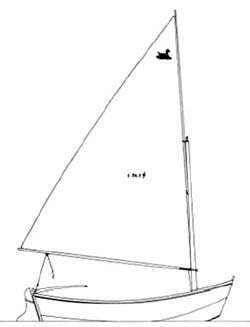
I chose this design for two reasons: 1. The sail plan and standing rigging: I hate flogging headsails and love to singlehand, but still want to be able to balance the helm, so i knew that a cat ketch was the rig for me. Many years of catboat sailing also make me very confident in using an unstayed mast. 2. The wife does not like long passages Thus, the desire for a trailable boat. The PS22 is the best i have found to fulfill these requirements; there is nothing commercially available that comes even close, as far as i know. So i get the plans and see all of those curvy lines and exotic (to me) materials and my crest fell. So the wife sez "why don't you build a small boat first?" (so glad there is one smart and sensible partner in this marriage). I recalled reading a child's book which featured a young girl who sailed a small pram called a Puddleduck to my young girls, lo, these many years ago, and Googled it. The illustrations in the book revealed a lovely little, all-purpose sailing pram with a lot of rocker, very sea-worthy. Turns out to have been designed by R. H. Baker in 1951 and put in production in 1953 (my birthdate as well). I am currently laying out the bottom and side panels in 2-D for stitch and glue using the method of Sam Devlin as the plans from Baker Boat Works, while drawn for plywood construction, require lofting (Sam Devlin, Woodenboat Issue no. 106, May/June 1992 ""Converting to Stitch and Glue"). I plan to build at least two of them, one each for my girls, who are already fighting over who gets the pram. Should be a plywood boat-building monster by then, and since my science career is not too satisfying, who knows where it will go? I want to give special thanks to Charlie Jones, who tutored me on the use of the block plane. Also, source of Okume plywood in the Greater Seattle area and the Olympic Peninsula in Washington state is Edensaw. Really easy to use epoxy products are available from Seattle-based System Three (go online and get their Epoxy Book).[/img]

-
The noise/drag created by the Princess Sharpie 22 motor well as specified in current plans disturbs me. There must be an easy modification to minimize or prevent this and i would like to have it before i begin construction of hull #22. I will be researching this on my own, of course, but i can never be as smart as all of us put together.
-
Let's discuss the taping of the OUTSIDE seams. I have seen commercial sources of stitch and glue craft tape the outside of hull seams both before (Chesapeake Light Craft) and after (Devlin) completely fiberglassing the hull. Which one is advantageous?
-
I hope that you recover from your fall down the stairs. If you have any visions of boatbuilding as a result, feel free to come back.
-
Pilgrim goes for a sail on Matagorda Bay, Texas
Joe Sundstrom replied to Travis Votaw's topic in B & B Yachts Forum
Good to see a PS22 in a stiff breeze. -
Knock-down, plywood cutting grid
Joe Sundstrom replied to Joe Sundstrom's topic in B & B Yachts Forum
since one must adjust the sole plate so that the blade does not cut the grid, tighter curves can be cut with the circular saw. -
I, and i am sure others, need to know what weights and widths of biaxial fiberglass tape are available commercially and who retails all of these different weights and widths for the amateur? I have some 15.5 oz tape from Jamestown Distributors, and it is far too heavy for my application Joe
-
I have searched and searched for fiberglass tape, especially biaxial, and i do not believe i have scratched the surface of available types, weights, etc., and their best uses for stitch and glue boatbuilding. It is interesting that Devlin likes to cut tape from fiberglass cloth, but that sounds like a lot of work. Probably saves him a ton of money (he doesn't like the work that selvaged edges require, either). I would appreciate information from the experienced ones among us, as well as retail suppliers. I am building an 8 foot sailing pram, then graduating to a B&B Yacht Designs Princess Sharpie 22. :shock: Joe