Fishman38
-
Posts
340 -
Joined
-
Last visited
-
Days Won
9
Content Type
Profiles
Forums
Events
Everything posted by Fishman38
-
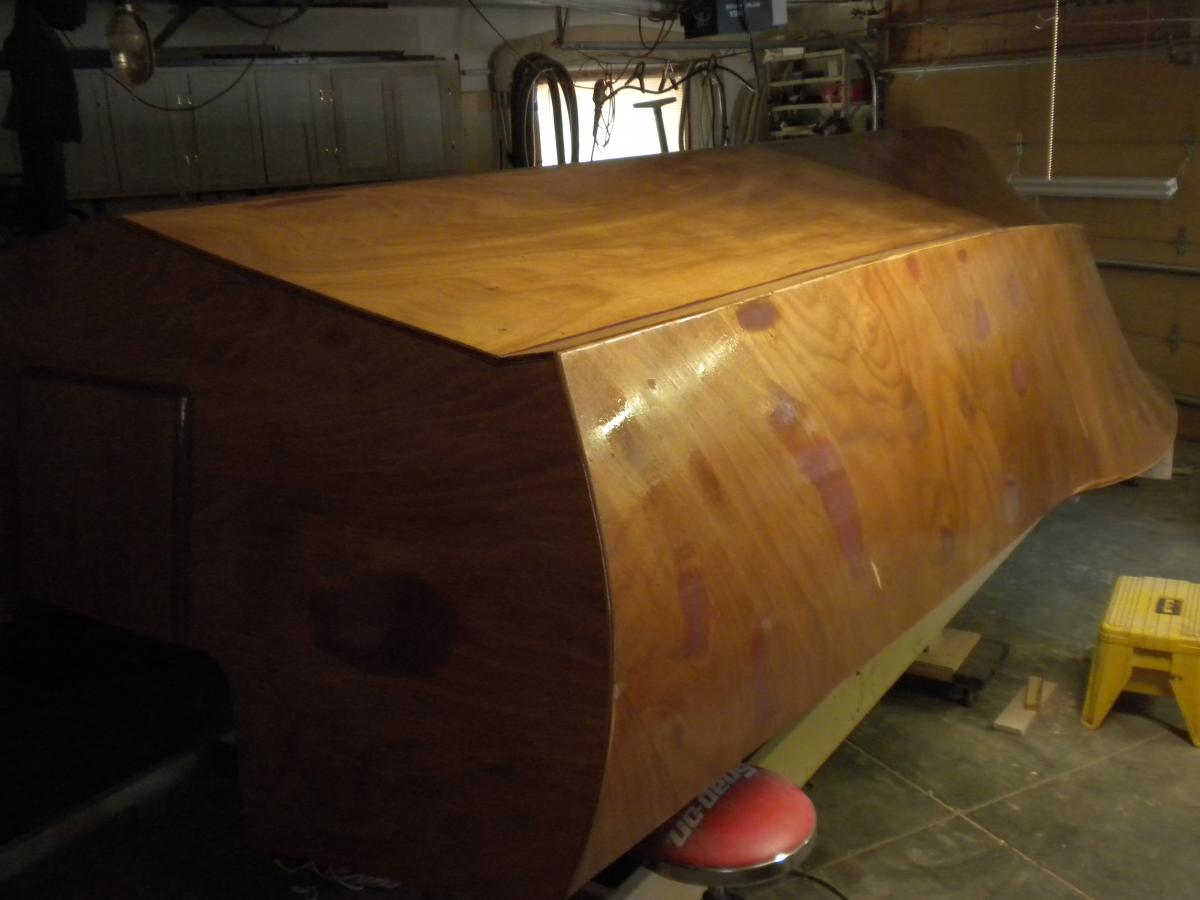
First coat of epoxy done, hope to get the glass on this weekend.


-
Thanks for the suggestion Dave. That doesn't work for me either. Frank thought it could be a problem with Java but my PC guy says there nothing wrong with Java. No doubt there's something amiss with my laptop. I'll try later with another machine.
-
Please ignore this. I was attempting to use the cut and paste/quote functions. Doesn't work for me and I haven't figured out how to delete this.
-
Miyot if there are flaws in the exterior finish work, it doesn't show in the pictures and that's cosmetics only anyway. I'm more impressed with the neatness and layout of the wiring, plumbing, fuel system, hatches, trim tabs and pumps and so on. Aside from seaworthiness, that's what really matters. I only have a vague notion of how I'm going to do all that. Cheers to you!
-
Only wish I was that far along! I've been sanding , fairing , squinting , etc,etc now for about 6 or 8 weeks and if there's anymore of that that needs to be done it's beyond my ability to see it. I'll be laying epoxy, glass fabric and more epoxy in the next week or so. Miyot, your boat looks great!!
-
After one more pass with the 80 grit. Best I can tell these lows range from less than 5 to 16 hundredths of a millimeter. Not sure that novice that I am at this type of work (I'm not much good at drywall finishing either and have never done a lick of autobody work) that I can improve on this. And wondering if I should even attempt it now or wait 'til the glass is down.


-
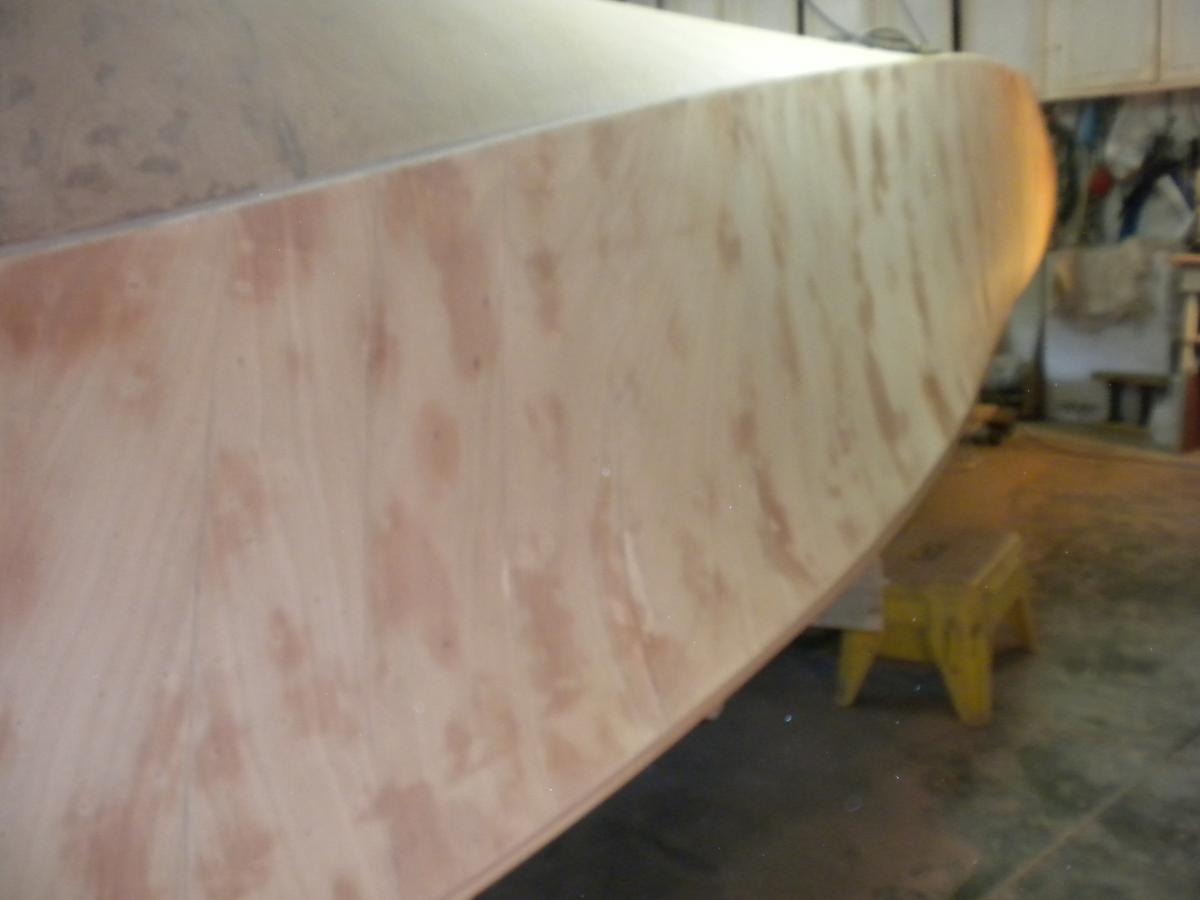
Turns out no one in this town sells drawer knobs that were what I considered large enough to be comfortable. I found these wooden spheres that seemed a little too large (they're a little larger than a billiard ball............the board is 3" wide) but decided to try them on the long board. Bought two and sanded about a 1" diameter flat spot on each and attached them with 2 flathead screws and epoxy. These suckers work great! From any position they fit my hands the same so there's no odd torqueing on the wrists and elbows and so far no blisters on the hands. The other pic shows the result of using the light coat of primer to highlight the highs and lows. I first tried aerosol canned black primer but too slow and (for me) impossible to get a smooth coat. I switched to my pneumatic sprayer using Rustoleum Rusty Metal primer, A little pricey at $12/qt but I figure the quart will be enough for my next 3 boats Actually I bought a used trailer which is in need of a paint job, Enough rambling. The method works great. My only question: how does one decide when it's time to stop sanding and start filling? Maybe when the second ply starts to show?


-
Graham, that is exactly one of the reasons I decided to build this boat, for a drier ride. But I was impressed by the high, flared prow. So if a sharp chine will help me stay dry, sharp it will be! Many a wet trip have I made in the boat I've had for over thirty years! ................and a few I didn't take because of how wet it would be.
-
Regarding building the chine back up to a sharp angle, that was my understanding in talking with Graham.* Matter of fact, that was the first I knew that it should be done on either the chine or the transom. And I'm still not sure I understand the method of doing that. Guess I'll figure it out when I get there. Graham said to use tape to construct a wall to contain the epoxy. What kind of tape would be rigid enough to work for that? Masking tape maybe if doubled or tripled? I'm at the same stage as you, sanding and fairing and you're right, it's a rather tedious process, although as I get further into it and learn some of the tricks, it gets a little less so. A friend of mine stopped by yesterday who has some experience with auto body work and gave me a tip on fairing a concave compound curved surface: build a longboard that has a convex sanding surface. May be old stuff to some but not to me. Helped me a lot. I'm trying the method suggested by someone, Paul at PAR or maybe Charlie Jones down on Matagorda Bay in Texas, of lightly spraying the surface to be faired with primer, then sand with the longboard to help highlight the highs and lows. With a little practice I think it will be very helpful. (actually I think it was Charlie in the "Epoxy Tricks" thread).................scratch that, I don't know who it was....sorry. *See Graham's March 8 post above.
-
Filling holes. The second pass is to fill the little divot that's often left after the epoxy is cured. But that's all pretty much done now. Just trying to get the surface all smoothed out.
-
Actually I think that may be the best idea. You mean like golf tees? Or just hdwe store dowels? I had forgotten about that method and probably will do that if there is a next boat.
-
I think on my next boat I will (1) wait 'til I'm done fairing and sanding the wood to fill the screw holes and (2) use fairing compound to fill the screw holes. (I used regular thickened epoxy on the first pass at filling screw holes and switched to fairing compound for the second and final pass) Because (1) otherwise the area around the screw hole is very hard to sand making it difficult to avoid removing more wood than epoxy and (2)the goo seems to continue hardening for a couple of weeks, so the sooner the sanding of it can be completed, the better.
-
I was beginning to get a little smug, thinking I didn't have as much sanding/fairing to do as I had expected...................then the sun got real low in the west and OMG........... even though in direct light I cannot see the bumps where I filled the screw holes , and can feel them only if I know they're there, nor see them when I lay a fairing stick against the surface, they are definitely there. So it looks like I need to spread fairing compound over the entire surface then knock it back down with the long board. Is that about right? These were taken before the sun got low.


-
Nice work Miyot!
-
............uhh..what colors do pickup bed liners come in?
-
OK thanks Paul. Just wanted to be sure I'm not overlooking an easy solution.
-
Makes sense to me, certainly on horizontal and near horizontal surfaces. Maybe a little trickier on vertical/near vertical but still do-able? I'm in the long-boarding phase on my Ocracoke 20. Having a little difficulty figuring out a technique for LB' ing the sharply curved surfaces, especially the concave ones such as up under the bow. I'm sure it's going to require a different size, shape and flexibility of the only one I've made so far which is 3x22x 1/4 inches. Any suggestions?
-
For screw holes I use thickened epoxy in a syringe. I'm not real pleased with this method because If the hole has no bottom, i.e. goes through both layers of ply, you can wind up with a big glob of goo on the back side of the ply. If the hole has a bottom, it's very hard avoiding getting a bubble and leaving a void in the hole. And it's very difficult to know whether you effectively filled the hole. The other problem, assuming you succeeded in filling the hole, once it hardens, it shrinks, leaving a "dimple" which can be up to say 1/16th inch deep. There doesn't seem to be an easy way to "scratch" the surface of the dimple, so: 1. When I fill this dimple with another dab of thickened epoxy and a putty knife will it bond? 2. Or will sometime in the future will this little dab of epoxy pop out along with the paint finish and have to be repaired. 3. Should I just ignore these little dimples and assume that the glassing, fairing, priming and painting process will fill them, and all will be ok? 4. I suppose one could find a Dremel tool sanding head that could be used to rough the surface of these little boogers, but really.............give me a break!
-
Dale, if you're planing directly cross grain (90 deg) you're right, of course. But otherwise, that is, more than say 15-20 deg from 90, for me it made a significant difference. In the particular situation I was in, maybe not, as it's going to be sanded, then glassed, sanded again, painted etc,etc. But if it's for bright work I'm sure it would make a difference.
-
Oops. Did I say sane? I meant to say "the boat builders on this forum" . We know they're all sane.......... I also meant to say "another practical reason"
-
I'm trying to develop a sense of how much prep time should go into the bottom vs the top paint. I know its important for the bottom paint to be tough, durable etc. But aside from pride in workmanship is there a practical reason to spend additional time and energy simply to make it look slick if the boat is going to be in the water or sitting on the trailer and not upside down on top of a car? In other words does the average sane boat builder pay as much attention to making the bottom look good as he does the topsides?
-
Charlie in your post you mention Raka, are you referring to their epoxy or have you used their paints? I like their prices on paints.
-
Sounds like maybe an issue with System 3 only or maybe it just needs a couple coats of (System 3?) primer between the epoxy and the alkoyd paint.
-
Dale most if not all of what's being cut here is the end grain if I understood Graham's instructions correctly. I may have used the wrong terminology. Given that with the boat upside down and the planks sloping toward the bow, you are planing the bottom end grains at roughly a 45 deg angle if you work fore to aft instead of roughly 135 deg by planing toward the bow. The latter makes a rougher cut though not a big deal since a few strokes with coarse sandpaper smooths it out.
-
Thanks for the input PAR (Paul I think?). I know it's a huge subject. I discovered how huge yesterday when I started seriously researching to arrive at what to order for when I'm ready to start painting mine! The popular brand names all seem pricey to me, some more so than others, and there seems to be a fairly wide range in prices among those. Is it safe to assume that for a given type, single part polyurethane for example, regular, that is MSRP, price is a direct (but not necessarily linear) function of quality. Or should one look for the cheapest among a given category and quality brand names? I realize there's probably not a simple answer to this question and am just looking for a best guess from those with some experience in the field. I, like most folks I suspect, hate to paint, so don't mind paying more (and for that matter spending more time prepping), so long as it gets me a few more months/years between re-paintings.