Bryan Rolfe
-
Posts
98 -
Joined
-
Last visited
-
Days Won
14
Content Type
Profiles
Forums
Events
Everything posted by Bryan Rolfe
-
I get all my epoxy online. You can order the Totalboat stuff directly off Amazon if that's what you decide to use. Okoume may be hard to find locally in general, but I'm not familiar with the ATL area. You may have to order a stack and have it delivered.
-
Yeah every new technology has its hiccups, and it's too bad e-propulsion doesn't have replacement cables/connectors, as I do see that as a vulnerability too. Gas outboards have been around a lot longer and improved over decades to (mostly) be reliable and low maintenance. That said, I've had to re-build carbs in many exotic places. We're leaving the option open for a gas outboard, preferably a small 2-stroke, but we're going to give the electric a shot until it stops working, or proves itself incompatible with our needs.
-
Is it really $35/day now? I think when I was there it was $10/day, but I honestly don't remember having to pay it. That could be because my boat was only 27ft, and someone had a private mooring that was a little closer to shore that they very kindly let me use (there were no moorings available when I arrived). That is kind of one thing I didn't like about Bonaire, is that there were so few moorings and they were basically always all taken, that whenever you wanted to go day sail somewhere else on the island you had to "reserve" your mooring with your dinghy. I did enjoy it much more than Curcao though. Curacao is a more useful place to be, as it has the stores and ammenities needed for our boats. But Bonaire is quiet and cute, unless there's a cruise ship on the dock.

-
Though I waffled back and forth on this for a while, I decided ultimately to go with an electric outboard, at least for now. If we feel like we need a small 2-stroke, I'm confident we'll find one 2nd hand very cheaply once we're in Mexico. I took it out for a little 5NM stroll through the estuary where our boat is kept. Was really satisfying, I can't believe ho quiet these things are. In fact, the noise the water makes against the hull is far louder than the motor itself, especially at the speeds I was running it (100-230W for 3-4kts). I do need to come up with a bracket for it to mount on. Today I used some plastic material so I wouldn't damage the relatively soft wood. Unfortunately the rudder gudgeons are bolted through basically right where the bolts need to be for the engine mount, so I think I will just 3D print something with ASA (UV resistant) that slips over this bit on the inside, and maybe a thin metal plate on the other side. Or I could swithc to screws... I thought there was a good reason I through bolted them, but I really can't think of the reason given the force on the rudder is so minimal.


-
Yeah I'm wondering if I should add a reef to my sail for the trade winds. Sometimes I forget how it's just constantly blowing 15-20kts there. Hope you got to spend some time in Bonaire before Curacao. Both have their advantages, but Bonaire is really hard to beat from the standpoint of how beautiful the water is in comparison. You should also head over to Klein (little) Curacao, makes for a fun little trip. And when it times to depart further west, assuming that's your plan, there are a bunch of nice littel spots along the west coast of Cuarcao to anchour outside of Spanish Water.
-
Yeah the reef passage to Le Phare Bleu would be risky under sail the the daggerboard down. Were you removing sections of the mast on the fly? That's something I haven't figured out how I'll do yet, if it ever becomes necessary. I'm not sure we'll make it back to the Caribbean with our Spindrift, but if we go west long enough we might. I am excited to explore the atolls of the south Pacific with one though, I think that could be a lot of fun.
-
Wow, I'm impressed you've seen so many! Kudos to the guys without any oar locks, not sure if they're crazy or just really competent. Have you guys been sailing your dinghy very much? When I was in Grenada, I would row my inflatable a mile every morning to shore (I was in Woburn Bay overy by the Hog Island bridge). But sometimes I would need to go over to one of the adjacent bays, which is quite a long trip to row -- but would have been a blast to sail.
-

Cutting a perfectly good SD10 in half
Bryan Rolfe replied to TooManyHobbies's topic in B & B Yachts Forum
I ended up glassing before cutting in half since it made the actual glassing easier, since I could just do each side in one go. But if your temperatures are such, or you resin is a fast curing resin, it could be nice to cut it in half first so you have more manageable surfaces to glass in one go. -
Hope you're enjoying the islands, and getting some time to go north before the hurricane is fully upon you. I really in enjoyed Dominica -- not the best anchorages, but it's a fantastic island to explore and much less developed than some of the other ones. Also if you haven't already, the Tobago Cays in the Grenadines are absolutely worth visiting. Might be worth adding a bow eye or similar that you can attach the chain to instead? Going over the hull like that I think you'll get chafe. When I was in St. Martin, with an old dinghy and a 2.5HP outboard, I walked up on a guy trying to cut through my chain and confronted him. He straight up tried to tell me it was his dinghy. Like you, I'm sort of hoping that a hard wooden sailing dinghy is not a desirable target for thieves, but the outboards surely are.
-
That's very flattering! I had a sailing YouTube channel a while back, so I definitely have been knee-deep in this before. But I wasn't really planning on documenting this at all, and so I leaned heavly on a lot of phone footage which isn't the best. I think the shots that are most "Leo" like are the ones I shot on my DSLR though, as they are much more deliberate, controlled, and provide both dramatic lighting and depth of field. Yeah and the plywood might have been more affordable back then, or more available at least. I really couldn't even find reasonably priced marine plywood of the right thickness around here, so there would have been added costs of shipping or ferrying it from somewhere else. I don't know how much time I saved, but it was probably substantial and there's enough work to do still that I don't feel like it was cheating at all.
-
Well I compiled all the footage I had of the build process and put it into a very long video if anyone is interested!
-
I need to decide how to fender our Spindrift too. I also am concerned about mildew though with the fabric/weave of some of these solutions. Is there not a rubber-like/UV-stable plastic version that has a foam interior?
-
Seems like a fun little project! In all seriousness, how epic and ambitious -- how much solar is on that cabin top? Looks like maybe 1 kW? We're considering putting a Beta 35/38 in our Westsail 32 as well, had a smaller beta on my last boat and it treated me well.
-
We finally got the dinghy to the boat today, which was an important milestone since we had never test fitted it on our boat other than with a 3D print I made earlier. I think we like it best under the boom, as its out of the way there compared to the foredeck. We'll have to mount some wooden blocks on deck and then probably strap things down. We also got out for a sail which was lovely. Sailed down to a restaurant not too far from where our boat is docked and got some tacos to celebrate.


.thumb.jpg.d753fcc289dfa8c00f14af53cc357f42.jpg)


-
Any time you store energy in a confined space, be it gas, diesel, or various battery chemistries, and design that stored energy to be "easy" to release, there's a risk of that energy releasing much faster than you intended. Gas is probably the most dangerous, followed by LFP maybe, and then diesel. Usually the bigger risks with any battery system is the wiring not being properly protected, and a short causing a fire that way. Off topic: Will Prowse has really good when he sticks to the subject matter he knows well: batteries and solar. However, he has in recent years chosen to share some of his pseudoscientific views, particularly about drinking alkaline water and chemicals in our clothing causing health issues (which is why he is always wearing a merino wool shirt in his video). Neither of which are supported evidence-based research. I just find it interesting how people can use data-driven analysis rigorously in one aspect of their life, and would probably poo-poo anyone making claims about batteries that are not supported by data, but are willing/able to completely ignore it in other aspects of their life -- or more likely, they just don't trust it if they didn't do the testing themselves.
-
I'm not sure what it is about the trolling motors that doesn't have me sold yet. They just don't seem like they'd hold up to full-time ocean cruising conditions, and it also seems like I'd be operating them at a higher % of their max output to get to our hull speed, and thus we'd have much less range on a full charge. But they are much much cheaper. That said, I did 3D print the dimensions of one of the 25AH cells I had linked above, and it absolutely would not fit through my 6" hatches if built into a battery pack. Esepcailly not one built of 16* cells. I realized the ePropulsion batteries are 48V.
-
Oh absolutely. When we stow it ontop of the car for transport, I use a furniture blanket between the two halves and some pieces of high density foam. Not sure what we'll use yet when it's stowed long-term on deck, but probably something similar.
-
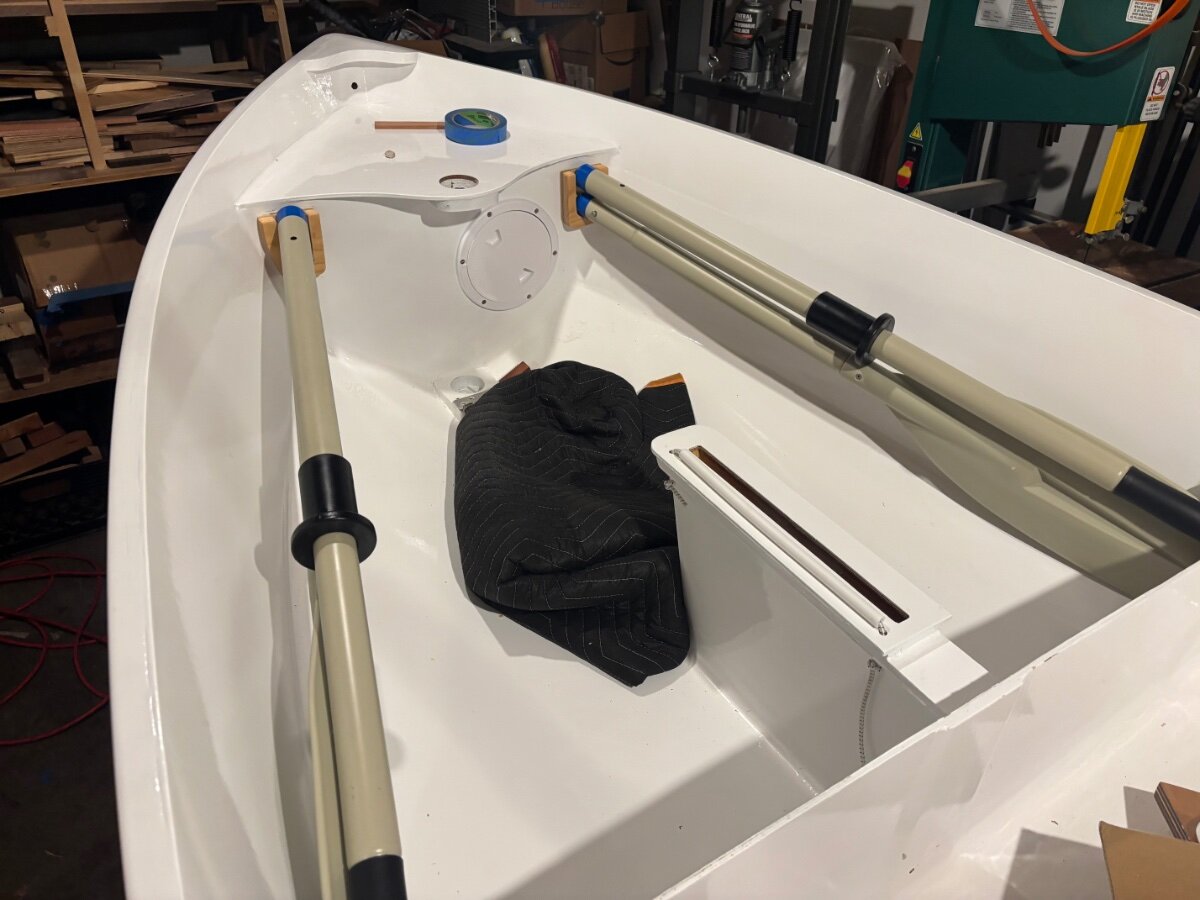
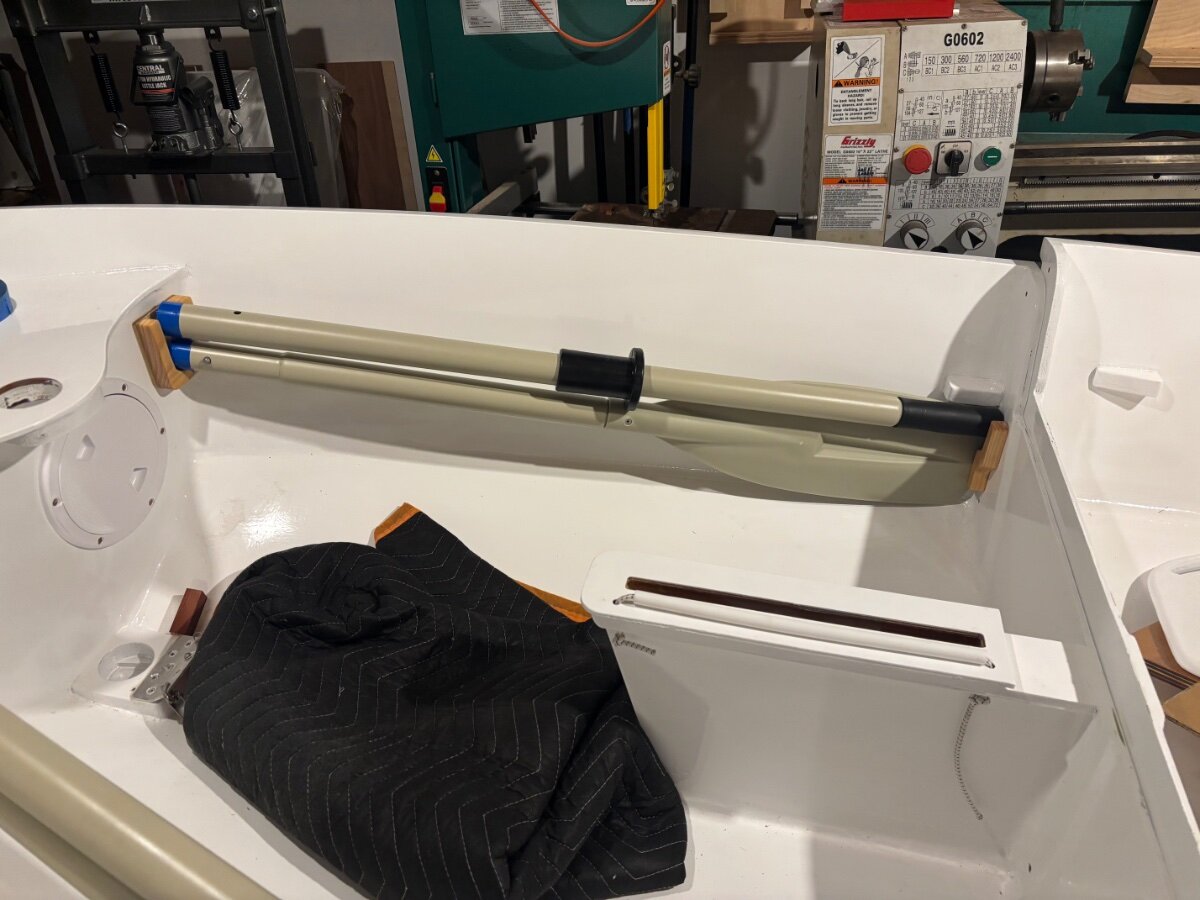
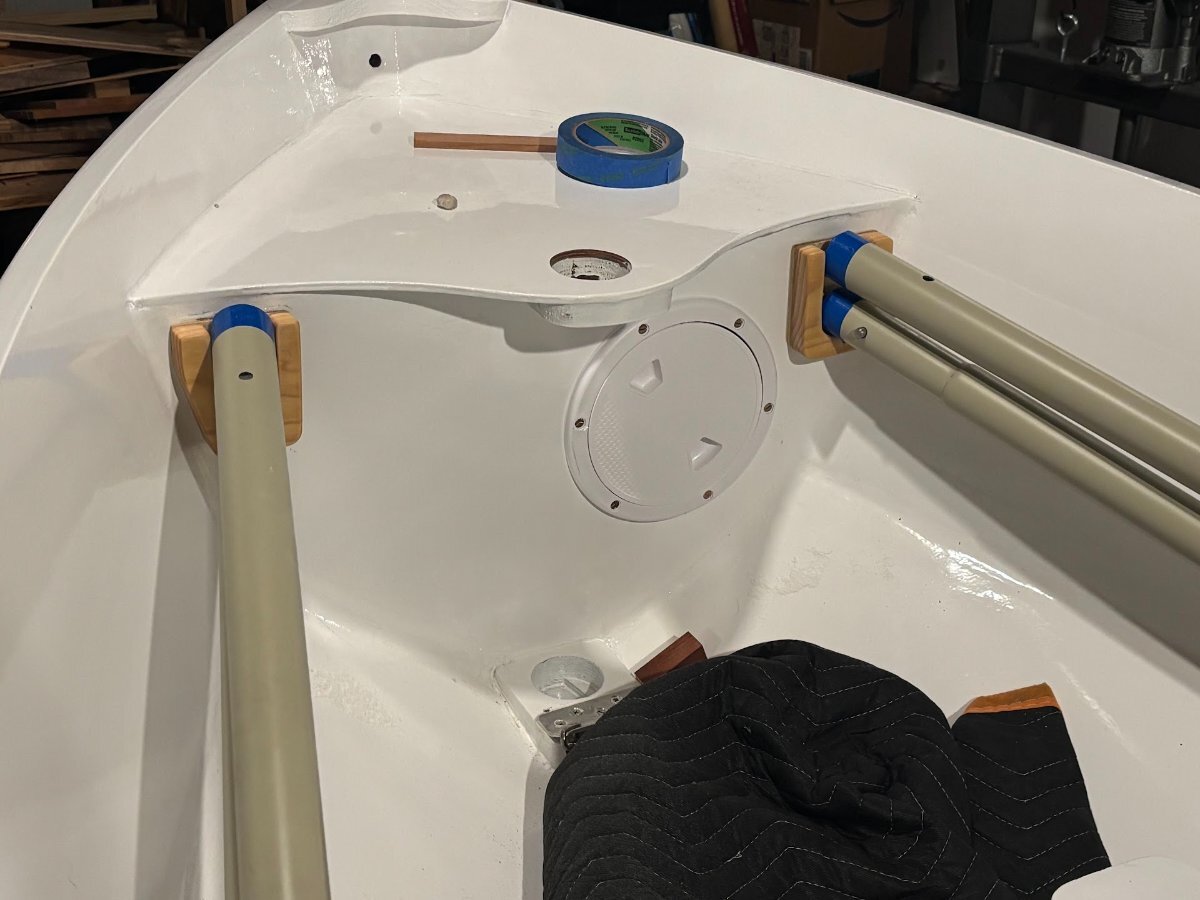
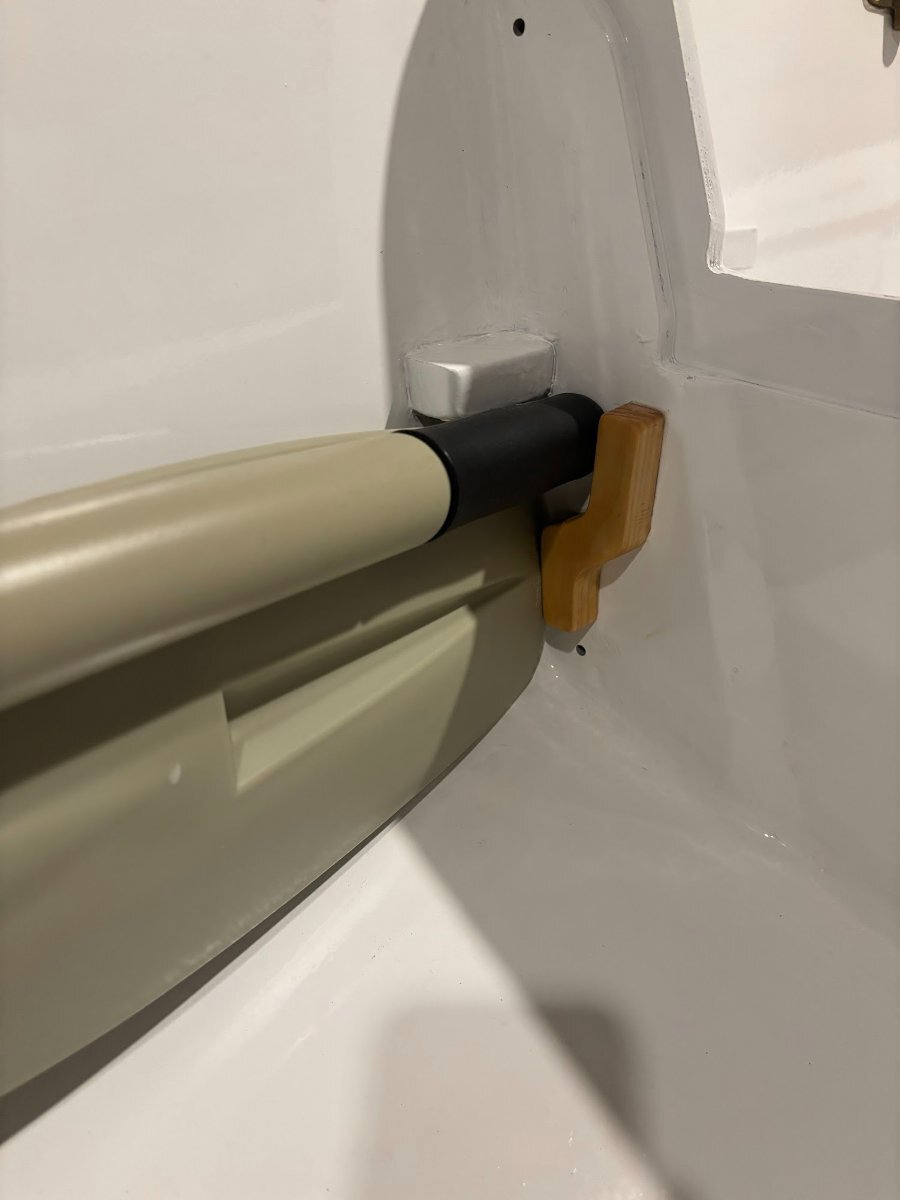
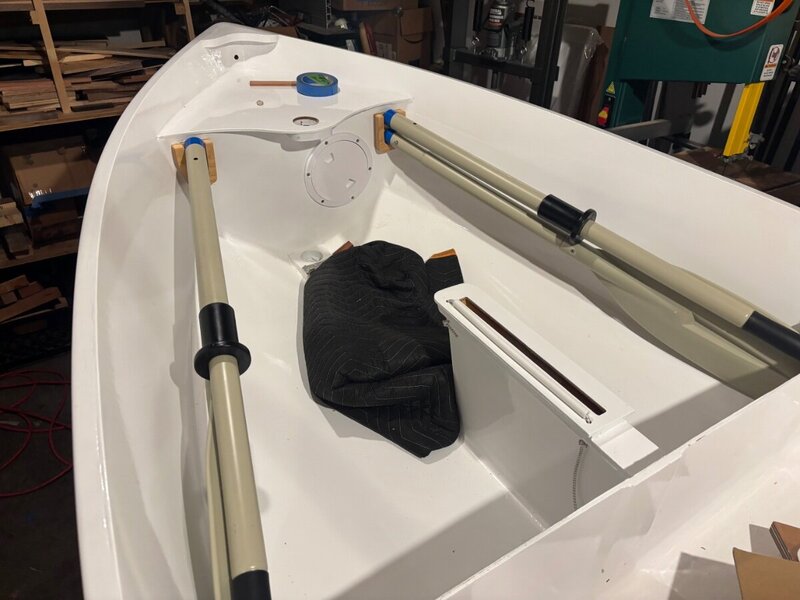
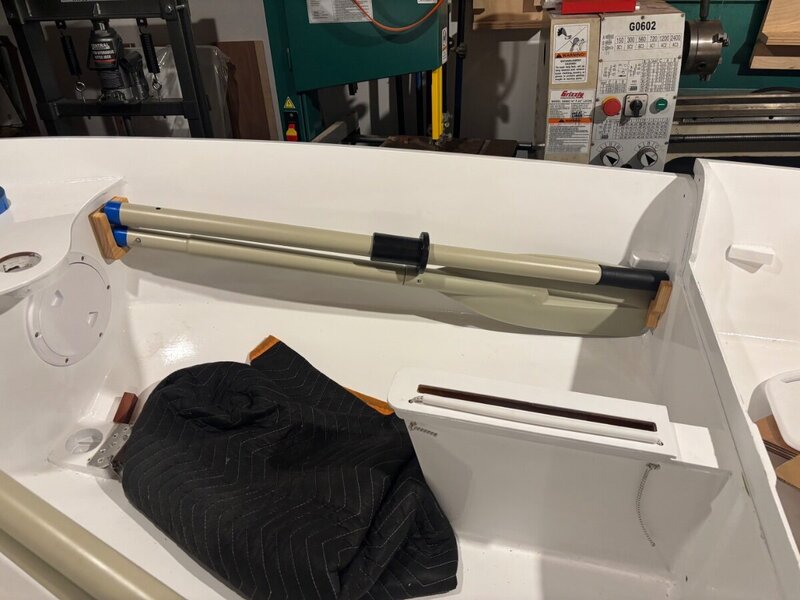
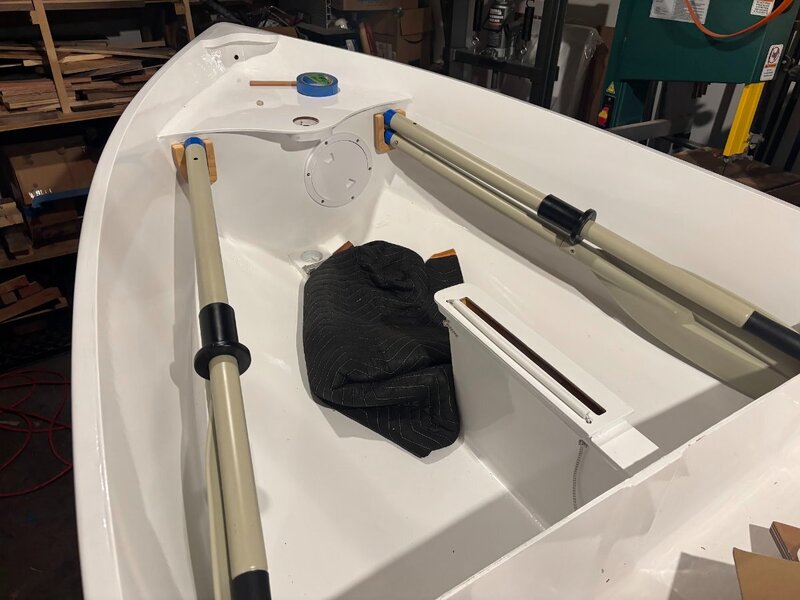
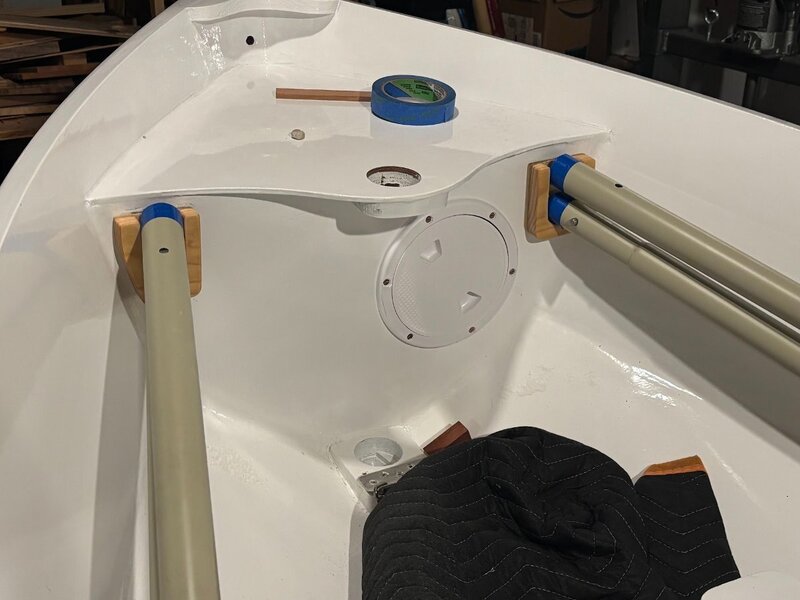
Got some collapseable aluminum oars, that just happen to fit nciely between the nesting bulkhead and fwd bulkhead. Made up a few pieces of wood so that the oars can be secured here nicely out of the way when not in use and epoxied them in place. Need to put some paint on them, but I think they'll work nicely.
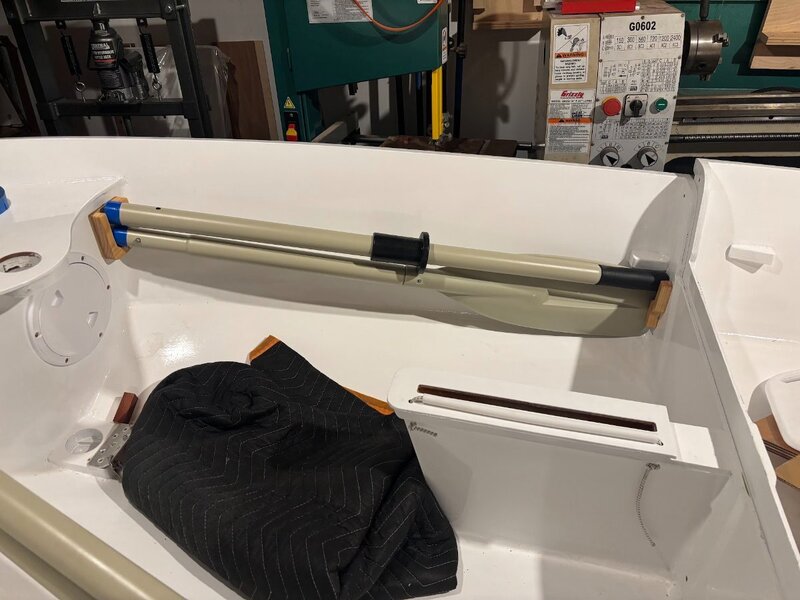
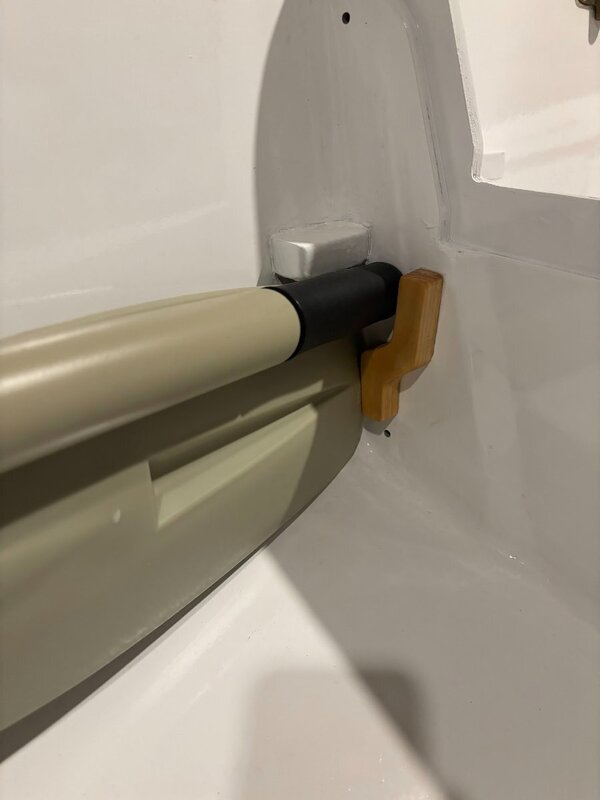
-
One thing I considered with options that accept an external battery is to just build a small LFP that I could fit in one of the storage areas under the aft seats, and installing a connector on the side of the seat you could just plug into. The main problem is designing a battery with the available LFP cells that are out there, that could fit through the 8" circular access port. The advantages would be: No proprietary battery Convenient, safe storage, in a dry location. Out of sight from thieves, and probably makes the outboard itself less desirable for thieves. Because most of these outboards run at 36V, you need 12 x 3.2V cells. These 25AH cells might work, certainly small enough I'm not sure if they're grade A though: https://www.amazon.com/LiFePO4-Phosphate-Rechargeable-Max-Continous-Discharge/dp/B0CQYL9ZW4/ref=asc_df_B0CQYL9ZW4?mcid=4bc96a4516ec3862a29c08d770ca448a&tag=hyprod-20&linkCode=df0&hvadid=720249836134&hvpos=&hvnetw=g&hvrand=5918267030363300650&hvpone=&hvptwo=&hvqmt=&hvdev=c&hvdvcmdl=&hvlocint=&hvlocphy=9031012&hvtargid=pla-2380154735443&th=1
-
Thanks for all the links to peruse, some of these I've seen, some are new. I think my thoughts on the EP Carry are mixed. Didn't Torqeedo go from a gear drive to a direct drive after having many units fail in the field? I feel like a well constructed direct drive might be more reliable. ePropulsion also sells a cord that allows you to plug in an external battery now if the proprietary one fails, or if you just want to use your own. The Newport NT300 is kind of interesting too, but you're not saving a ton of money if you purchase their battery -- perhaps if you build your own or buy a LiTime battery or similar. Having the battery on the floor of a small dinghy is also pretty awkward and almost certainly problematic without a way to encapsulate it. Economically the electrics are still pretty expensive, but I do really like the appeal of not having to carry/get gas we otherwise don't need, and being able to quietly explore places. I have really fond memories exploring the mangroves around Panama, and it being kind of a bummer to have that engine puttering the whole time.
-
I've been erring away from going with an electric outboard for our Spindrift 10N, largely because you so desperately depend on your dinghy when you're cruising, especially when things go pear shaped, and small gas outboards (especially 2-strokes) are very reliable, and will give you a lot of range for the fuel they burn (especially 4-strokes). It's also easy to find parts for gas outboards in far away places. I saw someone mention that they only need 25% throttle to get to hull speed on their nesting dinghy, and the battery lasts 6-8 hours for them, which is actually pretty good. In my cruising experience, I was not frequently motoring the dinghy around for more than an hour a day. This would mean in normal use, we'd only need to achieve a full charge once a week, so 182 Wh/day of surplus energy would be needed a day, and I think we have that (we have 700-900W of solar, depending on if we're anchored or sailing). Does anyone have first hand experience with one of these outboards used on a small wooden dinghy?
-
Not yet, we haven't gotten it out to the boat yet since it's about 30 min down the highway and we can't transport it at those speeds on the roof. I think we'll borrow a friends truck though and try to get it over there sometime soon -- that or we'll sail our boat down here onto a slip or mooring. I'm also thinking of installing the optional fittings for the center aft seat, as I do think that will be handy for when we're rowing.
-
This is a really good point that I hadn't fully considered. We currently have ~750W installed, and have a few options of where to put a little more, but "deployables" were something I was budgeting at another 200W or so, and this would be a perfect place to put those. We haven't fully decided whether we'll go electric outboard or just a small 2 stroke, but if we go electric we'll want as much power as we can get.
-
Love it. What are you guys' long term cruising plans? If you make it to the pacific maybe we'll cross paths and compare dinghies.
-
Also wanted to share a summary of tips/lessons learned that might help anyone else that stumbles on this thread working on their own build: Fiberglassing: If you decide to fiberglass the outside of the hull, make sure you use plain-weave fabric and not woven fabric. This may seem like a no-brainer, but when trying to source glass online, you can get easily misled. Woven would result in a much too heavy lamination. For fiberglass tape, be aware that one side has what's called selvage edge, basically a sewn edge that keeps the tape form unravelling. This also creates a little ridge on your tape when wetted out that needs to be sanded down later. Normally that's ok, but for the sections that require multiple layers of tape, like the nesting bulkheads, it's inconvenient to have to wait for it to fully cure, sand, clean, and apply your next layer of tape. However, if you don't do this, the ridge easily traps air for the next glass layer, and that's bad. What I decided to do (eventually) is carefully trim off the selvage edge on these shorter sections, and that worked great. Peel-ply: peel-ply is great, but it has to be used correctly, and I think there are differences in the quality that may make life more difficult. Specifically, if it ships folded, iron it flat before using or the creases will transfer to your boat. When wetting out, it's probably easier if the temperature is warmer and the resin less viscous. With one of my peel-ply materials, it was very difficult to properly wet out, and I ended up with tiny pinholes because the peel-ply soaked up resin from the glass. Build: When "going 3D" in the build process, the instructions provide some guidance on how to prevent cracking at the bow, but either I didn't follow these correctly, or was unlucky. I found that wetting out the forward section of the panels at the bow with hot water made this process much easier. Fitting the bulkhead was a little challenging, but I found a combination of a ratchet strap around the hull pieces and bulkhead, as well as temporary screws near the "V" in each floor piece made this a little easier. The plans don't call for it, but I added wooden "shelves" for the aft seats on all sides to help support the top of the seat -- I think the plans only call for these strips of wood along the hull sides. Probably not necessary. Consider coating your panels with epoxy before assembly, especially the smaller pieces. It's easier and you can probably do a better job while everything is still flat (e.g. you can use a roller). Cutting the boat in half: Just be careful here, as your blade might wander and before you realize it, you're cutting into one of your bulkheads. I also think this would have bene easier with the boat upside down, or a longer saw. Otherwise only the tip of the saw blade is being used to cut the boat in half and your stroke length is very short. Getting the nesting bulkheads to The boom took more time than expected -- the actual construction was not hard, I used two pieces of pine laminated together with opposing grain, and then used a jigsaw to roughly cut the shape and refined it with planes. However, getting all the hardware attached took time because the holes need to be drilled fairly precisely in many places so the fitting on the opposite side fits (e.g. the gooseneck). This is theoretically straightforward on a drill press, except the finished boom is tapered at both ends on 3 faces, so you have to wedge it level to your drill press' table. I think if I were doing it again, I might consider drilling some of these holes as pilot holes prior to doing the shaping, when everything was still square. Many fasteners need to be cut to length for things to be nice. This includes all the rudder gudgeon fasteners, the rudder, and most of the ones through the boom. Not hard with a hack saw and a vice, maybe easier with a grinder, but just another thing that will take a little time. The 3-part aluminum boom was a another nice easy build and a good way to use your left over glass tape. One piece of advice, don't rivet in your gooseneck if you're planning to nest your boom sections -- I wasn't thinking straight when I did this and will have to drill these out and secure it differently. I think one option is to glass it in place. Painting/Finishing: Invariably you will need a fairing compound unless you're really skilled with your epoxy work. The total boat stuff works great, cures fast, and is easy to sand -- but it's also green. In some ways this is nice because it shows easily, but it also means when you go to paint, it may take more coats to get it to stop showing through the paint. If you do use a fairing compound that has a contrasting color, it's probably easier to re-prime the boat (if you did any fairing after priming), as that will cover much better than the finish paint. If using Epifanes 2-part poly, I honestly found rolling to be sufficient, and didn't have good luck tipping this paint. Your experience may vary. I would try to have other small parts ready to paint when painting the hull, so you have something to use your left overs for. If I think of some more I'll come back and edit this post.


.jpg.5b8605430f7d3c3d69e816f987846e30.jpg)