

Tom Lathrop
-
Posts
1,351 -
Joined
-
Last visited
-
Days Won
24
Content Type
Profiles
Forums
Events
Everything posted by Tom Lathrop
-
Finally got some more work done on Lapwing. The strakes are all rough cut and scarfed. Here is the garboard strake dry fitted and the lap bevel planed. The next strake (#7) will have to be fitted and router trimmed to final shape before the garboard can be permanently glued.
-
That is a difference in the plywood pad and the "soft" pad that I use. When you learn to use this 8" variable speed sander, it becomes the sander of choice for big jobs and can do fine work on flat or convex surfaces. The ability to guide it on only one part of the disc means that there are few cross grain scratches to sand out with finer grit.
-
Charlie, I went through a couple of those but the last one failed at a bad time and did not have time to order another. I made one from a piece of 1" thick closed cell polyurethane ethafoam, the same closed cell stiff foam used in thin backpacking sleeping pads. I used epoxy to attach it to the old backing pad. It's holding up really well. This is one that I made for my Makita 8" sander when it went bust.
-
Rob, At first, I intended going with tracks on Lapwing. Remembering the nice luff shape on my Spindrift 10 and Lasers, I came up with exactly the same solution as yours for reefing on Lapwing. Whether I will use either of these or not, I don't know yet. One great advantage of the unbattened rig, whether sleeve luffed, parelled or tracked is the ability to rotate the mast and roll the thing up. Remembering the many times this made life so simple and easy compared to having to deal with the sails in any other way is about to convince me to go with unbattened sails again. My Bay River Skiff "Loon" was the first unbattened sail rig I had ever had and I frankly never felt the loss of any performance it might have had. This is from a long time racer too. Every time I work rigging the Southern Skimmer, I think about the simplicity of the old rig on Loon. Now Skimmer is a racing boat and needs the extra sail area and control over sail shape that leech battens gives but, especially now that I'd like to be sailing Lapwing in my dotage, I'm leaning toward simplicity. Loon is perhaps the most traveled and sailed of Graham's small boats and I don't think the sails have ever been taken off the mast since I rigged them in 1994. Ten minutes from trailer to sail away is hard to beat. Maybe tracks and no battens is the best way to get reefing with good sail shape and easy handling. The slides and track will make for a less neat roll though.
-

Glassing inside and omitting bottom stringers?
Tom Lathrop replied to Rune Forsberg's topic in B & B Yachts Forum
Ray, I scarfed the 6mm flush to the outside of the 9mm. The biax then goes on the inside after the side panels are on. Easy. I don't really know how much thickness the biax adds but could dig up some old data from some tests I made if it's important. If the concern is rupture from hitting flotsam or lurking dragons, having the fabric on the inside of the panel is much more puncture resistant than having it on the outside. I do add a second layer of ply to the outside forward bottom panel of another boat but it is a much bigger one where 3/4" is scarfed to 1/2". I think the inside biax would work in this case also but the full 3/4" bottom sounded better to the client. -
Glassing inside and omitting bottom stringers?
Tom Lathrop replied to Rune Forsberg's topic in B & B Yachts Forum
I recently did a boat with extreme twist in the bow that needed 6mm ply to make the curve. I laminated 18 oz biaxial non woven glass on the inside in the bow. This stuff is much stiffer than woven glass or wood so that would work also. It will weigh more than the stringers but is easier than laminating another layer of ply. -
The final version will also have a curved plywood transom but the laminated mahogany over the plywood is my addition. Of course, anyone can add that on their own for a bit more pizazz. Graham is moving right along and the interior parts are already cut and mostly put together for his beta kit version. At this rate, he may finish before I do. His shop is above flood level, mostly. There are people beating him over the head about a 65' offshore fisherman so that may slow him down.
-
Graham does intend to offer the Lapwing as a kit. Parts will be precut, including the scarfs. Here is today's work. The transom has been fitted to the mold. Since the only permanent attachment at this point is to the keelson, only that has been glued. The little blocks on the edges are taped ply washers to allow accurate pre-positioning of the transom to the mold. Strakes will overlap the transom.
-
Progress is slow but moving along. Mold is lined off for strakes. Graham made this a little easier than normal by cutting the molds in a shape that helps but I wanted to work it out for myself also. It takes a lot of juggling and eying to get it to look right. That means it looks right to my eye, of course. I think each builder might have a somewhat differing take on just what is "right". Graham's plans will have this all worked out. My transom is going to be built with an outer laminate of mahogany. The photo shows it glued up on a form matching the curve of the plan. A curved transom is a bit harder to build than a flat one but makes a lot of difference in the overall appearance of the boat. A lapstrake is more difficult to build in the first place so it is no big jump to add a few garnishes here and there.
-
Yep, RAKA probably gets their Xynole from either Defender or the same source. I made some pretty exhaustive tests years go on several sheathing fabrics for abrasion resistance. Ray, you may need to clean the wood dust off your glasses. I said that one layer of xynole properly coated with epoxy is 6 times more abrasion resistant than one layer of 10oz fiberglass also properly coated with epoxy. These tests were reported in an issue of Boatbuilder magazine six or seven years ago along with equivalent tests of Vectra polypropylene, Dynel, Knitex FG and plain epoxy. P Doug, This is all relevant to boat building and to what is planned for Lapwing in particular.
-
Given Tom's location of mostly sand and mud bottoms.... I fail to see any problem wiith epoxy. Ever see what an oyster or mussel encrusted beach can do to a wood hull? What weight xynole are you using, and where do you source it Tom? Costs per yard? As far as I know, there is only only one weight. It is lighter than 10oz glass and about the same as Dynel. It comes from Defender Industries. It does take more resin to cover it so is heavier than the glass. Kind of forces you to have plenty of waterproofing epoxy on the bottom.
-
When is a fabric required and when not? A case history gives a situation when an epoxy saturated cloth is needed. Joe gave one good example. About 20 years ago we built a trimaran with the center hull bottom laminated of two layers of juniper. The layers were stapled and the staples were removed after the epoxy set. The bottom was then coated with several coats of epoxy. During the launch and sail, with TV camera crews taking video, the boat started taking on water. Luckily, the TV people left before the boat came back to shore and the builders were saved from further embarassment. After some cogitation, the source of the water was seen to be the staple holes. Anyone who has tried to fill small holes by painting has seen that the holes might appear to be covered at first. However, the paint gradually shrinks away leaving the hole still open. In engineering terms, its called "surface free energy" and one thing it means is that a liquid does not like to stay on a sharp edge. A hole being a 360 degree sharp edge, neither paint nor epoxy will cling to it. The problem was solved by adding a layer of glass and epoxy to the bottom. Fiberglass is not the best thing to use for abrasion resistance and is only about twice as good as epoxy alone. One layer of Xynole is 6 times as abrasion resistant as one layer of 10 oz fiberglass, which is why I use it for that purpose.
-
Everyone to their own opinion. Around here, we have had many years of experience with both epoxy and no epoxy, in coating and gluing. Both methods have their champions and both can produce good boats. Graham has my copy of Brooks and Hill so I can't see what they have to say about epoxy but will look at the first opportunity. We now coat just about everything with epoxy and, of course, glue almost everything with epoxy too. Some fine joinery is often glued with PVA Titebond glue which is very strong and pretty well waterproof but needs tight joining surfaces. Most epoxy naysayers fail to grasp a fundamental truth. An epoxy coating should be looked at as nothing more than another form of paint, although one that is superior to most other paints in one important aspect. That is, it is much less permeable to water or water vapor transfer through the coating than paints available to the home builder. In boats, this is a good thing. There is the argument that some water or vapor will get through and will be trapped inside and cause rot. In a word, that is just someone's conjecture and is just so much BS. I have seen plywood cut from the keel of a boat that Graham built in Israel and which has spent many years in the water and crossed the Med and Atlantic and now resides in Vandemere. The plywood looked like it was built yesterday. Not to say that there was no moisture in the wood at all, just that there was no problem associated with it. If the boat had only been painted, it is not likely to have survived so well. That said, my plan is to only coat the plywood in Lapwing and perhaps cover the garboard and second bottom strake with Xynole for abrasion resistance. This boat, like most of our small boats, will be dry sailed and live most of its life on a trailer. I will still use an epoxy coating because I believe it gives the best base for whatever finishing top coat is applied. That includes epoxy as a base coat for varnish. I have never used CPES (a very thin form of penetrating epoxy) which is claimed to be a superior base for paint by many on the forums. We have mostly used Awlgrip LPU (linear polyurethane) as paint but I am planing on going back to a quality "normal" paint for Lapwing due to the very high cost, tricky application and toxic nature of LPU. LPU is great paint but I'm ready to try a more approach, particularly on a more traditional boat.
-
Ray, I don't know a John Hills as author of a book on lapstrake/clinker building. Ruth Hill is co author with John Brooks of one though. And then there is Tom Hill' book. Where is the Hills book available?
-
Materials and methods for attaching tracks to masts?
Tom Lathrop replied to Joe Nelson CS#35's topic in B & B Yachts Forum
I use beeswax to lubricate any stainless to stainless rubbing parts. I did this on Southern Skimmer after the tracks were filed by heating the track slightly with a torch and just running a piece of beeswax along the track edge. Other lubricants will wash off or melt away in sunlight while beeswax stays there. Works great on stainless turnbuckles or stainless cable that rubs on anything. -
Tim, This is my first lapstrake boat so I am not certain just how it will go. I am learning and making it up as I go. I started it but it's Graham's design and he will get the plans out. We will work together and decide what works well and what doesn't work so well.
-
Picked up the last mold for the transom from Graham today and mounted all of them temporarily on the strongback. The area I cleared out to build looks a bit small now. Time to start watching weather waves out in the far tropical Atlantic. Tow of them as of today. Don't want to wish anyone else bad luck but do hope they don't come this way. Messes up the boat building schedule.
-
Lapwing molds put together to day. The fit from the CNC machine is very accurate and final measurements are very close to design values. The view of the shop is before I dropped the table saw down to floor level to cut stringers for the mold. I have Tom Hill's and Ian Oughtred's books on lapstrake building and will kind of blend their methods to build Lapwing. I also ordered Brooks and Hill's book and it came today. After a brief lookthrough, I find that there is a ton of info but their methods seem excessively (and unnecessarily) complicated. Boats are complicated enough and I like the simple building methods when possible and practical.
-
After some start up software problems that kept us up past midnight, Graham woke this morning and found the problems with the computer program that runs the ShopBot CNC machine. In a short time today, the mold sections were all cut out of 3/4" plywood. The accuracy and fit of the sections is great, much better than could be achieved with a saw. I will now get started on the mold. My greatest problem is that I had already raised all my woodworking machines up in the air in anticipation of hurricanes before we left for a trip to England. Now I have to take some down to do the work and gain enough room for the mold in the shop. I dread it a bit since they may have to be lifted back up again it a hurricane decides to make an appearance. Just dog work and it must be done. Photos will follow when there is something to show.
-
I preferred a center boom mainsheet on my Spindrift 10 which eliminated any snagging on tacks or jibes. Also shortens the mainsheet by a lot. Not to say that I never capsized it. Did that twice in frostbite races against Graham some years ago. Once was inattention and once was just having the bow submarine in a strong following wind. And yes, I was all the way on the transom when the strong puff hit. The force of wind in the sail just forced the bow down under the water. Would never happen unless the adrenaline is flowing high in a race.
-
Neat locker Dale. An 11 lb bruce should hold LIVELY in a hurricane.
-
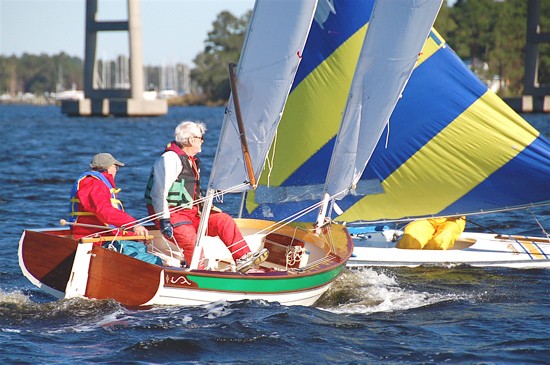
The Yacht and Tractor Club came about when sailing families started to move into a very small farming and fishing community situated on the water in eastern NC. The idea of the club was a brilliant one to involve the local people with the newcomers who came from greatly different backgrounds. It has worked extremely well to foster harmony and the annual Summer Solstice Regatta is one part of it. The rest of us from nearby communities are glad to take part in it. Dale, that photo was taken off Cedar Key in May. The wind was very light and Graham and I were on the leeward side to heel the boat which works well with this beamy design. Maybe you took the photo and are just pulling my leg.
-
Ray, Take another look at all the photos on the link I gave. ;D :
-
;D Graham and I entered the Southern Skimmer in the annual Summer Solstice Regatta run by the Whortonsville Yacht and Tractor Club. It is a 10 mile race set at the junction of the Neuse River and Pamlico Sound. The handicapper did not have an inkling of how to handicap the EC22. Since we were the smallest boat, home built with a supposedly lower performance cat-ketch rig, they put us at the first starting time. We opted to give ourselves a 15 minute later start with several Catalina 27s and some other boats. We were able to go up wind better than any of those and led by a good margin at all marks. The handicapper looks with great disfavor on the race winners and always adds time to their starts in future races. We will likely see another 15 minutes added next year. We may have sandbagged a WEE bit. The story of the race is on Town Dock website at: http://www.towndock.net/whortonsvillecup2007.html This race is always good fun and the after race pot-luck feed with barbeque pig picking is always great too.
-
I went with Graham yesterday to pick up his new ShopBot CNC machine from the manufacturer in Durham, NC. First we stopped at a steel supplier to get a heavy load of steel sections for the base and then on to ShopBot. ShopBot has made very impressive gains in the smaller CNC machine market since we saw one of their first machines about 12 years ago. Their operation and personnel appear to be first class, very helpful and interested in getting a customer up and running. Graham is probably already digging into the big crate in the back of the van. There will be a learning curve for Graham but we can expect to see some boat parts zinging off the line soon. Well, realistically, there is a lot of welding, hammering, bolting and software manipulation to get past first. In addition to just cutting out plywood, this machine is capable of 3D carving of some intricate objects.