Tom Lathrop
-
Posts
1,351 -
Joined
-
Last visited
-
Days Won
24
Content Type
Profiles
Forums
Events
Everything posted by Tom Lathrop
-

Tabernackle as radar dome support
Tom Lathrop replied to Joe Nelson CS#35's topic in B & B Yachts Forum
I helped my neighbor install a stainless tube on the stern of his sailboat for mounting a RADAR. The RADAR is only in place for cruises. Works fine so I see no problem with your plan. -
I'm really glad you guys found productive work to do today other than watch the Superbrawl. Like erster, I've been lazy. Even lazier since I did no useful work at all. Well, I did lay out a rudder and daggerboard but was watching TV at the same time, so that doesn't count full points. Now we will see if I met all those ridiculous + 0, -2mm tolerances.
-
We usually use duct tape to avoid sticking to the mold. If the patterns are accurate enough, no epoxy will come through if care is used. On a male mold, it can happen anywhere along the chine or keel, while on this female mold, sticking can occur only at the 1/2" thick station molds so it is a far smaller problem anyway. Actually, I don't remember having this problem on the school male mold for the Spindrift 10 and we pulled many-many boats off that mold for the last 18 years. Hey guys, I know why I'm sitting at the computer. My back hurts and I trying to rest but don't you have some useful work you can do in the boatshop ???;D ;D
-
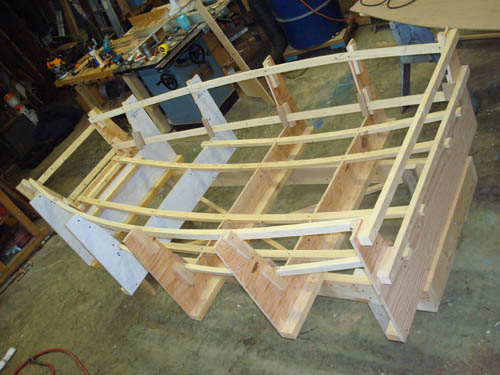
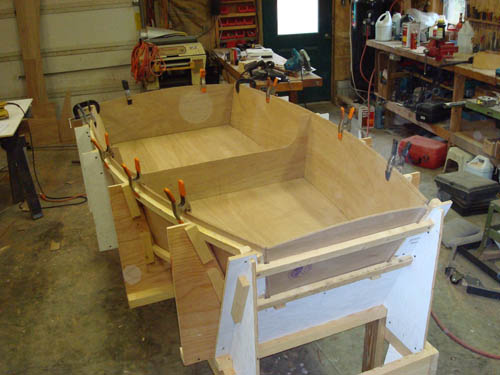
Yeah Ray, having a boat with a lot of twist in the forefoot changes the balance in favor of a male mold. It is hard to force a panel with that much twist into a female mold, in that case, the male is better. In a historical sense, the plywood/resin/glass-tape composite boat was started in Norway in the 1950's in female molds. That was before anyone thought of stitch and glue. They did not have epoxy, so polyester was used. It required great care to make good joins but the Brits made lots of successful racing boats that way. In the 2nd photo above, the panels in the mold are patterns made by cut and try to exactly fit the mold.. These are used as routing patterns for the final patterns which are done in stacks of several at one time for series production like we are doing. Very simple and accurate. As I said, one size does not fit all. Charlie, That looks a lot more like a military vehicle, including a big gun ;D I completely agree on the issue of making a boat that everybody can enjoy. The Optimist Pram was like that before the internationals got into it and actually created a new boat and class. Plans are still available for the original but the local organizer wanted a boat that could be raced in sanctioned IO races, so that is what I built.
-
How did you guess : On the other hand, I can pull the hull, with all interior assembled and no (that's zero) screw holes in it, from the mold after two days. Those aren't two full days, it just takes that long for the epoxy to cure well enough to pull it. Sometimes the male mold works better and sometimes the female of the species is superior. With real tight tolerances, this mold guarantees a more uniform product. With all the interior in place, the boat is rigid when it comes out of the mold. Not true with a male mold which turns out a wobbly shell that must be handled with care until you get the interior in place. If the boat does not have to meet rigid measurement specs, the two kinds of molds are more even but I usually find the female easier. Of course that only works in boats ;D ;D
-
Haven't had time to do any more work on Lapwing lately. here is the reason. A group of local woodworkers is building a fleet of Optimist Prams to get the younguns out sailing. I have built the mold and made the patterns to get things rolling. Much of the assembly will take place in John Burritt's shop where there is more room and John can supervise. I go for back surgery on Feb 13 and will be out of action for a while. We plan on 6 to 8 boats for a start this Spring. I have to say that the International Optimist plans are the worse that I have ever built from. I guess that is what happens when a committee of "concerned parents" gets involved. I once coached little league basketball so I know how that can be. There is one measurement that has a tolerance of plus/minus 1mm. Most are plus/minus 2.5mm which is hard enough on a boat. Be thankful that you build for a good set of plans.


-
Trying to Make Up My Mind -- BRS 15 V CS15
Tom Lathrop replied to W. Micawber's topic in B & B Yachts Forum
I built and sailed one of the first BRS 15's that was intended primarily as a sailboat. It is the one on the B&B website, the Loon. It is a great boat that sails, rows and powers well. That said, the CS 15 or 17 are better suited to sailing in bigger water. For two people I would choose the CS 15 but if I planned on have more than two along very often, I would choose the CS 17. Neither is as well suited to power as the BRS but can accept a small outboard. -
That will work Charlie, but you should wrap them is something like bubblewrap to hold them off the metal surface. In the near field of a strike, some current will flow in the box case and that means a voltage drop, which means the possibility of a shock to anything bridging the voltage drop.
-
Ray, The bottle brush and the porous grounding plate are two of my favorite straw men. I don't think the brush is better than a single sharp conductor or the porous plate better than a solid bar of the same dimensions. There are good electrical theories behind this belief but I won't bore you with them.
-
Careful now Greg, I was a Twiget. If that is what you called the ET's, on DDR 874, radar picket destroyer. Seen a lot of that stuff there too. St Elmos is a great sight.
-
Ken, Great story of your brush with fickle lightning. When you say you were all hit, I assume you mean that you were all in the electric field of a nearby hit. I have also been on high rocky ground when one of those quick storms came up and was frightened to think that this was the hard place next to a rock. A bolt did hit nearby but I only had my hair to prickle. Soil conductivity is so high in such rocky terrain that your body looks pretty inviting to a lightning stroke. Liz and I were racing our Windmill when we were caught in one of those near electric fields and our hair jumped straight out. Looked funny but neither of us laughed. We had already capsized and brought the boat back upright and were bailing after taking the sails down. The mast was wood but the halyard was stainless cable. The lightning found a more inviting target and hit elsewhere. None of the 200+ boats were hit although most might have been capsized. I've sailed through many storms over the years, have been very near several bolts on land, and am still lucky to not have been hit or actually seen another boat hit.
-
Ry, For sure lightning protection is much simpler on a unstayed mast boat without stanchions and bow or stern pulpits. There will be the boat wiring though. Are you considering protection for both masts? Would you do them individually, which I would favor as simpler and more effective?
-
Ray, I see that you have been studying the book All good information but I think we may be overdoing this issue for most of the small boats that we build. Most of us will not be sailing our little boats in conditions that warrant extensive lightning protection. We will mostly be going out in decent weather and close enough to shore to get off the water when lightning is threatened. I don't mean that it is a non-issue but that it is not something to deter us from enjoying our little boats. When in a threatening situation, we can make the proper decisions as skippers. I know of not a single situation in over forty years on the water in small boats, often in large racing fleets in thunderstorms, where lightning has caused a problem although I sail in the southern lightning belt. I don't mean to say that lightning is not dangerous, just that we have many - many more more dangerous events to worry about, like driving to the lake. More of us will probably die while sailing of a heart attack because we forgot to bring our nitro pills along than will be hit by lightning. I do know of one of those locally. At some point in either boat size or use, it makes sense to build in some lightning protection but I question whether it is practical or necessary in day sailers like our Core Sound and similar boats. I will not be adding any to Lapwing and hope that I am not that one in several million that gets hit :-[
-
Howard, The issue of solid versus stranded wire has to do with the fact that a lightning (no e in lightning) strike has the properties of broadband AC. Before anyone yells that it is DC, let me explain. The current pulse has an extremely steep wave front. That is, the current builds up very rapidly in the initial surge. That is why a lightning strike will be heard on any AM radio within range, regardless of the frequency it is tuned to. All frequencies from DC to VHF are in the pulse. A well known property of high frequency current is that it prefers to travel on the surface of any conductor. So, a stranded wire has more surface and therefore less resistance to high frequency current than a solid wire of the same total cross section. Whether this results in significantly better protection is something I don't know. Florida State University operates the best laboratory I know of in lighting research. The only person I have known personally who was killed by lightning was a Scout leader with his troupe on a camping trip in the mountains of western NC. The troupe was sheltered under a tarp and under a tree. They were in a forest so it would have been hard to avoid trees. He was wearing hobnailed boots and no one else was badly injured. My conjecture is that he was hit by a side flash from overhead limbs to the tree roots with his boots making the path easier. I have worked on lightning damage in the telephone industry and studied it quite a bit but to say that I understand it would be long stretch.
-
Many good thoughts so far. Lightning protection is a good thing but not always easy to implement correctly. Some boats just don't lend themselves to the best methods. Making a direct (straight as possible) path from the mast top to the water can be difficult but usually possible. Tying all metal rigging to ground is even harder to do well. Running wires that connect stays, etc, together along the interior of the hull is a sure way to blow holes through the hull if the wire is run along the hull underwater. It is something of a catch 22. Avoiding sharp sharp turns in bonding wire while avoiding running along the inside of the hull underwater can be a tough choice. Reliance on the "cone of protection" to guarantee lightning protection is a mistake. It is a good guide but no guarantee. The so called cone is no more than a statistical average of probability of having a strike occur in a given spot. Having been an engineer with Bell Labs, I have seen both the data and the actual apparatus used in developing the protection curve. Given a large number of strikes, some will hit at all points surrounding the high conducting protective post or mast. The cone just illustrates the probability of not getting hit at any point.
-
Gary, I built a temporary shelter very much like the one you are thinking about. It will not handle any snow load beyond a very light one. It is not so easy to remove and replace a tarp and a tarp that is not fastened in some way will like to blow away. A plastic tarp will want to shrink in sunlight and distort the PVC pipes. Most plastic tarps will not last longer than one season before deteriorating and leaking. If I used another one for this purpose, I would paint it before it went up to protect it from the sun. Using separate PVC pipes for each side joined at the peak with a 90 degree coupling will shed water and snow much easier and be stronger. Mine blew down in a hurricane but was reset without significant damage. The Stimson bow roof is better in many ways but if it gets blown down, its permanently damaged. One thing that did work well was that I built a stud wall on each side 4' high and ran the PVC pipes from that. This gave a 4' vertical side for more space and strong enough to lean plywood and other stuff against. I also had roll up polyethylene on the 4' sides for ventilation which worked well. I mounted a vent fan at the peak too. Comfort in both winter and summer was acceptable. I attached the shelter so the garage door formed on end. Very convenient. 10' 8" is not high enough, especially since it is only in the center. Mine was 12' and this was marginal for swinging material around in.
-
The deck mahogany was sawed from a baulk that is 2 3/4" thick so I was able to do it on the tablesaw with a thin kerf blade. The thickness of individual strips did not come out as uniform as I like. I might attribute this to having my carbide blades sharpened recently by a local sharpener that I have some doubts about. The fellow in New Bern that I trusted closed his shop. I did use a stabilizer on the 10" blade. The reason may be something else and I am looking for it. The surface was first worked with a 8" Makita variable speed sander. This will be followed with a scraper to level it out, a half sheet orbital and finally hand sanding. The mahogany is pretty old true Honduras with a decent figure. Are you going into the Simmons business? I need to come down and take a ride. On my Bay River Skiff, I built an anchor well in the bow but this is much-much easier to build and not too difficult to get to. A negative is that our soft bottom muck has to be cleaned off before bringing the anchor aboard. That stuff gets harder than some paint when it dries.
-
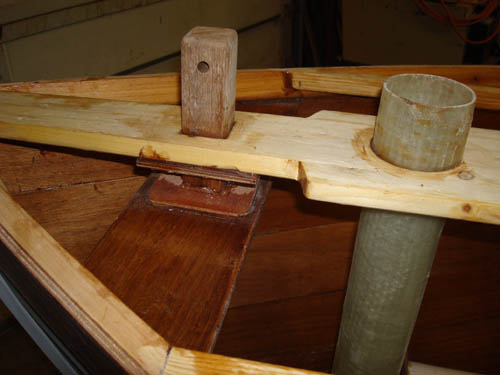
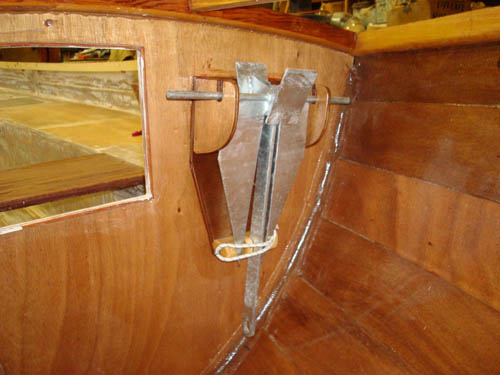
Some work has been done since the last post. Here is the anchor storage inside the bow compartment and the samson post with underdeck reinforcement. The last photos show the mahogany deck installed and sanded. The mahogany is approximately 0.15" thick over 4mm plywood. Ok, the order of photos is a bit mixed up. I am having some trouble with the new photo upload software.


-
Great cruise with the girls, Scott. Times to remember when they are gone off to college or married. Might as well hang around and enter the EC ;D
-
I remember about 20 years ago visiting one of the few remaining builders of skiffs on Harkers Island. He was recognized as one of the masters and hobbled by arthritic knees so bad that he moved about with two canes. He was still building a skiff in the back yard and needed the canes to move around while he worked. The workmanship was just as Mike shows and the techniques was the same. If you asked one of these builders to see the plans, he might point to a worn drawing on a small piece of wood nailed to the wall or even a serpentine curve carved into the wood floor that represented the midships rib of a boat. From this groove he might have built boats of many different sizes over the years. Everything done by eye and experience. Our local maritime museums have documented and preserved much of this work. What they cannot preserve is the independent will and spirit of these builders. There is perhaps even more wooden boatbuilding here than in the past but it is not the same.
-
Captain, it's nobody's design. It's a Harker's Island skiff. At least that is as good a name as any. These boats are not built from plans. Such boats have evolved over many years in the backyards and boatyards along the middle part of the NC coast. You can find "plans" for many of the old working boats from the NC Museum in Beaufort but these are just made from lines taken off existing craft. Mike can probably make some addition to this but it's probably close to the truth. The flair in the topsides forward is probably the beginning of the extreme flair seen on the NC offshore fishermen that work this area. One thing has always puzzled me about the construction of these boats. That is the joint in the frames at the chine. A plain lap joint with a single through bolt. It must work or they would have changed it but it does seem weak to me. Charlie, you must be kidding. The Capt. lives on Puget Sound and it's January. He has had no sight of the sun for weeks. When he is outside, he has seen nothing but mud puddles and his shoes.
-
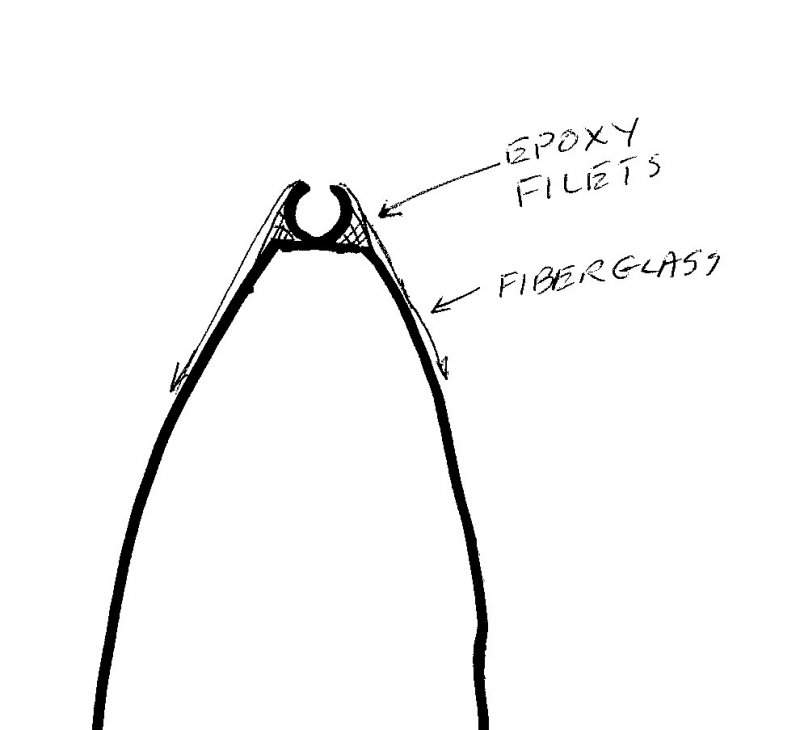
In 1988, I was part of a team building a 20" trimaran to race in the World 1000 race from Ft Lauderdale to Virginia Beach. Graham was the designer and skipper. We built a 40' wingmast that was 15" fore-aft and 5" side width. Yep, that is a forty foot mast on a 20 foot boat. One of my first tasks with Graham was to scarf forty feet of 3mm ply for the mast. My first time to scarf plywood and I guess that is why I am not afraid of scarfs ever again. Had to roll up the finished scarfs in order to have room in the shop to make the next ones. For a sail track Graham found some of the track that is used to support awnings on motorhomes, campers, etc. It was just as PAR shows in the drawing except that it had a flange for attaching to the vehicle or whatever the awning was for. We sawed the flange off leaving the slotted tubing. The remaining slotted tubing was fiberglassed to the aft edge of the wingmast. Later the fiberglass covering the slot was sawed out. There were joints in the tubing but they were not a problem. We used a boltrope for the main but slides would work as well. No problem with strength since it lasted through some big wind around the Carolina Capes. I have thought of doing the same thing on my boat. Cost is negligible compared to the prices given above.
-
Using plastic cable ties for stitch and glue seams
Tom Lathrop replied to Garry's topic in B & B Yachts Forum
Plastic wire ties are fine but will most likely give trouble with the filets. You will either have to make the filets larger than necessary or tolerate the bumps. Why not just cut and remove them? There's no positive for leaving them in. -
Charlie, I'd love to have you come visit but, for my protection, you'd have to wear shoes in my shop. To find dropped screws in my shop, I turn out the lights and get down on the floor with a flashlight casting shadows across the floor. I have to bring a box along to pick all the other crap too. Sometimes I actually find the part I'm looking for.
-
Graham, On Tuesday I ran the annual New Year's Day race in the Neuse off Oriental. There were 45 boats from a small cat boat to 40 something yachts. One was Joe Valinoti's Nonsuch 30. Winds were 12 to 15 for the start and increased a bit toward Adams Creek entrance mark. On the run to Garbacon Shoal, the wind increased and many were lulled to the wind strength as usual. Rounding Garbacon some found themselves overpowered and had to fight to get sails trimmed, often by inexperienced crews that come out for this fun race. The Nonsuch is apparently ballasted well enough and has enough form stability that it was able to carry on in wind over 25 knots to the finish while the smaller catboat retired after the first leg. Your question was how could the crew of a catboat have made any change while running down wind? I guess they could not, while the crew of a sloop could choose to change to a small jib or none at all. I completely agree with you view of single large sails. I have recently sailed a gaff rigged catboat and did not at all like having to work in the bow to make sail reduction on a boat without any sail balance. A cat ketch like the Core Sound would be much easier to make sail changes on though.