brigait1
-
Posts
97 -
Joined
-
Last visited
-
Days Won
3
Content Type
Profiles
Forums
Events
Everything posted by brigait1
-
I've attached a few pics showing our GPS track from the Texas 200 overlaid on Google Earth. These pics show the only two times for the whole week that we had to beat to weather to get where we were going. In both cases it was less than perfect conditions for making the best headway. At the Padre Island Yacht Club we had a few sand dunes and buildings to windward that were chopping up the wind a bit. At Army Hole we were dealing with a shallow approach before the harbor, so we had the centerboard up a bit. So in and around-the-cans race situation I'd be willing to bet you could get a Core sound to tack through around 90 degrees pretty reliably. Maybe not quite as high as a dedicated racing sloop, but pretty close. Pete


-
Phil, glad I could help. It took me quite a while to figure out some of the niceties of boat handling myself. I used to race on a lake that required a beat out of a narrow channel to get to the race course on the main lake. What I figured out there was that on a small sloop-rigged dinghy, there is no reason to strike the jib ever. You can just let it luff when you don't need it, but without it up you can't make it to weather worth anything. The reason for this is that the main is always trying to round you up into irons, and to compensate you have to use the rudder to try to fall off. These competing forces just make the boat stop. Next time you are in this situation, look at your rudder and you will see big swirling eddies coming off of it. Might as well throw a big anchor off your stern. Now if you have the boat well balanced with the crew weight centered and both sails working together, you will notice that it takes very little pressure on the helm to get the boat to respond. If you're not sure how to get that balance, here's a good place to start. When you are beating to weather, ease your grip on the tiller and see if the boat wants to round up or fall off. If it wants to round up hard you have lot's of weather helm. This means you have one or more of the following problems; too much crew weight forward, jib eased too much or conversely main trimmed too much. If the boat wants to fall off, that's lee helm and the reverse sail and weight variables are true. In addition to sail and crew weight, lee helm can be caused by your centerboard not being all the way down. LEE HELM IS BAD :o. It can cause you real trouble in windy conditions. Mess around with all these variables until you get just a little bit of weather helm when you let go of the tiller. Now you've got her dialed in. Then of course the conditions will change and you are back to square one... :-\ If you haven't been racing yet, I recommend it highly. Sure there can be some uber-competitive jackasses out there, but for the most part you will find very helpful skippers who are more than willing to share tips on boat handling. Plus, being near other boats that are trying to go fast gives you excellent feedback on what works and what doesn't when you tweak stuff. As for choosing a Core Sound, I think you will be very happy with the performance. They are a great balance of performance and stability, and the FMG factor is very high. Take care, Pete P.S.- My wife just asked what I was writing. When I told her, she said to include the following: "The pointy cloth part goes up". Very helpful woman, my wife...
-
I agree with Dale. On a sloop, if you back the main, it is going to tend to round you up into irons. If you are having a big problem tacking the DS, you should ease the main at the beginning of the tack. Keep the jib sheeted just until it gets backwinded for a second or two. The jib with pull you through the tack and with the main eased it wont be competing with the jib trying to bring the bow over. Then tack the jib and sheet the main and you're off. On the Core Sounds, you get the same effect by easing the mizzen before the tack and backing the main for a second if needed. All that said, during the Texas 200 we never had any trouble making a tack even in nasty, gusty, choppy conditions. Another thing you might want to consider is the weight distribution in the boat. If you have too much crew weight forward, it can make tacking dang near impossible. Pete B
-
Actually, I never saw a Puddle Duck in any real trouble the whole week. Which is more than I can say for some of the other boats. Sure, they had minor issues, but they dealt with them on the fly, just like a lot of us did. Those guys were very aware of what their boats were and were not capable of and planned their days accordingly. The only real problem was the fact that they had to be on the water so long each day. Not comfortable, but also not inherently dangerous. The one day that the weather got to be a bit too much for them, they simply adjusted their course and stayed out of the rough stuff. From a safety standpoint, I'd much rather see an experienced skipper at the tiller of a Puddle Duck than a newbie at the helm of a much more "capable" boat. That said, don't expect to see me attempting it. I'm nowhere near as tough as those guys Pete B
-
Yeah, it was a blast. The picture of Tim and I posted above was on the Lower Laguna Madre. That day we had 20+ winds and were traveling with the increasing fetch. So by the time we reached the north end of the bay, we had some nice waves for surfing. Let me tell you, the CS-17 loves to surf, and she handles the waves beautifully. Shortly after that pic was taken, we sailed into the land cut, so there were no waves, but still the same winds. We decided to try out the staysail for a while, and BOY, WERE WE FLYING. We only kept the staysail up for about 15 minuted, but it was a VERY exciting 15 minutes. Once we took it down we were still going planing speeds for long stretches. I can't say enough about what a great trip it was. And any Core Sound owners should know that they have pretty much the perfect boat for this trip, just in case any of you are thinking about next year Pete B
-
Charlie isn't kidding about Traveller's performance. The amas that Graham designed for her are beautiful and do their job to perfection. We were on a CS-17 and Charlie and Laura were just killing us off the wind. The only reason we hung with them was that we had some windward legs where we had a bit more boat speed and could outpoint them a touch. And that was only because they had damaged their centerboard. If someone can tell me why my pictures aren't attaching, I'll try to post them. Pete B
-

Couple of pics from delivering CS 20 #87
brigait1 replied to Charlie Jones's topic in B & B Yachts Forum
Slight lee helm! Hmmm... Maybe that's due to the main riding so much higher than the mizzen and getting into some higher velocity wind. Strange though. Pete -
Couple of pics from delivering CS 20 #87
brigait1 replied to Charlie Jones's topic in B & B Yachts Forum
Hey Charlie, While your answering sail questions, here's one. I noticed you guys had the main reefed one notch but the mizzen full. How's she handle in that configuration? Any noticable weather helm? Thanks, Pete -
Tim, I'm in the same proverbial boat as you. I'd be more comfortable with the Texas 200 if I had a couple long overnight trips, camp cruising around here first. So between now and then, I'll be taking a few trips up to Lake Texoma to see how my boat and body handle 10-12 hours of straight sailing. Let me know if you want to tag along. Safety in numbers and all that... Pete B
-
I've told Chuck at Duckworks that I'm planning to be there. For the moment, I'm thinking of taking my C-15, but if anyone is looking for crew for a slightly bigger boat, I'd be happy to talk with you. In case you haven't seen it at the Texas200 web site, there is a windrose image that shows the typical conditions for the month of June. The image is from the National Resources Conservation Service of the USDA. http://tinyurl.com/3d3g3j Based on the course and conditions it looks like there is a good chance this will be a long broad reach. Sounds like a blast! Pete B
-
Someone posted this link on the Duckworks site. It's a Google Earth map based on Southern Skimmer's tracking data. The link is: http://www.pdmartin.pwp.blueyonder.co.uk/SouthernSkimmer.html The data is several hours old so it only shows tha track up to just north of Englewood. Pete
-
I agree with Garry that lead on the centerboard is ideal for improved righting moment. If that is the only consideration, you have to go with lead. The real issue with water ballast IMHO is flexibility. For example, if you use your CS for daysailing 95% of the time, you will likely want to keep it as light as possible. But on thise occasions that you go for extended excursions in which conditions may vary quite a bit, it might be nice to be able to fill the ballast tanks when conditions warrant it. If my thinking is way off here, someone please chime in. Pete
-
Rob said "It seems to me that the MORE weight on board, the less likely you are to suffer some sort of misfortune." I've noticed several people mention that the CS-20 gets much more tame with a load. Has anyone out there experimented with water ballast for rougher conditions. It seems like I've read somewhere that similar boats like the Sea Pearl do this. Any thoughts? Pete
-
Greg, My wife and I are also North Texas alum. In fact we both moved here in the 80s and after finishing undergrad studies, we both decided to stay for graduate school and started a business here. This town has a way of sucking people in like that... Currently I sail a Coronado 15 and I do some foredeck work on a San Juan 24. I have had the plans for a CS-20 for a while now but will only get started building in earnest this summer. I agree there are some nice lakes around here. Lake Ray Roberts is just north of us and has good access and light traffic. Lewisville Lake can be a bit crazy on weekends, but there is good racing there if one is inclined in that direction. If you're ever back this way for a visit, do give us a shout. Pete
-
I'm a huge advocate of mixing by weight rather than volume. There's a great article at the Duckworks site on how to build a very simple epoxy ratio scale. Using this, you can mix amounts for any size project and always be certain you are going to get the proportions correct to the drop. In order to use this you must get info from the supplier on the correct weight proportions for their resins and hardeners. Here's a link to the article; http://www.duckworksmagazine.com/05/articles/scale/index.cfm Hope this helps, Pete
-
"The only problem might be painting. You might need tarps then to keep the dust and bugs off." Yeah, I'm already envisioning a way to rig up some plastic sheeting to create a temporary paint booth. Also considering some kind of drop-down canvas sides that can make a quick indoor/outdoor conversion. However, that much canvas would probably be pretty expensive.
-
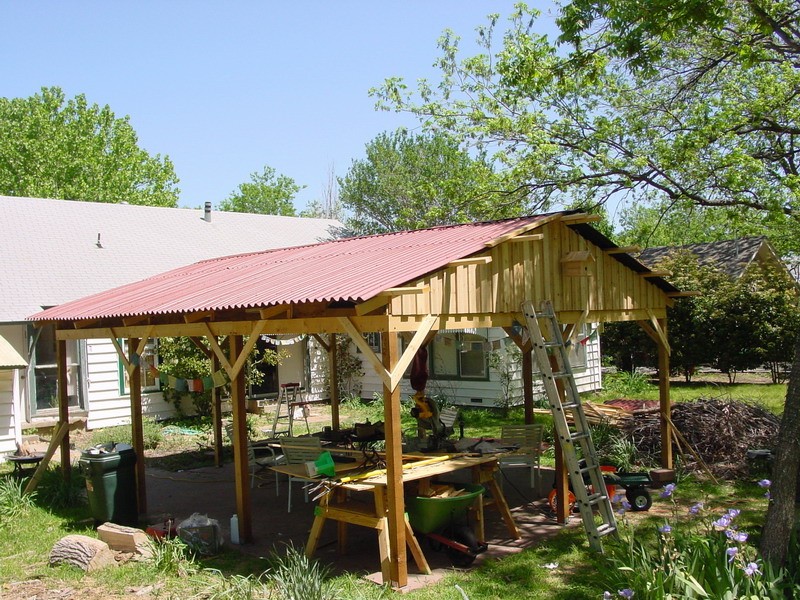
In an effort to avoid trying to build a 20 foot boat in a 20 foot shop, I've finally covered the patio to give myself some elbow room. It may not be a nice as Charlie's new shop, but it's out of the weather at least. BTW - Never mind the avatar picture. I lost a bet...


-
I don't post much here, but I actually have a little experience with this one. I have a radio-controlled Victoria that needed an upgrade on the rig. I made the spars out of arrow shafts from the sporting goods store. They come in a variety of materials and diameters so you can actually build nested-tapered masts in the same fashion that Graham suggests for his aluminum masts.
-
Graham, Good luck in the race. A freind of mine competed several years ago when the wind was howling directly out of the north. On the first day, many of the less experienced canoers and kayakers were hauled out of the bay by the Coast Guard. Also, a few boats had high speed close encounters with oyster beds that put them out of commission. Finally, I have it on good authority that you must be on the lookout for crazy Russians in inflatable boats bearing gifts of vodka... Have a great time, we are all pulling for you. Pete B in Denton Texas
-
Thanks for all the great suggestions. I went to the city offices and had a chat with the chief inspector. She has agreed to approve my plans without a formal engineering report on the trusses since the truss design comes from a publication on pole buildings. I think more than anything, the one-on-one time with the inspector is a good way to show them that you're not some wahoo trying to throw-up a half-baked shanty that will come crashing down in the first good blow. I tend to err on the side of overbuilding, so I don't anticipate any other problems with the plans. Thanks again for the help. I'll post pictures as the project gets rollin'. Pete Brigaitis
-
Thanks for the thoughts. The patio is too far from the house and therefore the cover will be free-standing. Otherwise I would probably go with the sloped attachment to the house. The reason I'm considering the trusses is that I can set them on larger centers with purlins, and use metal roofing or greenhouse panels rather than decking and shingles.
-
Hi all, I've been lurking on this list for a while but have not had anything to contribute or ask until now. In anticipation of starting CS20 (hull#62) this spring, I've decided I will need to cover my patio since my workshop is barely 20' long. Rather than build a temporary cover, I'm going to build a permanent structure to get the patio out of the Texas heat. Here's the question, do any of you have experience building your own trusses? I will need to span 16 to 18 feet and it looks like the best way to do it is with a 4x4 pole structure with trusses to span the width. I know manufactured trusses are put together using hydraulic presses to attached the truss plates. Will a home-made truss joined with plywood gussetts have similar strength? Any thoughts on how to best approach this would be greatly appreciated. Pete Brigaitis Denton, Texas