Ken Haydu
-
Posts
13 -
Joined
-
Last visited
Never
Content Type
Profiles
Forums
Events
Everything posted by Ken Haydu
-
I first listed it on the Forum's Classifieds, but did not have much responce, so I deleted the Classified post and moved it to the auction site for a try Mike, you are correct, it is the same boat pictured on the CS20 page as the top photo. I believe it is hull number 8, as the Man. Hull ID number is CS202000171108 Jeff, Marvin Haas built the boat with a shorter foredeck. I find the shorter deck makes it easy to reach the foremast step with the mast in hand I was recently given an older O'Day daysailor that had damage from a fallen pine during a storm. I have been repairing that boat and it looks like it can be saved to sail again, thus the listing of the CS20 to make some room in the yard. All of you know how that is

-
Jan Beautiful work and photos. If the rest of your boat received this level of planning, you have done well. Thanks also for the tips and photos of the saws you used. That will help many in the future Ken
-
Nice November Sail and one unlucky Catamaran
Ken Haydu replied to Ken Haydu's topic in B & B Yachts Forum
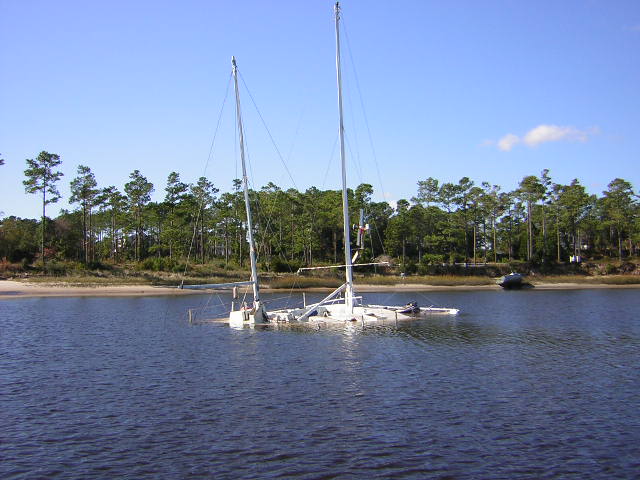
Graham, I do not know how you keep up with all the boats, but you are correct, this was the boat that Marvin built. I thoroughly enjoy your design, but still have the desire to build one of my own. Greg This was a 38' homemade catamaran. The photo is not too clear, and I can see how it does look like a trimaran. This shallow bay is used as an anchorage, perhaps only 7' deep at low water. At first I could not fathom how a catamaran could sink so evenly, but guess that the hull that sank first pulled the second hull down far enough for water to find a handy entrance into the second hull -
Peter I considered a lifting bracket also. They are only about $150 new I believe. When not in use, I just tilt my 2 hp clear of the water for sailing, and it does fine. Not in the way. When needed, it is a simple matter to swing the foot down into the water.
-
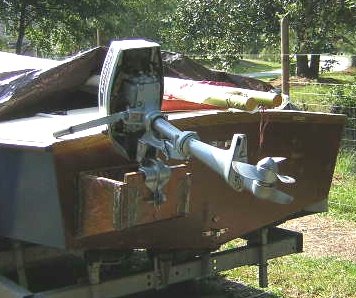
Peter I posted some photos of the 2hp mount on my CS20 on Sept 24th http://www.messing-about.com/forum/viewtopic.php?t=5021 The motor is well to the port side of the transom, and does well on the boat. Under power, the boat handles best with the centerboard down and using the rudder to steer with. The motor is left in the "ahead" position
-
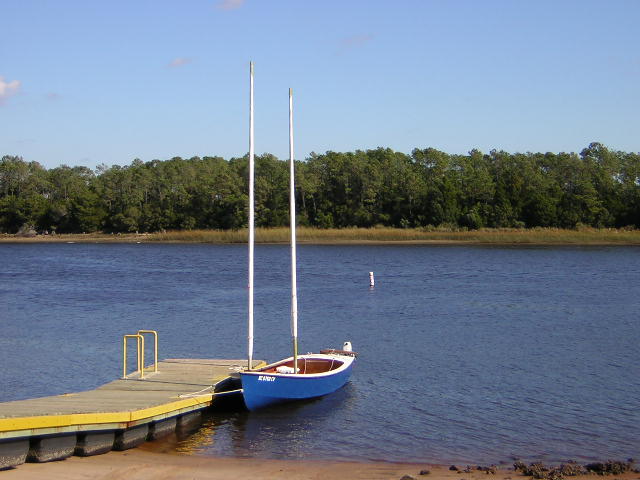
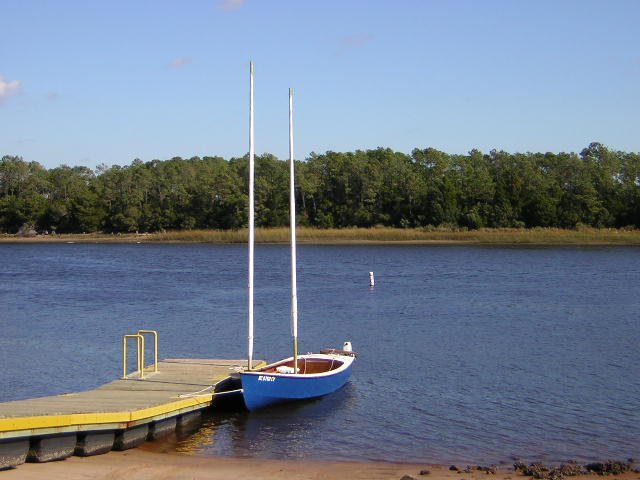
Had a nice sail today even though it was a little cool. With each launching, I wonder if it will be the last of the year. Just a couple of photos. An anchored Snowbird on their way South for the winter. An unusual old wooden motor boat. A large Catamaran that went under a few days ago. It has sat anchored all year at this small bay. My CS20 waiting at the ramp while I park the truck.


-
Louis I would think that the right size piece of bamboo would make a fine mast. It is certainly a strong plant, has a natural taper to it, and is flexible. Would take a minimum of work to fashion the masts from bamboo also
-
Jeff The other choice for sailing in windy conditions has probably already occured to you.... have a set of "storm" sails made for the boat to use on windy days. Perhaps 2/3 rds the size of the normal rig Since your sails slide over the masts, it should be easier to change them out. The new sails could be made to lower the center of effort on the rig also Just a thought. I hope to have my boat back on the water tomorrow. I know your sailing window is coming to an end up North, while we still have some nice days here even into Dec. Of course, in the middle of summer we miss a lot of days because of the heat, so I guess it all evens out
-
Jeff I have a reefing method for you to consider. I note that your sails slide over the masts, and this would require modifying the lower part of the sails. You could have the sail's mast pocket removed from the snotter attachment point downward, and add 4 or 5 grommets to lace the lower part of the sail to the mast for normal sailing To reef the sail, the lacing could be freed, and the foot of the sail could either be rolled up over the sprit, or secured to the sprit with reef lashing points. The sprit could then be attached to the mast as before, just requiring a longer sheet as the clew end of the sprit would be higher You should at least retain the sail shape on the rest of the sail. It would probably be easier to do this than to unship the masts in a blow, or to wrap the sails around the mast in a blow The only drawback to this would be that the remaining sail would still be carried high on the mast, rather than moving the sail downward as the foot is reefed. This would add to the heeling force, but at least you would be carrying less sail and maintain your ketch rig
-
Noklin Nice to hear that another CS 20 will be in the area. If you come home in the meantime, feel free to call and come look at this boat. I am in the phone book here, and live at 1 Forest Oak Drive. The Long trailer seems to be well suited to carry the CS 20
-
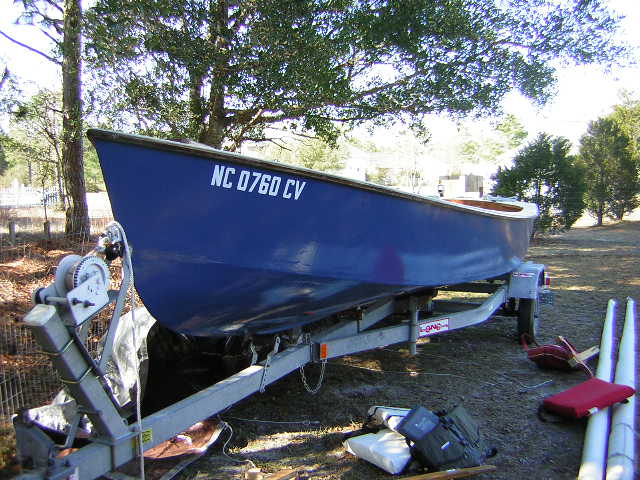
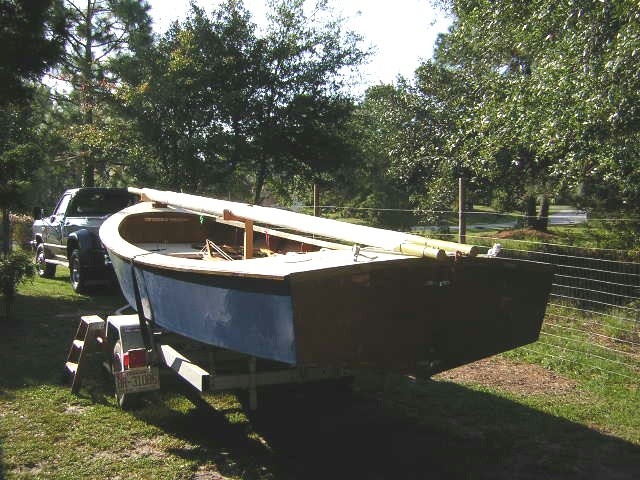
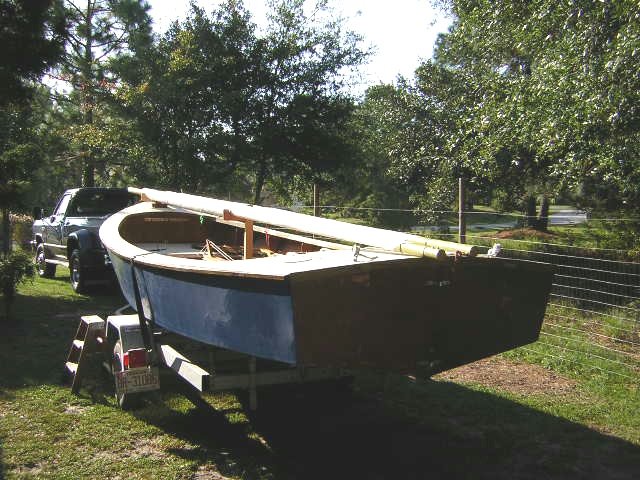
I finally found the time to take out the CS 20 that I purchased in Morehead City, NC on Sept 15th. I had a delightful sail in the ICW here off Southport, for a distance of 12 miles. Winds were only about 10 kts out of the South. I have to give Graham and the individual builder of this particular CS 20 credit, as it is a wonderful handling sailboat. This boat was set up nicely, with a gun tackle for the main sheet, leading into a swivel cam cleat, and dual sheets for the mizzen sail, with small flush clam cleats in just the right position. The centerboard has two tackles to position the board. I don't see a thing that I would change about the boat. I saw some 5.2 kt GPS readings today, even though the winds were light. Boat is very responsive, yet carries a nearly neutral tiller I was surprised to have a motorboat stop and the fellow ask me if the boat was a CS 20. Southport has a few sailboats, but the centerconsole fishing boats are the norm here. I launched from a public ramp, and chose to step the masts in the parking lot. As suggested, I just barely wet the tread of the tires on the trailer, and the CS 20 rolled easily off the tilting trailer. The small 2hp Evinrude started easily for me, and pushed the boat at 4.1 kts. As a bonus, it is a quiet little motor. I moved away from the ramp area and anchored temporarily to rig the sails Upon returning to the ramp, I again just wet the tires on the trailer, and positioned the bow against the first roller. I took a slight strain with the trailer winch, and then lifted the front section of the tilting part of the trailer. The boat rolled right back on for me easily with the trailer winch I am moving down from larger sailboats, and would like to highly recommend the CS 20 for anyone. It is just large enough to be comfortable, yet is a breeze to trailer and launch The photo is of the boat in the side yard. This same boat is shown on B&B's website of the CS 20, with a previous owner sailing her
-
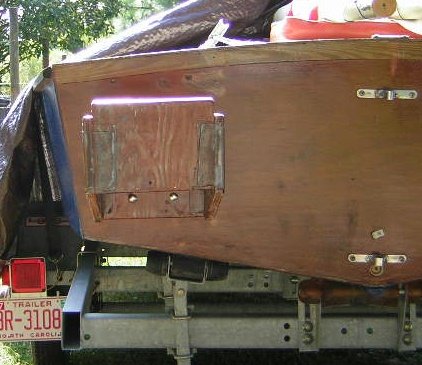
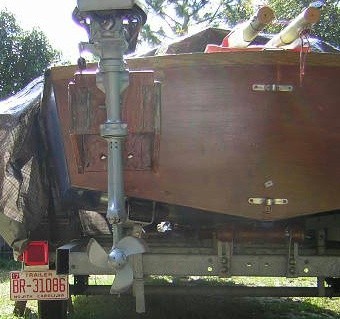
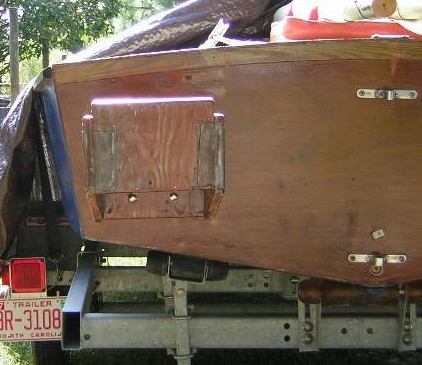
The builder of this CS20 has the foresight to add two vertical 1" x 4" vertical boards inside the transom at this point. They are laminated onto the inside of the transom I found this CS20 in Morehead City on 15 Sept. Have not had the boat out yet, as I wanted to have a kicker along with me I have had a sucession of sailboats here, the last being a 33' yawl. I have decided to get out of the marinas, as their fees keep climbing in this area. The CS20 can reside in my side yard I read your post regarding experimenting with reefing. I understand that the Main Sail in the center position will sweep lower than the mizzen. It would seem that wrapping the sails around the mast would reduce their height (desirable), as well as reducing the sail's area. In that case, I guess there is no choice but to make the sprit fast to the mast at the lowest part of the sail....perhaps even fastening the snotter over the lower section of wrapped sail.
-
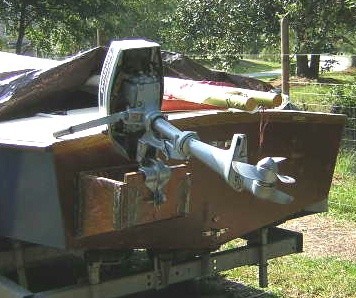
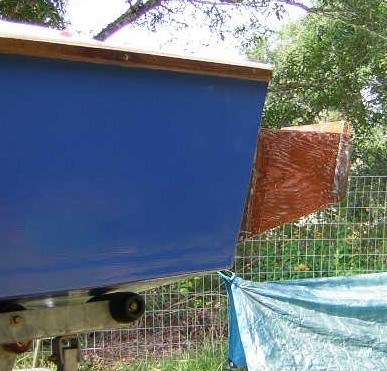
Just a few photos of a bracket that I added to the stern of my CS20 for a small kicker. While planning for a homemade bracket, I did not find any posted photos, so perhaps these may encourage others. I know that commercial brackets are available that will raise and lower the outboard, and may try one in the future Some considerations that must be thought out are the angle of the stern and the desired angle of the bracket. Naturally, you also want the motor to stand off far enough to allow use of the motor's tiller, and to allow the motor to be raised when not needed. The correct prop submersion is also important. In my case, it was also necessary to angle the actual motor mounting surface, so that the outboard would mount perpendicular to the waterline I do not know if the 2hp will be enough in all conditions. Graham recommended a 4hp. The light weight of the 2hp was appealing, as was the self contained gas tank The mounting of the engine so far to the port side may give some starboard turning effect. This position was chosen because there were already permanent backing blocks installed inside the transom at this location. It should keep the prop clear of the rudder also The photos do not show it, but there is a horizontal brace inside the bracket which acts like an I beam to stiffen the bracket