smacrae
-
Posts
29 -
Joined
-
Last visited
Never
Content Type
Profiles
Forums
Events
Everything posted by smacrae
-
Was talking to a pro boatbuilder mate of mine the other day about gluing with resin. He wipes both bonding surfaces with acetone before applying a priming coat, again to both surfaces, of resin he thins with about 5% metholated spirits. He maintains that the resin more readily soaks into the timber and as it cures the meths evaporates and does not affect the structural integrity of the resin. The thickened resin glue (with cab-o-sil) is then applied in the usual manner. Does anyone else use this method?
-
I was given 24 sets of measuring cups each containing 1/4, 1/3, 1/2 and 1/1 cup sizes. My erroneous mix was 5 x 1/3 to 1x 1/4. I have since colour coded them. But you are right Frank, one must fully concentrate when tallying 5 measures - it is surprisingly easy to miscount. Pity I wasn't given some 1/5 cups.
-
Thanks Tom, cab-o-sil it is. Of course the other thing thing I need to learn is to take care with my resin to hardener proportions. Because I used the wrong sized measuring cup for my hardener, the proportions turned out to be 7:1 rather than 5:1. :cry: I was easily able to split the boards apart after 3 days of curing. Never thought I'd have to use a machete to build a CS17 :?

-
Where fillers are specified to thicken epoxy for gluing, what fillers are suitable? Specifically, can Q-cells be used in this application?
-
Thanks for the replies. The bottom I'll be bumping into will be the Great Barrier Reef and perhaps Australia. I'll definitely use the epoxy rope on the leading edge of my rudder, but I'll let the spotted gum handle the reef alone.
-
Couldn't find anything on this using board tracker even going back the full 6142 years - I guess Noah isn't registered on this site! The plans specify an epoxy filled hole drilled out to take the pin. Presumably this does the job well enough. Anybody have any observations on this? I have read about epoxy soaked ropes attached to the leading edge of centreboards. It appears this is to harden the edge and to make repairs easier. I have made my board from extremely well seasoned spotted gum that is too hard to nail. My thought is that with double glass on the leading edge it will be robust enough to take any normal knocks. Any dings in this edge should surely be no harder to fix than those in the epoxy rope. Any comments? With thanks
-
Have found a locally available timber that seems to be a good substitute for Douglas Fir or Sitka Spruce. It is Hoop Pine (Araucaria cunninghamii). Can get it in clear 20' lengths (longer if needed) and it is from plantations. Have attached a comparison table. Strength value.doc
-
Just noticed that Boat tracker defaults to view posts for the past 6142 years. I take it that the Ark would have been one of Grahams earlier designs? Now I think a cubit is measured from the fingertips to the elbow or don't I know my arm from my elbow?
-
Good on ya, Frank: the search engine works well. It will certainly stop me posting queries that have been already adequately covered.
-
Not only a genius, but ingenious! Can hardly wait to build my mast! What a wonderful medium the WWW is for disseminating ideas across the world and cultures. It's such a shame that others choose to use it for darker purposes. The knowledge you blokes share is humbling - I only hope that soon I will be able to give rather than just take. Another question: Charlie, you mentioned "The formulas on Frank site". For the life of me I can't find this formula - could you lead me to it, please? The plans mention a composite aluminium/timber mast. From an aesthetic point of view I would prefer all timber. Any recommendations? with thanks from the apprentice
-
Thank you once again for your replies. Quite a learning curve this boat building. I can see why it is so hard to stop at one! I've ordered a birdsmouth bit from Timbecon (thanks Frank) and am hoping to pick up a rotary cutter in Cairns on Monday. (thanks Charlie) More mast questions: I want to use a sail track, so any tapering must be smooth. Does that mean I have to taper the eight sheaves that make up the mast? Secondly, is rounding off the mast a matter of planing the corners, or do I build a 20 foot long lathe or some other jig?
-
Thanks for your answers. My apologies re units of measurement: the dreaded imperial/metric challenge. In Oz, most builders, timber yards (that's "lumber" to you) deal in millimetres or metres. We also put our larger measurement first. So a board might be 4800 x 150 x 50 mm or in your old fashioned terminology 16' x 2" x 6". There was a lot of grumbling in Australia when we changed from imperial to metric, but once you've worked in metric, using millimetres as your base unit, the advantages become obvious. We have Douglas fir over here. We call it Oregon. Like all timber, top grade clear stuff is becoming harder to find and more expensive. Looks like both self cut and factory made tape have their places. Am unfamiliar with carbide scrapers - presumably these are readily available from hardware stores as are the cutters Charlie mentioned. When birdsmouthing long lengths I would presume that a tilting arbour table saw would be useful. For those of us without such luxuries, what other methods are available?
-
Have started my CS 17. Actually, the work to date has been building a boatyard, sewing a tarp to cover said boatyard and glueing up a blank for the centreboard. Ripped up a length of 6x2 spotted gum and laminated it as per the plans. It was an old floor joist I've had kicking around for about 20 years - it's now very well seasoned and hard as the hobs! My ply arrives next week. Questions: The plans specify 3" tape; is cutting your own tape a reasonable alternative? I have heard the selvedge edge of the tape creates some problems. What sort of fibreglass cloth should be used? Woven rovings, chopped strand? Masts: I have an 8x2 length of clear western red cedar (17 foot long). If ripped, laminated and sheathed in glass, would it make an adequate mast? With thanks Steve
-
Thanks everyone for your helpful replies. It looks like I'll just have to get off my butt and start scarfing. Steve
-
Have just received my CS17 plans (#164). Need to decide on scarfing the ply sheets or butt joining. I know there are pros and cons for each method. Any thoughts would be greatly appreciated. With thanks. Steve
-
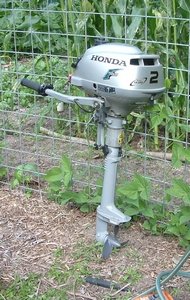
Actually there is a Japanese motor that would be small enough. Now what was the brand......? Starts with "H"....... :roll:
-
It will be some time until I am ready to rig my CS17 - let's get real, the plans haven't even arrived yet - but sails and sail configurations interest me. Having never sailed using a mizzen stays'l, from reading these posts, would I be right in saying that it seems to be for use off the wind similar to a spinnaker? Which brings me to my next question: is a spinnaker ever used on a cat rigged boat?
-
Many of us used to paint our fishing boats with household enamel. Much cheaper than the Marine stuff, and as we had to slip our boats every year for survey, it lasted well enough. Certainly by the end of the season those boats painted with expensive marine paints looked just as scruffy. :cry:
-
So what did your final hull weight end up as?
-
Hey! Look at that! I did it! You little beauty!! Thank you Frank. I just knew that between the two of us we could get a picture up! :shock: There will no doubt be some rather pedantic types who will mention the sordid subject of money, namely $200. However, as I stole it from my son :twisted: it has cost me nothing (apart from 17 years of blood, tears toil and sweat) coming well within the afore mentioned financial parameters. Discerning observers will notice that while there is actually no boat in front the purloined putt-putt, the jaws of the clamp are set to the exact width of the transome of a CS17. Watch this space! One thing though - isn't everyone who chooses to go down to the sea in ships being allegorical? Steve
-
Now I may be wrong ("usually" says my supportive wife) but it is a rare boat indeed, that after a few sea miles, her owner/builder doesn't have some little modifications that they would do if building her again. As soon as my plans arrive I will be building her again, as it were, so any thoughts along these lines will be most welcome. Steve
-
It always gets down to the old doing the business or getting of the pot. I have a photo here to show you, but blowed if I know how you blokes do it. :oops: A bit of the hands across the water wouldn't go astray here. Steve
-
and it wasn't until 1992 that the "terra nullius" legal convention that "allowed" the Poms to take over was declared invalid. Hell, aborigines were protected under the Fauna and Flora Act until 1967!Although it may seem as this has strayed far from the topic, it actually hasn't: it's classed as putting one's oar in the water. BTW, "pom" was originally"POHM" which was stencilled on the back of a convict's shirt. Meant "prisoner of his majesty". Now it refers to any limey (as I think you septics call them) Steve
-
Tch! Tch! Tch!!! (sigh)
-
Yeah, Tom, and all you have to do is send your bank account details to the brother of the Nigerian finance minister to receive your prize....! Thanks for the oar length, Irish. I guess, regardless of formulae, the "best" length will be somewhat subjective. Once Graham sends me my plans I can actually build the boat and find out for myself. Keen to see how she goes at sculling. Surely one oar will be easier to stow?? As for this ridiculous notion of your bog dwelling ancestors first "peopling" Oz, it was the Poms who reckoned they did that. Your mob was brought out in chains to do the heavy lifting (and, quite possibly, the rowing). You certainly weren't considered "people". Just wasn't done, old boy. Of course, the Poms also considered the place "terra nullius", so there you go. BTW as a linguist and regular poster, you would no doubt agree that "Is buaine port n